Tuesday, August 13, 2024

SDR: The Next Level of Shortwave Radio Listening

 
AirSpy HF + Discovery

Where have these things been all my life?

By James Careless
Published: August 5, 2024

There is a new breed of RF receivers known as software-defined radios, and they are revolutionizing the way in which people listen to shortwave (SW) radio, or indeed any form of radio broadcast. 

SDRs combine plug-in radio receiver dongles/boxes with personal computers, with the computer serving as the user interface. What makes this interface so useful is that the listener’s screen displays a wide swath of the bandwidth being tuned to, with each station’s signal shown as a visual vertical line that moves and grows/shrinks with its signal strength. 

In other words, the listener can literally see what is happening across the band in real-time, rather than having to turn the dial or push the Up/Down scanning buttons on a conventional shortwave radio, checking one station at a time.

SDRs come with a range of software tools for viewing, filtering, and recording sound. One (or more) of these devices is an absolute must for anyone who likes to tune around the bands. And if you own a computer the only device to be bought is the RF receiver dongle/box, which is often less expensive than a standalone SW receiver of similar quality and performance.

Additional story on How SDRs Work and more at: 

Monday, August 12, 2024

Shortwave Radio in Haiti

 
4VEH QSL

Special thanks to Ray Robinson and Jeff White for sharing this week's Wavescan feature on Haiti ... a country we wish was still on shortwave !!

Jeff: The small independent nation of Haiti in the Caribbean regularly features in news stories, but not for good reasons.  It’s one of the poorest countries on Earth, has a high crime rate, and seems to lurch from one crisis to another – be it earthquake, hurricane, or political upheavals of their own making.  Some have called it the “Basket Case of the Caribbean.”  But, on this occasion here in Wavescan, we thought we’d take a look back at shortwave broadcasting in that country, in years gone by.  Here’s Ray Robinson in Los Angeles to tell us more.

Ray: Thanks, Jeff.  The country of Haiti occupies the western third of the island of Hispaniola which is located in the Caribbean between Cuba and Puerto Rico.  Haiti is French and Creole-speaking, and the Dominican Republic, in the central and eastern side of the island, is Spanish-speaking.

The total area of Haiti is a little over 10,000 square miles, roughly in a horseshoe shape, with the arms pointing to the west.  The total population is around 11½ million, and the capital city is Port-au-Prince.

The radio scene in Haiti began a little over 100 years ago when the US Navy established a wireless communication station in Port-au-Prince with the callsign NSC.  Subsequent communication stations were erected by the Haitian government and these were given the callsigns HHM, HHW and HHZ.

The first radio broadcasting station in Haiti appeared on the radio dial in 1927 with the callsign HHK, and this station was also located in the capital city.  Station HHK was a government facility, and it was licensed with 1 kW on 830 kHz AM.

Shortwave broadcasting began in Haiti eight years later in 1935, when the Haitian Automobile Association established a station that was given three different callsigns, one for each of the three licensed channels.  This station was heard in North America and Europe under the callsigns HH2R, HH2S and HH2T.  However, the first Haitian shortwave station that was heard in the South Pacific was HH3W, which was noted five years later, in 1940.

In the year 1946, ambitious plans were announced by a commercial organization in France for the establishment of a powerful station in Haiti that would give radio coverage to almost the entire planet.  This station, with a commercial world service, was planned with three transmitters at 50 kW each.  However, that august announcement was the last that was ever heard of this project.

Over the years, a large number of small shortwave stations were established in Haiti, and these have been on the air with programming mainly in French, Spanish and English.  Each of these small stations was usually a shortwave relay from a regular medium wave station, though on occasions a truly international service was heard from a few stations.  The target areas for an international service were usually other island nations in the Caribbean basin.

The power output of the shortwave stations in Haiti was usually around 1 kW or less, though a couple of stations were on the air at times with 10 kW.  Some of these stations also issued QSL cards which these days are quite rare.

It was at the beginning of the year 1950 that the callsigns of all radio stations in Haiti were changed from the original prefix HH to the new prefix 4V.  Thus, for example, the station mentioned earlier, HH2S, became 4V2S.

Over the years, more than 60 different callsigns have been noted on shortwave in Haiti, but the era with the greatest number of shortwave stations was in the 1960’s and 1970’s, with more than 20 on the air at that time.  The second longest running shortwave station was 4VWA, which operated for more than half a century as Radio Citadelle.  This station finally closed in 1992.

But, the station with the longest tenure, and the one that is by far the best known beyond the borders of Haiti, is the gospel station 4VEH.  Situated in the perennially difficult political climate of Haiti is this small and exotic radio station which began its days as a shortwave station and is today still heard on medium wave and FM.

It was on the northern coast of Haiti, at Cap Haitien, that Haiti's best known shortwave station was first established more than 70 years ago.  This station, 4VEH, with the slogan “La Voix Évangélique d’Haiti” or, "The Evangelical Voice of Haiti", was founded in 1950 specifically as a shortwave station by Rev. G.T. Bustin.  This unique station made its first broadcast on June 2, 1950 and at the time it used a small transmitter radiating just 400 watts on the unusual channel 9884 kHz.

Both the studios and transmitter for this new station were located at first in the back rooms of the church building of the “East and West Indies Bible Mission” at Vaudreuil in northern Haiti.  At the time, there were several other shortwave stations located in Haiti, though most operated from the capital city area, Port-au-Prince.

Subsequent to its inauguration, and with the evidence of success for this bold new venture, new studios were established and a new transmitter building was constructed for 4VEH.  The transmitter base was located seven miles away in the salt flats at Petite Anse, across the bay from Cap Haitien.  A 10 watt FM link between the studios in Vaudreuil and the transmitter at Petite Anse came into service in 1965.

To celebrate their 5th anniversary and to honor the 25th anniversary of the International Shortwave Club in London, 4VEH made a series of special DX broadcasts on May 21 and 22, 1955.  Three different channels in the 31 metre band were used, and attempts were made also to use two other shortwave transmitters for the occasion.

In 1958, just eight years after its inauguration, station 4VEH was taken over by the missionary organization OMS International, with its world headquarters in Indianapolis.  The station, originally established to broadcast the Gospel to the Caribbean, continued under its new ownership with regular programming in French, Spanish and English to Haiti and neighboring islands.

At its peak of operations, 4VEH was on the air with a total of eight transmitters radiating on allocated frequencies in the shortwave, medium wave and FM bands.  These were generally lower powered units, though for many years they operated two 10 kW units simultaneously.  During its era as a shortwave broadcaster, reception reports were received from all areas in the United States, as well as from many other countries in Europe, the Americas and the Pacific.  Two shortwave antennas were in use: a simple dipole, and a two element delta beamed towards Florida.

Gospel station 4VEH left the international shortwave bands in 1982, but continued to use the 60 metre tropical band.  Here’s a clip of the station on 4930 kHz at 0730 Eastern on Sunday, September 2nd, 1984.

< Audio Clip - 1984 09 02 Sun 0728-0730 - R 4VEH (Cap Haitien, Haiti 4930kHz) >

Then in 1992, like Radio Citadelle, 4VEH also left the shortwaves.  But unlike Radio Citadelle, that wasn’t the end of 4VEH.  The station continued to be heard locally on medium wave and FM.  And although it continued to use “4VEH” as its name, that call sign was actually only ever assigned to their shortwave transmitter, which of course it was no longer using.  For some years, it was affectionately known as “The Right Station with the Wrong Callsign.”  But eventually, they switched to using the call sign for their medium wave transmitter, “4VEF”, as their name instead.

Currently, the American headquarters for radio station 4VEF are located in Florida.  So what is probably the most famous radio station in Haiti can still be heard on the air today, with 10 kW on 840 kHz AM, and on 94.7 MHz FM.  In fact, 4VEF’s medium wave transmitter is one of half a dozen Haitian medium wave stations still listed as active in the 2024 WRTH.

And before we leave Haiti, we should also mention that the Adventist radio station in Haiti, together with the Adventist university and the Adventist hospital, all found it necessary to modify their activities due to the social unrest in the country.  The Adventist radio station, 4VVE (Voix de L’Esperance), began operation on 1560 kHz AM with 10 kW in 1988, and also had an FM outlet in parallel on 89.7 MHz from 2001.  But, the medium wave transmitter closed in 2010, and the last listing for the FM was in 2022.

Gospel station 4VEH was indeed an exotic shortwave station in an exotic tropical location.  In bygone years it was much sought after by distant international radio monitors who wanted a picturesque QSL card from this fascinating island nation in the blue Caribbean.

Back to you, Jeff.
(AWR/Wavescan)

Weekly Propagation Forecast Bulletins

 :Product: Weekly Highlights and Forecasts
:Issued: 2024 Aug 12 0219 UTC
# Prepared by the US Dept. of Commerce, NOAA, Space Weather Prediction Center
# Product description and SWPC web contact www.swpc.noaa.gov/content/subscription-services
#
#                Weekly Highlights and Forecasts
#
Highlights of Solar and Geomagnetic Activity 05 - 11 August 2024

Solar activity was ranged from moderate to high levels. 34 events, which ranged from R1-R3 (Minor-Strong), were observed during the week. Region 3767 (S10, L=318, class/area=Dso/beta on 27 Jul) produced the strongest flare of the period, an X1.7/Sf at 05/1340 UTC. Two other regions produced X-class activity with an X1.1/2b at 05/1527 UTC from Region 3780 (S12, L=173, class/area=Fkc/1280 on 09 Aug) and an X1.3/2b flare at 08/1935 UTC from Region 3777 (S09, L=209, class/area=Ekc/460 on 09 Aug). 

CME activity observed over 07-08 Aug from multiple sources were analyzed and considered likely to be Earth-directed with a transit time of 3-4 days. An additional CME associated with an M5 (R2-Moderate) flare at 10/0237 UTC produced a faint halo signature first observed in SOHO/LASCO C2 imagery at 10/0312 UTC. Analysis and modeling suggested arrival on 12 Aug. 

The greater than 10 MeV proton flux observed at geosynchronous orbit became slightly enhanced over 05-06 Aug, but well below the 10 pfu (S1-Minor) threshold due to energetic activity on the Sun&#39;s farside. 

The greater than 2 MeV electron flux at geosynchronous orbit was at normal background levels. 

Geomagnetic field activity ranged from quiet to G1 (Minor) storm levels. G1 conditions were observed on 11 Aug, likely due to the influence of passing CMEs that left the Sun over 07-08 Aug. Total magnetic field strength increased to ~11 nT on 10 Aug and increased to a peak of 21 nT on 11 Aug. Solar wind speeds steadily climbed during that time from ~350 km/s to just over 500 km/s at the end of 11 Aug. The Bz component was primarily oriented neutral or northward which resulted in a limited geomagnetic response. A brief period of -20 nT was observed during the final hour of 11 Aug. The remainder of the summary period was at quiet to unsettled levels. 

Forecast of Solar and Geomagnetic Activity 12 August - 07 September 2024

Solar activity is expected to reach moderate (R2-Moderate) conditions, with a chance for R3-Strong events, over 12-18 Aug due to multiple complex regions on the visible disk. R1 (Minor) conditions remain likely on most days through the end of the outlook period due to the anticipated return of multiple complex regions from the Sun&#39;s farside. 

No proton events are expected at geosynchronous orbit.

The greater than 2 MeV electron flux at geosynchronous orbit is expected to be at normal background to moderate levels throughout the outlook period. 

Geomagnetic field activity is expected to reach G2 (Moderate) levels on 12 Aug due to the passing of multiple CMEs from 08 Aug and 10 Aug. As CME influence wanes, active conditions over 14 Aug are likely to decrease to unsettled levels over 14-15 Aug. Unsettled conditions are again likely on 22-23 Aug in response to a recurrent CH HSS. The remainder of the outlook period is likely to be at quiet levels, excluding any CMEs that have yet to erupt with an Earth-directed component. 

Product: 27-day Space Weather Outlook Table 27DO.txt
:Issued: 2024 Aug 12 0220 UTC
# Prepared by the US Dept. of Commerce, NOAA, Space Weather Prediction Center
# Product description and SWPC web contact www.swpc.noaa.gov/content/subscription-services
#
#      27-day Space Weather Outlook Table
#                Issued 2024-08-12
#
#   UTC      Radio Flux   Planetary   Largest
#  Date       10.7 cm      A Index    Kp Index
2024 Aug 12     280          38          6
2024 Aug 13     270          15          4
2024 Aug 14     270           8          3
2024 Aug 15     270           8          3
2024 Aug 16     260           5          2
2024 Aug 17     260           5          2
2024 Aug 18     260           5          2
2024 Aug 19     250           5          2
2024 Aug 20     240           5          2
2024 Aug 21     230           5          2
2024 Aug 22     210          10          3
2024 Aug 23     200           8          3
2024 Aug 24     210           5          2
2024 Aug 25     220           5          2
2024 Aug 26     220           5          2
2024 Aug 27     235           5          2
2024 Aug 28     235           5          2
2024 Aug 29     245           5          2
2024 Aug 30     245           5          2
2024 Aug 31     240           5          2
2024 Sep 01     245           5          2
2024 Sep 02     270           5          2
2024 Sep 03     300           5          2
2024 Sep 04     300           5          2
2024 Sep 05     300           5          2
2024 Sep 06     290           5          2
2024 Sep 07     290           5          2
(NOAA)

Friday, August 09, 2024

Blog Logs, August 2024


 Welcome to the August 2024 edition of Blog Logs. Thank you for your emails and for following the postings at the Shortwave Central blog and X/Twitter at Shortwave Central @QSLRptMT. 

Do you have any radio loggings or information to share for the August edition of Blog Logs? Your input from mediumwave, or shortwave can be sent to: w4gvhla@gmail.com  Tell the world what you're hearing from your listening post or portable monitoring!

Have you subscribed to the Shortwave Central YouTube channel? There is a large selection of videos and audio airchecks with more planned for the future! Join your fellow radio enthusiasts at: https://www.youtube.com/c/ShortwaveCentral   

By following the Shortwave Central blog and following on X, you will receive the latest tips and information from the ever-changing realm of radio! Additional station news is covered in my monthly column, Bits & Bytes in The Spectrum Monitor e-zine.

Thank you to the new and regular contributors. Your monitoring observations are always welcome!

Language services as indicated.
// denotes station heard on a parallel frequency
*Sign-on Sign-Off*/ frequencies kHz
Monitored 15 July – 08 August 2024

All times UTC

Mediumwave
Argentina
530, Somos Radio, El Libertador in Spanish at 0227. Commentary on politics in Argentina. SINPO 35443 (Rudolf Grimm, São Bernardo, Brazil)
1040, Radio Capital, Santa Rosa, La Pampa. Spanish at 0255. Pop songs, comments to mentions of ‘en Argentina.’ SINPO 15421. (Grimm).

Benin
1566, Trans World Radio at 0400 sign-on with ID and information. Religious praise music and sermon text in listed Twi language. (Van Horn/Kiwi Ethiopia) https://twr.org/africa 

Bonaire
800, TWR Bonaire 0110-0125. Spanish praise music to station promos and testimonials. Web address and station ID (Van Horn/Airspy) http://www.twrbonaire.com 

Brazil (Portuguese)
820, Rádio Cultura, Foz do Iguacu PR, 0219. Brazilian songs and jingle for ‘Cultura.’ SINPO 34543 (Grimm)
820, Rádio Jauense, Jaú, SP. “Identificacion…aqui pela Rádio Jauense” at 2149. SINPO 35543 (Grimm).
1080, Rádio Deus é Amor, Juiz de For a, MG at 2001. Christian programming and mentions of Juiz de For a to prayer. “Igreja Pentecostal Deus é Amor.” SINPO 35553. Excellent signal (Grimm).
870 Rádio São Francisco, São Francisco do Sul SC at 2145. Transmitting 840 Rádio Bandeirantes, São Paulo, sport broadcast. Station time pips at 2145. SINPO 23542 (Grimm).
1390, Rádio Esperanca, Porta Alegre, RS at 0232. Christian programming and music. SINPO 34543. Website streaming checked for programming. (Grimm).

Djibouti
1431, Voice of America relay. English from 1830 tune-in to French at 1835 with ID’s and news headlines. Schedule 1600-0300. Radio Djibouti 1820-1830 in listed Somali talk on 1116 // 1539 with African music vocals. (Van Horn/Kiwi Cyprus).

Iran
1557, IRIB Radio Iran 1900-1930. Arabic text, fanfare intros to Arabic music program. Heard on // 1566, 1404, 1224. (Van Horn/Kiwi Qatar) http://www.radio.ir/ 

Kuwait
963, Radio Kuwait-Multilingual Channel in Arabic 2245-2255. Parallel freq 1134 is the best signal for the Main Arabic program. Classical Arab Music channel on 1269 with format as noted. Sked is 24 hours (Van Horn/Kiwi/Qatar)

Oman
1278, Radio Sultanate of Oman, Seela, 2235-2345. Arabic conversations heard on // 576, 639, 738 and 1242. Station schedule 24 hours. SINPO for all freqs 44344. (Van Horn/Kiwi Qatar)

Paraguay
680, Radio Caritas, ?emby. Spanish at 0223 with comments for SINPO 23542. Streaming check matches programming. (Grimm)
1250, RCC Radio, Asunción. Spanish at 2118 with comments to “Paraguay…nuestras familias” SINPO 24532, checked by station steaming audio (Grimm).

Romania
1467, Trans World Radio Europe 2032-2045. Arabic presumed religious text. Good signal for fanfare intros and features (Van Horn/NLD Twente).

Saudi Arabia
1449, SBA-Radio Riyadh 2225-2235. Arabic programming including traditional Arabic music (sked 24-hours) noted on // 549, 594, 612, 648, 675, 945, 1071 and 1260. (Van Horn/Kiwi/Qatar)

Euro Free Radio 
5940, Free Radio Service Holland 1858-1914. Summer Splash special broadcast with station IDs, music from U2, Euro pops and music from the Summer of Love. QSL card and website info to postal address. Super Tramp’s Hide in Your Self. tune Signal abruptly cut at 1914. SINPO 34434 (Van Horn/NLD Twente).
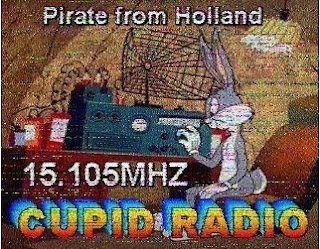
Screen capture by Paul Walker

15105, Cupid Radio Shortwave 1847. Great image as Cupid uses 500 watts into a 3-element beam antenna, pointed in the general direction of the northern USA and southern Canada at the time. I use a TEF6686, DX Engineering Preamp, EmTech Zm2 antenna tuner and a Wellbrook loop. (Tony Pavik, BC Canada) 

Shortwave
Algeria
17600, Radio Ifrikiya FM 1850-1915. Two males trade Arabic news topics with correspondent’s fill-ins. Station ID, mention of Facebook, contact info, promos to Arabic pop vocals. Time tips 1859 into French service. SINPO 43444. (Van Horn/Kiwi Qatar) https://ifrikyafm.com/ 

Australia
11900, Reach Beyond Australia at 1343. Punjabi service with contact info at 1345, followed by Oriya service. Fair signal quality (Harold Sellers, BC, Canada). 11875, 1200-1210.Sign-on with Kookaburra and English ID in the Matu Chi language, followed by long talk for fair signal quality (Pavik). Japanese service on 17650 at 2150. Christian programs to instrumental music. SINPO 35543 to Japan (Grimm). 11900, 1259-1315 (Pavik). http://www.reachbeyond.org.au 

Bolivia
3310, Radio Mosoj Chaski, Cotapachi, 2343-2352. Quechua comments on programming. SINPO 15422; Heard 0028-0036 on 3310 (Manuel Méndez, Lugo, Spain). Very weak signal at 2335 to 2350 and at 0910 with poor modulation (Paul Walker, AK).

6145, Radio Betania (tentative) Possible relay over Radio Juan XXIII, Santa Cruz 0930-0950. ID noted FM station “Radio Betania 93.7” to religious music. (Van Horn/AirSpy)

Botswana
4930, Voice of America relay via Selebi-Phikwe. English at 0304 with VOA News. SINPO 35443 to East Africa (Grimm). http://www.voanews.com 

Brazil (Portuguese)
6150, Rádio Saturno, Belo Horizonte 0457-0610. Brazilian pop tunes to station ID and address. SINPO 25422 (Méndez,) 0230-0240 on 6150.  Station ID’s, freq info into Braz pops (Van Horn/AirSpy)

11750, Rádio Voz Missionária 0630. Religious programming with good signal quality. Observed a hum interference on this channel, only present when Brazil is on (Walker). Heard 0300-0315 with the announcer’s phone interview (Pavik).

11815, Rádio Brasil Central, 0418. Portuguese/English music from 1980’s/1990’s. SINPO 45554.One of the better signals I’ve heard from this 7.5kW station with nice steady clean signal to the point I have my audio filter in my radio opened up to 6kkHz. (Walker) Heard on 4985, 0520-0533 (Méndez).

15190, Rádio Inconfidencia, Belo Horizonte 2006-2028. Brazilian music and comments for program A Hora do Fazendeiro. SINPO 25422 (Méndez) http://www.inconfidencia.com.br 

China
11430, New Star Broadcasting Station V13, 1259. Located in Taiwan and listed as a Taiwanese number station. You can clearly hear the flute interval signal at 11 seconds into programming (Tony Pavik, BC Canada). V13 noted in Mandarin, listed as 7502, 7688, 8169, 8300, 9276, 13974, 1494415890, 18040, 20025, 20095 kHz. (Van Horn).

11785, China National Radio 1200-1205. Chinese for ads format to 1200. Time check (Beijing time 2000), ads for air conditioners, energy drinks, and China Telecom. Station ID at 1202 into the children’s program (Pavik). http://www.cnr.cn 

7415, China Radio Int’l 2125-2129.  English service feature on the history of transportation. SIO 333 // 11640 via Bamako, Mali relay. Off at 2129. Noted on 7205 // 7325 in English with a promo for the Technology Report and Learning Chinese (Frank Hilton, SC) https://www.cgtn.com/ 

6035, Yunnan Radio Int’l 1230-1315. Traditional music as opposed to Chi-Pop. Time pips at 1300, format 5+1, that sounded like those heard on CNR-1. Signal fair to poor (Pavik). 

Clandestine
6520, Voice of the People (South Korea) 1100-1105. Korean sign-on // 6600. North Korean jammer on frequency. Audible 6600, 1059-1105 in Korean. Jamming patterns observed // 6520 at 1100. Jamming see-saw/alternate with the short plusses on the plus side. By flipping to AM and not SAM/DSB, I was able to clear the signal up a bit (Pavik) 


11640, Radio Dabanga via Talata-Volondry. Dari service logged at 1715. Comments and “Radi Dabanga” ID. SINPO 35553 to Africa and Asia (Grimm).

12045, Nippon no Kaze via Tashkent, Uzbekistan 1300-1315. Korean program discussing denuclearization of the Korean peninsula. (Pavik).

21595, Radio Ergo via Al-Dhabbiya, United Arab Emirates in Somali. Heard at 1240 with text and phone calls. SINPO 25552 to Africa and Asia (Grimm).  

Colombia
6016.8 Organización Radial El Prado 0436-0459*. Colombian music to time check “11 de la noche y 49 minutos, 11 y 49.” Additional music to the national anthem and 0459 sign-off ((Méndez,)

Cuba
5025 Radio Rebelde 0959 to 1015, Spanish speech, perhaps Castro, leading up to a speech by a woman. "Tweedle" top-of-the-hour sounder to intros for programming. News at 1002 with “buenos dias Cubanos to newscast to 1006. Brief classical music to 1007. Another rousing speech at 1009 ending in long station ID. Fair to good (Pavik).  

10345, HM01, 0700. Spanish numbers segment to tones and digital burst. Initially not strong enough to decode portions but at 0758 on 10345 signal able to decode (Pavik).

Denmark
5970, Radio 208 2017-2035 via Hillerod. Euro-pop vocals including tunes from Moody Blues, The Smiths and the Beatles, to station ID and promos. (Van Horn/NLD Twente). World Music Radio via Bramming 5930, 1958-2025 with English and Brazilian songs to “World Music Radio” ID (Méndez). https://www.wmr.dk/ 

Ethiopia
6030, Radio Oromia, Geja 1815-1830. Amharic conversations. Presentation of a ‘radio-drama’ style format that included farm animal sound effects. Station sked 1530-2100. Amhara Radio via Geja on 6090 with Amharic text at tune-in to news script and conversations. Radio Fana, Geja 1835-1850. Announcer’s ‘echo effect’ announcements to Ethiopian music. (Kiwi/Cyprus).

Finland
11690, Scandinavian Weekend Radio, Virrat 0507-0655. Monthly broadcast with Finnish comments to English pop songs and station ID. SINPO 25422. Audible 1945-2052 on 11720.

France
13740, Radio France Int’l via Issoudun 1945-2000. French discussion on Paris Olympics with interviews. French Euro pops to magazine-style programming. Shift to 9790 at 1958 with ID. (Sam Wright, MS).11790, 0430-0459. Swahili service with ID, fanfare and correspondent’s reporting (Tony Pavik, BC Canada). http://www.rfi.fr 

15275, Deutsche Welle relay 1655 in Amharic. Program targeted to Ethiopia. Discussion with excessive fading. Suddenly just seconds before 1759UTC, the signal very quickly cascaded into a 21122 SINPO, and riddled with noise and unintelligible. (Walker) 

Germany
6180, Deutscher Wetterdienst 2000-2010. Located in Pinneberg in German for weather forecast, // 5905. Station part of National Meteorological Service with IDs included. (Van Horn/NLD Twente) Website: www.dwd.de 

Guam
9320, KTWR Guam 1935-1945. Korean service of religious text and praise music at 1935. (Wright). My best DRM logging on 9910, 1214-1241 in Chinese. Sign-on 1215 into discussion to mention Luke 15:1. Heard on 12055, 1300-1315 in Kachin service. Poor signal (Pavik).

Indonesia/Kalimantan
3325, Voice of Indonesia via Palangkaraya, Kalimantan (Borneo) 2040-2113. SINPO 43344. French service in progress at tune-in including pop music program and announcer’s chat. Station info, ID, address, website info and closing “au revoir” to listeners. Brief instrumental melody to English service, “Voice of Indonesia.” Broadcast info, station promo with freq info, ID and fanfare music. National and world news briefs to 2109 Be advised – the listed contact email at the VOI website voi@voinews.id bounced. (Van Horn/Kiwi Hong Kong). https://voinews.id/

Madagascar
9885, World Christian Broadcasting/KNLS. Russian service at 1820. Religious programming, old traditional tune and message. SINPO 35543. Programming targeted to Europe Also logged on 3650 at 1836 with religious programming. SINPO 35543 to Central Africa (Grimm).

México
6185, Radi Educación 0657. Great signal for SINPO 55555. Instrumental music program of jazz, classical, and piano selections. (Walker) 0451-0604 Spanish ID and music. SINPO 24422 (Méndez). http://www.radioeducacion.edu.mx 

Peru
4820, Radio Senda Cristiana at 0722. Fair amount of atmospheric noise and fading, but sounds like children singing. SINPO 45344 (Walker).

4775, Radio Tarma 2339-2356. Spanish comments to Peruvian music. Also heard 2329-2336 with comments about Peruvian athletes at the Paris Olympics. SINPO 25422 (Méndez,)

Philippines
11805, Vatican Radio relay at 1249. Russian service ID to interval signal and off at 1250. Good signal. 11750 Chinese 1300-1310 with mass and hymns for poor signal (Pavik). http://www.vaticannews.va 

7530, BBC relay in Korean with sign-on routine. 12095 FEBC at 1350 in Khmer language via listed schedule. Religious sermon to Christian music and off at 1400. (Sellers).
9275, FEBC Radio Liangyou, Bocaue. Chinese service at 0957. Interval signal, station ID, FEBC jingle. Christian programming for SINPO 35543 targeted to China. (Grimm). http://www.bbc.com 

Romania
13860, Radio Romania Int’l via Tiganesti to Europe. Tune-in 1925 with classical music interspersed with Spanish text. SINPO 55455 (Walker). DRM on 15170 in Spanish at 2100. Interval signal to ID and news bulletin “Eurodeputados, Parlmento europea, Partido Republicano Donald Trump” SINPO 45554 to South America (Grimm). http://www.rri.ro 

Solomon Islands
5020, SIBC at 0738. Classic country music song followed by island tune. First in long time for decent modulation that wasn’t covered by Rebelde. SINPO 55344 with good signal, with a bit of fading but very listenable (Walker). Noted on 5020 at 0945 with programming to Pacific Islands (Grimm). http://www.sibconline.com.sb 

Thailand
9385, Radio Thailand at 1200. English service including station sign-on, chimes/gong music and announcer’s station ID. Very poor signal. (Sellers). 

Turkey
9875, Voice of Turkey 2103. Announcer’s English travelogue program to closing comments, “keep exploring the world around you.” Easy-listening instrumentals to Turkish music vocals (Wright). http://www.trtvotworld.com/ 

United Kingdom
17670, IBRA Media 1832. Arabic service via Encompass-Wofferton to Sudan target area. Religious style programming with a bit of fading. SINPO 54555(Walker). https://ibra.se/en/ 

United States
9475, WTWW Lebanon, TN 2105-2200. Pastor’s text as part of Scriptures for America Worldwide. Station ID, freqs into classic sermon from Overcomer Ministries. (Wright).

15150, WMLK Bethel, PA 0400-0420. Station sign-on ID, address, operating hours, but no freqs mentioned. Non-stop sacred music to 0415. Elder Jacob O. Meyer text at 0415 for good signal (Pavik). https://assembliesofyahweh.com/wmlk/ 

15140, Voice of America in English 1755. Discussion on U.S. political race. SINPO 55454. Noted slight fading which causes the signal to dip for a split second. Amharic on 15660 at 1813 covering news and discussions (Walker). http://www.voanews.com 

17530, Voice of America 1800-1815 via Greenville. Opening as “this is a VOA News in Washington. Announcer’s name (indistinct) with lead story on Israel/Gaza. Interview with Joseph Segal at the African Center for Strategic Studies at 1807 (Pavik).

Vanuatu
7260, Radio Vanuatu, Port Vila 0525-0644. Pacific Island music format to Bislama comments. SINPO 15421. Heard on 9960, 0519-0613 with IDs, island music and news. Interval signal (twice), and station comments. QRM from WRMI on 9955. SINPO 12421 (Méndez,) 3945 at 0754 in Bislama for a cooking show format, which considering background noise, may have been ‘live.’ (Walker).3945 with Bislama comments at 0935. SINPO 25442 (Grimm). Additional monitoring: 0719 on 7260, with adult contemporary music. (Walker).

Vatican City
11815, Radio Vaticana 0439-0459. Interval signal, station ID and lady’s Ukrainian news and reports. Announcer’s voice-overs to music to final station ID with interval signal at 0459 (Pavik). Portuguese service on 15565 at 1806 with station info, musical interlude and news style format. SINPO 55444 (Walker).

Vietnam
9840, Voice of Vietnam at 1331. English service with poor signal for news and ID. Fair signal for // 12020. (Sellers).11825, 1600-1610 English sign-on. Presumed news for very noisy signal (Pavik).

 Zambia
4965, Voice of Hope Africa via Lusaka at 2035. English religious programming and comments. SINPO 25432 to South Africa (Grimm). Monitored 2018-2029 (Méndez).

Thursday, August 08, 2024

Encore Classical Music from Radio Trumbil


Dear Listener,
Regular Broadcast times of Encore By WRMI and Channel 292 are:
02:00 - 03:00 UTC Friday 5850 kHz WRMI to US
20:00 - 21:00 UTC Friday 15770 kHz WRMI to Europe
10:00 - 11:00 UTC Saturday 9670 kHz Channel 292 to Europe
01:00 - 02:00 UTC Sunday 5850 kHz WRMI to US and Canada
19:00 - 20:00 UTC Sunday 3955 kHz Channel 292 to Europe
02:00 - 03:00 UTC Monday 5950 kHz WRMI to the US and Canada
13:00 - 14:00 UTC Tuesday 15770 kHz WRMI to Europe, east coast of US and Iceland. (Sometimes RTTY on the lower sideband. Suggest notch out or use USB.)

Some Things to see on The Encore Website:
The Encore website is www.tumbril.co.uk where you will find:
Important information about funding of Encore - Radio Tumbril.
Up-to-date transmission times and frequencies.
The playlists for the most recent programs.
An email link.
Informal reception reports as well as those requesting eQSL cards are welcome.

ENCORE IS A ONE-MAN OPERATION -  PLEASE MAKE A PAYPAL DONATION OR 'BUY ME A COFFEE' AND HELP PAY THE  BROADCASTERS AND KEEP ENCORE ON THE AIR - Go to - www.tumbril.co.uk

WRMI and Channel 292 are very generous with their air-time but Encore still costs around 100 Dollars/Euros a month to broadcast.
If you can - please send a small contribution to help Encore keep going.

THE DONATION BUTTON AND 'BUY ME A COFFEE' BUTTON are on the homepage of the website - www.tumbril.co.uk - which folks can use if they would like to support Encore.

(Please don't be put off by the POWR security wall when using the PAYPAL button - it is a harmless requirement of WIX the website hosting service.)

THIS FORTNIGHT'S PROGRAMME - (First broadcast this FRIDAY 9th August) by WRMI at 0200 UTC on 5850, (and 2000 UTC on 15770) and then Channel 292 on SATURDAY (10th August) at 10:00 UTC on 9670 kHz):
Starts with part of the Concerto for Flute, Harp, and Orchestra by Mozart, some Tango inspired music from Argentina, and an example of music for high Baroque trumpet by J S Endler.
After that an arrangement for piano quartet of The Sea and the Seagulls from Rachmaninoff, and some film score by Caroline Shaw.
The last piece is the first movement of Borodin's Quartet No. 2.

A very good site for online SDR receivers all over the world is: http://kiwisdr.com/public/  Click the 'Map' button in the top left of the screen.
 
Thank you for spreading the word about Encore - Classical Music on Shortwave on Radio Tumbril - and thank you for your support.

Brice Avery - Encore - Radio Tumbril - www.tumbril.co.uk 


Shortwave Radiogram, Program 365

 Hello friends,


If you are in eastern North America, I hope that Hurricane Debby and associated storms and flooding have not caused you too many difficulties.  Al WD4AH, who produces the Birthday Radiogram on The Mighty KBC and helps with Shortwave Radiogram, lost electricity and internet for a time at his northern Florida location.

Here in northern Virginia, we are getting some rain from the outer bands of Debby, which is welcome given our severe drought. There will be more tonight, but I think the main consequence for our house is that we will have to put some towels on the floor of the basement to soak up some moisture. Farther west, in the Blue Ridge Mountains, flooding is likely. The weather is more exciting in the mountains.

The wet streets gave me an opportunity to test out my two new tires, on the front axle. They performed well, but I noticed the markings on the left and rear tire are different. Same brand, but different tire. When the rains subside, I will have to go back to the auto repair shop that installed them and have a frank discussion.

A video of last week's Shortwave Radiogram (program 364) is provided by Scott in Ontario (Wednesday 1330 UTC). The audio archive is maintained by Mark in the UK. Analysis is provided by Roger in Germany.

Here is the lineup for Shortwave Radiogram, program 365, 8-14 August 2024, in MFSK modes as noted:

 1:42  MFSK32: Program preview
 2:48  MFSK32: Thin layer of tin improves lithium-ion batteries
 6:59  MFSK64: Silica dust could become the 'new asbestos'
10:51  MFSK64: This week's images
28:29  MFSK32: Closing announcements

Please send reception reports to radiogram@verizon.net
And visit http://swradiogram.net 
Twitter: @SWRadiogram or https://twitter.com/swradiogram 
(visit during the weekend to see listeners’ results)
Facebook group: https://www.facebook.com/groups/567099476753304
  
Other Shortwave broadcast programs that include digital text and images include The Mighty KBC, Pop Shop Radio and Radio North Europe International (RNEI). Links to these fine broadcasts, with schedules, are posted here.
 
Thanks for your reception reports!
Kim

Kim Andrew Elliott, KD9XB
Producer and Presenter
Shortwave Radiogram
Reporting on international broadcasting at https://twitter.com/kaedotcom


Texas Radio Shortwave on August 11


Texas Coloring Book QSL

Propagation conditions were terrible for the August 5th test, so we’re trying again using a beam heading different from the one we use for our regular monthly program to NAm.  The broadcast will come from Channel 292, Rohrbach, Germany, with 10 kW power into a 10.5 dB gain beam antenna at 0300 UTC

We’ll test beam heading “S” to see if it delivers a good signal to the West Coast and Western Canada. It should also deliver a signal to Pacific listeners, who are encouraged to send us a report.

The transmission will be our standard Yellow Rose of Texas format with 24 versions of the song.  Our signal will be easy to find!

If you can, we’d like you to use your home receiver and as many SDRs as possible in the target areas and provide SINPO readings (and maybe an audio clip or two). 

We know this will be a lot of work. Thank you for working with us to provide the best coverage for NAm listeners.

A new QSLs will be available for correct, detailed reception reports, including a SINPO or SIO rating.  If you try and don’t hear us, let us know, and we’ll send you a souvenir card, which will be a nice addition to your collection.   Reports from listeners using remote receivers, called SDRs, are welcome.

Our address is texasradioshortwave@protonmail.com. 

We'll issue Texas Coloring Book QSL #7 for correct, detailed reception reports to texasradioshortwave@protonmail.com.

(Texas Radio Shortwave)

Returning to our roots on Channel 292


Radio Caroline North upcoming broadcast


Our next Radio Caroline North broadcast is between 9th-11th August, live from our radio ship Ross Revenge.

You'll hear some great music from the 60s to early 90s – plus all the fun of our Annual Fundraiser!

Listen on 648 AM across England, The Netherlands, Belgium and beyond, on 1368 AM in the North/North-West courtesy of our friends at Manx Radio, worldwide online here via our Caroline North Player, on smart speakers and the Radio Caroline app.

We'd love to hear from you during the broadcast via memories@radiocaroline.co.uk and remember, it's the only email address that gets you straight through to our 'North' broadcasters.

Wednesday, August 07, 2024

Atlantic 2000 International to air on August 10


Atlantic 2000 will be on the air this Saturday, 10th of August, from 0800 to 0900 UTC (1000 to 1100 CEST) on 6070 and 9670 kHz via Channel 292.

Streams will be available at the same time here: http://radioatlantic2000.free.fr

Reports to: atlantic2000international@gmail.com

Before that, you can listen to our 24/7 web stream or our podcasts on our website.

Good listening!

Visit our website and listen to Atlantic 2000, 24 hours a day: http://radioatlantic2000.free.fr   

Tuesday, August 06, 2024

AFN Europe – The Early Years


Special thanks to Ray Robinson and Jeff White for the interesting story from Wavescan.

Jeff: A couple of months ago on June 6th, world leaders and military veterans celebrated the 80th anniversary of the D-Day landings on the beaches of Normandy, in 1944.  AFN Europe took part in those landings, which we thought deserved comment in our program today.  Of course, following World War II, the American Forces Network in Europe grew to become a major AM and FM radio network, with stations covering much of West Germany, Belgium and The Netherlands during the daytime, and the whole of Europe at night.  The flagship station in Frankfurt operated on 872 kHz with 150 kW, and was beloved by Europeans who enjoyed American music and culture.  On the 25th anniversary of the network in July 1968, a commemorative brochure was produced, which included information about the network’s humble beginnings during the last years of the war.  Let’s go to Ray Robinson in Los Angeles.

Ray: Thanks Jeff.  Here’s the article about AFN’s early years, as recounted in that brochure.

The idea for the American Forces Network was hatched at the very highest level during World War II days, when America was beginning to build strength for the big cross-Channel push.  It came out of a conversation in early 1943 between General Dwight D. Eisenhower, commander-in-chief of the European Theater of Operations (or, ETO), and General George C. Marshall, U.S. Army chief-of-staff.

They agreed that the American soldier needed the same sort of information media he was accustomed to at home.  He was to get a magazine (later called Yank), a newspaper (Stars and Stripes) and a radio network (AFN).

So much for the idea.  As an organization, AFN came into being a few days later at a meeting in the London office of Lt. General Jacob Devers, ETO chief of staff.  He showed a group of officers a paper on the Eisenhower-Marshall decision.  The general turned to a young captain named John S. Hayes (later appointed as U.S. Ambassador to Switzerland) who was there because of his radio experience.

“See this part about a radio network?”
“Yes sir!”
“Well, start one!”

No Name Network
At this point, a slightly reeling Captain Hayes became the first AFNer.  He couldn’t call himself that, because at that point, the network had no name.

Hayes must have reflected as he walked from the general’s office that a name was the last thing the Network needed.  There were such “minor” matters as staff, studios, and transmitters.  He didn’t yet have an office, or even a typewriter!

But, he got to work fast.  First, he wheedled some working space and a secretary.  Then it was over to personnel for a laborious sifting of their personnel records (no machine record cards in those days).  Finally three weeks later, he had the help of 12 former radio men.  (Among them was Pfc. John Vrotsos, who civilianized after the war and remained with the Network a full 20 years.)

Meanwhile, the State Department, prodded by Capt. Hayes, was getting the help of the British.  The BBC came through with studio space in an auxiliary building it maintained on Grosvenor Square; the same one from which Edward R. Murrow did his famed “This is London” broadcasts.

Other British authorities granted frequencies, and five tiny 50 Watt transmitters were built in areas of American troop concentration.

Things were in readiness by the nation’s birthday, July 4, 1943.  AFN signed on with The Star Spangled Banner and broadcast four hours.  “None of us could possibly have believed” Hayes recently wrote, “that 25 years later, AFN would still be operating in Europe.”

8800 Continuous Days
Operating it is, and it hasn’t missed a single day of broadcasting in the whole quarter-century.  Hayes was to be with the organization for two and a half years, rising to lieutenant colonel in the process.  By the time he left, the Network was operating 68 stations from England to North Africa.  It had nearly 700 staffers, its own vehicles and its own plane.  The Network even had its own uniform patch.

Programming during this period could not have been better.  The Armed Forces Radio Service was recording and sending over the cream of the programming from four networks.  And this, remember, was during the heyday of radio.  There was such a superabundance of material that officials had difficulty deciding what to leave off the air.

A large number of America’s talented young entertainers from radio, the movies and the stage were also answering the wartime call to colors.  AFN got the pick of them, including Sgts. Mickey Rooney and Broderick Crawford.

(It also got some pretty incompetent people, like the officer who was informed that a man on a remote link couldn’t get a return feed.  “Well” came the reply, “tell him to order some!”)

AFN people saw plenty of action.  One of them rode on an RCAF mission and described it vividly.  AFNers crossed the Channel with the troops on D-Day.  Mobile transmitters were assigned to the 1st, 7th and 9th Armies and moved right up with them.  Inevitably, there was tragedy.  Sgts. Jim McNally and Pete Parrish were both killed while reporting front line action.

Lily from Laguna
Memories of World War II are many and varied.  Hayes recalls being ordered to play some idiot tune, like ‘Lily from Laguna’, at some precise time, say 13:07 hours.  “In addition we had to play ‘Sur le Pont d’Avignon’ 14 times in a single day,” he laments.  He never did find out why the orders were given.  No doubt the tunes were a signal to the French underground or some other group in German-held territory.

Ex-staffers still recall fondly some of the places that were pressed into service as studios as the war advanced.  Programs went out, for example, from the former abode of Napoleon III in Paris and from a spot at Rheims directly above nine million bottles of Pommery Champagne.

The headquarters and main broadcasting operation remained in London right through to the end of hostilities, engendering jittery memories of the ‘buzz bomb’ era.  You could hear the motor as a bomb got near and all you could do was hold your breath and pray that it would keep on buzzing past.  If the motor cut off, you could brace yourself for a shattering blast.

AFN’s headquarters were never hit, but programming was interrupted three times by blasts so close that they jarred the needle off the disc that was playing.  And not one word about the bombs could go out on the air.  There was a complete blackout on news of them to keep the Nazis from knowing how terrifyingly effective their ‘secret weapon’ really was.

Miller Lawn Concerts
With the spring offensives of 1945, AFN moved into Germany with the troops and established stations at Munich, Stuttgart, Frankfurt and Berlin, plus one at Bremen that later moved to Bremerhaven in 1949.

At first, AFN Frankfurt was just another of the 68 stations.  It went on the air July 15, 1945 and its first home was a large residential building only a few blocks from the site of its present, modern studio building.

This place was typical of the AFN homes in those chaotic days.  The studio walls were soundproofed with bolts of uniform cloth and there was no room to accommodate the Glenn Miller Band when it wanted to make a broadcast.  Concerts had to be held on the lawn outside.

It was decided about this time to move AFN headquarters from London to Frankfurt (and that actually occurred at the end of 1945).  US facilities were being phased out in Britain.  Germany, as an occupied country, would be the new center of American military activity.

The house occupied by AFN Frankfurt clearly would not do for the Network headquarters.  So, they started looking around for a more suitable home, and AFN was soon launched into the 21-year-long ‘castle era’.

Well, that’s all we have time for today, Jeff, but maybe we’ll come back to that AFN brochure in a future program.  For now, back to you.
(AWR/Wavescan)

Monday, August 05, 2024

Pop Shop testing on August 6


Pop Shop Radio will be conducting a beam test ... this is a great opportunity to tune in!

 August 6, 2024 

Channel 292: 6 August 2024 0200 UTC
9670 kHz bean to North America
6070 kHz non-directional to Europe

We'll see what the Qodosen can do!

Tony Pavick
Pop Shop Radio
Hope BC Canada

Bandladesh Betar down due to transmitter issues

 
Bangladesh Betar's shortwave channel on 4750 kHz has been off air (for a few weeks now?) due to a transmitter fault.

With the news this morning that the country's Prime Minister , heikh Hasina had resigned after a 15-year "reign" and that she had fled to India following some weeks of unrest, I checked medium wave on 693 kHz (Dhaka) for the local 5pm news in English today (5 Aug, 1100 UTC).

Daytime reception of Government run Bangladesh Betar on 693 kHz on the Siliguri (West Bengal, India) KiwiSDR was noisy but readable with headphones. Recording uploaded at: https://app.box.com/s/3rhapzo7t7dmq1t197hasnnrbuts47ll

The Bangladesh Betar website www.betar.gov.bd has also been down for a couple of weeks, but their programming division website is still online http://betarprogram.org/
(BDXC/A Pennington)

Additional information stated as: 

As the unrest in Bangladesh continues with violent protests which saw the state broadcaster Bangladesh TV being burnt down last week, public radio Bangladesh Betar’s website is still silent.

The government cracked down heavily on students who were protesting quotas reserving 30% of government jobs for veterans who fought in the 1971 independence war and their children.

The internet and all forms of telecommunications were shut down last week and there was a complete information blackout.

Weekly Propagation Forecast Bulletins

 Product: Weekly Highlights and Forecasts
:Issued: 2024 Aug 05 0210 UTC
# Prepared by the US Dept. of Commerce, NOAA, Space Weather Prediction Center
# Product description and SWPC web contact www.swpc.noaa.gov/content/subscription-services
#
#                Weekly Highlights and Forecasts
#
Highlights of Solar and Geomagnetic Activity 29 July - 04 August 2024

Solar activity was at high levels throughout the period. A total of 63 M-flares (51 R1-Minor events, 12 R2-Moderate events) and one X-flare (R3-Strong event) were observed during the course of the week from 13 unique regions. The largest event was an impulsive X1.5/2b flare at 29/0237 UTC, with associated 300 sfu Tenflare and 535 km/s Type-II sweep, from Region 3766. 

No proton events were observed at geosynchronous orbit.

The greater than 2 MeV electron flux at geosynchronous orbit was at normal to moderate levels. 

Geomagnetic field activity reached G1 (Minor) storm levels on 30 Jul-01 Aug due to the arrival and passage of multiple CMEs that left the Sun over 27-29 Jul. G1-G3 (Minor-Strong) storm periods were observed on 04 Aug following the arrival of a CME that left the Sun on 01 Aug. Quiet and quiet to unsettled levels were observed throughout the remainder of the period. 

Forecast of Solar and Geomagnetic Activity 05 August - 31 August 2024

Solar activity is expected to be at moderate to high levels throughout the outlook period. M-class flares are expected with a chance for X-class flares through 31 Aug. 

There is a slight chance for S1 (Minor) solar radiation storms throughout the outlook period. 

The greater than 2 MeV electron flux at geosynchronous orbit is expected to be at normal to moderate levels. 

An Isolated period of G1 (Minor) storms are possible on 05 Aug due to waning CME influences. Geomagnetic field activity is expected to be mostly quiet and quiet to unsettled over 06-31 Aug. 

Product: 27-day Space Weather Outlook Table 27DO.txt
:Issued: 2024 Aug 05 0210 UTC
# Prepared by the US Dept. of Commerce, NOAA, Space Weather Prediction Center
# Product description and SWPC web contact www.swpc.noaa.gov/content/subscription-services
#
#      27-day Space Weather Outlook Table
#                Issued 2024-08-05
#
#   UTC      Radio Flux   Planetary   Largest
#  Date       10.7 cm      A Index    Kp Index
2024 Aug 05     240          15          5
2024 Aug 06     240          10          3
2024 Aug 07     240           8          3
2024 Aug 08     240           5          2
2024 Aug 09     240           5          2
2024 Aug 10     240           5          2
2024 Aug 11     240           8          3
2024 Aug 12     230           5          2
2024 Aug 13     225           5          2
2024 Aug 14     210           5          2
2024 Aug 15     205           5          2
2024 Aug 16     205           5          2
2024 Aug 17     200           5          2
2024 Aug 18     185           5          2
2024 Aug 19     180           5          2
2024 Aug 20     180           5          2
2024 Aug 21     180           5          2
2024 Aug 22     180          10          3
2024 Aug 23     200           8          3
2024 Aug 24     210           5          2
2024 Aug 25     220           5          2
2024 Aug 26     220           5          2
2024 Aug 27     235           5          2
2024 Aug 28     235           5          2
2024 Aug 29     245           5          2
2024 Aug 30     245           5          2
2024 Aug 31     240           5          2
(NOAA)

Friday, August 02, 2024

August 4th programming from Unique Radio


August 4th, Music for the Punk/Alt Culture, My all Music in the Raw special because of goings on in Blackpool UK called Rebellion Festivals on many indoor stages, Electric & Acoustic.Thurs through Sunday All day & night.

Playing the music of Bands that played and are playing there plus Jen's Bands she thinks should be there in the future.

http://uk4-vn.mixstream.net:8104/index.html

Join us in our live chat room is open for you in https://libera.chat/
click on connect, then web chat
Please put in the following:
For nick: name or like me radionutresss
Then next line channel, that's the following:
#eyeradiojd
and you are in the room.

For your contact pleasure
jenur@proton.me

Jen In The Rad.

Pogo on the keys at your own risk.

FRS Summer Splash to broadcast August 4


From our friends at FRS....


FRS Summer Splash

The 4th edition of FRS' Summer Splash takes place on August 4th (19:00- 21:00 UTC).

See 'Latest News' section in our top menu


19:00-21:00 UTC / 21:00-23:00 CEST. Frequencies will be (subject to change) 5940 and 9300 (alt. 9335). We are sorry for the lack of our 7700 outlet.

Each evening consists of two one-hour programs. The main idea is that each program is thematic. This approach can lead to surprising choices. Let yourself be pleasantly surprised! The Summer evening broadcasts create a wonderful atmosphere:  experience the ‘magic of shortwave free radio’ on August 4th.

We warmly invite you to tune in, turn on & enjoy!

Please note: if there are any important announcements (for example frequency changes), they can be found under the ‘Latest News’ section on this website.

Thursday, August 01, 2024

Shortwave Radiogram, Program 364


Hello friends,

Not many of us are awake for the "red-eye" edition of Shortwave Radiogram Mondays at 0800-0830 UTC (4:00 am EDT) on 5850 kHz. I was awake this past Monday  (29 July), when I heard the WRMI station ID at 0800 UTC. Then silence. After about a minute WRMI's filler music (an interesting, eclectic mix) started. WRMI responded to my email, but I don't think they ever found out what happened. All the other transmissions of program 363 on WRMI (and WINB) were broadcast as scheduled.

Here in northern Virginia, it's still hot. We're on track to experience the most days per summer above 90F/32C. And there is the humidity and the drought. At least I'm retired now and no longer must cope with cars on the Washington Metro (subway) with broken air conditioning. That made for an interesting evening commute.

A video of last week's Shortwave Radiogram (program 363) is provided by Scott in Ontario (Wednesday 1330 UTC). The audio archive is maintained by Mark in the UK. Analysis is provided by Roger in Germany.

Here is the lineup for Shortwave Radiogram, program 364, 1-7 August 2024, in MFSK modes as noted:

 1:44  MFSK32: Program preview
 2:52  MFSK32: Plans for world-first space-based energy grid
 6:28  MFSK64: 'Dark oxygen' created without photosynthesis?
 9:33  MFSK64: This week's images
28:34  MFSK32: Closing announcements

Please send reception reports to radiogram@verizon.net


Twitter: @SWRadiogram or https://twitter.com/swradiogram 

(visit during the weekend to see listeners’ results)


Radio Taiwan International slated for August 2-4 broadcast


For Europeans and (North) Africans, and possibly for people far beyond these designated target areas, there are currently opportunities to listen to Radio Taiwan International (RTI) directly from Tamsui, Taiwan, without much trouble. 


The German service can be heard on  Friday, Saturday, and Sunday on August 2 – 4. 

If you are more into French, their series of broadcasts, also from Fridays to Sundays, starts on August 9, with their last transmission from Tamsui on September 1.

Apart from that, both services can regularly be heard, daily from 19:00 to 19:30 UTC on 6005 kHz (French) and on 5900 kHz (German), both via Kostinbrod, Bulgaria, with news updates at the beginning of those half hours from Mondays through Fridays. On weekends, the programs become more magazine-like.

Tune-in to Radio Blacksmith Knoll on August 3 and 4


The new low-powered station, Radio Blacksmith Knoll, located in Pori, on the west coast of Finland, the license will be in effect to August 6, 2024. 

The schedule varies: Fridays at 18:05 UTC, with random repeats on Saturdays, targeting the same time as on Fridays, depending on conditions and available frequencies on 6120 ±5 kHz). The carrier turns on at the top of the hour, with the program starting five minutes past the hour.


 You can reach the station via e-mail: blacksmith.knoll@gmail.com

For your reception reports, please prepare some basic information and the SINPO code, and send them to our email.

We’ll verify all valid reception reports with a unique Radio Blacksmith Knoll station eQSL.

The Rich History of the Ham Radio Culture


Drawing on a wealth of personal accounts found in magazines, newsletters, and trade journals, historian Kristen Haring provides an inside look at ham radio culture and its impact on hobbyists' lives.


By: Kristen Haring     
Every night thousands of men retreat to radio stations elaborately outfitted in suburban basements or tucked into closets of city apartments to talk to local friends or to strangers on the other side of the world. They communicate by speaking into a microphone, tapping out Morse code on a telegraph key, or typing at the keyboard of a teletypewriter. In the Internet age, instantaneous, long-distance, person-to-person communication seems ordinary. But amateur radio operators have been completing such contacts since the 1910s. The hobbyists often called “hams” initially turned to radio for technical challenges and thrills. As the original form of wireless technology became more reliable and commonplace in the 1930s, ham radio continued as a leisure activity. uals, trade journals, and government documents to illustrate how ham radio culture rippled through hobbyists’ lives.

Additional story at: 

Radio Taiwan International, begins Global Listeners Story Collection contest


Your memories become our story. Capture how we met in your own words!

Participants will receive a “Meeting RTI” commemorative postcard. Each card enables one lottery draw.

Rules for Entry
Eligibility:
This contest is open to people of all nationalities around the world.

Registration deadline:
September 29, 2024 (24:00 Sunday, GMT+8)

How to register:

Visit the official website
https://reurl.cc/xaYal5 to fill out the registration form

Email your registration information (including your name and nationality) and entries to radiotaiwanintl@gmail.com.

Rules for Entry:
Share the story of how you discovered RTI (Radio Taiwan International), such as your first time listening to an RTI program (including podcasts), or any memorable moments related to RTI.
Interested listeners and online users should submit their experiences via email or handwritten letter in 200 words or less. Entries can also be in audio or video format. There is no limit to the number of submissions.

Example text: I am (full name or nickname) from (City, Country). My mother was a loyal listener of RTI, and I first encountered RTI during my elementary school years. RTI became a cherished part of my childhood memories as my mother would listen to it while doing household chores. Even after growing up and losing my mother, I continue to listen to RTI’s podcast programs, because they remind me of the times we spent together.

Participants must provide a photograph related to RTI, such as:
A photo with an RTI commemorative item, RTI pennant, or QSL card.
Photos taken during a visit to the station, with radio program hosts, or while participating in RTI events.
Images of RTI listening devices or platforms, such as a radio tuned to RTI frequencies, or computer or mobile screens displaying RTI’s official website or podcast pages.

Acceptable image file formats: JPG, PNG, or TIFF, with a file size of at least 1MB.
(BDXC/Paul Gager, Austria)