The
Radio Scene on a Small Island with a Large Volcano! That’s our opening topic here in Wavescan
today. The small island with a large
volcano is Montserrat in the Caribbean, but that’s not where we begin our radio
story today. Instead, let’s begin this
radio story in El Salvador in Central America rather than on Montserrat in the
Caribbean.
Early in the year 1967, Deutsche
Welle in Cologne Germany, announced that they planned to erect a shortwave
relay station in the small Central American country of El Salvador. This information about a new Deutsche Welle
relay station, their first in the Western Hemisphere, was copied and recopied
quite widely throughout the international radio world at that time. Original planning for the El Salvador relay
station called for four high powered transmitters: 1 @ 100 kW mediumwave; and
on shortwave, 1 @ 150 kW and 2 @ 250 kW.
Two
years later (1969), and still with no real sign of progress, international news
media re-iterated the Deutsche Welle intent to erect a shortwave relay station
in El Salvador. In anticipation of a
completed project, Deutsche Welle went
ahead and bought the transmitters for installation in El Salvador. However, at that stage, the government of El
Salvador disallowed the installation of the projected Deutsche Welle relay
station in their country.
According to Jerome Berg of suburban
Boston in his outstanding volume, Broadcasting on the Shortwaves 1945 - Today,
the shortwave transmitters originally planned for installation in El Salvador
were instead diverted and installed in another new Deutsche Welle relay
station, Radio Trans Europe in Sines Portugal in 1970.
However, at the same time, Deutsche
Welle continued looking for a new host country in the Central
American-Caribbean region, and two years later again (1972), they announced
that they had become a shareholder in Radio Antilles, on the island of
Montserrat. In fact, over a period of
time, Germany provided funding into Montserrat to the value of many millions of
Deutschmark.
Back in the times of ancient
antiquity, Montserrat, a small island almost in the middle of the chain of
small islands that separate the Caribbean from the Atlantic, was inhabited by
Amerindians who had migrated from the American mainland and other islandic
areas. At the time when the famous
Christopher Columbus discovered Montserrat in 1493, the island was uninhabited
he declared, due to local tribal fighting.
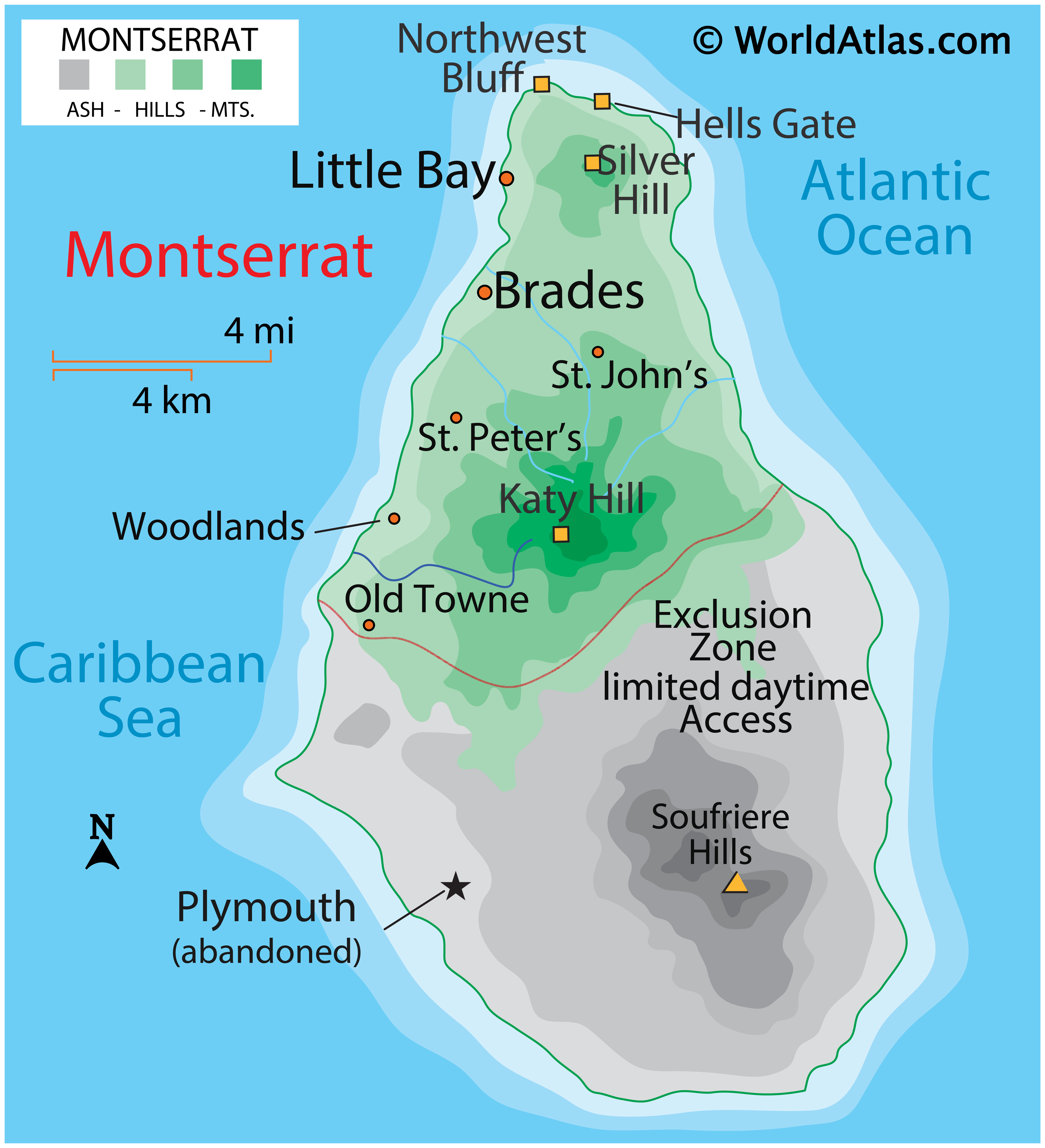
The local citizens on Montserrat
describe their island as in the shape of a pear (fruit), perhaps we might say,
a crooked pear. It is eleven miles long,
and seven miles wide at its widest point.
It is a quite hilly tropical island, very verdant, with what had been in
earlier times a couple of quiescent volcanoes.
We are told that the island is home to 1,241 different species of small
animals, and 718 species of beetles.
Two hundred years after Columbus, a
batch of Irish migrants was taken onto Montserrat, and in fact over a period of
time, so many Irish migrants settled onto the island that the Irish Gaelic
language was at one stage quite dominant in all of its communities. During the year 1666, which incidentally
happened to be the year of the Great Fire in London, the Irish migrant
communities on Montserrat invited France to claim the island, but instead,
England invaded and captured it.
However in 1782, during the still
raging American Revolutionary War, the War of Independence, France did actually
invade and capture Montserrat. During
the following year though, the island was ceded back again to England by the
Treaty of Paris (1783).
Hurricane Hugo on September 17, 1989
with its sustained wind force at more than 185 mph wrought horrendous damage to
the island and this wide spread 90% devastation was compounded half a dozen
years later with the onset of almost continuous volcanic activity beginning on
July 18, 1995. So powerful was the total
devastation from the explosive eruptions of Mt Soufriere that the large bottom
half of the pear shaped island is declared an exclusion zone, for which
everybody has to obtain a police permit to enter. It is claimed that Mt Soufriere has been the
subject of scientific study more than any other volcano anywhere else upon
planet Earth.
The small capital city of New
Plymouth was so overwhelmed with millions of tons of mud, volcanic ash and lava
that the entire city has been abandoned.
At one stage, the town clock on top of its ornamental tower could be
seen just above the level of the accumulated and solidified debris. Some 8,000 citizens fled Montserrat and they
were settled on other nearby islands, in England and elsewhere.
A new capital city Brades is under
construction on the northern half of the island, and a totally new
infrastructure is underway. In 1994 the
total population of the entire island was 13,000, but today their population
numbers just 5,000.
The well known European radio
entrepreneur Jacques Tremoulet provided two mediumwave transmitters (20 kW and
200 kW) and two shortwave transmitters (15 kW each) for a new radio
broadcasting station on Montserrat, Radio Antilles in 1959. This equipment had been previously in use as
a commercial broadcasting station, Radio Africa in Tangier. These units, together with additional
ancilliary equipment were installed in a new transmitter building located close
to the Caribbean shore at the southern edge of the island.
Soon after Deutsche Welle entered
the radio scene on Montserrat, it is stated, they installed a 200 kW mediumwave
transmitter that had been procured previously for their El Salvador
project. In addition, Deutsche Welle
subsequently installed a new 50 kW Continental shortwave from the United States.
Thus, Radio Antilles, with its
transferred equipment from the
old Radio Africa in Tangier and also from the El Salvador project, together
with the new 50 kW Continental, formed the electronic equipment that would be
used as as a joint relay station on behalf of Deutsche Welle in Cologne Germany
and the BBC in London England.
More about the Deutsche Welle - BBC
relay station on Montserrat Island next time.

