Monday, December 04, 2017

The Current Radio Scene in Zimbabwe

QSL via Gayle Van Horn Collection
           As you’ve probably heard, Zimbabwe’s long-time ruler Robert Mugabe resigned this past week as president of Zimbabwe.  This was after the country’s military forces put Mugabe under house arrest several days earlier.  One of the first acts of the military, as often happens during a coup, was to take over the state broadcaster, in this case ZBC, the Zimbabwe Broadcasting Corporation.  It consists of four radio networks and a TV station.  The main radio station is Radio Zimbabwe, also known as Radio Zim.

It has been many years since ZBC broadcast on shortwave.  However, there is a shortwave broadcast going INTO Zimbabwe from a major international broadcaster.  That’s the Voice of America, with its special Zimbabwe Service.


The VOA’s program Studio 7 has been broadcasting to Zimbabwe since 2003, and it has become an important alternative source of news for many Zimbabweans.  The program covers politics, civil society, the economy, health, sports, music, the arts and other aspects of life in Zimbabwe.  The program is multilingual; in English, Shona and Ndebele.


            The VOA Zimbabwe Service appears to be on the air at 1700-2000 UTC daily, with possibly some variations on the weekend.  On the air, they are announcing the frequencies of 909 kHz mediumwave plus 4930, 6080, 13860, 15460 and 15580 kHz shortwave.  These frequencies may be on at different times.  

            We looked at frequency registrations, and 4930 kHz is registered to broadcast to the Zimbabwe area at 0300-0600 and 1400-2100 UTC daily.  That frequency comes from the VOA Botswana relay. The two shortwave channels 13860 and 15460 kHz are registered to be on from 1700-1900 UTC from the VOA site on Sao Tome island.  6080 is registered for 1700-1800 UTC from Sao Tome.  15580 kHz is registered from the VOA Kuwait site from 0300-0500, and from Botswana from 0500-0700 and 1400-2100 UTC.  Some of those transmissions are probably carrying other VOA programs besides VOA Zimbabwe.


The VOA Zimbabwe website, which is www.voazimbabwe.com, says listeners in the area of Harare, the capital of Zimbabwe, may experience jamming on 909 kHz AM.  That may have changed now.  The programming can also be heard on satellite and Internet.  We have noted that the times and frequencies on their website do not correspond exactly to the latest HFCC listings and to what they are announcing on air, so there may be some changes due to the recent dramatic events in the country.
(AWR-Waescan/NWS 457)

The Radio Scene in the World’s Smallest Kingdom


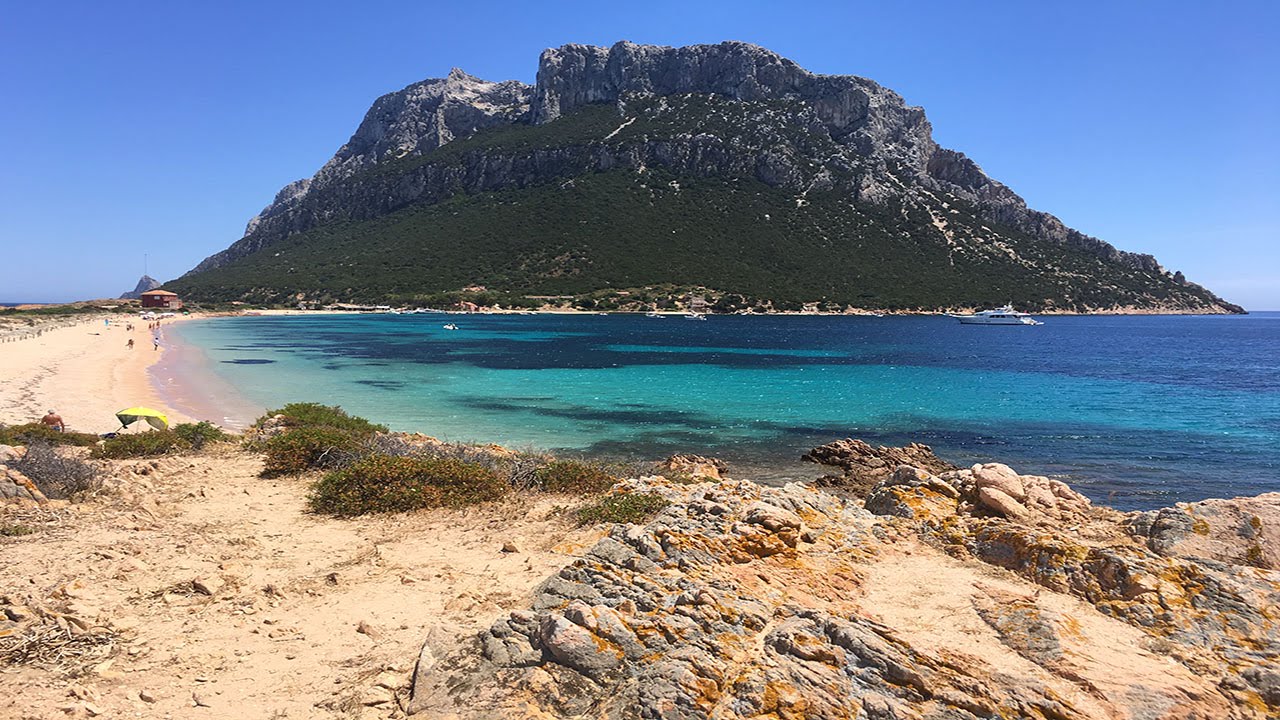
Tavolara Island

The small island named Tavolara is located off the north east coast of the larger nearby island of   Sardinia in the Tyrrhenian Sea, the west Italian section of the wider Mediterranean Ocean.  The island is 3 miles long and ½ mile wide, with a high jagged limestone massif in the center, and fingerlike coastal beaches at each end.    

            The island of Tavolara was known to the ancient Romans as Hermea, and to the Arabs of the same era as Tolar, though in those days the island was uninhabited.  Pope St Pontian, history tells us,  was exiled to Sardinia after he abdicated the pontificate in the year 235, and according to some accounts, he died and was buried on Tavolara, though subsequently his body was removed and reburied in the catacombs of Rome.        

            In a historic document dated in the year 1767, it is claimed that the island of Tavolara was not incorporated into the Kingdom of (nearby) Sardinia, but rather it retained its own separate independence.  This island was noted in these earlier years for its unique goat population; these goats had golden colored teeth due to the chemicals in the seaweed and lichen that the goats were eating.

            A settlement on the island began in the year 1807 when an Italian shepherd from Genoa migrated to the island, together with his two sister-wives and their children, in order to escape the charge of bigamy in Italy itself.  Thus it was that Giuseppe Bertoleoni became the first king on the island of Tavolara.

            Nearly 30 years later, King Charles Albert from nearby Sardinia visited Tavolara and he was impressed with the knowledge and education of Giuseppe Bertoleoni.  King Charles of Sardinia gave a Royal Charter to King Giuseppe of Tavolara, recognizing him as king, and recognizing his small island as a separate sovereign state.   

            Over the subsequent years generally speaking, each time the king father died, the eldest son took over with the prerogatives of royalty as king, though at one stage a queen, Mariangela, carried on as the royal ruler after her husband pre-deceased her.

            After the unification of the nearby separate Italian states into the Kingdom of Italy during the 1800s, King Victor Emmanuel 1 granted approval for Tavolara to retain its separate status as an independent state.  Soon afterwards, the Kingdom of Italy bought land on the island of Tavolara for the construction of a lighthouse, for which full payment was made.

            During the year 1900, Queen Victoria of England gave direction that the royal navy vessel HMS Vulcan should visit Tavolara and have an official photographer take a portrait photo of the island’s royal family.  The gold framed photo was hung in Buckingham Palace in London in the gallery of royal portraits from other countries around the world.  A copy of this portrait is hung also in the Da Tonino Restaurant on Tavolara. 

            According to the BBC TV Travel Channel, Tavolara is the world’s smallest kingdom, with these days just 11 part time residents.  The current king is the 84 year old Antonin, and his kingdom is a tourist resort that is famous for its nature reserve, beaches and scuba diving.  If ever you have the opportunity to visit this micro-nation, the Kingdom of Tavolara, you can buy some of their souvenirs, such as a cinderella postage stamp, a mint coin at $200, and a fridge magnetic portraying their national flag.  

            It was during the year 1962 that the United States, under the auspices of NATO, the North Atlantic Treaty Organization, constructed a huge radio station on small Tavolara Island.  The few remaining residents on the island, and the golden teethed goats, were removed and resettled across the water on nearby Sardinia. 

            The main buildings for the new radio station were constructed on the fingerlike cove and beach area at Spalmatore di Fuori, at the northeast end of the island.  The massive antenna system was attached to a tall 440 feet self standing tower at ground level, and to four spread out towers on top of Mount Cannone, the giant 1855 ft limestone massif in the enter of the island.

            Two quite different functions were activated in this unique radio station.  One purpose for the station was to communicate with submerged submarines in the Mediterranean Sea and the Atlantic Ocean; and the other purpose was for navigation with planes and ships in the European arenas. 

            This NATO radio communication station was licensed with an Italian callsign, ICV; and its high powered longwave transmitter radiated on the very low frequencies of 20.27 kHz and 20.76 kHz.  The radio-goniometric direction finding station operated under the American Bullseye system, and this was back in the era before GPS navigation became available by satellite.

            As time went by, this NATO communication station on Tavolara Island was no longer needed due to advancement in electronic communication via satellite, and so the station was decommissioned and handed over to the Italian government.  The Italians are still operating this original radio station on this small island, though at a considerably lower level than when it was originally constructed more than half a century ago.
(AWR Waescan/NWS 457)
photo via YouTube

Weekly Propagation Forecast Bulletins


Product: Weekly Highlights and Forecasts
:Issued: 2017 Dec 04 1640 UTC
# Prepared by the US Dept. of Commerce, NOAA, Space Weather Prediction Center
# Product description and SWPC web contact http://www.swpc.noaa.gov/weekly.html
#
#                Weekly Highlights and Forecasts
#
Highlights of Solar and Geomagnetic Activity 27 November - 03 December 2017

Solar activity was at very low levels. The only spotted region on the disk, Region 2689 (N13, L=108, class/area Cao/060 on 26 Nov), was quiet and stable. No Earth-directed CMEs were detected. No proton events were observed at geosynchronous orbit.
The greater than 2 MeV electron flux at geosynchronous orbit was at  moderate flux levels throughout the period. A maximum flux of 602 pfu was observed at 27/1435 UTC.  Geomagnetic field activity was at predominately quiet levels through the period. Isolated unsettled and active periods were observed on 28 and 30 Nov and again on 01-02 Dec due to waning, negative
polarity CH HSS influence. Solar wind speed averaged about 425 km/s through the period with a peak speed of 525 km/s observed midday on 30 Nov and again early on 01 Dec.

Forecast of Solar and Geomagnetic Activity 04 December - 30 December 2017

Solar activity is expected to be at very low levels though out the outlook period.  No proton events are expected at geosynchronous orbit.
The greater than 2 MeV electron flux at geosynchronous orbit is expected to reach high levels on 05-10, 12-17 and 19-21 Dec due to recurrent CH HSS influence. Normal to moderate levels are expected
for the remainder of the outlook period.  Geomagnetic field activity is expected to be at G1 (Minor) levels on 04-06 Dec and 18 Dec with G2 (Moderate) levels expected on 04-05 Dec due to recurrent CH HSS effects. Unsettled to active levels are expected on 07-08, 11-14, 17-21 and 27-28 Dec due to recurrent CH HSS effects. Mostly quiet levels are expected for the remainder of the outlook period.

Product: 27-day Space Weather Outlook Table 27DO.txt
:Issued: 2017 Dec 04 1640 UTC
# Prepared by the US Dept. of Commerce, NOAA, Space Weather Prediction Center
# Product description and SWPC web contact http://www.swpc.noaa.gov/wwire.html
#
#      27-day Space Weather Outlook Table
#                Issued 2017-12-04
#
#   UTC      Radio Flux   Planetary   Largest
#  Date       10.7 cm      A Index    Kp Index
2017 Dec 04      70          32          6
2017 Dec 05      70          48          6
2017 Dec 06      70          18          5
2017 Dec 07      70          12          4
2017 Dec 08      70           8          3
2017 Dec 09      70           5          2
2017 Dec 10      70           5          2
2017 Dec 11      70          12          4
2017 Dec 12      72          15          4
2017 Dec 13      75          12          4
2017 Dec 14      75           8          3
2017 Dec 15      75           5          2
2017 Dec 16      75           5          2
2017 Dec 17      74           8          3
2017 Dec 18      73          25          5
2017 Dec 19      73          10          3
2017 Dec 20      73           8          3
2017 Dec 21      74           8          3
2017 Dec 22      74           5          2
2017 Dec 23      76           5          2
2017 Dec 24      74           5          2
2017 Dec 25      72           5          2
2017 Dec 26      73           5          2
2017 Dec 27      72          10          4
2017 Dec 28      70           8          3
2017 Dec 29      70           5          2
2017 Dec 30      70           5          2
(NOAA)

Saturday, December 02, 2017

From the Isle of Music & Uncle Bill's Melting Pot schedules, December 3-9 2017


From the Isle of Music, December 3-9, 2017
This week our special guest is Emilio Martini, guitarist, composer and leader of the Natural Trio. We will feature songs from this year’s Cubadisco-winning album Notas al viento. Also, some classic Timba and Cuban Fusion.
Four opportunities to listen on shortwave:
1. For Eastern Europe but audible well beyond the target area in most of the Eastern Hemisphere (including parts of East Asia and Oceania) with 100Kw, Sunday 1500-1600 UTC on SpaceLine, 9400 KHz, from Kostinbrod, Bulgaria (1800-1900 MSK)
2. For the Americas and parts of Europe, Tuesday 0100-0200 UTC on WBCQ, 7490 KHz from Monticello, ME, USA (Monday 8-9PM EST in the US) NOTE THAT UTC CHANGES BUT EASTERN US TIME IS STILL THE SAME.
3 & 4. For Europe and sometimes beyond, Tuesday 1900-2000 UTC and Saturday 1200-1300 UTC on Channel 292, 6070 KHz from Rohrbach, Germany.

Chickens Around the World…..
Episode 39 of 
Uncle Bill’s Melting Pot features songs and dances about chickens (some funky, some strange) from around the world.
Sunday, Dec 3,  2300-2330 UTC (6:00PM -6:30PM Eastern US) on
WBCQ The Planet 7490 KHz shortwave from the US to the Americas and parts of Europe.

(Bill Tilford/Tilford Productions)

Friday, December 01, 2017

Shortwave Radiogram weekend programming


Hello friends,
Last weekend’s experiment with Olivia 64-2000 was very interesting, and lots of fun. The mode did provide successful decodes in conditions where the MFSK32 would have failed. Warren in Arizona described his decode …
   
            I am astounded. Based on your email I received, I set Fldigi to Olivia 64/2K and set the radio on 11.580 MHz and forgot about it. About 23:35 I decided I had missed the broadcast as I was hearing nothing but background white noise. I had Fldigi minimized so with the idea of shutting it down, I opened it up and was amazed to see text coming in. I listened to the entire broadcast and I could not hear the signal nor see any of it on the waterfall, yet the text was printing. There was a lot of fading based on the quality of the copy changing but there were periods of perfect copy and a few sections that were pretty bad. Over-all I would say I had 80-90 percent copy of the entire broadcast.

Of course, the Olivia 64-2000 did not work in all instances. For some listeners, the signal was bad enough that no decode was possible.

We will try more slow modes this weekend.  On 3 December, during the troublesome Shortwave Radiogram transmission Sunday at 2330-2400 (24-S), we will try three slow modes that might succeed where our usual MFSK32 fails. The three modes are MFSK16, MFSK8, and IFKP 1.0.

2030:00   Voice introduction

2030:50   MFSK16: India net neutrality*

2041:32   MFSK8: India net neutrality (continued)

2049:21   IFKP1.0: Migrating birds in Israel*

2057:47   MFSK16: Closing announcements

* with image
Each mode will be preceded by its RSID and five seconds of silence. The MFSK8, in particular, needs precise tuning of the audio frequency. The IFKP1.0 will require a recent version of Fldigi. And, sorry, IFKP1.0 and MFSK8 are not available on TIVAR and AndFlmsg.

The other three transmissions will be in the usual MFSK32. Here is the lineup for Shortwave Radiogram, program 24, 2-3 December 2017, all in MFSK32:

 1:29  Program preview

 2:37  Ocean's deepest fish*

10:47  Could we run out of sand?*

19:21  Russia looks into separate internet for BRICs*

23:24  Sun's activity steady during solar minimums*

26:50  More SSTV from the ISS

28:07  Closing announcements

 * with image
Please send reception reports to radiogram@verizon.net
And visit http://swradiogram.net
Twitter: @SWRadiogram
Facebook group: https://www.facebook.com/groups/567099476753304


Shortwave Radiogram Transmission Schedule
(2-3 December 2017)

24
Saturday
1600-1630 UTC
9400 kHz
MFSK32
Space Line, Bulgaria
24
Sunday
0600-0630 UTC
7730 kHz
MFSK32
WRMI Florida
24
Sunday
2030-2100 UTC
11580 kHz
MFSK32
WRMI Florida
24S
Sunday
2330-2400 UTC
11580 kHz
MFSK16, MFSK8, IFKP1.0
WRMI Florida


The Mighty KBC transmits to Europe Saturdays at 1500-1600 UTC on 9400 kHz (via Bulgaria), with the minute of MFSK at about 1530 UTC (if you are outside of Europe, listen via websdr.ewi.utwente.nl:8901/ ).  And to North America Sundays at 0000-0200 UTC (Saturday 7-9 pm EST) on 5960 kHz, via Germany. The minute of MFSK is at about 0130 UTC.  Reports to Eric: themightykbc@gmail.com . See also http://www.kbcradio.eu/ and https://www.facebook.com/TheMightyKbc/

Italian Broadcasting Corporation (IBC)  For the complete IBC transmission schedule visit  http://ibcradio.webs.com/  Five minutes of MFSK32 is at the end of the 30-minute English-language “Shortwave Panorama,” per the schedule below:

To Europe
Wednesday
2025-2030 UTC
1584 kHz (MW)
Thursday
0325-0330 UTC
1584 kHz
Saturday
2125-2130 UTC
1584 kHz
Sunday
1155-1200 UTC
6070 kHz

To the Americas
Tuesday
0125-0130 UTC
11580 kHz

Friday
0225-0230 UTC
9955 kHz
Saturday
0155-0200 UTC
11580 kHz

Sunday
0055-0100 UTC
7730 kHz


Thanks for your reception reports! 
Kim

 Kim Andrew Elliott, KD9XB

Producer and Presenter


Adventist World Radio frequency updates

AWR via Guam transmitters

AWR/KSDA
All times UTC
0300-0330 NF 12010 MDC 250 kW / 000 deg to EaAf Oromo, ex 15500 TRM
0330-0400 NF 11875 TAC 100 kW / 226 deg to EaAf Amharic, ex 15500 TRM
0500-0600 NF 17780 TAC 100 kW / 236 deg to CEAf Arabic, ex same TRM
1200-1230 NF 15195 SDA 100 kW / 285 deg to SEAs Shan Shoshoni, ex 15610 TRM 1130-1200
1230-1300 NF 15195 SDA 100 kW / 285 deg to SoAs Mon, ex 15400 TRM 1200-1230
1300-1400 NF 12025 SDA 100 kW / 330 deg to EaAs Korean, ex 11825 TRM 1200-1300
1400-1430 NF 15430 SDA 100 kW / 285 deg to SoAs Manipuri Su/We/Fr, ex TRM 1230-1300
1400-1430 NF 15430 SDA 100 kW / 285 deg to SoAs Bengali Mo/Tu/Th/Sa, ex TRM 1230-1300
1400-1500 NF 11935 SDA 100 kW / 300 deg to EaAs Chinese, ex 11630 TRM
1500-1530 NF 15150 MDC 250 kW / 040 deg to SoAs Punjabi, ex same TRM
1530-1600 NF  9505 TAC 100 kW / 163 deg to SoAs Gujarati, ex 15525 TRM
1600-1630 NF 11985 SDA 100 kW / 285 deg to SoAs Urdu, ex 15360 TRM
1630-1700 NF 11985 SDA 100 kW / 285 deg to SoAs Pashto Mo/We/Fr, ex 15360 TRM
1630-1700 NF 11985 SDA 100 kW / 285 deg to SoAs Sindhi Su/Tu/Th/Sa, ex 15360 T
(SWL DXing 30 Nov 2017)

Free Radio Service Holland schedules Christmas programming


On the FRS website you will find info about our  upcoming Christmas programming December broadcast.

On Sunday December 3rd FRS will be testing 09:00- 10:00 UTC as well as in the later afternoon.
See also our website for further details: [ http://www.frsholland.nl/20-latest-news/112-frs-test-seasonal-broadcast.html ].
For all of you: have a good weekend!

73s  Peter Verbruggen on behalf of the FRS team

Radio New Zealand International frequency update


Radio New Zealand International

Effective: 01 December 2017

0459-0758 UTC: 0459-0758 on 13730 RAN 050 kW / 035 deg to All Pacific English, (ex 11725 kHz)
(SWL DX 01 Dec)

Shiokaze/Sea Breeze frequency update

Clandestine, Shiokaze/Sea Breeze
Effective: 01 December 2017

All times UTC

1300-1400 6085*YAM 300 kW / 280 deg to NEAs, ex 7410 as follows:
1300-1330 Chinese Mon; Japanese Tue/Sat; Korean Wed/Fri/Sun; English Thu
* co-ch same 6085 KLL 001 kW / 120&300 to CeEu Ger/Eng Radio MiAmigo Int

1330-1400 Korean Mon/Wed/Fri/Sat; Japanese Tue/Sun; English Thu

1405-1435 NF  5935#YAM 300 kW / 280 deg to NEAs Japanese(Furusato no Kaze), ex 6095
# co-ch same 5935 LHA 100 kW / 085 deg to EaAs Chinese PBS Xizang

1600-1700 NF  7285 YAM 300 kW / 280 deg to NEAs, ex 7335 as follows
1600-1630 Chinese Mon; Japanese Tue/Sat; Korean Wed/Fri/Sun; English Thu

1630-1700 Korean Mon/Wed/Fri/Sat; Japanese Tue/Sun;English Thu
^ co-ch same 7285 RAN 035 kW / 035 deg English DRM RNZI from 1651 Su-Fr
(SWL DX-01 Dec)


Monday, November 27, 2017

International Shortwave Broadcast Guide 9th Edition (Winter 2017-2018)

To the person who just who just purchased a copy from Amazon of 9th edition of the International Shortwave Broadcast Guide (Winter 2017-18), your copy is not the current one. It has new features for that new edition, but it still has the summer frequency schedules You need to ask Amazon for refund. To the SWL crowd the new edition will be out within the next 24 hours.

Larry Van Horn
Teak Publishing
Production Manager

December Specials from Airmail Postage and DX Supplies


Dear Customer,
Below are DX specials and news for DECEMBER  2017.

 If you need a current stamp list or supply list, I can email it to you. 

  DISCOUNT POSTAGE!!: I have a supply of Forever stamps in rolls of 100.  Minimum order w/o a shipping charge would be 5 rolls at the listed $208. ppd. price. BUT if you can use 10 rolls, the price will be $400. Email to reserve!

In single format, I still have a few. 100 single forever stamps at $40.00 ppd.

FLEA MARKET: Saturday, Dec. 2nd: I'll have a table at Bridgewater Middle School, in Bridgewater, NJ. I'll have fountain pens and mech. pencils for sale. On Saturday, Dec. 9th: at Somerville High School, in Somerville, NJ I'll have a table here with more pens and pencils... Including a beautiful 1914!! Sheaffer's Ladies' ring top pen and a good number of silver mech. pencils on pocket chains for that vintage steam punk look!

NEW RATES: EARLY WARNING NOTICE: January 21, 2018. US 1st class rate increases from 49c to 50c. Postcard rate increases from 34c to 35c. International rate holds at $1.15....Psst! Buy some forever stamps now, why don’t cha!! In January, I hope to offer 5 stamp units again.

 NEW PRICES: Suriname now priced at $2.50

IN STOCK AGAIN:  Azerbaijan, Indonesia
STAMPS ON BACK ORDER:   Saudi Arabia
STAMP LIST UPDATE:

U.S. DISCOUNT POSTAGE DEALS!!

Save Big on your domestic mailings when you plaster 

 your envelope with colorful vintage stamps!

HAPPY  MAILING!!

49c units
Forever

in  2 stamps
3 stamps  
 4 stamps
x 100
$45.00

xxxx
$41.00
$40.00 
x 200
$85.00

xxxx
$63.00 
$62.00 
x 500
$208.00

xxxx 
$157.00 
$157.00 

Payment by credit card, check or money order
                               for forever stamps and 49c units                   

No charge for posting Discount Postage Offers, sending only to USA addresses. 

 DECEMBER 2017  DX  STAMP  SPECIALS

2 Germany-$2.60       2 Russia-$2.60       3 Japan-$3.90  

2 Italy-$7.00    2 UK-$3.00    2 France-$3.60    5 Spain-$10.00

 DECEMBER 2017  DX  SUPPLY  SPECIALS

200/200 European Plain Mailers and Plain Returns - $40.00

200/200 European Air Mailers and Plain Returns - $40.00

200/200 STATESIDE Mailers and Returns - $22.00

European AIR Returns are SOLD OUT!!

Priority Mail Shipping Rates: Orders up to $40.00 add $9.00, orders from $41.00 to $100.00 add $15.00. orders from $101.00 to $150.00 add $20.00, orders over $150.00 add 15%. When ordering supplies and stamps, the stamps ride free, just use supply total to figure shipping costs. Shipments to Canada and overseas ship at a greater cost. (07/2015 modified)

Stamps Only Orders: Just add $1.00 P&H for posting to USA, add $2.00 for posting to Canada.
73, bill

William Plum
12 Glenn Road
Flemington, NJ 08822
908 788 1020
Email: plumdx@msn.com


The Radio Scene on Rottnest Island


The Island of Rats, that is Rottnest Island, lies just off the Western Australian coastline opposite Perth and Fremantle.  This island has featured on two separate occasions in massive wide area searches in the Indian Ocean. 

            The first occasion was after the firefight in the Indian Ocean off the Australian coastline between the two navy vessels, the Australian HMAS Sydney and the German HSK Kormoran, on November 19, 1941.  That was 76 years ago this weekend.

            The two warring ships tragically destroyed each other in a fierce battle lasting just one hour.  Both ships were sunk, with a heavy loss of life.  Aboard the Kormoran were 400 crew, 300 of whom survived and were taken prisoner along the Australian coastline.  Aboard the Sydney however were 650 men, none of whom survived, making it Australia’s deadliest wartime disaster.  The Australian naval authorities became aware of the deadly naval battle only when survivors of the German raider Kormoran arrived in lifeboats on the Western Australian coastline. 

            The first search over the ocean was carried out informally and unofficially by a Fairey Battle airplane on November 23 (1941), four days after this tragic wartime engagement.  The Fairey Battle was a light single engined bomber from England, and in this initial search flight over the Indian Ocean, the plane used Rottnest Island as its reference point.  During the two following days, a flight of 6 Hudson Bombers flew a fan shaped search pattern, again referenced on Rottnest Island, though no ship debris nor survivor lifeboats were found.

            It was not until 2008 that the wreckage of both the German Kormoran and the Australian Sydney were located by the Finding Sydney Foundation which was using sophisticated underwater technical equipment.  The scattered wreckage of both ships was found 12 miles apart in ocean waters 1½ miles deep, 128 miles west of Shark Bay in Western Australia in March 2008.

            The second major aircraft search in which Rottnest Island featured again began in March 2014, when the Malaysian airliner MAS370 went missing over the Indian Ocean.  This passenger plane with more than 200 passengers and crew began a regular scheduled flight from Kuala Lumpur in Malaysia to Beijing in China.

             After one hour in flight, the plane turned around and flew back across the Malay Peninsula and then out over the Indian Ocean.  When the fuel was exhausted, the plane fell into the ocean. 

            Several different search patterns were implemented, with some based on Rottnest Island as a reference point.  Though some debris has washed up on distant shores, the wreckage of the sunken plane itself has not been rediscovered.  This search and recovery effort developed into the largest,  most extensive and most expensive aviation search in the history of the world. 

            The Island of  Rats, Rottnest Island, is 7 miles long and 3 miles wide, and it lies 11 miles due west of Fremantle on coastal Western Australia.  On the map, it looks like a scrawny ancient monster.

            This island was known to the Aborigines as Wadjemap who did inhabit it at times in the ancient eras, though not since European discovery.  The first European discoverers were Dutch explorers (1610), and the first to land on the island was Willem de Vlamingh who went ashore on December 16, 1629; he spent 6 days on this small and rather featureless island.

            It was Vlamingh who named the island Rotte Nest in the Dutch language, which later became Rottnest.  Vlemingh discovered the rare Australian animal the Quokka which is best described as a miniature variety of Kangaroo.  He thought that it was a large type of rat.

            The first European settlers were William Clarke and Robert Thomson together with their families, in 1831.  The island has since been used as a prison for Aboriginal criminals, a reform school for boys, an internment camp for Germans and Austrians during World War 1, and an internment camp for Italians during World War 2.  These days the island has a resident population of about 100, and it is a tourist destination for ½ million visitors each year. 

            Southwest of Rottnest Island is a ship graveyard, 7 miles in diameter, and the first ship was deliberately sunk there in 1910.  Since then, 47 historically significant ships have been sunk at that location, in addition to a whole host of American lendlease vehicles and aircraft towards the end of World War 2.

            The first wireless experiments in Western Australia took place during the year 1899.  A spark transmitter was installed in the Royal Yacht Club in Perth and a small police launch carried a coherer receiver on the Swan River and on Swan River Lake. 

            Right towards the end of that same year (1899), the police launch ventured out from the Swan River in an attempt to establish wireless communication with Rottnest island.  The simple electrical signal was lost soon after the launch entered open waters.

            Just six years later (1905), the Postmaster General, the Honorable Austin Chapman, made an official statement in which he indicated that the Australian government was giving consideration to installing a wireless station on Rottnest island.  Three years later though (1908), the federal government stated that the Western Australian wireless station would be installed on the mainland, not Rottnest.   Ultimately, the wireless station, with the projected callsigns POF and later POP, was installed at Applecross as VIP in 1912.  

            However, a communication station was installed on Rottnest around 1933 and it was on the air under the callsign VKN on 1620 kHz, just immediately above the standard mediumwave band.  Four years later (1937), the navy announced that they would install a communication station on Rottnest, and during World War 2, the army did so too, in conjunction with a radar station. 

            This army station was installed on the bottom floor of the 3 storied Rottnest Fortress.  It was this station, under Naval Commander Victor Ramage, that declared that they had heard no wireless signals from the two ships Kormoran and Sydney during their firefight 450 miles to the north.
(AWR/Wavescan 456)