Tuesday, June 21, 2016

All India Radio news of interest


Message from All India Radio, SMS Division
As you know, that All India radio is regularly receiving reception reports/ feedback from various listeners residing in India and abroad. In this regard, a feedback form was provided on our website www.allindiaradio.gov.in

Now, All India Radio has created a 'Listeners Corner' section ón its website http://allindiaradio.gov.in where listeners may have several useful information. A special link named Reception Report/ Feedback from Listeners along with mandatory one time Listener Registration  is created to send the feedback online on our services.

We may issue e-QSL. All listeners are requested to send their reports and feedback to: http://pbinfo.air.org.in/feedback/
Link to 'Listener's Corner' http://allindiaradio.gov.in/Information/ListenersCorner/Pages/default.aspx
(Alokesh Gupta, India)

AIR to revive Bangla service - 'Probably one of its kind in the world'
New Delhi, June 20: All India Radio will re-launch its special Bangla service for Bangladesh after a gap of six years, adding a cultural content to the news bulletins that conveyed India's perspective on global affairs.

The service, which began during the Liberation War of 1971, was discontinued in 2010 when the old transmitter in Calcutta broke down.

A strengthened transmitter with a higher capacity has now been installed in Chinsurah following Prime Minister Narendra Modi's Dhaka visit last year, Prasar Bharati sources said.

Full story at :
http://www.telegraphindia.com/1160621/jsp/nation/story_92427.jsp#.V2inOGh97IV

AIR Itanagar goes digital
Itanagar, June 14: The All India Radio (AIR) Itanagar is all set to begin a new innings with completely digitalized version, likely from this week with Digital Radio Mondiale (DRM) technology.

Aiming at providing better facilities in the world of Radio, AIR, Itanagar has installed DRM transmitter recently and would start functioning regularly after it gets properly tested and monitored. The Digital Radio Mondiale (DRM) technology would completely replace the analogue system with better signal and reception quality and other broadcasting facilities to the radio listeners, a press release informed.

The coverage area would also be wider as the station has installed 200 kW capacity replacing its earlier 100 kW analogue system facilitating more people to listen to radio programmes broadcast from AIR, Itanagar including state’s border areas.

Soon after AIR Itanagar starts functioning on DRM technology; AIR Pasighat in East Siang district would also begin to function on this technology within a week with 100 kW capacity.

AIR, Dibrugarh in Assam is already functioning smoothly on DRM technology with 300 kW capacity. At present all total 27 All India Radio stations have installed DRM technology across the country.

Digital Radio Mondiale AM transmitter, manufactured by Nautel, Canada, is a set of digital audio broadcasting technology designed to replace the analogue radio AM broadcasting.

DRM technology has advantage of transmitting four different radio programmes simultaneously on same frequency at a time over analogue system where only a single programme can be transmitted at a time. Listeners would also be able to read the scrolling of text and bulletins in a DRM receiver along with JPEG file.

Though at present DRM receivers are not readily available in the local market, Indian Radio Receiver manufacturer have already launched DRM radio sets and are available in main cities.

Moreover, vehicle manufacturer like Mahindra has already included DRM technology in their car radio sets. Other companies are following it very soon.

Till the period the broadcast from All India Radio would be on simulcast mode (Analogue + Digital), so that listeners can tune in to the analogue mode with the normal receivers available in market, the release added.
Source: http://www.sentinelassam.com/arunachal/story.php?sec=2&subsec=7&id=270817&dtP=2016-06-15&ppr=1
(Alokesh Gupta, New Delhi, India)

Please note that from last weekend DRM from Bangalore has restarted on 7550  & 11620. It will restart soon on 17895 kHz.
Jose Jacob, VU2JOS
National Institute of Amateur Radio
Hyderabad, India


Saturday, June 18, 2016

New Publication from Teak Publishing


Gayle Van Horn at Teak Publishing in North Carolina, informs us that the Summer Edition of the twice annual publication International Shortwave Broadcast Guide is now available.  This regular shortwave program guide lists the programming of all known shortwave stations in an hourly format according to frequency.
            The news release from Teak Publishing states that more than 300 languages and dialects can be a heard on the air shortwave and this programming presents local and international news and information, as well as cultural motifs and music.  This remarkable totality of shortwave programming presents insight and information from all parts of the world that is just not available via any other electronic medium. 
            This new Summer edition of the International Shortwave Guide is the sixth since its inception, and it contains several items of new information, in addition to the multiple pages of program listings.   New in this edition is a lead story on clandestine broadcasting, and also a special feature on Who’s Who in the shortwave spectrum.
            Also new in this edition is the addition of frequency and station coverage for the radio stations that are broadcasting in the longwave band, as well as international programming that is heard from powerful radio stations that are broadcasting on mediumwave.  All chronohertz stations, those stations that give you the time pips in different parts of the world, are also listed in this new volume.

            In an era when radio broadcasting stations in some parts of the world are reducing, or eliminating altogether, their shortwave programming, we would commend Gayle Van Horn for her emphasis in making information on shortwave programming available to a worldwide audience.  You can obtain her new 2016 Summer edition of the International Shortwave Guide in any part of the World  from Amazon, at: https://www.amazon.com/International-Shortwave-Broadcast-Guide-Semi-Annual-ebook/dp/B01FV3FL72?ie=UTF8&*Version*=1&*entries*=0 
(AWR-Wavescan/NWS 380) 

Tuesday, June 14, 2016

Summer Schedule Updates


 From June 6 IBB transmitter station Iranawila in Sri Lanka is closed. All of the scheduled IRA transmissions are shifted to other
sites as follows: 
BIB=Biblis, ERV=Yerevan, KWT=Kuwait, LAM=Lampertheim,
PHT=Tinang, SAI=Saipan, TIN=Tinian, UDO=Udorn Thani and WOF=Woofferton:
All times UTC

Radio Free Asia
0030-0130 on  9940 IRA 250 kW / 057 deg to SEAs Burmese,replaced by SAI
0100-0200 on  9780 IRA 250 kW / 020 deg to CeAs Uyghur, replaced by KWT
1230-1330 on  7530 IRA 250 kW / 057 deg to SEAs Burmese,replaced by TIN
1630-1730 on  9940 IRA 250 kW / 057 deg to SEAs Burmese,replaced by ERV
Deewa Radio
0100-0300 on 11700 IRA 250 kW / 334 deg to WeAs Pashto, replaced by UDO
0100-0400 on 13840 IRA 250 kW / 334 deg to WeAs Pashto, replaced by UDO
1300-1430 on  9310 IRA 250 kW / 334 deg to WeAs Pashto, replaced by KWT
1430-1600 on  9310 IRA 250 kW / 334 deg to WeAs Pashto, replaced by UDO
1300-1900 on  9335 IRA 250 kW / 340 deg to WeAs Pashto, replaced by LAM
1300-1400 on 13590 IRA 250 kW / 334 deg to WeAs Pashto, replaced by UDO
Radio Mashaal
0400-1300 on 15760 IRA 250 kW / 334 deg to WeAs Pashto, replaced by UDO
1000-1300 on 15360 IRA 250 kW / 334 deg to WeAs Pashto, replaced by UDO
Radio Farda
0630-0730 on 17880 IRA 250 kW / 316 deg to WeAs Persian,replaced by UDO
1200-1800 on 12005 IRA 250 kW / 316 deg to WeAs Persian,replaced by WOF
Voice of America
1330-1430 on 11695 IRA 250 kW / 073 deg to SEAs Khmer,  replaced by PHT
1400-1500 on 17870 IRA 250 kW / 316 deg to WeAs Kurdish,replaced by WOF
1430-1530 on 11965 IRA 250 kW / 057 deg to SEAs Burmese,replaced by UDO
1700-1800 on  7485 IRA 250 kW / 316 deg to WeAs Kurdish,replaced by UDO
2330-0030 on  7440 IRA 250 kW / 057 deg to SEAs Burmese,replaced by UDO
adio Liberty
1600-1700 on 11910 IRA 250 kW / 334 deg to CeAs Tajik,  replaced by LAM
1600-1700 on  7475 IRA 250 kW / 316 deg to CeAs Tajik,  replaced by ERV
1900-2100 on  7475 IRA 250 kW / 340 deg to CeAs Russian,replaced by BIB
(DX Mix 952)

Marconi Radio International slated for June 15 broadcast


Just a short reminder of our regular weekly brodcasts on Wednesdays. Marconi Radio International will once again be on air tomorrow 15 June 2016,as follows: 1730-1830 UTC on 13960 kHz (USB mode), 1915-2015 UTC on 15070 kHz (USB mode) and 2045-2145 UTC on 7700 kHz (USB Mode).
 
Our broadcasts include some kind of programmes now sadly missing from most shortwave radio stations:  an old style DX show in English “Italian Short Wave Panorama”  and Italian "Panorama Onde Corte" with lot of recent logs  as well as  a mailbag programme in Italian. Our  station identification  announcements are not only in English and Italian but also in French, German, Spanish and Catalan.
 
MRI encourages reception reports from listeners. Audio clips (mp3-file) of our broadcasts are welcome! We QSL 100%. Our electronic mail address is: marconiradiointernational@gmail.com - Please don’t forget to include your postal address as some lucky listeners will also receive a printed QSL card.
 
Last but not least,  we need your help! If you use social networks, please post an announcement on Facebook  or send out a tweet the day  before the broadcast. You can also forward this message to a friend. This should help increase our  potential audience.
 
We hope to hear from a lot of shortwave listeners about our transmissions.
 
Best 73's
 

Marconi Radio International (MRI)

Voice of Tibet summer schedule update


Clandestine - Voice of Tibet

All times UTC
Updated summer A-16 SW schedule of Voice of Tibet:
1200-1215 NF 15542 DB  100 kW / 095 deg to EaAs Chinese, ex 15543
1215-1230 NF 15548 DB  100 kW / 095 deg to EaAs Chinese, ex 15538
1230-1245 on 15573 DB  100 kW / 131 deg to CeAs Tibetan
1245-1300 NF 15567 DB  100 kW / 131 deg to CeAs Tibetan, ex 15568
1300-1315 on 15518 DB  100 kW / 095 deg to EaAs Chinese
1300-1315 NF 15558 DB  100 kW / 131 deg to CeAs Tibetan, ex 15553
1315-1330 on 15528 DB  100 kW / 095 deg to EaAs Chinese
1315-1330 NF 15558 DB  100 kW / 131 deg to CeAs Tibetan, ex 15553
1330-1345 on 15528 DB  100 kW / 095 deg to EaAs Chinese
1330-1345 NF 15557 DB  100 kW / 131 deg to CeAs Tibetan, ex 15558
1345-1400 on 15522 DB  100 kW / 095 deg to EaAs Chinese
1345-1400 NF 15557 DB  100 kW / 131 deg to CeAs Tibetan, ex 15558
1400-1415 NF 15557 DB  100 kW / 131 deg to CeAs Tibetan, ex 15558
1400-1415 on 15560 MDC 250 kW / 045 deg to CeAs Tibetan
1415-1430 on 15552 DB  100 kW / 131 deg to CeAs Tibetan
1415-1430 on 15565 MDC 250 kW / 045 deg to CeAs Tibetan
2300-2310 on  7598 DB  100 kW / 131 deg to CeAs Tibetan
2310-2320 on  7592 DB  100 kW / 131 deg to CeAs Tibetan
2320-2330 on  7598 DB  100 kW / 131 deg to CeAs Tibetan
All frequencies are jammed by CNR-1 on xxxx0 / xxxx5
Changes between frequencies vary from 5 to 7 minutes
(SWL DX Bulgaria/13 June)

Radio Cook Islands on Shortwave

(RCI QSL via Gayle Van Horn Collection)
Back in April 1954, international radio monitors in New Zealand and Australia were surprised to discover a new country on shortwave.  This new country was an island nation in the Pacific; the station was a low power operation; and it was on the air for only two hours a week.
            The Cook Islands are located in the central Pacific a little south of the equator and the radio station was a 100 watt Post & Telegraph transmitter located at Black Rock, a little west of the main town of Avarua on Rarotonga Island.  The electronic equipment was used equipment gifted by the government of New Zealand and it was in use in the Cook Islands for occasional shortwave communication. 
            The original programming from this diverted facility was intended for reception only at nearby island schools and it was on the air on Wednesdays and Fridays for one hour beginning at 11:00 am local time.  The initial frequency for these schools broadcasts was 3390 kHz, though during the next month, May (1954), the channel was changed to 5050 kHz which provided good reception during local daylight hours.
            This new programming on shortwave in the Cook Islands was the beginning of official radio broadcasting in their island nation.  Previously the local citizens had to rely on night time mediumwave propagation from other Pacific island entities, or from New Zealand and the United States.  Very few of the local citizens owned shortwave receivers back during that era.
            Three months after the introduction of the schools broadcasts on shortwave, a weekly half hour program was broadcast from the same station and this was on the air every Thursday beginning at 2:30 pm.  It was the same 100 watt transmitter, though at times another unit rated at 500 watts was employed for this general coverage broadcast, and the operating channel was 6180 kHz. 
            By this time, the broadcasting station was under the auspices of the Cook Islands Administration.  An internationally recognized callsign was allocated to the station, ZL1ZA, though this radio broadcasting callsign gave the semblance of an amateur radio facility in New Zealand itself.
            Beginning on May 1, 1957, the channel in the 60 metre shortwave broadcast band was changed from 5050 kHz to 4954 kHz; and by this time programming was pre-recorded on tape by the Social Development Department in Avarua.  At this stage, the callsign of the radio broadcasting service was amended and ZL1ZA became ZK1ZA, thus reflecting the individuality of the Cook Islands as a separate geographic entity, though the callsign still gave the semblance of an amateur facility.
            In June 1960, listeners in Australia and New Zealand noted that Radio Cook Islands was on the air on 4965 kHz with a two hour program each week on Thursdays, in which a bulletin of news was read in alternating languages, English and Cook Islands Maori. 
            Exactly one year later (June 1961), the broadcast transmitters were removed from the Cable & Wireless station at Black Rock and re-installed at a new site 3½ miles distant, in Avarua itself.  A new higher frequency shortwave channel 9695 kHz was deployed in an endeavor to overcome the obstruction of the signal by the nearby mountains.   
            Then, exactly one more year later again (June 1962), the first mediumwave transmitter was installed, apparently co-sited with the already existing shortwave transmitters in Avarua.  At this stage, the callsign ZK1ZA was transferred to the new mediumwave unit with 150 watts on 820 kHz. 
            In addition, new callsigns were allotted to the shortwave transmitters, and 5050 kHz was redesignated as ZK5, and 9695 kHz became ZK3.  The power of the two shortwave transmitters was rated at 500 watts each. 
            Soon afterwards, a new 10 kW mediumwave transmitter with a 350 ft mast was installed in the grounds of the Takitumu Primary School at Matavera, 5 miles clockwise from the studios in Avarua. The original mediumwave unit on 820 kHz was closed in favor of the new larger unit on 600 kHz.  
            At this stage, states the Te Ara Encyclopedia in New Zealand, the government communication station ZKS in Avarua maintained contact with New Zealand, and with 12 sub-stations throughout the Cook Islands. 
            In 1967, three transmitters at 5 kW were ordered for installation in the Cook Islands; and in 1974, the legendary George Jacobs at the Voice of America arranged for the VOA transmitters on 11760 kHz to go silent on one occasion so that listeners in the United States could log the distant shortwave station in the South Pacific.  However, another station on the same 25 metre band channel, Radio Havana Cuba, remained alive, thus blocking in North America the signal from the Cook Islands.   
            Two years later, Radio Cook Islands was noted in Australia, New Zealand and the United States with test broadcasts on shortwave, using a new antenna system.  A broadcast in the French language was noted in California on 5045 kHz, apparently for the benefit of listeners on French islands over the Pacific waves and somewhat nearby to the Cook Islands.  
            Over the years, several international radio monitors living in the United States, New Zealand and Australia have visited the Cook Islands, and one visitor, Bill Whitacre reported in 1980 that the shortwave transmitters were located at the Telecom Training Center a little west of Avarua, with a golf course under the towers.  However, the technical equipment was in disarray with 5045 kHz the only shortwave unit still on the air, using parts cannibalized from the other units.  A secondary mediumwave transmitter in Avarua was activated on 864 kHz for local programming when the National Assembly was in session which was heard on the main mediumwave channel 630 kHz.   

            In May 1992, a disastrous fire destroyed the C&W transmitter building, and that was the abrupt end of shortwave broadcasting from the Cook Islands.  The land remained vacant for a while and subsequently a Courthouse was constructed on the site.
(AWR Wavescan/NWS 381) 

Trans World Radio schedule update


Moldova relay - Trans World Radio
Updated schedule of TWR Africa on 9940 & 15105 kHz via Grigoriopol: 
1630-1645 on 15105 KCH 300 kW / 160 deg to EaAf Somali Sun, ex 11635 DHA
1630-1700 on 15105 KCH 300 kW / 160 deg to EaAf Somali Mon-Sat, ex 11635 DHA
1800-1815 on  9940 KCH 300 kW / 157 deg to EaAf Tigrinya Mon-Thu, ex 5965 DHA
1815-1845 on  9940 KCH 300 kW / 157 deg to EaAf Tigrinya Mon-Fri, ex 5965 DHA
1800-1830 on  9940 KCH 300 kW / 157 deg to EaAf Tigre Sat, ex 5965 DHA
1800-1830 on  9940 KCH 300 kW / 157 deg to EaAf Kunama Sun, ex 5965 DHA
1830-1900 on  9940 KCH 300 kW / 157 deg to EaAf Tigrinya Sun, ex 5965 DHA
DX Mix Nx 752)

Monday, June 13, 2016

IRDR Project offers global HF platform for disaster situations

The HFCC in cooperation with Arab States and Asia-Pacific Broadcasting Unions has developed the International Radio for Disaster Relief (IRDR) project. The objective of the IRDR project is to offer to the world community a global HF platform for a radio service to audiences in disaster and post-disaster situations when local and even regional communication and information networks are destroyed or overloaded and the population affected by the disaster suffers from an information blackout.

The aim of the project is to identify and select dedicated frequency channels, completely free from interference, and to have them assigned under the Article 5 of the Radio Regulations (RR) of the International Telecommunications Union (ITU).

The project is currently being implemented at the HFCC-ASBU-ABU groups: several frequencies, and their adjacent channels, have been selected and have been made available around the clock and on global basis thanks to the coordination activity carried out within the groups by the Members.

The selected frequency channels which are allocated for the project until today can be found at http://www.hfcc.org/humanitarian/

International Radio for Disaster Relief (IRDR)
International Radio for Disaster Relief (IRDR)The IRDR (International Radio for Disaster Relief) project was founded to identify and select dedicated frequency channels, completely free from interference, and to have them assigned under the Article 5 of the Radio Regulations (RR) of the International Telecommunications Union (ITU). The project is currently being implemented at the HFCC (High Frequency Co-ordination Conference), ASBU (Arab States Broadcasting Union) and ABU (Asia-Pacific Broadcasting Union) groups. Several frequencies, and their adjacent channels, have been selected and have been made available around the clock and on global basis.

Background:
Shortwave radio was by far the most widely used means of distribution of international broadcasting only a couple of decades ago. In contrast with the rest of the radio spectrum, no acceptable method of assigning frequencies has ever been developed since the discovery of shortwave propagation in the 1920s. The unacceptable level of mutual interference among stations, and an improved climate after the end of the Cold War led to the development of global co-ordination HFCC (High Frequency Co-ordination Conference).
The HFCC is a non-governmental, non-profit association and is registered as a regional co-ordination group with the Radiocommunication Sector of the International Telecommunication Union (ITU-R). It is also a Sector Member of the ITU-R. The HFCC manages and coordinates global databases of international shortwave broadcasting, by providing tools and services to its Members for the resolution or minimisation of instances of mutual interference among shortwave transmissions.
Aim of the IRDR project:

Because shortwave radio has always been associated with its potential of being a communication tool in emergencies, this use of shortwave radio is still very much present among amateur radio enthusiasts. Amateur radio provides a means of communication on shortwaves and other frequencies "when all else fails".
But although the life-saving role of radio broadcasting is widely recognised by the public, and confirmed by surveys conducted after recent disasters - and even acknowledged by world leaders - no concrete projects have been ever designed and no regulatory framework has been developed.
Furthermore in contrast to amateur radio the huge technical potential of international shortwave broadcasters that operates transmitter facilities tens, or hundred times, more powerful than those of amateur radio, remains almost unused in emergencies
That is why the HFCC in co-operation with the ASBU and ABU are working on the IRDR project that is based on the system of online co-ordination of frequencies managed by the HFCC in accordance with International Radio Regulations.
The purpose of the IRDR project is to offer to the world community a global platform for a wireless radio service to audiences in disaster and post-disaster situations when local and even regional communication and information networks are destroyed or overloaded and the population affected by the disaster suffers from an information blackout.
The distribution of radio content has become more fragmented with the advent of new - mainly digital - technologies, but the role of shortwave broadcasting as "crisis radio" was again identified during recent disasters. International broadcasters and their listeners have been aware of the unique property of shortwaves. Shortwave radio is capable of covering all world regions and therefore its implementation for disaster risk reduction and mitigation needs a co-ordinated system. The present proposal sets out the groundwork for a project of participating broadcasters, technical specialists and frequency managers.

External links / Sources:
http://www.hfcc.org/humanitarian
ITU Radiocommunication Study Groups, Source: Annex 16 to Document 6A/264, Subject: Question ITU-R 118-1/6, Document 6A/294-E, 3 October 2013
http://www.diamundialradio.org/node/521
Michael Puetz
Sales Consultant, Business Unit Radio & Chairman of the IRDR Project Working Group
MEDIA BROADCAST GmbH

Isle of Music Program for June 13


Our June 14 (June 13 in the Americas) program features special guest Luna Manzanares, who has the lead role in Carmen la Cubana, a cubanized version of Bizet (remember Carmen Jones?). We'll also feature some of the album Cosmopolitan by D'Corason, which won the Nueva Trova category in Cubadisco 2016. We'll also have some more music from Popularmente Sinfónico Vol II by Orquesta Sinfónica de Matanzas and some vintage Los Papines.
Two listening options on shortwave:
WBCQ, 7490 KHz, Tuesdays 0000 UTC (8pm EDT Mondays)
Channel 292, 6070 KHz, Tuesdays 1900 UTC (2100 CEST)
See the NOTES section of our Facebook page for more information.

William "Bill" Tilford, Owner/Producer
Tilford Productions, LLC
5713 N. St. Louis Av
Chicago IL 60659-4405
email: bill@tilfordproductions.com

Weekly Propagation Forecast Bulletins


Product: Weekly Highlights and Forecasts
:Issued: 2016 Jun 13 0444 UTC
# Prepared by the US Dept. of Commerce, NOAA, Space Weather Prediction Center
# Product description and SWPC web http://www.swpc.noaa.gov/weekly.html
#
#                Weekly Highlights and Forecasts
#
Highlights of Solar and Geomagnetic Activity 06 - 12 June 2016

Solar activity was at very low levels from 06-08 June and again on  10 June. Low levels were reached on 09 June and again from 11-12 June due to C-class flare activity from Region 2552 (N15, L=359, class/area Dao/150 on 11 June). The largest flare of the period was a C6 at 11/2228 UTC. Region 2552 grew rapidly since its emergence on 07 June to a compact beta-delta magnetic class, but appeared to be in decay by 11 Jun as it neared the NW limb. No Earth-directed coronal mass ejections were observed during the period.

No proton events were observed at geosynchronous orbit.

The greater than 2 MeV electron flux at geosynchronous orbit was at moderate levels on 06 June and again from 11-12 June. High levels were reached from 07-10 June with a peak flux of 1,590 pfu observed at 10/1520 UTC.

Geomagnetic field activity ranged from quiet to G2-Moderate geomagnetic storm levels during the period. The period began with solar wind speeds near 650 km/s and total field values near 7 nT while the Bz component fluctuated between +/- 6 nT under the slowly waning influence of a negative polarity coronal hole high speed stream (CH HSS). As a result, mostly active levels and an isolated
G2-Moderate storm period were observed during the first half of the UTC day on 06 June. Solar wind speeds continued to decrease to nominal levels by 10 June. Quiet to unsettled conditions were observed on 07 June with quiet conditions on 08-09 June. By midday on 10 June, a solar sector boundary crossing was observed into a positive (away) sector followed by an increase in total field to 14 nT by late on 10 June. A lesser rise in solar wind speed to near 540 km/s was observed as a positive polarity CH HSS moved into a geoeffective position. Solar wind speeds continued to be elevated in the 450 km/s to 550 km/s range for the rest of the period with total field ranging between 7-10 nT. The geomagnetic field responded with quiet to active periods on 10-11 June and quiet to unsettled levels on 12 June.

Forecast of Solar and Geomagnetic Activity 13 June - 09 July 2016

Solar activity is expected to be at very low to low levels for the forecast period.

No proton events are expected at geosynchronous orbit.

The greater than 2 MeV electron flux at geosynchronous orbit is expected to be at high levels on 17-18 June, 26 June-01 July and 04-07 July in response to CH HSS activity.

The geomagnetic field is expected to be at unsettled to active levels on 13, 15-17, 22-24, 26-27 June and from 02-03, 07-09 July with G1-Minor storming likely on 02-03 July due to recurrent CH HSS activity.

Product: 27-day Space Weather Outlook Table 27DO.txt
:Issued: 2016 Jun 13 0444 UTC
# Prepared by the US Dept. of Commerce, NOAA, Space Weather Prediction Center
# Product description and SWPC web contact http://www.swpc.noaa.gov/wwire.html
#
#      27-day Space Weather Outlook Table
#                Issued 2016-06-13
#
#   UTC      Radio Flux   Planetary   Largest
#  Date       10.7 cm      A Index    Kp Index
2016 Jun 13      92           8          3
2016 Jun 14      92           5          2
2016 Jun 15      92           8          3
2016 Jun 16      95          12          4
2016 Jun 17      95           8          3
2016 Jun 18      95           5          2
2016 Jun 19      95           5          2
2016 Jun 20      95           5          2
2016 Jun 21      95           5          2
2016 Jun 22      92           5          2
2016 Jun 23      90          10          3
2016 Jun 24      85          12          4
2016 Jun 25      85           8          3
2016 Jun 26      85          10          3
2016 Jun 27      85          10          3
2016 Jun 28      85           5          2
2016 Jun 29      85           5          2
2016 Jun 30      85           5          2
2016 Jul 01      80           5          2
2016 Jul 02      80          25          5
2016 Jul 03      80          20          5
2016 Jul 04      80           8          3
2016 Jul 05      80           5          2
2016 Jul 06      85           5          2
2016 Jul 07      85           8          3
2016 Jul 08      85          10          3
2016 Jul 09      85           8          3
(NOAA)

Updated WBCQ The Planet summer schedule


All times UTC

1900-2000  7490vBCQ 050 kW 245 deg to EaNoAM Tue Pirate Joe Extravaganzo
2000-2100  7490vBCQ 050 kW 245 deg to EaNoAM Mon-Fri Financial Survival
2100-2200  7490vBCQ 050 kW 245 deg to EaNoAM Sun-Fri WOR at 2100 UT Wed
2200-2300  7490vBCQ 050 kW 245 deg to EaNoAM Mon-Fri Brother HySTAIRical
2200-2300  7490vBCQ 050 kW 245 deg to EaNoAM Sat/Sun various programs
2300-2400  5130vBCQ 050 kW 245 deg to EaNoAM Sat/Sun various programs
2345-2400  5130vBCQ 050 kW 245 deg to EaNoAM Fri The Smart Money Guy
2300-2400  7490vBCQ 050 kW 245 deg to EaNoAM Daily various programs
2300-2400  9330vBCQ 050 kW 245 deg to EaNoAM Sat Allan Weiner Worldwide
0000-0100  5130vBCQ 050 kW 245 deg to EaNoAM Sat Allan Weiner Worldwide
0030-0100  5130vBCQ 050 kW 245 deg to EaNoAM Wed Antena DX
0000-0100  5130vBCQ 050 kW 245 deg to EaNoAM Mon Radio New York Inter
0000-0100  7490vBCQ 050 kW 245 deg to EaNoAM Mon Brother HySTAIRical
0000-0100  7490vBCQ 050 kW 245 deg to EaNoAM Tue From the Isle of Music
0000-0100  7490vBCQ 050 kW 245 deg to EaNoAM We/Sat Allan Weiner Worldwide
0000-0100  7490vBCQ 050 kW 245 deg to EaNoAM Thu/Fri various programs
0000-0100  7490vBCQ 050 kW 245 deg to EaNoAM Sun Shortwave Saturday Night
0000-0100  9330vBCQ 050 kW 245 deg to EaNoAM Daily The Full Gospel Hour
0100-0230  5130vBCQ 050 kW 245 deg to EaNoAM Wed Amateur Roundtable
0100-0200  5130vBCQ 050 kW 245 deg to EaNoAM Thu Brother HySTAIRical
0100-0200  5130vBCQ 050 kW 245 deg to EaNoAM Fri-Mon various programs
0100-0200  7490vBCQ 050 kW 245 deg to EaNoAM Daily Brother HySTAIRical
0100-0200  9330vBCQ 050 kW 245 deg to EaNoAM Sun Open Your Eyes People
0200-0300  5130vBCQ 050 kW 245 deg to EaNoAM Thu Brother HySTAIRical
0200-0300  5130vBCQ 050 kW 245 deg to EaNoAM Sat Open Your Eyes People
0200-0300  5130vBCQ 050 kW 245 deg to EaNoAM Sun/Mon various programs
0200-0300  7490vBCQ 050 kW 245 deg to EaNoAM Daily Brother HySTAIRical
0300-0400  5130vBCQ 050 kW 245 deg to EaNoAM Sun Eric Dolphy Mystery Hour
0330-0400  5130vBCQ 050 kW 245 deg to EaNoAM Mon Hobart Radio Inter
0300-0400  7490vBCQ 050 kW 245 deg to EaNoAM Tue-Sat Financial Survival
0300-0400  7490vBCQ 050 kW 245 deg to EaNoAM Sun Open Your Eyes People
0300-0400  7490vBCQ 050 kW 245 deg to EaNoAM Mon Herald of Truth
7490v=7489.9 AM mode    5130v=5129.7 in CUSB    9330v=9330.2 in CUSB
(Ivo Ivanov-BUL, hcdx via wwdxc BC-DX TopNews June 5)
(Top Nx 1256/12 June 2016)

WINB summer schedule update


Effective from: 22 May 2016

All times UTC
1130-1330 9265 INB 050 kW 242 deg to CeAM English Sun
1330-2000 9265 INB 050 kW 242 deg to CeAM English Sat/Sun
1600-1900 9265 INB 050 kW 242 deg to CeAM English Mon-Fri Brother Stair
1900-1945 9265 INB 050 kW 242 deg to CeAM English Mon-Fri
1945-2000 9265 INB 050 kW 242 deg to CeAM Eng/Spa Mon-Fri
2000-2230 9265 INB 050 kW 242 deg to CeAM English Daily
2230-2300 9265 INB 050 kW 242 deg to CeAM Spanish Mon
2230-2300 9265 INB 050 kW 242 deg to CeAM English Tue-Sun
2300-2400 9265 INB 050 kW 242 deg to CeAM English Daily
0000-0130 9265 INB 050 kW 242 deg to CeAM English Daily
0130-0200 9265 INB 050 kW 242 deg to CeAM English Tue-Sun
0200-0230 9265 INB 050 kW 242 deg to CeAM English Tue/Fri-Sun
(Top Nx 1256)

Friday, June 10, 2016

DXers Unlimited Mid-Week Edition

Radio Havana Cuba
Dxers Unlimited's middle of the week edition for Tuesday June 7 UTC day
By Arnie Coro
radio amateur CO2KK

Hola amigos.... lots of rain here in Havana during the past several days as the weather system that gave birth to tropical storm Colin formed  very near to Cuba.  Rainfall levels of as much as four inches fell at  the extreme western end of Cuba and also at the Isle of Youth, requiring
the activation of amateur radio emergency communications nets .

The weather continues to be overcast and rainy here in La Habana and all  over western Cuba, but the rate of rainfall has diminished .

Ham radio operators always are ready to provide alternative emergency  communications whenever they are required... it does not need for a  tropical storm to enter your area to require communications assistance  when local floods happen.

The use of portable battery operated hand held and mobile transceivers  on the 2 meters band provides excellent local coverage, especially if a  mountain top or a high rise building repeater station is available.

Among Cuban radio amateurs the use of portable easy to assemble small  Yagi antennas proves to be very effective to reach longer distances than  those that can be reached using the portable handy talkies factory built  short vertical monopole antennas.

Another thing we have learned about batteries is that computer UPS power units GEL CELL accumulators work very well and provide much longer service than the radio's plug in batteries...

Home built battery chargers with three different charging rates are popular among the emergency backpacks that most Cuban radio amateurs always keep ready to provide communications whenever needed....

I am Arnaldo, Arnie Coro, radio amateur CO2KK, this is Dxers Unlimited's middle of the week edition and here is item two of our program....

Four days without a single sunspot in sight... yes, a totally blank Sun since the third day of June has kept scientists scratching their heads forthe last four days...

Heliophysicists are now trying to figure out it this four days without sunspots are signalling a much earlier than expected end of solar cycle 24, that according to forecasters should be coming to an end by in about  two years, when many days of zero sunspots counts are going to happen....

Item three: How many optical telescopes are now aiming at the Sun trying to find the first sunspot to appear after the four days of a blank Sun.... It will be difficult to estimate but all I can say is that
amateur astronomers all around the world are trying to be the first one to report a new sunspot, in full competition with professional observers....

All they have seen so far is a rather large solar coronal hole that is sending to Earth a stream of charged particles disturbing the otherwise very quiet ionosphere....

Now item four:  Also related to the period of extremely low solar activity.... This is certainly the right moment to monitor for the presence of higher than usual frequency of Sporadic E events... because
there are some theories that relate the periods of very low solar activity to an actual increase in the number and duration fo sporadic E layer events...

  So please keep a close watch for short skip on the 20 and 15 meters amateur bands and for DX signals on the 10 and 6 meter bands that will come from sporadic E layer openings....

Si amigos, sure, I am always looking for original circuit diagrams that  can be described as using the minimum possible number of parts.

And although the one I am about to describe does need a quartz crystal capable of operating on one of the CW segments of 40 or 30 meters, it  has proven to be among the simplest to build and easiest to get going transmitter-receiver combos....

Yes,  it is not a transceiver as such... but it does use some common parts.

The transmitter module was built and tested first, and used on the air on 7053 kiloHertz, the only quartz crystal that I had at hand in my workshop to run the test.

The power supply , built on separate chassis without any attempt to make if a miniature piece of electronic equipment, is one of the now three identical ones that are at hand.

It provides several alternating current voltages for running the vacuum tubes filaments and the direct current voltage required for the plate  and screen grids... It also provides negative bias , a very convenient feature for experimenting ....

The transmitter module uses a single tetrode vacuum tube, that is capable of delivering several Watts to the antenna . It is keyed by inserting the radiotelegraphy key between the cathode and ground.

A very simple circuit that uses few parts, and that will start oscillating even with very sluggish crystals.

Ideally you should aim at obtaining quartz crystals  for 40 meters within the range between 7000 and 7040 kiloHertz, and between 7100 and 7125 kiloHertz.

You will want to use older sturdy crystals , like the still found FT243 World War II vintage rocks.

Despite the not so good frequency in my test rig... 7053 kiloHertz several stations have come back to my CQ DX calls and provided reports as good as a 579 from Texas and a 559 from New York... not too bad considering that no more than 5 or maybe 6 Watts are going to the wire dipole antenna on my roof.

The transmitter module is now awaiting for the cabinet , where it would fit side by side with the receiver module.

For those of you interested in this home brew project using recycled or new old stock vacuum tubes, I will soon be making available the circuit  diagrams, building instructions and some photos so that you can easily duplicate this QRP or low power amateur 40 meters band station.

By the way, as solar cycle 24 continues its downward trend 40 meters is going to become an excellent amateur band for night time operation !!!

Now let's take a look at the receiver. Originally it was going to be a single tube regenerative , but it ended with one more triode-tetrode tube added to boost the audio output.

The detector tube I am using is my favorite screen grid controlled Hartley , using the 6AK5 or 5654 pentode, or the Russian clone 6ZHE1P equivalent... The audio tube is a ECL82 or 6BM8 that provides excellent quality and loudspeaker volume .

So we have ended up with a three vacuum tubes 40 meters band amateur station, although in actual practice there are four active devices... because the ECL82 or 6BM8 includes two tubes inside the same glass envelope, one that is a triode and the other the output tetrode.

The external power supply unit uses silicon diode rectifiers and high capacitance electrolytics plus a voltage regulator to provide stabilized voltage to the detector tube.

The receiver is very sensitive and I can pick up very weak stations with it... In the first upgrade to the power supply I added a regulated 6.3 volts DC module that is feeding the filaments of the 6AK5 regenerative detector tube and the filaments of the ECL82 something that keeps the background audio hum levels to very low values....

A preliminary parts count for the complete project includes it into the less than 100 components category, and I can also add that there are no rare , hard to find or unobtanium parts used.

As a matter of fact, many parts can be replaced with approximate values and the self contained CW statation will continue to perform very well....

Now, I can add that it can also be used on the 30 meters amateur band, by using the proper quartz crystal for the transmitter and changing the tuned circuit values for the regenerative detector ....

I was asked by a local radio amateur who recently saw the now almost complete project why it was not designed to use solid state components, and my answer was that here in Cuba we have a large number of vacuum tubes from old TV sets and parts from them that cost nothing and can
work very well for many years to come.

All that said, he started to ask me for parts in my junk box , and also we went upstairs to look for the hand drawn schematics in order to copy them for him .... soon we may have several of these easy to build and tune up 40 meter band stations in operation from Cuba....At the end of the show: An update about solar activity was included...!!!!
(Arnie Coro/R Habana Cuba)

VOA Radiogram weekend schedule


Hello friends,

Judging from your reports, reception was good last weekend, either because of or in spite of the recent lack of sunspots.  These images sent by listeners show that the Saturday transmission at 1600-1630 UTC on 17580 kHz had an especially wide footprint.

This weekend’s VOA Radiogram will again be all MFSK32, and again it will include some Russian – the North Carolina transmitter has been putting a signal into Russia lately.

Here is the lineup for VOA Radiogram, program 167, 11-12 June 2016, all in MFSK32:

1:32  Program preview
 2:55  Four new chemical elements named*
7:21  New Russian medium-haul airliner*
11:13  In Russian: NASA astronaut selection process* **
18:40  Astronauts enter inflatable module on ISS*
24:20  Five days with no visible sunspots*
26:34  Closing announcements*

* with image

** Russian text requires UTF-8 character set. In Fldigi:
Configure > Colors & Fonts > set Rx/Tx Character set to UTF-8.

Please send reception reports to radiogram@voanews.com.

VOA Radiogram transmission schedule
(all days and times UTC):
Sat 0930-1000 5745 kHz
Sat 1600-1630 17580 kHz
Sun 0230-0300 5745 kHz
Sun 1930-2000 15670 kHz
All via the Edward R. Murrow transmitting station in North Carolina.

The Mighty KBC broadcast to North America is back to two hours this weekend: Sunday at 0000-0200 UTC (Saturday 8 to 10 pm EDT) on 9925 kHz, via Germany. A minute of MFSK32 will be transmitted at about 0130 UTC. Please send reports for this reception to Eric: themightykbc@gmail.com .

DigiDX will transmit DX news in MFSK32 and other modes on its usual schedule: Sunday 2130-2200 on 15770 kHz, and 2330-2400 UTC on 11580 kHz, both via WRMI in Florida. And Monday at 2000-2030 UTC on 6070 kHz, via Channel 292 in Germany. Also listen for DigiDX on 6070kHz (Channel 292) every day at 1830-1900 UTC (co-channel with Vatican Radio) and 0530-0600. Consult http://www.digidx.uk/ and https://www.facebook.com/digidx/ for any schedule changes.

The Italian Broadcasting Corporation (IBC) had a good first broadcast of digital on Wednesday. This will be transmitted Wednesdays at 2030-2100 on 6070 kHz, via Channel 292 in Germany, part of the IBC broadcast Wednesdays at 2000-2200 UTC. On 8 June, the modes were MFSK32 at 1500 Hz at 2030-2045, and Olivia 16-500 at 2200 Hz at 2045-2100. I don’t know if those will be the modes on 15 June, so be ready to adjust Op Mode if necessary. 

Thanks for your reception reports from last weekend. I’ve been busy this week with audience research projects involving Myanmar and Laos, so I’m farther behind in responding. I hope to send out galleries from program 137 this weekend.

A reminder that Fldigi automatically saves your decoded MFSK images as png files in the folder \fldigi.files\images\.  Please send those png files with your reception reports.

I hope you can tune in and write in.

Kim

Kim Andrew Elliott
Producer and Presenter
VOA Radiogram
voaradiogram.net
Twitter: @VOARadiogram


Weekend relays


Saturday HLR:
06.00 to 12.00 UTC, on 6190 KHz
12.00 to15.00 UTC, on 7265 KHz

Atlantic 2000 will be on the air this Sunday, 12th of June, with our 34th anniversary show,
at 0700 and 1900 UTC on 6070 kHz, and at the same time on our website : http://radioatlantic2000.free.fr
Special QSL card available, by sending a detailed reception report to :atlantic2000international@gmail.com

Sunday HLR:
09.00 to 12.00 UTC on 9485 kHz

Hobart Radio International has an additional broadcast Tuesdays 9955kHz 2230-2300 via WRMI

EMR scheduled Short Wave Transmissions for June 2016:
Relay on 18th of June 2016: 
NEW Time Slot
17.00 to 18.00 (Eastern Time) on 7490 KHz - Central & North America via WBCQ.
Relays on 19th of June 2016:07.00 to 08.00 UTC on 11650 KHz - Southern Europe - Portugal & Spain via KBC.
08.00 to 09.00 UTC  on   6045 KHz - Western Europe & UK via KBC
.
08.00 to 09.00 UTC on   9485 KHz - Western Europe & UK via MV Baltic Radio.
19.00 to 20.00 UTC  on   6070 KHz - Western Europe & UK via Channel 292.


Radio Channel 292  Transmission schedules:

http://www.channel292.de/schedule-for-bookings/


Radio Mi Amigo Transmission schedules:

(Tom Taylor)

Monday, June 06, 2016

Isle of Music Program June 6


Beginning June 7, From the Isle of Music begins an exciting new phase.  Our host, Bill Tilford, recently returned from Cuba with the music of the winners and nominees of Cubadisco 2016, which among other things is Cuba's equivalent of the GRAMMY Awards.  He also recorded several interviews.    We will begin sharing this music and the interviews this week.

Our June 7 (June 6 in the Americas) program brings back NuJazz artist Zule Guerra, who recently won a Cubadisco 2016 in the category Opera Prima (Best New Artist), and we'll feature some of El Arte del Sonido by Thellus, which won the Cubadisco 2016 category Electronic and Electronic-Acoustic Music. We'll also have some vintage Orquesta Aragon from the 70s along with more of Popularmente Sinfónico Vol II by Orquesta Sinfónica de Matanzas. This week, we begin bringing the winners and nominees of Cubadisco 2016 to you on the radio.

Two listening options on shortwave:
WBCQ, 7490 KHz, Tuesdays 0000 UTC (8pm EDT Mondays)
Channel 292, 6070 KHz, Tuesdays 1900 UTC (2100 CEST)

Blog Logs


// parallel frequency - *sign-on    sign-off*
logs edited for clarity

All times UTC

Alaska
11765  KNLS, Anchor Point, at 1435-1446. English religious comments, SINPO 24322. (Manuel Mendez-ESP, via Anker Petersen-DEN, dswci DXW/Top Nx 1254) (Manuel Mendez-ESP, via Anker Petersen-DEN, dswci DXW

Angola
4949.729 Radio Nacional de Angola, Mulenvos, at 1850-2005. Portuguese comments, African songs, identification: "Radio Nacional de Angola, onda curta, frecuencia de 4950 kHz, onda media,
frecuencia..., frecuencia modulada,...", at 1859 "Desde Luanda, capital da Republica de Angola, transmite Radio Nacional de Angola", time signals, news. SINPO 24322. Also heard at 1905-1940 with Portuguese news and comments. SINPO 14321. (Manuel Mendez-Lugo, Spain/HCDX/BCDX-Top Nx 1255-04 June).

Bangladesh
4750.01  Bangladesh Betar, Shavar, Dhaka, at 1655-1705.* Folk music, Bengali news, abrupt s/off, SINPO 35333. Also heard at 1920-2330, extraordinary All Night service in Bengali due to
an severe cyclone, with folksongs, ID's "Bangladesh Betar" every quarter, news, weather, sports and talks, 45434. Not heard 24 hours later. (Anker Petersen-DEN, dswci DXW/Top Nx 1254)

Botswana
6080, Voice of America - Moepeng Hill, 0312-0400.* Daybreak Africa program with promos, IDs and features. Editorial at 0357 UT just before closedown. Instrumental music and carrier cut. Fair to good. (Rich D'Angelo-PA-USA, DXplorer/BCDX-Top Nx 1255-04 June).

Colombia
5910 Alcaravan Radio, Puerto Lleras, at 0500-0550. Latin American songs, identification, female: "5910 kHz Alcaravan Radio y 6010 kHz La Voz de tu Conciencia, desde Colombia para el mundo", male: "Alcaravan Radio, 1060 AM". SINPO 24322. (Manuel Mendez-Lugo-ESP/HCDX/BCDX-Top Nx 1255-04 June).

Congo Dem. Republic
5066.4  Radio Tele Candip, Bunia, at 1845-2015.* Heard in vernaculars and French comments and songs, SINPO 14321. (Giovanni Carboni-ITA, Thomas Nilsson-SWE; and Manuel Mendez-ESP, via Anker Petersen-DEN, dswci DXW/Top Nx 1254)

Ethiopia
Horn of Africa music heard at 2000-2100, probably Radio Amhara from Addis Ababa-Gedja. Maybe Ramadan or weekend special, music program also at 2025 UT. S=9+20dB or -56dBm signal.
(wb, wwdxc-BCDX-Top Nx 1255-04 June).

Equatorial Guinea
5005, Radio Nacional, Bata, at 1903. On the air with clear signal, Spanish ID as "Radio Nacional", African songs. SINPO 14321. (Manuel Mendez, Lugo Spain/HCDX//BCDX-Top Nx 1255-04 June).

France
5910 NHK/Radio Japan relay  via TDF Issoudun, France. heard at 0440-0500.* Male/female announcing team speaking in the Japanese language with brief instrumental music segments. Musical fanfare prior to news at 0455. NHK ID and announcements at 0458, with three time pips before the carrier was terminated. Good signal. (Rich D'Angelo-PA-USA, DXplorer/Top Nx 1254)

Indonesia
7289.93 RRI Nabire, 0736-0812.* Began with JBA music, after 0800 announcer to abrupt ly off, by which time the signal had improved a lot. Sign-off time conforms to Atsunori Ishida's info. (Ron Howard-CA-USA, DXplorer/BCDX-Top Nx 1255-04 June).

Iran
7285 Voice of the Islamic Republic of Iran (Zahedan) 2324-0025.* Conversation by two men in Arabic.  Station ID at 0000, followed by announcer hosting recitations and later woman hosting
other features. Carrier terminated while another man was talking. Fair to good. (Rich D'Angelo-PA-USA, DXplorer/BCDX-Top Nx 1255-04 June).

Nigeria
7255 Voice of Nigeria, Ikorodu, 0605-0625. Hausa comments, SINPO 24322. Also heard at 1800-1828 with English news and comments about Nigeria. SINPO 24322. (Manuel Mendez-Lugo, Spain/HCDX/BCDX-Top Nx 1255-04 June).

Papua New Guinea
7324.95-non log Wantok Radio Light has not been heard for a while now. Latest check on June 3 at 0905 UT, with clear frequency. Heard 6020 NBC Bougainville, at 0634-0642.* on June 3 with pop American hits and Pacific Island pop songs. Suddenly off for poor signal. (Ron Howard, CA/DXplorer/BCDX-Top Nx 1255-04 June).

Swaziland
9585 TWR Africa (Manzini Mpangela Ranch) at *1454-1508+. Loud w/ internval signal to station ID, and opening with sermon in Malagasy (lots of French crossover words). CRI (Xian) starts the same time in Japanese, but never gets above a distant second place. (Dan Sheedy-CA-USA, via Robert Wilkner-FL-USA, DXplorer/Top Nx 1254)

Zambia
9680 Voice of Hope Africa, (via Makeni Ranch in Lusaka Zambia, at 0504. English; time given as "7 0 4," which is their local Central Africa Time. "Breakfast Table" program with preaching and songs, after 0530 UT same segment repeated twice. Good signal number of IDs, almost fair with QRN (static). (Ron Howard-CA-USA, DXplorer via wwdxc BC-DX TopNews June 3)


Elephant Cage Radio and other Interesting Radio Stories on the Island of Guam


Elephant Cage Radio on the island of Guam!  There are no elephants on Guam, and no need for a cage to contain them.  Let’s go back to the middle of last century so that we can find out about the beginning of this strange phenomenon, Elephant Cage Radio.
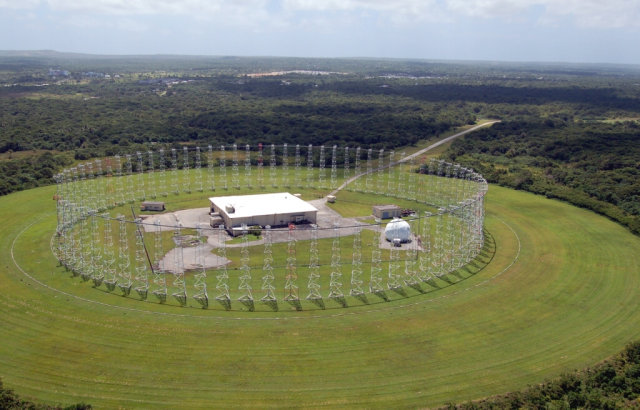
            During the early part of the European War in the middle of last century, German radio personnel erected a huge new antenna system that would enable the reception of long distance shortwave stations and that would also enable accurate direction finding of these stations.  Under the direction of Dr. Hans Rindfleisch and with the participation of the German radio manufacturing company, Telefunken, a large circular array of receiving antennas was constructed at Skibsby in Denmark.  
            The outer ring of this circular antenna system with a diameter of 390 feet was made up of 40 vertical radiator elements based on true North.  An inner circle of reflectors was suspended on wooden poles, and the electronic receiving equipment was installed in a specially constructed building at the center of the circle.  This new and unusual radio receiving antenna system was given the code name Wullenwever.
             After the end of the European war, British radio personnel studied this Skibsby radio receiving antenna system and then had it demolished.  However, soon afterwards, Telefunken constructed a new Wullenwever antenna system in Germany itself at Langenargen/Bodensee.  Soon afterwards, the Americans disassembled this new Wullenwever antenna system, transported it to the United States, and re-erected it in Illinois.  
            Then a similar though considerably larger station was constructed near Bondville, a little to the south east of Champaign in Illinois.  This new American station with a diameter of 1,000 feet consisted of 120 wide band vertical monopoles that could tune shortwave signals from 2 MHz right up to 20 MHz.  Even though this station was long ago dismantled, the extended circle can still be seen quite readily on Google Earth.
            A large number of these circular antenna systems, now known under the adjusted name of Wullenweber, have been constructed by many different major countries around the globe.  The cost for each installation can be as high as $20 million, and the largest seems to be a German facility with a diameter of 1350 feet. 
            Over a period of time, the United States has installed a score of these stations in North America, as well as in Europe, Asia and the Pacific.  Russia installed 30 of these Krug antennas as they were known in their language, Canada had two, and Japan a couple also.  At Sugar Grove in West Virginia there were two of these Wullenweber antenna stations side by side; they became operational in 1969 for maritime communication, though they were demolished thirty or more years later. 
            The total number of these massive electronic structures throughout the world is thought to have been around one hundred; and somewhere less than a dozen are still active.  The satellite era finally brought an end to the half century Wullenweber era.  
            On the island of Guam, the American Wullenweber receiving station was located towards the north of the island.  The empty and abandoned circle can be seen on Google Earth at the end of Howth Street; though on Google Maps, you can see the station at the time when all of its equipment was still standing.
            Originally, the Germans named this massive antenna system, Wullenwever; the Americans changed the name to Wullenweber, though officially they were known as Circularly Disposed Dipole Arrays (CDDAs); the Russians called them Krug; though most people knew them colloquially as Elephant Cages, due to their massive size.
            While we are still on the island of Guam, we are reminded that back during the two year period in 1945 and 1946, the naval radio station NPN, under the tactical callsign KU5Q, often carried the relay of radio program inserts that were fed into the mediumwave networks in the United States.  These program relays consisted of news reports, news commentaries, feature programs and local music that were received from China, Japan and the Philippines and they were relayed onward to Honolulu and California.  On many occasions, these program inserts were spliced into the worldwide English language broadcasts from the Voice of America.
            In addition, during the Operation Crossroads atomic tests in the Bikini Islands in the same era, station NPN-KU5Q operated as a co-ordinating point for program relays to the Voice of America in California.
            Somewhere around the year 1980, the Voice of America gave consideration to the possibility of erecting additional relay stations at strategic locations in different parts of the world.  One of the possible locations that was investigated was the island of Guam, though nothing further came from this initiative.
            Then, back some forty years ago, the mediumwave station KUAM at Agana Guam announced that they planned on installing a shortwave transmitter that would relay their mediumwave programming throughout the island and to other islands in the Marianas and beyond.  Radio station KUAM was the first fully licensed commercial mediumwave station on Guam, and it was inaugurated on March 14, 1954.
            At 5:55 pm on that same day, Sunday March 14, the AFRTS station at Nimitz Hill signed off, for what they stated was the last time.  Then 5 minutes later on this the official opening day, that is at 6:00 pm on that same March 14 (1954) the new KUAM signed on with 1 kW on 610 kHz as the island’s first regular commercial broadcasting station. 
            The AFRS station had been on the air for nearly 10 years under the consecutive callsigns WXLI WVTG and FEN Guam, and it was then closed “forever”, giving way to the new commercial station KUAM.  However, as time went by, this was not at all the end of AFRTS stations in Guam.  Over a period of time, several new low powered AFRTS stations were subsequently installed on Guam, initially on mediumwave and later on FM.  
            In 1975, the WRTVHB listed a new 100 kW shortwave station as a future plan for mediumwave KUAM on Guam.  However, this projected station was never installed on Guam, but instead, the entire shortwave project was transferred to the nearby island of Saipan, and the station was inaugurated 7 years later under the callsign KYOI.
            More about the shortwave scene in the Marianas islands in coming editions of Wavescan
(AWR/Wavescan-NWS 379)

Regional Radio in Turkey


A Radio Tour in Modern Turkey

In our program today, we begin a radio tour around the entire country of Turkey.  This very ancient country, Turkey, is at the same time, a vibrant and very modern country.  It is the only country in the world that straddles into two continents, Asia and Europe; and it is a country full of interest as well as majestic beauty for the intrepid traveller.  This country of photogenic landscapes and colorful seascapes together with high snow covered mountains, wide verdant plains but no rugged barren deserts, is 1,000 miles long and 500 miles.
            As we begin this circular journey around Turkey, we discover that there were seven lower powered shortwave stations on the air from regional locations during a 30 year period in the 1950s, 1960s and into the 1970s.  We discover also that these days there are now six high powered mediumwave stations on the air in Turkey.  Just two locations have hosted both an earlier low powered shortwave station, and a subsequent high powered mediumwave station, and these are the cities of Diyarbakir and Izmir.
            As an overview before we begin our circular radio tour around Turkey, we note that the first radio transmitter was installed in Istanbul in 1927, a 7 kW longwave station on 166 kHz under the callsign TAC.  The first shortwave transmitters, two RCA units at 20 kW each under the callsigns TAP & TAQ, were installed in Ankara in 1938; and the first mediumwave transmitter TAW with 150 kW on 704 kHz was installed in Istanbul in 1950.
            We begin our radio tour in the city of Ankara, the national capital of Turkey with its five million population, which is located almost in the center of the country.  The city was named for its Angora Rabbits, Angora Cats, and Angora Goats, each of which provides a very fine white wool which is woven into colorful and expensive fabrics.  One of the main ancient languages in Turkey was Galatian, a historic forerunner to the subsequent Celtic languages, such as Gaelic, Welsh, Cornish, Breton, Scottish and Irish. 
            A little over 2,000 years ago, Roman armies overran the territories of Turkey, and soon afterwards, Christianity was introduced.  Islam came to Ankara 1,000 years ago; and in 1923, this city became the capital for the newly established Republic of Turkey.
            The first major radio station installed in suburban Ankara was located at Etimesgut, a little north of the outer airport.  In 1928, two RCA shortwave transmitters at 20 kW, TAP & TAQ, were inaugurated at this new radio transmitter base for national and international coverage. 
            The only mediumwave station for the capital city area was installed in more recent times, a 2 kW facility on 1063 kHz.  In 1970 the shortwave broadcasting services at Etimesgut came to an end; and around 1990, their high powered longwave station on 198 kHz was also closed.  This entire radio facility was then taken over for use as a military airport communication station.    
            Let’s travel now to the top northwest corner of the country with its huge bustling city, Istanbul, which is listed as the largest city in Europe with its 14 million inhabitants.  Istanbul, or Constantinople or Byzantium as it has been known over the centuries, was the crossover point between Asia and Europe for trade along what was known as the Silk Road.
            The first radio station in Istanbul was the aforementioned TAC with 7 kW on longwave 166 kHz.  A high powered mediumwave station was installed in 1949, station TAW with 150 kW on 701 kHz.  These days this station is operating with 600 kW on the adjusted 9 kHz spacing channel 702 kHz.
            We move now to the Black Sea north coast of Turkey, to the city of Trabzon on the coast towards the eastern area.  The ancient Silk Road running across Asia from China to Europe also traversed through Trabzon, and interestingly, the famous Italian traveller Marco Polo came to this city on his homeward bound journey, where he took a boat ride for the final leg of his quarter century travels from China back to Italy. 
            Currently, there is a high powered mediumwave station located at Trabzon, with 300 kW on 954 kHz.   
            The city of Erzurum, inland and over towards the eastern mountain ranges, is the highest large city in Turkey with an altitude of 6,000 feet, a little more than a mile high.  This city was featured in international newspaper reports back in May 1894, when an American cyclist, Frank Lenz, disappeared mysteriously.
            At the time, Frank Lenz was on the return journey to the United States at the end of a bicycle ride around the world.  Subsequent information would suggest that he was murdered by local village brigands.
            Back half a century ago, there was a low powered shortwave station located at Erzurum, with 1 kW on 7650 kHz.
            Another notable city in the eastern mountainous areas is the city of Van, on the eastern side of the picturesque Lake Van.  This city, Van, is home to half a million people, and its claim to fame is twofold; one being the unique Van Cat.  The Van Cat is a small white cat with pink skin and colored eyes, and it is reputed to be a capable swimmer in Lake Van, a characteristic that is unusual for most members of the feline animal kingdom. 
            The other claim to fame for the city of Van is that it is the staging point for expeditioners planning to climb Mt. Ararat.  The Van airport is the fly-in destination for Mt. Ararat climbers, and there are several local organizations that specialize in providing tourist facilities and tour guides. 
            Many climbers visiting Turkey enjoy the climb to the top of Mt. Ararat, in the same way that other well known mountains attract climbers, such as Mt. Everest in Asia and Mt. McKinley in Alaska.  However, many Ararat climbers are also on a pilgrimage, to visit the mountain where the Ark of the Patriarch Noah came to rest after the worldwide Great Flood of prehistoric times.
            A dozen writers and historians who chronicled early events on Planet Earth state that in their day, the remains of Noah’s Ark were still evident on Mt. Ararat.  The Chaldean historian Berosus wrote in 257 BC that part of the ship that grounded in Armenia still remained.  The Jewish historian Flavius Josephus referred to Noah’s Ark three times in his writings and he stated that relics of the Ark were visible in his day, 90 AD.  Writing in the year 1633, Adam Olearius stated that pieces of the Ark were still available on Mt. Ararat, and that they had become petrified due to age and weather conditions. 
            A small shortwave transmitter, rated at just 400 watts, was installed in Van in the early 1960s and it was in use on 6025 kHz for less than half a dozen years.  Their high powered longwave transmitter, with 600 kW on 225 kHz and a guyed antenna mast 820 feet tall was inaugurated in 1990, though it is no longer on the air these days.
            That’s as far as we can go today in our circular radio tour in Turkey.  Keep listening to Wavescan each week and you will hear a further episode in this fascinating radio story some time soon.

 (AWR-Wavescan/NWS 378)