Monday, September 04, 2017

Weekly Propagation Forecast Bulletins


Product: Weekly Highlights and Forecasts
:Issued: 2017 Sep 04 0551 UTC
# Prepared by the US Dept. of Commerce, NOAA, Space Weather Prediction Center
#   Product description and SWPC web contact  http://www.swpc.noaa.gov/wwire.html#
#                Weekly Highlights and Forecasts
#
Highlights of Solar and Geomagnetic Activity 28 August - 03 September 2017

Solar activity ranged from very low to low levels. Very low levels were observed on 31 Aug while low levels dominated the period from 28-30 Aug and again from 01-03 Sep. The period began as Regions 2673 (S10, L=117, class/area Dsc/130 on 03 Sep) and 2674 (N14, L=103, class/area Fhc/930 on 03 Sep) were rotating onto the east limb as simple alpha and beta magnetic configurations on 28-29 Sep, respectively. Region 2672 (N08, L=227, class/area Dao/270 on 22 Aug) was in decay as it approached the west limb on 01 Sep. By midday on 01 Sep, Region 2674 began a growth phase which increased its overall area to approximately 930 millionths and produced 12 C-class flares that included a C5/Sf at 30/1845 UTC. Region 2673 began a slow growth phase on 02 Sep, however rapid spot development occurred on 03 Sep increasing its area to approximately 130 millionths with a Dsc/beta-gamma spot classification. The largest flare of the period was a C7 observed at 02/1541 UTC, with an associated Type II (976  m/s) radio burst and non-Earth directed coronal mass ejection(CME),from Region 2672.

An earlier CME was observed off the west limb on SOHO/LASCO C3 imagery at approximately 28/1930 UTC. This CME was analyzed and it was determined there was a possibility of a glancing blow on 01 Sep, however no definitive signs were observed in solar wind data. No proton events were observed at geosynchronous orbit.

The greater than 2 MeV electron flux at geosynchronous orbit was at normal levels on 30-31 Aug, moderate levels on 28 Aug, and at high levels on 29 Aug and 01-03 Sep. The largest flux of the period was 12,319 pfu observed at 03/1705 UTC.

Geomagnetic field activity ranged from quiet to G1 (Minor) storm levels during the period. Solar wind speed appeared to be in decline from approximately 500 km/s to around 350 km/s by 29 Aug with total field around 6-8 nT. Solar wind speed, temperature, and density was unreliable in DSCOVR solar wind data between 28/0600 UTC and 29/1655 UTC. A solar sector boundary crossing into a negative sector was observed at approximately 29/1925 UTC with a brief increase in total field to 13 nT. The Bz component deflected southward to -10 nT. The geomagnetic field responded with quiet levels on 28 and 30 Aug while quiet to active levels were observed on 29 Aug.

At approximately 31/0100 UTC total field began to increase, phi angle switched into a positive sector, and solar wind speed and temperature began to rise as a positive polarity coronal hole high speed stream (CH HSS) moved into a geoeffective position. Total field reached a maximum of 30 nT at 31/0615 UTC. Solar wind speed was mostly between 530 km/s to 680 km/s through 03 Sep and then began to decline to approximately 480 km/s by the end of the period.

The geomagnetic field responded with quiet to G1 (Minor) storm levels on 31 Aug and 02 Sep, quiet to active levels on 01 Sep, and quiet to unsettled levels on 03 Sep.  Forecast of Solar and Geomagnetic Activity 04 September - 30 September 2017 Solar activity is expected to be at low levels with a chance for M-class (R1-R2, Minor-Moderate) flares from 04-11 Sep and again from 14-30 Sep due to potential significant flare activity from Region 2673, 2674, and the return of old Region 2672. Very low levels are expected from 12-13 Sep. No proton events are expected at geosynchronous orbit. The greater than 2 MeV electron flux at geosynchronous orbit is expected to be at normal to moderate levels on 07, 13, 21-27 Sep. High levels are expected on 04-06, 08-12, 14-20, and 28-30 Sep due to CH HSS influence.

Geomagnetic field activity is expected to be at unsettled to active levels on 04, 07-09, 13-17, 27-30 Sep with G1 (Minor) geomagnetic storm levels likely on 13-16, 27-29 Sep and G2 (Moderate) storm levels likely on 14-15 Sep due to recurrent CH HSS activity.

Product: 27-day Space Weather Outlook Table 27DO.txt
:Issued: 2017 Sep 04 0551 UTC
# Prepared by the US Dept. of Commerce, NOAA, Space Weather Prediction Center
# Product description and SWPC web contact http://www.swpc.noaa.gov/wwire.html#
#      27-day Space Weather Outlook Table
#                Issued 2017-09-04
#
#   UTC      Radio Flux   Planetary   Largest
#  Date       10.7 cm      A Index    Kp Index
2017 Sep 04     120          10          4
2017 Sep 05     118           8          3
2017 Sep 06     116           5          2
2017 Sep 07     116          15          4
2017 Sep 08     116          15          4
2017 Sep 09     105           8          3
2017 Sep 10      90           5          2
2017 Sep 11      85           5          2
2017 Sep 12      80           5          2
2017 Sep 13      80          25          5
2017 Sep 14      85          30          6
2017 Sep 15      85          30          6
2017 Sep 16      85          25          5
2017 Sep 17      85          12          4
2017 Sep 18      88           5          2
2017 Sep 19      92           5          2
2017 Sep 20      92           8          3
2017 Sep 21      92           5          2
2017 Sep 22      95           5          2
2017 Sep 23      98           8          3
2017 Sep 24     100           5          2
2017 Sep 25     105           8          3
2017 Sep 26     110           5          2
2017 Sep 27     110          20          5
2017 Sep 28     110          20          5
2017 Sep 29     110          20          5
2017 Sep 30     110          12          4
(NOAA)

The World’s Smallest Shortwave Station


The world’s smallest shortwave station, the smallest shortwave station of all time without question, had to be a little home made transmitter with a rated output at just 1½ watts.  This transmitter was licensed originally under the Canadian callsign VE9CS, it was located at the top of the stairway in a church building in Vancouver British Colombia, it was inaugurated in the latter part of the year 1929, and it was on the air for just a few late night hours each week.
  The parent mediumwave station for the little shortwave station in Canada was a Christian station CKFC  that had moved a few months earlier from the nearby First Congregational Church at 1155 Thurlow Street in downtown Vancouver to the Chalmers United Church at 2801 Hemlock Street on the corner of 12th Avenue.  A makeshift production studio was installed in a downstairs Sunday School classroom and the transmitter and a record player were installed at the top of the two storey stairway.
 The shortwave transmitter was a home brew breadboard unit constructed by Cyril Trott who operated his own radio business under the trade name Radio Service Engineers at nearby 734 Davie Street.  Engineer Trott operated the shortwave transmitter VE9CS on 6070 kHz as a service on behalf of the United Church of Canada. 
 In 1931, two years after the little station was inaugurated, approval was granted for operation at 100 watts, though they planned to operate at just 50 watts.  However, even this projected improvement was never implemented. 
 Also in 1931, Engineer Trott announced his intention to broadcast a special program beamed to Australia.  This information was printed in the Australian radio journal Wireless Weekly, but we would suggest that at just 1½ watts, the shortwave signal probably got lost on the way. 
 However, as time progressed through the 1930s, there was an increase in on air programming, usually on a daily basis around midnight.  This increase in programming was for the benefit of local listeners, of whom there were probably very few back at that time.
 In 1929, the studios and offices of the mediumwave parent station CKFC were moved into the new Stock Exchange Building at 475 Howe Street, though a new out of town location was chosen for the mediumwave transmitter.  The evidence would suggest that the little VE9CS transmitter was also then installed at the new mediumwave transmitter location.
 Seven years later (1936), the parent mediumwave station CKFC was leased to the Standard Broadcasting Co, along with the little shortwave station VE9CS as well.  However, during the following year (1937), Standard Broadcasting was taken over by Sun Publishing, and so the studios and offices of mediumwave CKFC were transferred into the Sun Tower at 128 West Pinder Street in Vancouver.
 When the 17 storey Sun Tower was constructed in 1912, it was the tallest building in the British Empire.  The Sun newspaper has long since relocated, though the building has retained its well known name as the Sun Tower.
 According to the best available information, the callsign for shortwave VE9CS was regularized to CKFX in December 1938, though the old identification lingered on for another year or two.  At that stage, shortwave VE9CS-CKFX was on the air at night, usually around 1 or 2 o’clock in the early morning hours.
 During the year 1940, the licensing authority in the Canadian government asked the parent mediumwave station CKFC to surrender its broadcast license, and in that way station CKFC was closed.  However at that stage, another mediumwave station in Vancouver CKWX agreed to take over all of the religious programming from the mediumwave station that was closing, and they also agreed to take over the small shortwave station as well.
 Mediumwave CKWX was owned by Western Broadcasting and they were in the process of constructing a new transmitter station on Lulu Island Vancouver.  The engineering staff built a new 10 watt shortwave transmitter which was co-sited with the new mediumwave facility on Lulu Island.  At the same time, the operating frequency for the shortwave unit was changed from 6070 kHz to 6080 kHz.    The shortwave antenna at the new location was described as a V beam, which was focused on the isolated coastal communities of British Columbia north of Vancouver.  The communication transmitter/receivers in use in those areas back then could readily tune the 49 metre broadcast band, which included of course VE9CS-CKFX.
 Over the years, several different shortwave antennas were installed for CKFX on Lulu Island, including a half wave omni-directional antenna with 30 buried radials as a counterpoise.  Then in March 1993 a new 10 watt transmitter was installed foat shortwave CKFX. 
 However, give three more years, and the transmitter malfunctioned.  There was no real need for the 10 watt shortwave station, it was little more than a DX novelty, so the transmitter was never repaired nor replaced.  That was the final and unceremonious end of the world’s smallest shortwave broadcast station.  
 There were many occasions when the little 10 watt shortwave CKFX was heard way across the Pacific in New Zealand and Australia, and also over there in Europe.  They were a very reliable verifier of listener reception reports and loads of international radio monitors in many lands around our world hold the now historic CKFX QSL card in their collection.  
(AWR-Wavescan/NWS445)

Ancient DX Report 1912


The radio scene throughout the world during the year 1912 could be described best in just one word, proliferation.  It could be estimated that the total number of wireless stations in existence throughout the world at that time - communication, shipboard, land based, amateur, licensed, unlicensed, experimental - would stand at around 5,000. 
 During the year 1912, the Marconi company in England could count 30 countries in which their equipment had been installed; and in total, there were wireless communication stations in 85 countries around the globe.
 In the continental United States, according to a 1912 list of wireless stations, there were 156 wireless communication stations large and small across the entire land mass.  The United States navy operated 46 wireless stations that were installed at strategic locations around the world, as well as 353 ships that were wireless equipped.
 In addition to the rapid proliferation of wireless around the world in the year 1912, there was also the terrible shipping tragedy, the sinking of the opulent White Star Liner the RMS Titanic, over the midnight hours of Sunday & Monday April 14 & 15 (1912).  The majestic ship Titanic was on its maiden voyage across the Atlantic from Southampton in England to New York in the United States.  This grand passenger liner struck an iceberg that dented and buckled the underwater side plates, thus allowing a fatal inflow of water that ultimately doomed this mighty vessel.
 As is so well known, the usage of wireless on land and at sea was directly responsible for the saving of more than 700 lives on that tragic occasion.  It was the Cunard Liner Carpathia that rushed to the rescue as a result of Morse Code wireless communications with the Titanic.
 Aboard the Titanic was a new Marconi wireless system, a 5 kW rotary spark transmitter that transmitted Morse Code signals on 500 kHz, with a center fed T type antenna.  The organizationally allocated callsign for the new Titanic was a Marconi identification, MGY.
 If there had been no wireless fixture aboard the Titanic, we could presume that the ship would have sunk without anyone anywhere else being aware of the tragedy, until perhaps next day another ship would unexpectedly steam through the field of debris.  It would have been then too late to rescue any survivors drifting in the below freezing water and air temperatures of the cold Atlantic. 
 As a result of the Titanic tragedy, the governments in many countries around the world enacted new safety laws, requirements and regulations, regarding the installation and operation of wireless equipment aboard ships at sea.  Wireless was required on an increasing number of ships, and additional wireless operators were required for a complete 24 hour day of service.
 There were so many wireless developments during the year 1912, that all we can do in our program today is to choose a few of the most interesting and most significant.  Some of the other wireless developments of that year can be observed in books and magazines found in libraries large and small in many countries around our world.
 In the United States, two wireless experimenters/inventors discovered the principle of feedback regeneration independently during this same year.  These wireless pioneers were Edwin Armstrong and Lee de Forest, and the successful procedure is to feed the partially amplified signal in the radio receiver back into the same amplification circuit.
 The famous United States navy station NAA at Arlington in Virginia was activated during the year 1912, though not yet at full power.  As soon as the three tower antenna system was completed, it was anticipated that the rotary spark equipment at the full power of 100 kW would be applied. 
 At that stage, Frank Conrad built a wireless receiver so that he could hear the time signals from the new navy station NAA.  At the time, the family was living in Swissvale, near Pittsburgh, though they moved to Wilkinsburg shortly afterwards.
 Another famous powerful station in the United States was the German constructed wireless communication station located at Sayville on Long Island New York.  Station WSL was described as one of the most powerful in the world at 100 kW, though through a special Telefunken design, there was an increase in radio frequency energy radiated from the antenna system. 
 During the year, Irving Vermilya received the first amateur experimental license issued in the United States and the callsign for his wireless station was changed from the do-it-yourself callsign SNY to the regularized 1ZE.
 Station 9YV was an experimental station operated by Kansas State University in Manhattan, Kansas, and it became the first radio station in the U.S. to offer a regularly-scheduled daily broadcast (in Morse Code) of the weather forecast.
 During that same year (1912), the Federal Telegraph Wireless built a transmitting station at Point San Bruno, near South San Francisco in California.  This new station had the tallest antenna towers in the world at a height of 440 feet, with more than 6½ miles of wire strung between the two towers.  The location for this new San Bruno Point wireless station covered 25 acres.
 Also on the California coast, Charles Herrold installed a set of two transmitters and receivers in the Fairmont Hotel and another set of two transmitters and receivers in San Jose for the purpose of continuous two way transmission.
 Over in England, Marconi constructed a brand new wireless factory; and the documents for the International Telegraphic Conference in London were signed on July 5.  This important conference promulgated regulations for the issuing of callsigns for all wireless stations. 
 A new Marconi station was opened at Aranjuez-Madrid on February 1, and King Alfonso sent a message to London for forwarding to the New York times.
  The first major maritime wireless station in New Zealand was installed in a small building on the roof of the Central Post office in Auckland and it was taken into service on October 24, 1912 under the callsign NZK.  The first two letters in this three letter callsign, NZK, stood rather obviously for the initial letters in the two word title of their country, New Zealand; and the K identified one of the letters in the city name, Auckland.
 One thousand miles to the west, we find that Australia also was in the process of installing a whole alphabetic list of coastal wireless stations, six of which were inaugurated during that same year 1912.  The first permanent AWA coastal station was installed at the Domain in Melbourne and it was taken into service with 2½ kW on 500 kHz, on February 8 (1912). 
 The projected callsign for this station was AAM, with the AA reminiscent of a temporary maritime station in Sydney with the callsign AAA; the M in the AAM callsign obviously indicated Melbourne.  When the station was inaugurated, the actual callsign was POM, indicating Post Office Melbourne, though soon afterwards this call was amended to the more familiar VIM.
 Macquarie Island is located half way between Australia and Antarctica.  The new 1½ kW wireless station MQI made its first two way contact with AAU aboard the SS Ulimaroa on February 13, 1912.  The SS Ulimaroa belonged to the Huddart Packard Line and it plied across the Tasman between Australia and New Zealand.  The name Ulimaroa is a New Zealand Maori name. and it was mistakenly thought back then that this was the Maori name for Australia.
(AWR-Wavescan)

Sunday, September 03, 2017

From the Isle of Music and Uncle Bill's Melting Pot schedules


From the Isle of Music, September 3-9:
This week, our special guest is Grupo Vocal Sampling, a unique acappella group who is this year’s Cubadisco winner in the Vocal/Choral Music category. We visited them in Havana during a rehearsal in May. Among other things, they demonstrate how they make their wonderful music. Also, a musical tribute to the late Lourdes Torres, a wonderful Cuban singer/songwriter who passed away last month.
F

our opportunities to listen on shortwave:
1. For Eastern Europe but audible well beyond the target area in all directions with 100Kw, Sunday 1500-1600 UTC on SpaceLine, 9400 KHz, from Kostinbrod, Bulgaria (1800-1900 MSK)
2. For the Americas and parts of Europe, Tuesday 0000-0100 UTC on WBCQ, 7490 KHz from Monticello, ME, USA (Monday 8-9PM EDT in the US)
3 & 4. For Europe and sometimes beyond, Tuesday 1900-2000 UTC and Saturday 1200-1300 UTC on Channel 292, 6070 KHz from Rohrbach, Germany.


It’s a funky world….Episode 27 of Uncle Bill’s Melting Pot tears the roof off of Planet Earth on Thursday, September 7 from 2300-2330 UTC on WBCQ, 7490 KHz on the short waves. We’ll have funky stuff from a few different countries plus yet another contest.
Apologies to our listeners for last week's accidental rerun of the pierogi episode.  Unless, of course, you really love pierogi...

William "Bill" Tilford, Owner/Producer
Tilford Productions, LLC

Friday, September 01, 2017

European station heard testing again


The station identifying as "Europe's New Voice on Shortwave," observed as testing again this evening on 6160 kHz with good reception here at 1840 UTC.
Continuous pop plus canned IDs in English. I heard a strong carrier on 6160 yesterday evening, so guess this was the same transmitter.
The announced schedule on 6160 kHz Mon-Sat 1000-1200; 1400-1600 and 1800-2000 UTC and email 6160@shortwaveradio.de. Also mentioned 3975 but not audible here.
(A. Pennington/BDXC)

Arnie Coro's Dxers Unlimited


Mid-week edition: 29 August 2017

Hi amigos radioaficionados all around the world now enjoying the slightly better short wave propagation conditions that happen as we approach the  autumn equinox  !!! Propagation conditions on the HF bands from 20 to 6 meters have taken a turn for the better, especially within the frequency range between 14 and 25 megaHertz!

I am your host Arnie Coro, radio amateur CO2KK, also having a good time listening to the the HF bands although the solar flux is hovering just near 80 units. Near Vertical Incidence Skywave propagation mode continues to provide short range communications during the daytime, especially on the 40 meters amateur band.

Item two: Some of the world's prominent solar scientists are really concerned about the possibility of an upcoming second edition of the so called Maunder Minimum, when the Sun stopped from generating sunspots for a period of around 70 years... Other scientists believe that the abnormal behavior of the present solar cycle is not as bad as initially thought, something that we are all hoping to be what would happen... If solar cycle 25, the next one, shows a very slow start up period, then radio amateurs around the world will have to deal with a situation at least as worse as the final years of cycle 23, when extended periods without sunspots left the higher bands dead for weeks and months...

Item three: Here at the mid week edition of Dxers Unlimited, coming to you from Havana amigos... No HF propagation, no sunspots, or very weak solar activity does not mean that the amateur radio hobby will go down the drain... Hopefully there are several very interesting options that range from the extended use of the very low and low frequency bands by means of advanced digital communications protocols to the launching of many more ham radio satellites, including perhaps , if funding can be found, the placing in orbit of several Molnya type satellites... or we can even dream of one or two geostationary ham radio satellites !!!

The present day amateur radio satellites are all orbiting the Earth at rather low altitudes, so their coverage is limited to a rather small footprint. In other words, the small footprint means that the time slot available to communicate between two stations operating via satellite is only a few minutes, even during the best passes... The fact that today's satellites are at such low height is what in my opinion have prevented more radio amateurs from experimenting with this type of space link...

As a young ham said to me during a satellite communications conference that took place at the venue of the Cuban Federation of Radio Amateurs here in Havana, it is barely worthwhile to build special antennas , install tracking software and learn how to use it, plus having to obtain VHF and UHF equipment capable of operating on Single Side Band and CW modes, only to enjoy perhapes two or three daily brief periods when the satellites that are operational can be reached from the place where one is located.

In a certain way the young ham is right... my perception is that a single new satellite placed at a much higher Earth orbit, so that the time window available for its use could reach at least half an hour four times every day will dramatically change the number of ham radio satellite users, to the present very few to a much larger number of experimenters...

Although the availability of dual band 2 meters and 70 centimeters FM handie talkies that can access the FM repeater type of satellites using a small dual YAGI hand held antenna , has increased the number of users of those satellites, at this moment what everyone is waiting for is for a satellite that could ride piggyback on one of the many professional geostationary birds that are constantly been launched. But so far, the owners of those expensive satellites, that  are worth hundreds of millions of dollars have not accepted the risks involved in providing extra space and electric power to a ham radio satellite that will form part of such a package. Insurance companies will not accept an extra satellite without the proper certification of compliance with many complex technical regulations….
In the meantime, there is still another very interesting Earth orbiting spaceship... the International Space Station that is fully equipped to operate on several amateur bands... The ISS is active from its low Earth orbit, and whenever the crew members that are licensed amateur operators decide to take a break, they communicate with fellow hams all around the world !!!

You have questions and your amigo Arnie tries to answer them as soon as possible, directly to your e-mail or postal address and also on the air too... Today's question came from five different locations, Argentina, Guyana, South Africa, the USA and New Zealand....

Dxers Unlimited's listeners in those five countries want to know more about the SLIM JIM low take off angle vertically polarized  antenna , especially the one designed to work on the world's most popular ham band.. 2 meters. There is a worldwide agreement that specifies the use of narrowband FM on the two meters band , using vertical polarization... At this moment there are more amateur radio stations in the world using the two meters band on the FM mode with vertically polarized antennas than in any other ham band... So, 2 meters band vertically polarized antennas are very popular, and because they are easy to homebrew and can be made with low cost materials, it is a fact that those antennas are really popular projects.

Among 2 meters band vertical antennas that are easy to make and show good performance, my favorite is the SLIM JIM, a type of folded monopole that when properly build and installed is capable of producing a very nice low take off angle vertical antenna pattern, exactly what you need to communicate via ground wave.

As a matter of fact the SLIM JIM two meters band vertical shows a much better performance than a half wave dipole at the same height, and that is way the British designed SLIM JIM has become so popular among the millions of hams around the world that communicate with each other using the 2 meters band...

And now that I am talking about what according to my own personal experience is the most efficient single element omnidirectional vertically polarized antenna for the two meters band, the SLIM JIM, let me add that the easiest to build and tremendously effective directional antenna for two meters also originated in the United Kingdom... It was created by Les Moxon, and for that reason is known as just as the MOXON, or better yet as the MOXON Rectangle antenna... that has a very high front to back ratio, plus an extremely wide horizontal pattern coverage...

In an upcoming edition of Dxers Unlimited, and at the request of several listeners , I will provide you with more information about the MOXON rectangle antenna that is now also becoming very popular among ham radio operators that are using them on the 20, 17, 15 , 12 , 10 and 6 meter bands... But let me add that they are single band antennas.... although I as have just said, the MOXON is a single band directional antenna system...

And now amigos, just at the end of our mid week edition, here is Arnie Coro's HF plus low VHF band propagation update and forecast... 

Expect soon to starttheTRANS EQUATORIAL PROPAGATION season that this year may be an early starter. Solar flux hovering between 75 and 80 units and the night time maximum usable frequency nose diving even below 7 megaHertz...Don't forget to send your signal reports and comments about this and other RHC programs to inforhc@enet dot cu, or VIA AIR MAIL to Arnie Coro, Radio Havana Cuba, Havana, Cuba

Free Radio Service Holland set for Setember 2-3 broadcast

Dear FRS Friends,
FRS Birthday
Yesterday Thursday August 31st it was exactly 37 years ago that FRS-Holland officially started short wave broadcasts to Europe. Last Sunday's broadcast in general gave (very) good results on both frequencies. About 15 minutes before the closing down announcement, the 6280 outlet went faulty and so only 7700 continued. 'Luckily' only 15 minutes on 48 metres had to be missed! By the way: the first show (Dave Scott) was repeated after 'closing down' implying that FRS-Holland continued till approx. 23:50 CEST.FRS Streams

The first stream of a total of three took place yesterday evening- on our birthday- but to be honest: it was not to our liking...  Programs should start at 20:00 CEST but started too late. And: the programs were played in wrong order as well. For instance the station opening was played at a moment other shows had already been streamed. Still we are happy with the LautFM facilities assuming this was an incident!

Hopefully things will go better this weekend...
Below the schedules for Saturday & Sunday...

http://laut.fm/jukebox Saturday September 2, 07:00 - 11:00 UTC = 09:00- 13:00 CEST
http://nednl.net:8000/frsh.m3u  Sunday September 3 - 14:52- 19 UTC = 16:52- 21:00 CEST
Repeat

Good news in case you missed (parts of) last Sunday's broadcast!
Next Sunday the complete four hour schedule of last Sunday will be repeated on 48 meters 6284 (most likely!)
Time slots will be similar to last Sunday: 16:52- 21:05 UTC = 18:52- 23:05 CEST

Remember...we have a brand new QSL for that broadcast waiting for you.
Correct reports to FRS-Holland, P.O.Box 2702 in 6049 ZG Herten, The Netherlands.
For all of you: have a good weekend!
73s
Peter Verbruggen (on behalf of the entire FRS staff)
For the latest news of FRS go to: http://www.frsholland.nl/20-latest-news/

September Specials from DX Stamps & Supplies


Honoring the amazing people in the state of Texas
Dear Customer,
 Below are DX specials and news for SEPTEMBER  2017.

 If you need a current stamp list or supply list, I can email it to you. 

MORE NEWS:  I recently bought a large Forever Stamps collection. All the stamps are singles and were in stamp mounts on his album pages. These take a little more time to remove from backing paper...not as quickly as those from a roll or full sheet. Offering these at a great deal:  100 Forever stamps for $40.00 ppd.!! Happy Mailing!!

 HAMFEST NEWS: 
 FLEA MARKET: 

NEW RATES:

IN STOCK AGAIN:  Moldova

 STAMPS ON BACK ORDER:  Azerbaijan, Cayman Islands, Saudi Arabia

U.S. DISCOUNT POSTAGE DEALS!!

Save Big on your domestic mailings when you plaster your envelope with colorful vintage stamps!

HAPPY  MAILING!!

49c units
Forever

in  2 stamps
3 stamps  
 4 stamps
x 100
$45.00

xxxx
$41.00
$40.00 
x 200
$85.00

$65.00
$63.00 
$62.00 
x 500
$208.00

xxxx 
$157.00 
$157.00 

Payment by Credit card, check or money order for forever stamps and 49c units                   

No Charge for posting Discount Postage Offers, sending only to USA addresses. 


                                     SEPTEMBER 2017  DX  STAMP  SPECIALS

2 Germany-$2.60       2 Russia-$2.60       3 Japan-$3.90  

2 Italy-$7.00    2 UK-$3.00    2 France-$3.60    5 Spain-$10.00

 SEPTEMBER 2017  DX  SUPPLY  SPECIALS

200/200 European Plain Mailers and Plain Returns - $40.00

200/200 European Air Mailers and Plain Returns - $40.00

200/200 STATESIDE Mailers and Returns - $22.00

European AIR Returns are SOLD OUT!!

Priority Mail Shipping Rates: Orders up to $40.00 add $9.00, orders from $41.00 to $100.00 add $15.00. orders from $101.00 to $150.00 add $20.00, orders over $150.00 add 15%. When ordering supplies and stamps, the stamps ride free, just use supply total to figure shipping costs. Shipments to Canada and overseas ship at a greater cost. (07/2015 modified)

Stamps Only Orders: Just add $1.00 P&H for posting to USA, add $2.00 for posting to Canada.

73, bill

William Plum
12 Glenn Road
Flemington, NJ 08822
908 788 1020
 Email: plumdx@msn.com

Marconi Radio International returns September 3

MRI QSL (Gayle Van Horn Collection)
Please be advised that  after about two months of absence, MRI will be back on the air on, Sunday, 3 September 2017, with its original, very old and just refurbished transmitter as follows:  07.30-11.30 UTC on 11390 kHz AM with only 20 watts.

Reception reports with audio clips (mp3-file) are welcome and confirmed by QSL verification. Some lucky listeners will ALSO receive our printed QSL card, so don't forget to include your postal address. E-mail: marconiradiointernational (at) gmail.com

As usual, we need your help! If you are a DX blogger, or use social networks, please post an announcement on your own  blog and/or Facebook or send out a tweet. You can also forward this message to a friend.

Last but not least: We kindly ask our listeners, who are still waiting for a QSL verification, to remain patient. All pending reception reports will be acknowledged  by the end of September.
We hope to hear from a lot of shortwave listeners about our transmissions.
 
Best 73's
Marconi Radio International (MRI)

Shortwave Radiogram weekend schedule

MFSK32 images decoded by Andrew in the UK, Sunday, 27 August, 1600-1630 UTC, 9400 kHz, via Bulgaria. Also the Pan Am boxcar via The Mighty KBC, 1530 UTC, same date and frequency.

Hello friends,
Shortwave Radiogram has several listeners in Texas. We hope you Texans are all safe after Hurricane Harvey.

Thanks to Al Holt @grovekid2 for moderating the Shortwave Radiogram Twitter account @SWRadiogram while my wife, son, and I were on the road, August 14-26. (Al also maintains the Shortwave Radiogram Facebook group: https://www.facebook.com/groups/567099476753304)

Our destination was Boulder, Colorado, where son Ian is beginning graduate school. (our route is at the bottom of this email.) Along the way, we visited relatives in Indiana, Illinois, and Missouri. We were in St. Joseph, Missouri, for the full eclipse, but it was too cloudy to see the corona. We did experience the sudden and dramatic shift to and from complete darkness. My wife and I left the car, a little Chevy Sonic, in Colorado with Ian and flew back to Washington.

 Thanks also to Neil Howard for providing the photos for program 9.

This weekend’s Shortwave Radiogram returns to the usual mix of news and images. It will be all MFSK32.

Here is the lineup for Shortwave Radiogram, program 11, 2-3 September 2017, all in MFSK32 centered on 1500 Hz …

 1:22  Program preview
 2:28  VOA and RFA FM affiliates in Cambodia off the air*
10:19  New MW transmitter in Lithuania relays RFE/RL*
15:30  Pink lake on an Australian island*
20:15  Hurricane maps*
24:33  Closing announcements*

* with image(s)
Please send reception reports to radiogram@verizon.net
And visit http://swradiogram.net
Twitter: @SWRadiogram
Facebook group: https://www.facebook.com/groups/567099476753304


Shortwave Radiogram Transmission Schedule

Saturday
1600-1630 UTC
9400 kHz
Space Line, Bulgaria
Sunday
0600-0630 UTC
7730 kHz
WRMI Florida
Sunday
2030-2100 UTC
11580 kHz
WRMI Florida
Sunday
2330-2400 UTC
11580 kHz
WRMI Florida

The Mighty KBC transmits to Europe Saturdays at 1500-1600 UTC on 9400 kHz (via Bulgaria), with the minute of MFSK at about 1530 UTC (if you are outside of Europe, listen via websdr.ewi.utwente.nl:8901/ ).  And to North America Sundays at 0000-0200 UTC (Saturday 8-10 pm EDT) on 9925 kHz, via Germany. The minute of MFSK is at about 0130 UTC.  Reports to Eric: themightykbc@gmail.com . See also http://www.kbcradio.eu/ and https://www.facebook.com/TheMightyKbc/

Italian Broadcasting Corporation (IBC)  For the complete IBC transmission schedule visit  http://ibcradio.webs.com/  Five minutes of MFSK32 is at the end of the 30-minute English-language “Shortwave Panorama,” per the schedule below:

WEDNESDAY  18.55 UTC  6070 KHZ TO EUROPE
                       19.55 UTC  1584 KHZ TO EUROPE
THURSDAY   02.55 UTC  1584 KHZ TO EUROPE
FRIDAY         01.25 UTC  9955 KHZ TO CENTRAL/SOUTH AMERICA
SATURDAY   01.55 UTC 11580 KHZ TO NORTH AMERICA
                       20.25 UTC  1584 KHZ TO SOUTH EUROPE
SUNDAY      00.55 UTC  7730 KHZ TO NORTH AMERICA
                       10.55 UTC  6070 KHZ TO EUROPE

Thanks for your reports.  I will be reading your emails to the extent possible.
Kim Andrew Elliott, KD9XB
Producer and Presenter
Shortwave Radiogram


Monday, August 28, 2017

World Harvest Radio frequency updates


WHRI QSL via Gayle Van Horn Collection
Effective: 03 September 2017
All times UTC
WHRI Angel 1
1300-2100 21610 HRI 250 kW / 085 deg to CeAf English, ex 17815 as follows:
1300-1400 21610 HRI 250 kW / 085 deg to CeAf English Sat/Sun Brother Stair
1400-1500 21610 HRI 250 kW / 085 deg to CeAf English Sat Brother Stair TOM
1400-1500 21610 HRI 250 kW / 085 deg to CeAf English Sun vary religious px
1500-1600 21610 HRI 250 kW / 085 deg to CeAf English Sat/Sun religious pxs
1600-1800 21610 HRI 250 kW / 085 deg to CeAf English Daily   religious pxs
1800-1900 21610 HRI 250 kW / 085 deg to CeAf English Mon-Fri Brother Stair
1800-1900 21610 HRI 250 kW / 085 deg to CeAf English Sat/Sun religious pxs
1900-2000 21610 HRI 250 kW / 085 deg to CeAf English Mon-Fri Brother Stair
1900-2000 21610 HRI 250 kW / 085 deg to CeAf English Sun vary religious px
2000-2100 21610 HRI 250 kW / 085 deg to CeAf English Mon-Sat religious pxs

WHRI Angel 2
2000-2100 11750 HRI 250 kW / 047 deg to WeEu English Sun rlg pxs, ex 15530
(SWL DXing 28 Aug)

Radio France International frequency updates

RFI QSL via Gayle Van Horn Collection
Effective: 03 Sept 2017
All times UTC
0430-0500 9685 ISS 500 kW / 135 deg to ECAf Swahili, ex 11790
0500-0600 9790 ISS 500 kW / 155 deg to CeAf French, ex 15300
0700-0800 21580 ISS 500 kW / 155 deg to CeAf French, ex 17620
0800-0900 21580 ISS 500 kW / 150 deg to CeAf French, ex 17620
1200-1230 17815 ISS 500 kW / 198 deg to WeAf Mandingo Mon-Fri, ex 15275
1200-1300 15300 ISS 500 kW / 200 deg to NWAf French, ex 13740
1200-1300 17620 ISS 500 kW / 185 deg to WCAf French, ex 15300
1600-1700 17615 ISS 500 kW / 170 deg to WCAf Hausa, ex 15670
1900-1930 17660 ISS 500 kW / 155 deg to SoAf Portuguese, ex 15360
2000-2030 11700 ISS 500 kW / 170 deg to WCAf Hausa, ex 13695
(SWL DXing 28 Aug)

Weekly Propagation Forecast Bulletins


Product: Weekly Highlights and Forecasts
:Issued: 2017 Aug 28 0402 UTC
# Prepared by the US Dept. of Commerce, NOAA, Space Weather Prediction Center
# Product description and SWPC web contact www.swpc.noaa.gov/weekly.html
#
#                Weekly Highlights and Forecasts
#
Highlights of Solar and Geomagnetic Activity 21 - 27 August 2017

Solar activity ranged from very low to low levels. Very low levels were observed on 26 Aug while low levels were observed from 21-25 Aug and again on 27 Aug. Regions 2671 (N11, L=305, class/area Fkc/430 on 21 Aug) and 2672 (N08, L=227, class/area Dao/270 on 22 Aug) were the only regions on the visible disk and were responsible for a total of 34 C-class flares between the two. The largest events of the period were a C6/1f at 27/1516 UTC from Region 2671, a C5/Sf at 21/0316 UTC from Region 2672, and another C5/1n at 25/0727 UTC with an associated 100 sfu Tenflare from Region 2672. No Earth-directed coronal mass ejections (CMEs) were observed during
the period.

No proton events were observed at geosynchronous orbit.

The greater than 2 MeV electron flux at geosynchronous orbit reached high levels from 22-27 Aug while very high levels were observed on 21 Aug. The largest flux of the period was 52,010 pfu observed at 21/1725 UTC.

Geomagnetic field activity ranged from quiet to G2 (Moderate) storm levels. The period began under the waning influence of a positive polarity coronal hole high speed stream (CH HSS). Solar wind speed was decreasing from approximately 700 km/s to around 580 km/s by late on 21 Aug with total field values near 4 nT. By approximately 21/2100 UTC, total field began to increase to 9 nT while the Bz component deflected southward briefly to -8 nT. Solar wind speed increased once again to near 675 km/s at 22/0655 UTC before slowly decreasing once more. A prolonged period of southward Bz was observed between 22/1840-24/1310 UTC reaching a maximum of -6 nT.
The geomagnetic field responded with quiet to unsettled levels on 21 Aug, quiet to G2 (Moderate) geomagnetic storm levels on 22 Aug, and unsettled to G1 (Minor) geomagnetic storm levels on 23 Aug. Solar wind speed continued to decline to around 330 km/s by early on 25 Aug. Another enhancement in total field was observed at the end of the period to 10 nT with another prolonged period of southward Bz after 27/1200 UTC. The geomagnetic field responded with quiet to
unsettled conditions on 24 and 27 Aug while quiet conditions were observed on 25-26 Aug.

Forecast of Solar and Geomagnetic Activity 28 August - 23 September 2017

Solar activity is expected to be at very low to low levels throughout the forecast period. There is a slight chance for M-class (R1-R2, Minor-Moderate) flares from 28 Aug-02 Sep as Region 2672
transits across the visible disk.

No proton events are expected at geosynchronous orbit.

The greater than 2 MeV electron flux at geosynchronous orbit is expected to be at mostly high levels throughout the forecast period due to recurrent CH HSS influence. A decrease to moderate levels is
expected on 30-31 Aug, 08 Sep, and again on 13 Sep due to electron redistribution associated with the arrival of the CH HSSs.

Geomagnetic field activity is expected to be at unsettled to active levels on 28 Aug, 30 Aug-02 Sep, 08-09 Sep, 13-17 Sep, and 23 Sep with G1 (Minor) geomagnetic storm levels likely on 31 Aug and 13-16 Sep and G2 (Moderate) geomagnetic storm levels likely on 14-15 Sep due to recurrent CH HSS activity.


Product: 27-day Space Weather Outlook Table 27DO.txt
:Issued: 2017 Aug 28 0402 UTC
# Prepared by the US Dept. of Commerce, NOAA, Space Weather Prediction Center
# Product description and SWPC web contact www.swpc.noaa.gov/wwire.html
#
#      27-day Space Weather Outlook Table
#                Issued 2017-08-28
#
#   UTC      Radio Flux   Planetary   Largest
#  Date       10.7 cm      A Index    Kp Index
2017 Aug 28      78          10          3
2017 Aug 29      78           8          3
2017 Aug 30      78          15          4
2017 Aug 31      77          25          5
2017 Sep 01      75          18          4
2017 Sep 02      74          15          3
2017 Sep 03      74           8          3
2017 Sep 04      72           5          2
2017 Sep 05      72           5          2
2017 Sep 06      72           5          2
2017 Sep 07      75           5          2
2017 Sep 08      80          10          3
2017 Sep 09      85           8          3
2017 Sep 10      85           5          2
2017 Sep 11      85           5          2
2017 Sep 12      85           5          2
2017 Sep 13      85          25          5
2017 Sep 14      85          30          6
2017 Sep 15      88          30          6
2017 Sep 16      88          25          5
2017 Sep 17      88          12          4
2017 Sep 18      88           8          3
2017 Sep 19      85           8          3
2017 Sep 20      85           5          2
2017 Sep 21      82           5          2
2017 Sep 22      80           5          2
2017 Sep 23      78          10          3
(NOAA)

Saturday, August 26, 2017

From the Isle of Music, August 27-September 2


No interviews this week - this week we focus on some great moments in recorded Cuban Jazz during the past few decades that you may have missed when they first appeared.

Four opportunities to listen on shortwave:
1. For Eastern Europe but audible well beyond the target area in all directions with 100Kw, Sunday 1500-1600 UTC on SpaceLine, 9400 KHz, from Kostinbrod, Bulgaria (1800-1900 MSK)

2. For the Americas and parts of Europe, Tuesday 0000-0100 UTC on WBCQ, 7490 KHz from Monticello, ME, USA (Monday 8-9PM EDT in the US)

3 & 4. For Europe and sometimes beyond, Tuesday 1900-2000 UTC and Saturday 1200-1300 UTC on Channel 292, 6070 KHz from Rohrbach, Germany.

It's a funky world....
Episode 27 of Uncle Bill's Melting Pot tears the roof off of Planet Earth on Thursday, August 31 from 2300-2330 UTC on WBCQ, 7490 KHz on the short waves. We'll have funky stuff from a few different countries plus yet another contest.

William "Bill" Tilford, Owner/Producer
Tilford Productions, LLC

Tuesday, August 22, 2017

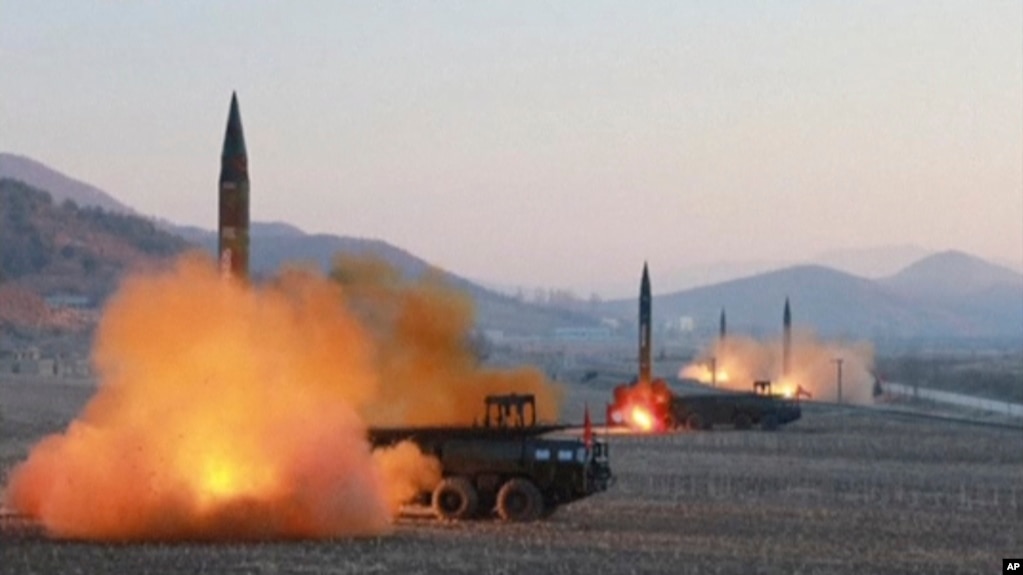
BBC braces for backlash over North Korean service


Director of BBC World Service says tensions over North Korea’s nuclear tests vindicate the launch of a targeted service

The BBC is braced for a backlash from the North Korean government about the launch of a new service targeted at the country amid growing international tensions over its nuclear missile tests.
Francesca Unsworth, the director of BBC World Service, said the corporation was wary about launching the new North Korean service next month due to the likely opposition from the government but insisted the fragile political situation vindicated the move.

Additional article The Guardian: https://www.theguardian.com/media/2017/aug/20/bbc-braces-for-backlash-over-north-korea-service
(photo/VOA News/scmp.com/abc.com)

Voice of the Broad Mases heard on new frequencies


New frequencies of VOBME 1 and VOBME 2 Dimtsi Hafash heard on August 18:

All times UTC
1400-1830 7181.6 ASM 100 kW / non-dir to EaAf Tigrinya VOBME 1, ex 7175.0
1400-1830 7140.0 ASM 100 kW / non-dir to EaAf Amharic  VOBME 2, ex 7150.0
1800-1830 7181.6 ASM 100 kW / non-dir to EaAf Arabic   VOBME 1, ex 7175.0
(SWL DXing)

You Tube monitoring: https://www.youtube.com/watch?v=vvIf-a7azeQ

Program Erkrather Radiotag 2017, set for broadcast today

Tonight at 1800 UTC, on Channel 292 6070 kHz from southern Germany, there is a special program in the German language called 'Erkrather Radiotag 2017'.

According to Google searches this is an annual Free Radio event which takes place on October 7th this year, so why it's on tonight I'm not sure, but I'm sure some of you will be able to tell us afterwards! :-)
http://www.radiocaroline.de/erkrath2017/
Start time is 1800 UTC and it's followed at 1900 by the always enjoyable 'From the Isle of Music'.
(Alan Gale/BDXC)

BBC set to close additional medium wave transmitters

by Doug Irwin
LONDON — Ten BBC local radio stations will lose at least one AM transmitter this coming January as part of the BBC’s Delivering Quality First plan.
BBC Radio Devon, Radio Lancashire and BBC Essex will be heard on fewer frequencies; BBC Radio Sussex, Surrey, Humberside, Wiltshire, Nottingham, Kent, and Lincolnshire will no longer be accessible on medium wave at all, according to radiotoday.co.uk.

Additional story at: http://www.radiomagonline.com/around-the-world/0020/bbc-to-shut-down-additional-medium-wave-transmitters/39162