Friday, March 08, 2024

News on LRA 36 Radio Nacional Arcangel San Gabriel


Antarctica
LRA 36 Radio Nacional Arcangel San Gabriel, status info:

Alejandro Petrecca (Chief of the LRA1 TX Plant) and Claudio Garcia (technical operator of Radio Nacional El Bolson and amateur radio operator with previous experience at LRA 36) finally arrived at Joint Antarctic Base Esperanza. Their mission is to perform maintenance and optimization work on the audio chain, install a new console, and place the FM antenna and the tower that will be used for the new LRA 36 shortwave transmitter.

Upon arrival, they discovered that the output stage of the Collins HF 80 transmitter, which is used to transmit LRA 36 programs on 15476 kHz, was burned out. They also found that the tower sections for the shortwave antenna and the audio console had not yet arrived at the base. LRA 36 broadcast regularly until January 13.

Then, Juan Benavente, the architect of many LRA 36's achievements in recent years, was recalled. With Benavente's departure, the radio was left in the hands of unqualified people, which is evident by the fact that the transmitter burned out the day after he left.

The cause of the fire is being investigated. Juan and Nicole Valdebenito (operator) know the sequences necessary to start up the transmitter by heart, but this was not the case with those who came after them.

Currently, Petrecca and Garcia are installing the FM antenna for local coverage. It is estimated that the new Studio Console and audio distributor donated by Trialcom will arrive at Joint Antarctic Base Esperanza by the end of next week. The output board of the transmitter is also being sent to replace the burned one and keep it in operation during February.

If Juan Benavente had been coordinating, none of these situations would have occurred. Unfortunately, political favors promoted by the previous administration left LRA 36 abandoned in its most important mission, which is shortwave transmission. I estimate that if they agree and the planets align, we could resume LRA36 shortwave broadcasts before the end of February. 
(Adrian Korol Director of RAE via Horacio Nigro-Uruguay CX3BZ / DXplorer)

Juan Benevente confirms that a new 10 kW transmitter is due to be delivered this year.

LRA36 often takes breaks around this time of year - midsummer.
(Manual Mendez-Spain / British DX Club)

There were special tests conducted on February 2nd (Fri) and 3rd (Sat) that were widely reported. (R_A_D)
('Listener's Notebook' by Richard A. D'Angelo-PA-USA via
NASWA Journal #3 - page #26 / 27 ; of March 8, 2024)

Wednesday, March 06, 2024

How a pirate radio station shook Los Angeles: the story of KBLT


MARK FRAUENFELDER  1:55 PM TUE MAR 5, 2024


KBLT was an unlicensed pirate radio station in Los Angeles that operated out of a hilltop apartment in Silver Lake from 1995 to 1998, until it was shut down by the Federal Communications Commission (FCC). 

Founder Paige Jarrett (real name: Susan Carpenter) ran the station on less than $100 a month. At the time, as a freelance journalist, Jarrett also operated the pirate radio station KPBJ (named after the peanut butter and jelly sandwich) in San Francisco before moving to Los Angeles.

Get the story at: 

Monday, March 04, 2024

Weekly Propagation Forecast Bulletins

 :Product: Weekly Highlights and Forecasts

:Issued: 2024 Mar 04 0255 UTC
# Prepared by the US Dept. of Commerce, NOAA, Space Weather Prediction Center
# Product description and SWPC web contact www.swpc.noaa.gov/content/subscription-services


#
#                Weekly Highlights and Forecasts
#
Highlights of Solar and Geomagnetic Activity 26 February - 03 March 2024

Solar activity reached moderate levels on 28 Feb as Region 3590 (N18, L=223, class/area=Fkc/1450 on 25 Feb) produced a long-duration M1.5 (R1-Minor) flare at 28/1854 UTC. A subsequent CME associated with the flare was analyzed and the model results suggested the ejecta was off the Sun-Earth line. A filament eruption, centered near S11E30, was observed starting around 28/0900 UTC. It produced Type II radio sweep along with a C5.1/Sf flare at 28/0909 UTC. A subsequent CME signature in SOHO/LASCO C2. Analysis and modeling of the event suggested arrival late on 03 Mar. The remaining 11 active regions on the visible disk were either quiet or produced only C-class X-ray activity. 

No proton events were observed at geosynchronous orbit.

The greater than 2 MeV electron flux at geosynchronous orbit was at normal to moderate levels. 

Geomagnetic field activity ranged from quiet to G2 (Moderate) geomagnetic storm levels. A period of sustained southward Bz, which reached -7 nT, was observed for a few hours on late on 26 Feb and into 27 Feb. The geomagnetic field responded with an isolated period of G1 (minor) geomagnetic storm levels. As the solar wind returned to nominal conditions, quiet to unsettled levels followed through 02 Mar. The arrival of a coronal mass ejection that left the Sun on 28 Feb was observed just before midday on 03 Mar. Total magnetic field strength increased to a peak of 19 nT and the Bz component was oriented far southward (down to -18 nT). Solar wind speeds remained relatively low with speeds averaging near 350 km/s. The geomagnetic field response reached G2 (Moderate) geomagnetic storm levels during the 03/1800-2100 UTC synoptic period. 

Forecast of Solar and Geomagnetic Activity 04 March - 30 March 2024

Solar activity is expected to be at low levels with a chance for R1-R2 (Minor-Moderate) radio blackouts throughout the outlook period. 

No proton events are expected at geosynchronous orbit.

The greater than 2 MeV electron flux at geosynchronous orbit is expected to be normal to moderate levels throughout the outlook period. 

Geomagnetic field activity is expected to range from quiet to active levels. Active levels are expected on 04 Mar in response to waning influence from a CME that left the Sun on 28 Feb. Unsettled conditions are likely on 10-11 Mar and 28 Mar due to multiple,
recurrent CH HSSs. The remainder of the outlook period is likely to be mostly quiet. 

Product: 27-day Space Weather Outlook Table 27DO.txt
:Issued: 2024 Mar 04 0255 UTC
# Prepared by the US Dept. of Commerce, NOAA, Space Weather Prediction Center
# Product description and SWPC web contact www.swpc.noaa.gov/content/subscription-services
#
#      27-day Space Weather Outlook Table
#                Issued 2024-03-04
#
#   UTC      Radio Flux   Planetary   Largest
#  Date       10.7 cm      A Index    Kp Index
2024 Mar 04     145          14          4
2024 Mar 05     140           5          2
2024 Mar 06     140           5          2
2024 Mar 07     135           5          2
2024 Mar 08     135           5          2
2024 Mar 09     135           5          2
2024 Mar 10     135           8          3
2024 Mar 11     135           8          3
2024 Mar 12     135           5          2
2024 Mar 13     140           5          2
2024 Mar 14     160           5          2
2024 Mar 15     170           5          2
2024 Mar 16     170           5          2
2024 Mar 17     165           5          2
2024 Mar 18     160           5          2
2024 Mar 19     170           5          2
2024 Mar 20     175           5          2
2024 Mar 21     180           5          2
2024 Mar 22     180           5          2
2024 Mar 23     180           5          2
2024 Mar 24     175           5          2
2024 Mar 25     175           5          2
2024 Mar 26     170           5          2
2024 Mar 27     170           5          2
2024 Mar 28     160          10          3
2024 Mar 29     160           8          3
2024 Mar 30     165           5          2
(NOAA)

Friday, March 01, 2024

Scandinavian Weekend Radio monthly broadcast this weekend


Here's your opportunity to log the only station in Finland, broadcasting on shortwave and mediumwave!

March 2, 2024

Local SW MW FM Program details UTC
00-01 6170/11690 1602 94,90 22-23
01-02 6170/11690 1602 94,90 23-24
02-03 6170/11690 1602 94,90 SWR MusicMix 00-01
03-04 6170/11690 1602 94,90 SWR MusicMix 01-02
04-05 6170/11690 1602 94,90 SWR MusicMix 02-03
05-06 6170/11690 1602 94,90 SWR MusicMix 03-04
06-07 6170/11690 1602 94,90 04-05
07-08 6170/11690 1602 94,90 Soul, funk & R’n’B: Kaksoisolentoja – Heppu Hyypiö 05-06
08-09 6170/11690 1602 94,90 Kuunnelma: Local radio ja paparazzit – Heppu Hyypiö 06-07
09-10 6170/11690 1602 94,90 Huomenta-Good Morning Virrat – Dj Häkä 07-08
10-11 6170/11690 1602 94,90 Huomenta-Good Morning Virrat – Dj Häkä 08-09
11-12 6170/11690 1602 94,90 09-10
12-13 6170/11720 1602 94,90 Kantoaaltoa Suomirokilla höystettynä - Dj Esa 10-11
13-14 6170/11720 1602 94,90 Mustaa kultaa - RJ 11-12
14-15 6170/11720 1602 94,90 Asiaa ja asian vierestä – Dj Peeveli 12-13
15-16 5980/11690 1602 94,90 Tarinoita karkauspäivästä ja kotimaista iskelmää - Dj Dandy 13-14
16-17 5980/11690 1602 94,90 Progressive rock and other strange things - Dj Esa 14-15
17-18 5980/11690 1602 94,90 Afternoon Mix with Dj GZT 15-16
18-19 5980/11690 1602 94,90 Afternoon Mix with Dj GZT 16-17
19-20 6170/11690 1602 94,90 Tanssimusiikkia unohtamatta - Dj Onni 17-18
20-21 6170/11690 1602 94,90 Tanssimusiikkia unohtamatta - Dj Onni 18-19
21-22 6170/11690 1602 94,90 Levyraato – Dj Peeveli 19-20
22-23 6170/11690 1602 94,90 Dj Janne ja SWR Crazy Crew 20-21
23-24 6170/11690 1602 94,90 Dj Janne ja SWR Crazy Crew 21-22
Live stream 24h via Radioverkko.fi
Station website for additional information http://www.swradio.net/schedule.htm

Final show for From the Island of Music


The last broadcast of From the Isle of Music from WBCQ The Planet will be March 3 from 2200-2300 UTC on 7490 kHz. 

Thank you for your steadfast support over the years, unfortunately, North American listeners have not been nearly as enthusiastic as those in Europe, and I lack the financial resources to do justice to both. I certainly can't blame the lack of publicity, which has been ample.

I will let you know April's time and frequency in Europe once finalized, but North Americans will probably need to use a web SDR to catch the show.

The last episode will be a killer Cuban dance party - I am going out with a bang, not a whimper.

William "Bill" Tilford, Owner/Producer
Tilford Productions, LLC
809 S. 20th ST
Lafayette, IN 47905-1551
email: bill@...
phone: 312.351.2330

Radio Igloo to air on March 2

 
On Saturday, March 2, 2024, a new program from Radio Igloo will be on the air.

The West Coast DX-Club will have a listening camp in a cabin in the woods north of Gothenburg next weekend.

To draw attention to this, Radio Igloo will be on air with a new program with a mix of information and music with Swedish artists.

For the first time, the program will be broadcast simultaneously from at least four different transmitters, on different frequencies, and from different locations in Central Europe.

This has been possible thanks to our radio friends in Central Europe.

The program will be broadcast on Saturday, March 2 at 17.00 Central European Time (16.00 UTC) on   5010 or 5040, 5840 ,6260 , and 6300  kHz. (or on free frequencies nearby).

  Presumably the program will be rebroadcast the following day at 15.00 CET but then only on 6300 kHz.

Have you logged Radio Andorra's broadcast?


The next broadcast of Radio Andorra will be on Sunday, March 3, 2024.  As always, the broadcast will be at 1700-1900 UTC on 6005 and 2000-2200 UTC on 3985 kHz.

Programming is in French, and this edition will cover Radio Andorra in early 1980's.
(Christian G., France/BCDX) 

Radio Caroline-Voice on the Air released


New Radio Caroline Book Documents Six Decades of DJs

It features roughly 600 voices that have been heard since the ship's oceanic inception in 1964

BY JAMES CARELESS

There have been many books about Radio Caroline, the ship-based “pirate” radio station that brought 1960s pop music to Britons at a time when they couldn’t hear it anywhere else. But the new book, “Radio Caroline: Voices on the Air” does something rather different from previous volumes: 

It documents the roughly 600 DJ voices that have been heard on Caroline since its oceanic inception in 1964, right up to now when it can be heard on DAB+ and AM in parts of the UK, online and via smart speakers and smartphone apps. For the record, there were five ships that played home to Radio Caroline’s studio, AM transmitter and mast over the years. The largest was the Ross Revenge.

Additional story at: 

C.M.Obrecht' announces upcoming radio music program


From C.M.Obrecht's X account:
My next radio broadcast for the first time from @MEDIABROADCAST Nauen, Germany will be on March 2, 2024 at 1300 UTC, on 21600 kHz AM to southeastern Asia (86°, 125 kW),

The program will be a mixed-music program featuring music from Juno Reactor, Tchaikovsky, Sa Dingding, D-Block & S-te-fan & C. M. Obrecht"
(Alan Roe, Teddington, UK/BDXC)
(text edited for clarity)

To view his webpage, go to: https://cmobrecht.jimdofree.com/

Wednesday, February 28, 2024

Charleston Radio raided and shut down


Harry Richman writes this sad news to Charleston Radio International's Facebook this afternoon (28 Feb):


"CHARLESTON RADIO INTERNATIONAL is shut down by authorities today afternoon. So it's history and I thank you for listening and posting over the years. The project was made for 100 years of AM Radio. I hope you remember me fondly BYE BYE"

In reply to a comment, he replied:
"they just took the transmitter with them. It goes to a Laboratory to check the power. And I will hear of them later. There was 3 mens here for the shut down, i was nice with them and they was also nice with me. 
They made photos of the transmitter place and the antenna. So now i wait for the Penalty bill."
Charleston Radio Int's daily broadcasts of old 1920s, 1930s music (from site in Germany or Switzerland?) were on 5140 kHz (occasionally 5135 to 5150 to avoid QRM) and usually gave good reception here after dark.
(Alan,Caversham, UK/BDXC)

Wavescan continues radio from Sweden, Part 2

Special thanks to Ray Robinson and Jeff White for sharing the Wavescan script of Part 2, discussing radio in Sweden.

Radio from Sweden -  Part 2 

Jeff: Last week, Ray Robinson began a two-part look at the history of radio broadcasting in the northern European country of Sweden.  So here to continue once again is Ray from Los Angeles.

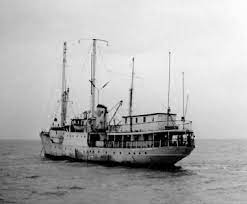
Ray:  Thanks, Jeff.  You may remember that back in November in our short series on the history of radio jingles, I mentioned the Swedish offshore station Radio Nord, which was the first to use PAMS-style jingles in Europe.  Following the success of offshore radio in Denmark and The Netherlands, Radio Nord was setup by Jack Kotschak in 1960, with a 10 kW medium wave transmitter on board a ship called the MV Bon Jour.  The station broadcast very successfully outside the Stockholm archipelago in the Baltic Sea for 17 months from 21st February 1961 until 30th June 1962 on a frequency of 602 kHz, announced as 495 metres.

Radio Nord

In its short life, Radio Nord experienced both disaster and success.  It survived ice, storms, threats of seizure, and technical difficulties that face a shipborne station.

It was eventually closed down by government legislation, after having built up a huge following within Sweden, with an audience of 24% of the adult population!  Not only was Radio Nord a pioneer of radio in Sweden, it was also one of the pioneers of offshore radio in Europe and, to a large extent, provided the inspiration for the radio ships which later anchored off the British and Dutch coasts.  Indeed, the ship itself, the MV Bon Jour, was renamed the MV Mi Amigo and was famously used by Radios Atlanta and Caroline from 1964 to 1980.

In July 1962, largely as a result of the success of Radio Nord, a new pop music channel called P3 (or Program 3) was officially inaugurated, although at that time it only covered part of the country.
Radio Syd 

But Radio Nord wasn’t the only offshore station in Sweden.  While Radio Nord was still on air in March 1962, a second station, Radio Syd (owned by Mrs. Britt Wadner) was launched using the ship MV Cheeta which she had acquired from the Danish station Radio Mercur.  Radio Syd broadcast on various FM frequencies from the Öresund Sound between Malmö, Sweden, and Copenhagen, Denmark, and continued after the new Nordic anti-pirate law came into effect on 1st August 1962.  By March 1964, a poll showed that Radio Syd then had more listeners in the Malmö area than all three Swedish Radio networks combined.  Mrs. Wadner was prosecuted and fined several times, as were a number of the companies that advertised on Radio Syd.  She even spent one month in prison, although under Swedish law, she was permitted to continue operating her business from her jail cell – the operation of Radio Syd! 

In October 1964, the MV Cheeta sank after a particularly rough storm, but undeterred, Mrs. Wadner acquired a new ship which she called the MV Cheeta II, and was quickly back on the air again.  In fact, in 1965 she even made some test television transmissions on UHF.  In January 1966, the station was forced to leave its anchorage by bad weather, and the ship was leased to Radio Caroline for three months as a replacement for the MV Mi Amigo which had run aground and had to be taken to Amsterdam for a refit.  But in April 1966, a more severe anti-radio piracy law went into effect in Sweden, and Radio Syd never returned to the Öresund.  In fact in late 1967, the MV Cheeta II headed south, first to the Canary Islands, and then onwards to the port of Bathurst in the West African country of The Gambia, where she was used as a restaurant and nightclub.  And interestingly, Radio Syd did go on the air again as a licensed station in Bathurst (now known as Banjul), from 7th May 1970, on 908 kHz, 329 metres.  Here’s a clip of Radio Syd in Bathurst in 1971:

Mrs. Britt Wadner died at her home in Sweden in March 1987, and the operation in The Gambia was then managed by her daughter and son-in-law.  The station moved on land, and the ship itself sank in Banjul harbor in the early 1990’s.  The station did eventually move to an FM frequency, but the last entry for the station in the WRTH is in 2006.

In 1977 the Swedish P3 network introduced regional programming from 24 FM stations around the country, and stereo broadcasts became the standard in Sweden for the first time.  15 more stations were added in 1979.  Independent commercial radio finally became legal in Sweden in March 1993, more than 30 years after the government monopoly had first been broken by Radio Nord.

The best-known high-powered medium wave station in Sweden was located at Solvesborg, which used a power of 600 kW on 1179 kHz, 254 metres.  From the 60's to the 80's during the evenings, it relayed the Foreign Service of Radio Sweden for Europe, including one of the best-known entertainment shows on international radio - the Radio Sweden Saturday Show - presented by Dr. Roger Wallis, Sydney Coulson and Australian Kim Loughran, known as 'Kangaroo Kim'.  Here's a clip of Roger with guest former Radio Caroline DJ Dave Lee Travis on Saturday 16th September 1967:

The English language programs came at the end of each evening’s transmissions, at 11pm UK time, 6pm Eastern.  The first half hour of the Saturday Show was carried globally on both shortwave and medium wave, but then it continued for a further 60 minutes on medium wave only for Europe.  It was quite zany at times and liked to poke fun at itself in a way that was later imitated by Media Network on Radio Netherlands.

On Sundays, the same team also presented a show called ‘The Pops’ which showcased the best in home-grown Scandinavian pop music at the time.

And, we should remember too the long-running DX program from Radio Sweden, "Sweden Calling DXers", which was broadcast on Tuesday evenings.  Do you remember the way that show opened?


Sweden Calling DXers began with Arne Skoog in February 1948 as a guide for DXers and SWL’s, and it depended entirely on the logging contributions of its listeners.  As an incentive, if you contributed an item, the station would send you the printed script for six weeks.  I had a whole stack of them!  Versions of the show were broadcast in several European languages such as German, not just English.  The show was taken over by the American George Wood in 1978, the name was changed to MediaScan a few years later, and the program ended in 2001.

Domestically, on longwave, as in many other countries of Europe, there were three high-powered stations to blanket the country and reach Swedish-speaking communities in Finland and elsewhere.  These were located at Motala, Lulea and Gothenberg.  In 1962, the longwave service at Motala was transferred to a new location at nearby Orlunda.  However, Sweden abandoned use of longwave broadcasting in 1991, and the Motala building was then turned into a radio museum, where the original longwave transmitter can be seen on display.

Eventually, over the years, more than 100 medium wave stations had been established throughout Sweden, mostly with quite low power, though about half a dozen were described as high power stations.  Most of these were closed in favor of FM and DAB broadcasting in the 1990’s and early 2000’s.

Sweden then finally closed its two shortwave stations, Horby and Karlsborg, and the one remaining medium wave station at Solvesborg on 1179 kHz, on Saturday 30th October 2010.  Nationwide coverage on radio in Sweden is now obtained solely with several networks of FM stations and DAB multiplexes totaling anywhere up to 2,000 mostly lower power transmitters.

There were two other radio stations of note in Sweden.  A large communication station known as Goteborg Radio traces its earliest origins back to the year 1905.  This station was progressively located at four different sites over the years, and it has been well known under the callsigns SAG and SAB.

The other interesting station is the old spark wireless station at Grimeton which was inaugurated in the 1920's by King Gustav V.  The old long-wave Alexanderson alternator is still functional, and it is placed on the air once each year under the callsign SAQ.

Radio Sweden was a prolific verifier of reception reports and we are aware of at least 50 different designs for their QSL cards.  Likewise, many QSL cards have been issued for the old longwave transmitter SAQ, and for Goteborg Radio SAG and SAB.

Back to you, Jeff.

Jeff:  Thanks, Ray.  Next week, Ray will tackle a topic which I don't think has ever been covered in Wavescan before - the history of broadcasting in the tiny British Overseas Territory of Gibraltar.


Wavescan on Sweden MW, LW and IBRA - Part 1


Special thanks to Ray Robinson for sharing the script with our readers, discussing radio from Sweden, Part 1 

Jeff: Today, Ray Robinson begins a two-part look at the history of radio broadcasting in the northern European country of Sweden.  So, take it away, Ray.

Ray: Thanks, Jeff.  Sweden is the eastern country situated on the Scandinavian peninsula in Northern Europe.  It is nearly 1,000 miles long, with a total population of about 10½ million.

The earliest written history of this Nordic country was documented by the Romans some 2,000 years ago.  The daring exploits of the Vikings in their Atlantic quests to the west and the south have been chronicled and re-chronicled, though it should be stated that the Swedish Vikings usually traveled east, spreading out into Russia.

Actually, as the old records tell us, wireless came very early to Sweden.  It was back in the year 1900, that the Swedish navy borrowed some Marconi wireless equipment from the AEG company in Germany.  This electrical equipment was used in a series of successful wireless tests at Stockholm, on land and at sea.

Two years later, the first permanent wireless station in Sweden was installed in Stockholm, and in fact it was in use for ship communication for exactly 100 years.  This station was originally installed in the year 1902, it went through several series of modernizations, and it was ultimately closed on February 1, 2002.  The long history of the Swedish coastal radio station SDJ must be one of the longest terms of radio service anywhere in the world.

During the era of wireless telegraphy in Morse Code, a whole network of coastal and regional stations was established in Sweden.  These stations were installed mainly at coastal locations throughout the country and each callsign was issued in consecutive order, beginning with SAA in Karlskrone, SAB in Gothenberg, SAC in Trallerborg, and so on down through the alphabet.

And again, as the records tell us, radio broadcasting also came quite early to Sweden.  The first amateur radio broadcasters began their experimental transmissions during the year 1922, and interestingly, the callsign for each of these stations during this era consisted of four letters of the alphabet, beginning with SA or SM.  These days, a regional identification number is inserted into amateur callsigns in Sweden.

It is stated that there were many local stations on the air in Sweden during the 1920s and these were operated by radio clubs, commercial organizations and individual operators, as well as by the government Royal Telegraph Administration.  Music programs were on the air quite often from many of these longwave and medium-wave stations.

The Swedish government announced in 1924 that it planned to nationalize the broadcasting industry, as in England, and on Thursday, January 1 of the next year, 1925, the new organization, Radiotjanet, produced its first network broadcast.  This epic radio occasion was a special program held in Jakob's Church Stockholm.

By the late 1920s, there were 15 medium wave stations scattered throughout Sweden, all of which used four-letter callsigns beginning with either SA or SM.
 
In the mid-1930s, Sweden had two shortwave stations on the air with program broadcasting.  These two stations, both with amateur style callsigns, SM5SD and SM5SX, were located in Stockholm, and they were logged in the United States and Australia.

Station SM5SX was installed at the Technical University and its operating channel was 15080 kHz.

With political tensions rising in Europe during the late 1930s, Swedish Radio and the Foreign Ministry decided that Sweden needed to have a more robust voice to the outside world.  A longwave station had been inaugurated at Motala in the summer of 1927, and it was at this location 10 years later that two Swedish-made shortwave transmitters rated at 12 kW each were installed.  One of these new units was inaugurated in 1938, and the other in 1939.  These transmitters used four different channel callsigns, SBO and SBU on one, and SBP and SBT on the other.  In December 1939, news in English, French and German went on the air for the first time.  Even though Sweden was a neutral country, it was still impacted by the privations of war, and wanted the world to understand that.

After things settled down in Europe in the post-war years and the Cold War took hold, Sweden placed an order with the Marconi company in England for the purchase of two shortwave transmitters at 100 kW each.  These two units were installed at the already existing radio station located at Horby which had been erected in 1928, and they were inaugurated in 1952.  The use of the two older 12 kW shortwave transmitters at Motala was phased out after the two 100 kW shortwave transmitters were inaugurated at Horby.

In 1972, two 500 kW shortwave transmitters were ordered.  One was installed at Horby, but due to coronal arcing in the antenna system during foggy weather, they had to reduce the power level to 350 kW.

The other 500 kW shortwave transmitter was installed at Karlsborg, a station which had originally been established back in 1918 as a spark wireless communication facility.  However, the output of this unit was also reduced to 350 kW due to a similar coronal arcing problem in the antenna system.

In 1955, the Swedish Pentecostal Movement set up a Christian broadcast ministry in Stockholm called I-B-R-A or IBRA Radio, which produced programs in many languages for transmission on various stations around the world.  Initially, they broadcast via the shortwave transmitters of Radio Tangier in Morocco, and in the 60’s they added HCJB in Quito, Ecuador, as well as many local stations around the world.  From the 70’s onwards, they expanded dramatically, producing programming that was also heard on shortwave via:
• Radio Trans Europe in Sines, Portugal,
• Radio Mediterranean in Malta,
• High Adventure in South Lebanon,
• FEBA in the Seychelles, and
• FEBC in the Philippines,
as well as on local stations in over 100 countries and in more than 60 languages.  In the 2000’s their broadcast activities have been scaled back in favor of more emphasis on usage of social media, but they are still active on shortwave in 2024, broadcasting now in a dozen or so African and Asian languages from Encompass transmitters around the world.  IBRA, though, has always followed a policy of buying time on established stations, and has never transmitted from within Sweden.

Next week when we continue the story of radio broadcasting in Sweden, we’ll look at the impact offshore stations had in the 1960’s at shaking up the official radio networks there, and we’ll also be remembering some of Radio Sweden’s external service programs that were so beloved by shortwave listeners.
(Photo credit/Flicker)

Tuesday, February 27, 2024

WRTH - Unlock the Lottery Excitement !


If you bought a copy of the 2024 WRTH, remember to enter the WRTH's prize draw by March 10th - details of how to enter on page 64 of the WRTH. Prizes revealed by WRTH today are listed below.
(if you still need to buy your copy, the club has a few copies in stock here for immediate despatch to UK members - email me for details and to reserve a copy tropical at www.bdxc.org.uk - Alan)
Reminder from the WRTH publishers today:

Unlock the Excitement! Join Our Lottery for a Chance to Win Prizes!
We're thrilled to bring you an exclusive opportunity to win fantastic prizes in our latest lottery. 
Prizes Up for Grabs:

1. NXP TEF6686 Based Radio (Model selected by WRTH team):
Immerse yourself in top-notch radio technology with a model handpicked by the WRTH team. It's a chance to elevate your radio experience!

2. DEGEN DE13 Ultimate Multi-functional Survival Radio (Sponsored by Bonito):
Stay prepared for any adventure with the DEGEN DE13 survival radio, generously sponsored by Bonito. A must-have for outdoor enthusiasts and those who value preparedness.

3. Boni-Whip Active Antenna (Sponsored by Bonito):
Compact bonuses whip antenna for excellent reception in long, medium, and shortwave range. Ideal for shortwave receivers and SDRs.

4. RTL-SDR Dongle (Model selected by WRTH team):
Explore the world of software-defined radio with the RTL-SDR dongle, thoughtfully chosen by the WRTH team. Unleash a spectrum of frequencies and take your radio hobby to new heights.

For Existing Book Owners:
If you've already purchased our book, you're in luck! Turn to page 64 for detailed information on how to join the lottery. Your chance to win one of these incredible prizes awaits you!

 For Those Yet to Own Our Book:
Haven't ordered your copy yet? Now is the perfect time! Purchase the book and become part of our exciting lottery. It's a win-win – valuable knowledge and a shot at fantastic prizes!
Unlock the Excitement! Join Our Lottery for a Chance to Win Prizes! 

Make sure you submit your entries by March 10, 2024. The winners will be announced in March, so stay tuned for the big reveal!

Monday, February 26, 2024

HAARP to Transmit Experiments February 28 Through March 3


The High-frequency Active Auroral Research Program (HAARP) will be conducting a research campaign February 28-March 3 UTC, with operating times specified in the table below. Operating frequencies will vary, but all HAARP transmissions will be between 2.8 MHz and 10 MHz. Actual transmit days and times are highly variable based on real-time ionospheric and/or geomagnetic conditions. All information is subject to change.

These experiments will help lead to a greater understanding of the production and enhancement of ELF/VLF waves, as well as lay the groundwork for future studies of satellite interactions with space plasma. For more information on ELF/VLF wave generation with HAARP, see the online HAARP FAQ at https://haarp.gi.alaska.edu/faq.
(photo/VOA News)

A few things to consider for DIY radio projects


A Place for Every Part …
… and every part in its place

BY John Bisset  
Published February 14, 2024 

Engineers. With the sponsorship of SCMS the webinar was free, so the next time you deal with SCMS, please express your appreciation for their help in educating engineers and their support of the society. You can watch the webinar on demand. 

When I shared a tip about organizing the parts in your workshop, I showed Fig. 1. Dave Morgan, CBRE, director of engineering for Sinclair Telecable in Norfolk, saw something eerily familiar. He shares Fig. 2, a “master” parts depot at a transmitter site. Similar shelving, bins and methodologies!

Dave admits that his bins are a work in progress, as his team sorts and consolidates parts from various transmitter sites accumulated over decades. This particular site has room for a “master” parts depot as well as equipment storage. 


The AM Radio for Every Vehicle Act will help protect our emergency infrastructure


Commentary: AT&T Outage Again Proves Why AM Matters 
BY PETE GAYNOR, OPINION CONTRIBUTOR - 02/24/24 3:00 PM ET

On Feb. 22, millions of Americans lost complete access to their cellular reception thanks to signal blackouts that crossed the entire country. This episode, while unfortunate, demonstrates just how crucial it is for Congress to begin shoring up the United States’ emergency infrastructure. 

Losing cell service for significant periods does not just present work and scheduling inconveniences. It also poses grave threats to public safety. 


Pete Gaynor served as administrator of the Federal Emergency Management Agency and acting secretary of the U.S. Department of Homeland Security.
(graphic/Jacobs Media)

This Shortwave Station’s Transmitter Site Sits Pretty in the Tropics


KTWR's home is on Guam, which makes for some interesting broadcasting


BY ELLE KEHRES 
Published February 23, 2024, updated February 25, 2024 

If you’re an avid Radio World reader, you know that we love to highlight unique radio facilities, whether they be local or abroad. If you happen to love that sort of content, you’re in luck!

Broadcasting since 1954, Trans World Radio, or TWR, is a Christian radio distributor that collaborates with U.S.-based radio stations to spread the gospel via local FMs, mediumwave or high-powered AMs, and shortwave transmitters.

According to its website, TWR’s programming is broadcast in 200-plus languages on air, online and on the ground in 190 countries. It is celebrating its 70th anniversary this month.

With such an extensive résumé, TWR was bound to have at least a few unique transmitter sites. One such site that we’ll share with you here can be found “Where America’s Day Begins,” floating just above the equator in the western Pacific Ocean.

In Micronesia, TWR’s shortwave member station on Guam, KTWR, serves listeners across most of Asia, spanning Siberia to India to Indonesia.

The KTWR site has three transmitters, one 100 kW HC100 and two 250 kW TSW2250Ds. The six TCI curtain antennas (one 2x2x1.5, one 2x3x.5 and four 4x4x1) were installed during various years from 1977 to 1998. Radio World is told that TWR installed the antennas and transmitters with its own personnel and volunteers.

Additional story at: http://tinyurl.com/5455exnd 
(photo/Mike Sabine-TWR)

Weekly Propagation Forecast Bulletins

 Product: Weekly Highlights and Forecasts
:Issued: 2024 Feb 26 0223 UTC
# Prepared by the US Dept. of Commerce, NOAA, Space Weather Prediction Center
# Product description and SWPC web contact tact www.swpc.noaa.gov/content/subscription-services
#
#                Weekly Highlights and Forecasts
#
Highlights of Solar and Geomagnetic Activity 19 - 25 February 2024


Solar activity reached high levels on 21 and 22 Feb and moderate levels on 23-25 Feb. The strongest of these events was an X6.3 (R3-Strong) flare at 22/2234 UTC, the strongest so far of the current solar cycle, from Region 3590 (N18, L=223, class/area=Fkc/1450 on 25 Feb), the largest region of the solar cycle so far. The region was responsible for two of other X-class flares, an X1.2 at 21/2307 UTC and an X1.7/2b at 22/0632 UTC, as well as 10 M-class (R1-Minor) flares. Despite the pronounced increase in flare activity, no Earth-directed CMEs were associated with the events from the Region. A Type II radio sweep on 21 Feb as well as a Type II and IV radio sweep on 22 Feb were both associated with events that were off the Sun-Earth line. While there were 13 other numbered active regions on the visible disk this week, they were either quiet or only produced C-class X-ray events. 

Other activity included a filament eruption in the NW quadrant beginning around 21/1500 UTC. Analysis and modeling suggested a glancing blow would be possible around 25 Feb. 

No proton events were observed at geosynchronous orbit.

The greater than 2 MeV electron flux at geosynchronous orbit reached moderate levels. 

Geomagnetic field activity was mostly quiet through 23 Feb, with a single isolated period of unsettled observed late on 20 Feb due to weak transient influence. Late on 24 Feb, the arrival of a CME from the filament eruption on 21 Feb was observed. The geomagnetic field responded with unsettled conditions that would persist through 25 Feb. 

Forecast of Solar and Geomagnetic Activity 26 February - 23 March 2024

Solar activity is expected to be at moderate levels (R1-R2/Minor-Moderate) through 02 Mar, when Region 3590 (N18, L=223, class/area=Fkc/1450 on 25 Feb) rotates off the visible disk. While flare potential will likely decrease substantially from 02 Mar through the end of the period, a chance for M-class activity will remain due to multiple significant regions on the far side of the Sun due to rotate back onto the visible disk. 

There is a slight chance for proton events (S1-Minor) at geosynchronous orbit through 02 Mar due to the flare potential of Region 3590. 

The greater than 2 MeV electron flux at geosynchronous orbit is expected to be at moderate levels. 

Geomagnetic field activity is expected to reach unsettled levels on 26-28 Feb due to negative polarity CH HSS influence. The remainder of the outlook period is likely to mostly quiet. 

Product: 27-day Space Weather Outlook Table 27DO.txt
:Issued: 2024 Feb 26 0223 UTC
# Prepared by the US Dept. of Commerce, NOAA, Space Weather Prediction Center
# Product description and SWPC web contact www.swpc.noaa.gov/content/subscription-services
#
#      27-day Space Weather Outlook Table
#                Issued 2024-02-26
#
#   UTC      Radio Flux   Planetary   Largest
#  Date       10.7 cm      A Index    Kp Index
2024 Feb 26     180          12          3
2024 Feb 27     175          10          3
2024 Feb 28     175          10          3
2024 Feb 29     180           5          2
2024 Mar 01     175           5          2
2024 Mar 02     170           5          2
2024 Mar 03     170           5          2
2024 Mar 04     172           5          2
2024 Mar 05     172           5          2
2024 Mar 06     170           5          2
2024 Mar 07     165           5          2
2024 Mar 08     165           5          2
2024 Mar 09     165           5          2
2024 Mar 10     168           5          2
2024 Mar 11     165           5          2
2024 Mar 12     165           5          2
2024 Mar 13     160           5          2
2024 Mar 14     160           5          2
2024 Mar 15     168           5          2
2024 Mar 16     172           5          2
2024 Mar 17     175           5          2
2024 Mar 18     175           5          2
2024 Mar 19     178           5          2
2024 Mar 20     180           5          2
2024 Mar 21     180           5          2
2024 Mar 22     180           5          2
2024 Mar 23     180           5          2
(NOAA)

Saturday, February 24, 2024

Announcements from Tilford Productions on broadcasts


This confirms today's announcement in The Spectrum Monitor that From the Isle of Music and Uncle Bill's Melting Pot will be doing its final broadcasts on WBCQ in March and migrating to Europe in April.  It was a good 9-year run, but the limited resources available to both programs can be more effectively focused in Europe.  More details next month. 

Many thanks to Allan and Angela Weiner for their wonderful support during my stay, and my gratitude for that makes the next part of this communique distasteful to me but necessary. The station's website has always been the weak link in the chain, and for some weeks now, it has listed my name and an email address in the staff section on the front page despite my repeated requests that the listing be removed since I decided rather quickly several weeks ago not to act in that capacity after all.   Any emails to and from that address (programs@wbcq.com) are neither read nor written by me nor have I been acting on behalf of the station.  Again, these lines would have been wholly unnecessary if anything resembling regular website maintenance were being done. 

I look forward to reconnecting with my former European audiences in April, and North, Central and South American listeners should still be able to catch the show via web sdrs.  
73,
Bill Tilford

Radio Delta set to broadcast on February 25


This week we are broadcasting on 6100 kHz and 12.030 kHz shortwave. Our transmission will begin on February 25th at 6.00 UTC on 6110 kHz. For reception reports or music requests, please send a message to info@radiodelta.am. We’ve been busy selecting new music for our broadcasts this week, and many new tracks have been added to our collection.

On our news page you can read two stories:

from Radio Monique and catch up on the latest developments through videos;
you can also delve into the experiences of our dedicated listener, Lennart Wennberg from Sweden, as he shares his insights on listening to radio stations.
We’ve created exciting videos showcasing the latest updates at Radio Monique. Tune in to 1332 for a week and share your reception reports with us. Stay tuned as we plan to enhance the antenna at Radio Monique next week. Our dipole antenna, currently hanging low, will undergo improvements.

We wish you a delightful listening experience! Your Gateway to Engaging Broadcasts!