Monday, May 18, 2015

VOA on the Frontlines of Political Crisis in Burundi

(photo by VOA)
WASHINGTON, D.C., May 13, 2015 -- Voice of America is leading international coverage of the political upheaval in Burundi with on-the-scene reporting and new programming in Kirundi, Kinyarwanda, French, Swahili, and English.

VOA East Africa Correspondent Gabe Joselow reported from the streets of Burundi's capital early Wednesday amid reports of a coup against President Pierre Nkurunziza. He filmed thousands of people cheering President Nkurunziza's apparent ouster, but also cautioned that their celebrations may be premature as the depth of military support for coup leader General Godefroid Niyombare was unclear.

VOA's Central Africa Service broadcast General Niyombare's statement claiming power and balanced it with an interview with President Nkurunziza's Interior Minister Edouard Nduwimana, who said the coup had failed and the president was on his way back to Bujumbura. VOA reporters in Burundi provided live updates on the standoff outside the national radio station along with a series of interviews with protestors.

The Central Africa Service broadcast White House Press Secretary Josh Earnest's call for all sides to end the violence and his pronouncement that the Obama administration continues to recognize President Nkurunziza. The Service also spoke to opposition politician Hussein Radjab and George Mason University professor Elavie Ndura while profiling General Niyombare and his objection to President Nkurunziza running for a third term.

VOA's Swahili Service reported from Dar es Salaam, where President Nkurunziza was scheduled to meet with regional leaders to discuss Burundi's political crisis. Swahili carried a statement from Tanzanian President Jakaya Kikwete condemning the coup and calling for a postponement of next month's vote. The service also interviewed Burundian opposition politician Agathon Rwasa, who backed removing the president but objected to military rule.

VOA's French-to-Africa Service preempted regular programming to focus on the crisis in Burundi. The English-language television show Africa 54 led with original Joselow reporting from Bujumbura and an on-set interview with Professor Ndura.
 
The political upheaval follows President Nkurunziza's decision to run for re-election, which his opponents say violates a regional peace accord limiting the president to two terms. President Nkurunziza says he is not bound by those limits because parliament voted him to his first term.

As clashes between police and anti-government protesters increased, VOA this week began boosting broadcasts to Burundi, adding shortwave and FM broadcasts in Kirundi, Kinyarwanda, Kiswahili, French, and English. VOA is now able to provide more reporting from the ground, new drive-time newscasts, and an expanded call-in show.

"The uncertainty of the situation in Burundi following the coup attempt makes accurate reporting even more essential," says VOA Director David Ensor. "Our coverage played a vital role before these events, and it is even more important now to help keep our audiences informed."
(VOA)

All times UTC

Extended schedule of VOA to Burundi from May 11:
0330-0400 on  7305 SAO 100 kW / 100 deg to SoAf Kirundi Daily
0330-0400 on  7325 SAO 100 kW / 100 deg to SoAf Kirundi Daily
0330-0400 on 11905 SAO 100 kW / 114 deg to SoAf Kirundi Daily

0400-0430 on  7305 BOT 100 kW / 010 deg to SoAf Kirundi Sat/Sun
0400-0430 on  7325 BOT 100 kW / 350 deg to SoAf Kirundi Sat/Sun
0400-0430 on 11905 KWT 250 kW / 220 deg to SoAf Kirundi Sat/Sun

0400-0430 on  7350 BOT 100 kW / 350 deg to SoAf Kirundi Mon-Fri
0400-0430 on  9815 BOT 100 kW / 010 deg to SoAf Kirundi Mon-Fri
0400-0430 on 11905 SAO 100 kW / 114 deg to SoAf Kirundi Mon-Fri

0430-0505 on  7350 BOT 100 kW / 350 deg to SoAf Kirundi Mon-Fri
0430-0505 on  9815 BOT 100 kW / 010 deg to SoAf Kirundi Mon-Fri
0430-0505 on 11905 SAO 100 kW / 114 deg to SoAf Kirundi Mon-Fri

0505-0530 on  7350 BOT 100 kW / 010 deg to SoAf English Mon-Fri
0505-0530 on  9815 BOT 100 kW / 350 deg to SoAf English Mon-Fri
0505-0530 on 11905 SAO 100 kW / 114 deg to SoAf English Mon-Fri

1600-1630 on 13630 BOT 100 kW / 350 deg to SoAf Kirundi Mon-Fri
1600-1630 on 11865 MEY 100 kW / 015 deg to SoAf Kirundi Sat
1600-1630 on 15460 SAO 100 kW / 100 deg to SoAf Kirundi Mon-Sat
1600-1630 on 17530 SAO 100 kW / 100 deg to SoAf Kirundi Mon-Sat

1830-1900 on 11865 SMG 250 kW / 170 deg to SoAf Kirundi Mon-Fri
1830-1900 on 13785 SAO 100 kW / 100 deg to SoAf Kirundi Mon-Fri

1930-2000 on  9470 SAO 100 kW / 088 deg to SoAf Kirundi Mon-Fri
1930-2000 on 11615 SAO 100 kW / 100 deg to SoAf Kirundi Mon-Fri
1930-2000 on 12140 BOT 100 kW / 010 deg to SoAf Kirundi Mon-Fri
(DX Mix Nx 910)

WRTH Bargraph Frequency Guide A15 now available


Now Available - Order your CD or download today!

We are delighted to announce the availability of the new WRTH Bargraph Frequency Guide for the A15 season. The CD contains the complete, and monitored, A15 international broadcasts on LW, MW and SW, and fully updated domestic shortwave, displayed as a pdf colour bargraph.

There are also other pdf and xls files to help you get the most out of the Bargraph. All these files are also available on a downloadable Zip file...

The CD and Download are only available from the WRTH site. Visit our website at
www.wrth.com/_shop at  http://www.wrth.com
(Hardyman, May 12; via Anker Petersen-DEN, dswci DXW May 13/WWDXC Top Nx 1208)

Monitoring Al Dhabbaya UAE relays


United Arab Emirates
6180.091 Another odd frequency outlet from Al Dhabbaya UAE relay site. IBRA Radio in Somali language noted performing a sidelobe signal of S=9+5dB into southern Germany, at 1745 UT on May 10, til 17.59:20 UT TX sign-off.

And from 1800 UT switched to 6145.091 kHz into BBC Somali service, same 250 kW unit, same 215degrees curtain antenna usage.

6119.995 TWR Africa in Kunama language on Sundays, heard at 1805 UT via Al Dhabbaya UAE relay, children's chorus, on 2500 kW unit at 225 degrees according listing.

9409.989 BBCWS in English noted in 18-20 UT slot from Al Dhabbaya relay, S=8-9 sidelobe signal at 1822 UT May 10. Registry request of 250 kW at 220 degrees. Discussion about coming U.K. politics, premier minister, Scotland separation plans, and EU matter opinions.

15420.123 Another odd frequency outlet from Al Dhabbaya's four 250 kW units. BBCWS English noted at 0550 UT on May 9. On 15790 kHz BBC Arabic is on even frequency from UAE?, or is back again to BBC Al Seela Oman relay site outlet?
(wb, wwdxc BC-DX TopNews May 9 / 10)
(WWDXC/Top Nx 1208)

Dunamis Shortwave Loggings


Uganda
4750 Dunamis Shortwave, Mukono. May 5, 2015 at 1800 UT noted gospel songs on 4750 kHz with poor/fair reception due to local noise. Later also English religious programming. Couldn't get an ID but a fellow DXer here in Finland, Jari Lehtinen, managed to hear them ID. Signed off at 1909 UT. Dunamis Shortwave, Mukono had been silent and irregular for quite some time.
(Jari Savolainen-FIN, DXplorer May 5)

4750 Dunamis SW. Per Jari's tip (tnx Yari!) Heard this station via the Perseus site in east Finland on May 6 with non-stop highlife music from 1744 tune to 1836 UT, at which time the Perseus site abruptly disconnected and I could not re-tune.
(Mauno Ritola-FIN, DXplorer May 6)

4750 Dunamis, SW
Dunamis SW was better today than 6 May with signals improving steadily after 1830 UT to sign off - programming abruptly stopped in mid-song at 1917 UT and the carrier went down at 1917:29 UT. Whatever happened on 7 May was fixed today. Tuned both Karelia MWDX and TreDXK Perseus sites today with similar signal levels on both sites.

No announcement heard, and no religious programming, just local music. Decent signal strength (SINPO 2v3/3/3/3/3) with periodic utility interference both below and above the channel. Re-tuning today (May 7), good carrier presentation from same site as well as north Sweden, but audio was pretty
much non-existent. Likewise from the Brisbane site, but there the carrier was a bit weaker. Perhaps station staff is having technical issues with thetransmitter.
(Bruce Churchill-CA-USA, DXplorer April 7 / 8)
(WWDXC-Top Nx 1208)

Solomon Island Monitoring and Observations


Solomon Islands

All times UTC

5020.0 SIBC - The Voice of the Nation, May 12 back to their normal frequency; ex anomaly 9545 kHz; at 0922 UT with the "Derek Prince Legacy Radio" religious program in English; ID - SIBC, the Voice of the Nation; 1015 UT info about a tropical low causing rain, but "possibility of a cyclone is low"; poor with Cuban interference from 5025 kHz.
(Ron Howard-CA-USA, wwdxc BC-DX TopNews May 12)

5019.999 SLM SIBC Honiara, in English, S=9+15dB -58dBm, heard Daily Police Report at 0843 UT. Splatter from adjacent 5025.0 CUB Exciting Cuban music heard on Radio Rebelde program,
via Quivican Bejucal old USSR relay site, S=9+10dB or -62dBm strength.
(wb, wwdxc BC-DX TopNews May 13)

5020 SIBC Honiara on May 12. Heard this morning from 1132 to 1204* UT with rather good signals (improving due to dawn enhancement). Noted with news at 1132 UT, followed with a variety program, with one selection by Amy Cross (C&W Ballad) .TC at 1155 UT, then Religious Sermon by preacher with rather dubious "Hell and Brimstone" scriptures. Closing announcements, nice ID for SIBC and then National Anthem played to 1204* UT. Best heard on the 31/60 meter Trap-sloper.
(Edward Kusalik-Alb-CAN VE6EFK, DXplorer May 12)
(WWDXC-Top News 1208)

HCJB Announces New Items on Tribute Page


Ecuador

HCJB Quito, Ecuador is surely one of the most famous shortwave stations. We have a number of historic items from the station, and we are going to put them all on a special "HCJB Tribute" page.

To start off we have posted a pamphlet called "Songs and Scenes" which, as the name implies, contains some photos of the station as well as sheet music for some songs, several of which were written by HCJB co-founder Clarence W. Jones.

Judging from the copyright dates of the songs and the "Gospel Sound Truck"  in one of the photos, this pamphlet appears to date from the very late 1940s or early 1950s. Note the group photo on p. 14. That's definitely Clayton Howard in the front row, far left, and maybe Helen in the back row, fourth from the left. Both had arrived at the station circa 1941.
(via new History material at  http://www.ontheshortwaves.com
(Jerry Berg-MA-USA, DXplorer May 10/WWDXC Top Nx 1208)

Clandestine frequency updates

Frequency update for Radio Tamazuj and Radio Dabanga


Radio Dabanga
0430-0600 11645 SMG 250 kW / 146 deg to EaAf Sudanese Arabic, ex 11650

Radio Tamazuj
0400-0430 11645 SMG 250 kW / 146 deg to EaAf Sudanese Arabic, ex 11650
(Ivo Ivanov/11 May)


BBC Uzbek frequency update


BBC frequency updates for Uzbek service - from May 11:

All times UTC

1300-1330 15180 SLA 250 kW / 010 deg to CeAs Uzbek Mon, ex 15330
1300-1330 on 15330 SLA 250 kW / 010 deg to CeAs Uzbek Tue, ex Daily
1300-1330 15500 SLA 250 kW / 010 deg to CeAs Uzbek Wed, ex 15330
1300-1330 on 15330 SLA 250 kW / 010 deg to CeAs Uzbek Thu, ex Daily
1300-1330 15180 SLA 250 kW / 010 deg to CeAs Uzbek Fri, ex 15330
1300-1330 15500 SLA 250 kW / 010 deg to CeAs Uzbek Sat, ex 15330
1300-1330 15180 SLA 250 kW / 010 deg to CeAs Uzbek Sun, ex 15330

1300-1330 on 17510 SNG 250 kW / 315 deg to CeAs Uzbek Mon, ex Daily
1300-1330 17575 SNG 250 kW / 315 deg to CeAs Uzbek Tue, ex 17510
1300-1330 on 17510 SNG 250 kW / 315 deg to CeAs Uzbek Wed, ex Daily
1300-1330 17665 SNG 250 kW / 315 deg to CeAs Uzbek Thu, ex 17510
1300-1330 17575 SNG 250 kW / 315 deg to CeAs Uzbek Fri, ex 17510
1300-1330 17665 SNG 250 kW / 315 deg to CeAs Uzbek Sat, ex 17510
1300-1330 17665 SNG 250 kW / 315 deg to CeAs Uzbek Sun, ex 17510

1300-1330 17760 NAK 250 kW / 325 deg to CeAs Uzbek Mon, ex 17735
1300-1330 17760 NAK 250 kW / 325 deg to CeAs Uzbek Tue, ex 17735
1300-1330 17860 NAK 250 kW / 325 deg to CeAs Uzbek Wed, ex 17735
1300-1330 17860 NAK 250 kW / 325 deg to CeAs Uzbek Thu, ex 17735
1300-1330 17860 NAK 250 kW / 325 deg to CeAs Uzbek Fri, ex 17735
1300-1330 on 17735 NAK 250 kW / 325 deg to CeAs Uzbek Sat, ex Daily
1300-1330 17760 NAK 250 kW / 325 deg to CeAs Uzbek Sun, ex 17735
(Ivanov/17 May)

Friday, May 15, 2015

Weekend VOA Radiogram schedule

Hello friends,

After the MT63-2000L bonus mode of program 108, Walt in the UK suggested that we transmit an entire news story in this mode. That will happen this weekend. This long-interleave version uses the entire 2000 Hz we have available in one sideband of a shortwave AM channel. I have measured its speed at nearly 200 words per minute, about twice as fast as our usual MFSK32 mode.

Here is the lineup for VOA Radiogram, program 111, 16-17 May 2015, all in MFSK32 except where indicated:

1:29  Program preview
2:44  VOA increases broadcasts to Burundi*
8:09  Forest management to reduce hunger*
16:02  Shipwreck found during search for MH370*
23:19  MT63-2000L: Huge demand for US entrepreneur visas
27:11  MFSK32: Closing announcements
28:40  Olivia 64-2000: Bonus mode of the week.

* with image

Please send reception reports to radiogram@voanews.com .

VOA Radiogram transmission schedule
(all days and times UTC):
Sat 0930-1000 5745 kHz
Sat 1600-1630 17870 kHz
Sun 0230-0300 5745 kHz
Sun 1930-2000 15670 kHz
All via the Edward R. Murrow transmitting station in North Carolina.

The Mighty KBC will transmit a minute of MFSK64 Sunday at about 0130 UTC (Saturday 9:30 pm EDT) on 9925 kHz, via Germany. (It will be a van Gogh painting.) Reports to Eric: themightykbc@gmail.com .

If you have an Android device, try the beta AndFlmsg app, available from http://www.w1hkj.com/vk2eta/

The Saturday 0930 UTC transmission is now propagating to Japan.  See videos at …
http://voaradiogram.net/post/118013945737/videos-of-voa-radiogram-on-2-may-2015-from-japan

I continue to be two weeks behind in answering your emails. I’ll try to send out all the galleries for program 109 before the end of Saturday.

Despite the backlog, please tune in and write in this weekend. 

Kim

Kim Andrew Elliott
Producer and Presenter
VOA Radiogram


IBB Frequency updates


Radio Free Asia from May 14
1300-1400 NF 11595 KWT 250 kW / 070 deg to CeAs Tibetan, ex 11605
1600-1700 NF 12035 TIN 250 kW / 303 deg to CeAs Uyghur, ex 12075

Radio Liberty from May 14
1400-1500 NF 15180 LAM 100 kW / 077 deg to CeAs Uzbek, ex 15480

Voice of America from May 14
1400-1500 NF 17595 LAM 100 kW / 077 deg to CeAs Tibetan, ex 17570

Voice of America from May 16
1600-1700 NF 15505 BIB 100 kW / 085 deg to CeAs Tibetan Mon, ex 15495 
1600-1700 NF 11910 PHT 250 kW / 315 deg to CeAs Tibetan Tue, ex 15505 
1600-1700 NF 15505 BIB 100 kW / 085 deg to CeAs Tibetan Wed, ex 15495 
1600-1700 NF 11910 PHT 250 kW / 315 deg to CeAs Tibetan Thu, ex 15505 
1600-1700 NF 15505 BIB 100 kW / 085 deg to CeAs Tibetan Fri, ex 15495 
1600-1700 NF 11910 PHT 250 kW / 315 deg to CeAs Tibetan Sat, ex 15505 
1600-1700 NF 11910 PHT 250 kW / 315 deg to CeAs Tibetan Sun, ex 15505 
(SWL DXIng/15 May)


Full data QSL Card for Spy Transmission, including Callsign


A valid QSL from a spy numbers station is quite a rarity, and the only known spy numbers station ever known to verify was on the air in Prague, Czechoslovakia under the callsign OLX.  Over the years, many international radio monitors have heard this enigmatic station when it was broadcasting a series of numbers in groups of five, either in Morse Code or in speech. 
            It is understood that these numbers broadcasts utilize a once only numbers pad and that they are one way transmissions to spies in another country.  Similar radio transmissions have been noted from other shortwave stations located in several different countries in Europe and the Americas.
            It is believed that the numbers broadcasts from Prague emanated from the Ministry of Internal Affairs building in Prague, though the actual location of the shortwave transmitter itself is not known. The callsign OLX belongs to the Czech News Agency, so probably the spy broadcasts were transmitted from their shortwave station, perhaps somewhere on the edge of Prague.

            The QSL sheet from station OLX, as today’s QSL of the Week, was addressed to “Vassily” and it shows a panorama picture of downtown Prague.  The QSL verifies a reception report dated December 7, 1995 when the station was heard on 9320 kHz in SSB single side band mode, apparently in speech.         It is known that just a few other international radio monitors have received a verification from spy numbers station OLX.  This broadcast service ended many years ago, in 1977.
(AWR Wavescan/NWS 324)

Tribute to Nepal: The Early Radio Scene

As would be expected after such a massive earthquake that occurred recently, the Himalayan country of Nepal is still in recovery mode in a slowly progressive move towards normalcy.  Crumbled buildings are still yielding the dead, and during the past week a few living though injured survivors have been rescued. 
            Massive aid has been brought in to Nepal, and the need for just as much further aid is still required.  It is indeed additionally requisite that a monumental endeavor on the part of the Nepali government as well as its citizens will need to be implemented in order to piece together again the regular routine of family and business life throughout their nation.
            The mountainous country of Nepal lies as a buffer state between its hugely larger neighbors, China and India. The country itself is 500 miles long and 150 miles wide.  The northern areas are composed of rugged and high mountain ranges, and the southern areas are made up of farmlands and villages, though in many locales it is still quite hilly.  The total population is in the range of 27 million, and their capital city is Kathmandu with around ¾ million inhabitants.

            From the very earliest times, people have lived in the Nepali areas of the Himalaya Mountains.  It is thought that the earliest known society in Nepal were the Kusunda people, who lived in what is now western Nepal. 
            According to a feature article broadcast by the BBC London three years ago, there was only one person left who still speaks the Kusunda language.  Subsequently however, a few other people who are fluent in the language have been discovered, and the known total now stands at seven or eight.  There are several different theories regarding the Kusunda language, including that the Kusunda people and their language are related to the Andaman Islands, and to Irian Jaya, western New Guinea.
            A national census in 2011 listed 123 spoken languages in Nepal, though the regional language of Kathmandu, Nepali, has become the official national language.  The Nepali language is closely related to Hindi and Bengali, and it is written with the Devanagari script, as in Hindi.
            Around 500 BC, small kingdoms and clan confederations began to grow in the southern more hospitable areas of Nepal.   A prince in one of these small kingdoms renounced his royal privileges; he led an ascetic life, and developed a new religion.  The young prince is better known in our era as Gautama Buddha. 
            However, Buddhism is not the dominant religion in Nepal these days.  Around 10% are Buddhist, and around 80% are Hindu.  Both Islam and Christianity are minority religions in Nepal.
            Towards the end of the 1700s, the various communities in Nepal began to come together as one nation, though this was accomplished in several bloody battles.  British influence came to Nepal with the growing encroachments of the British East India Company in Calcutta, and this included another war.
            The Royal family in the Kingdom of Nepal provided top government leaders, including Prime Ministers, for more than two centuries, though these days, Nepal is considered to be a Federal Parliamentary Republic.
            It was back in the year 1929 that the first radio receivers were imported into the country of Nepal.  The royal family imported from England half a dozen already assembled receivers that were made available to family members and top government officials.  It is stated that Mr. Dev Mani Dixit in Kathmandu imported the seventh radio receiver independently from England and when he received it, he staged a celebration party to honor the occasion. 
            It is probable that the imported English radio receivers back then were housed in ornate wooden cabinets and that they were capable of receiving radio stations that were broadcasting on the mediumwave and longwave bands.  However, at that stage, there were no radio transmitters in Nepal, and the only radio broadcasting stations on the air anywhere nearby were located in India.  At that time, the broadcasting stations in India were transitioning from the experimental era to the early era under what later became AIR, All India Radio.
            During the earlier part of World War 2 in Asia, the government of Nepal confiscated all radio receivers throughout Nepal and they were taken into storage at Singha Durbar in suburban Kathmandu.  At the time, it is estimated that there were just 500 receivers in Kathmandu itself.  However in 1946, many months after the war was concluded, the receivers were returned to their owners.
            Available information would indicate that the first radio transmitter in Nepal was a low powered unit that was installed for official communication purposes in 1939.  This transmitter, rated at just a ¼ kW we would suggest, was heard in the United States in December on a communication channel 14780 kHz with the identification announcement “Radio Kathmandu”.  For a couple of months, this station was heard occasionally in the United States at 4:00 am and 9:30 pm, eastern.
      
      During the era before the official government radio broadcasting station, Radio Nepal, was established in 1951, there were at least four separate occasions when radio broadcasting was attempted.  However, none of these attempts resulted in establishing a permanent station.
            In April 1945, the American radio journal Radio News carried a news item stating that a shortwave station that identified as “The Voice of the Himalayas” was on the air from 3:00  am to 9:00 am American eastern time.  The operating frequency was 11790 kHz in the standard 25 metre band. 
            Nothing else is known about this purported ‘Voice of the Himalayas”.  Was it an unsuccessful attempt at program broadcasting via the ¼ kW communication transmitter?  I guess we will never know!
            However, during the following year (1946) there was another beginning for radio broadcasting in Kathmandu.  Prime Minister Padma Shamsher Rana, a member of the royal family, had a radio transmitter assembled from radio receivers that were brought back into the country by soldiers returning home after the end of World War 2. 
            This radio station was placed on the air so that the Prime Minister could address the nation on important issues.  It was on the air for only a few months at the most.
            Two years later in January 1948, the same prime minister assembled a hybrid carrier current style system at Bijuli Adda in suburban Kathmandu.  The equipment was transferred from Bojhpur in eastern Nepal where it had been in use locally under a company style title, Mohan Aakashbani.
            This hybrid telecommunication system consisted of a low power transmitter with programming that was distributed over the telephone system, as in cable radio.  However, the signal from the transmitter could also be picked up direct on a radio receiver.
            This prime minister resigned on April 30 (1948), and the radio station was closed soon afterwards.  However, the radio station was reopened in August under the new prime minister,
Mohan Shamsher who was another member of the Rana royal family.  He also imported two new radio transmitters, though it does not seem that they were ever installed and taken into usage.
            Then in early 1951, a group of political leaders installed a radio broadcasting station at Biratnagar, in eastern Nepal near the border with India.  This station was on the air for just a few weeks at the most, under the political title, Prajatantra Nepal Radio.
            However shortly afterwards, all of the available radio equipments were assembled in Kathmandu and installed into a two storey building that had been previously in use as a privately operated school.  With the usage of the previous ¼ kW shortwave communication transmitter, Nepal Radio made its inaugural broadcast on 7100 kHz in the 40 metre amateur band, on April 3, 1951. 

            And that’s where we plan to pick up the story again, here in Wavescan next week.
(AWR-Wavescan/NWS 324) 

Euro weekend relays


Relays this weekend

Saturday and Wednesday HLR:
06.00 to 08.00 UTC, on 7265 KHz
08.00 to 11.00 UTC, on 6190 KHz
11.00 to 15.00 UTC, on 7265 KHz

Sunday HLR:
11.00 to 15.00 UTC on 9485 kHz
E-mail: redaktion@hamburger-lokalradio.de  Thank you!
HLR FM-Program via the Internet:    www.hamburger-lokalradio.net


Radio City Relays:
15th May 2015:  18.00 to 19.00 UTC on 7290 kHz via IRRS & 1368 + 846 kHz via Challenger Radio at 20.00
16th May 2015:  08.00 to 09.00 UTC on 9510 kHz via IRRS.
23rd  May 2015: 12.00 to 13.00 UTC on 7265 KHz via Hamburger Lokalradio
24th May 2015:  09.00 to 10.00 UTC on 9405 KHz via Radio Revival (Sala) Sweden

Every Saturday: 19.00 to 20.00 UTC on 1485 kHz via Radio Merkurs, Riga, Latvia
The address remains citymorecars@yahoo.ca  Thank you!

  
You can also hear many European free and alternative stations via the Internet at: http://laut.fm/jukebox 


For outside the listening area please try the Twente/Netherlands Web RX at http://websdr.ewi.utwente.nl:8901/


Radio Channel 292  Transmission schedules:

http://www.channel292.de/schedule-for-bookings/


Radio Mi Amigo Transmission schedules:

Radio Revival Sweden Transmission schedules:

http://radiorevivalsweden.blogspot.se/p/schedules.html


Good Listening!
73s,  Tom Taylor

Radyoya Denge Kurdistane monitoring

Bulgaria
Frequency 11510 / 23020  Radyoya Denge Kurdistane program from FMO frequency management organization BRB - Broadcast Belgium, of Ludo Maes, observed around 1615 UT on May 15th on harmonic strange frequency channel 23020 kHz too.

According Aoki list show 11510 kHz scheduled 13-17 UT as via Bulgarian Spaceline Ltd. Kostinbrod relay site.

Latter broadcast center uses very old former USSR transmitter gear, which produces often disturbed audio quality and on this service a harmonic on 23 MHz range.

On 11510 kHz is visible some 17.6 kHz wide range signal of disturbed audio at S=9 level in southern Germany.

And also harmonic noted on 23020 kHz of S=7 signal level, and 2 x 8.2 kHz wide range un-clean audio too.
(Bueschel/HCDX)

IBRA Radio frequency update


Armenia
Frequency 9445 kHz, since May 13 Babcock brokery changed their client IBRA Radio program in Dari to Persia and Afghanistan to new 9445 kHz channel from Gavar Armenia relay.

Observed during 31 meter band check in remote unit in Australia at 1515 UT May 15, S=8-9 signal downunder. Mens talk mentioned often Afghanistan and Iran in 1500-1530 UT schedule.

Frequency 9590 used now by China Natl Radio PBS Xizang from Lhasa Baiding transmitter  #602 site since April 26, and adjacent 9585 kHz by powerhouse China Radio Int'l Xianyan Japanese too.
(W Bueschel/HCDX)

Greek parliament votes to re-open ERT public broadcaster

                          (ERT QSL (Gayle Van Horn Collection)

Closed two years ago as part of the previous Greek government's austerity measures, lawmakers have voted to fund public broadcaster ERT. The move fulfills one of the leftist Syriza party's campaign promises. 

Under pressure from the European Broadcasting Union and Greece's top administrative court, ERT was closed in July 2013 after more than 60 years on air. Some 2,600 people lost their jobs provoking numerous demonstrations and was internationally criticized.
The service was replaced 11 months later by a scaled down version, Nerit, with a smaller budget and 500 employees.

Additional story at:
http://www.dw.de/greek-parliament-votes-to-re-open-ert-public-broadcaster/a-18416304

Monday, May 11, 2015

Weekly Propagation Forecast Bulletins


Product: Weekly Highlights and Forecasts
:Issued: 2015 May 11 0537 UTC
# Prepared by the US Dept. of Commerce, NOAA, Space Weather Prediction Center
# Product description and SWPC web contact www.swpc.noaa.gov/weekly.html
#
#                Weekly Highlights and Forecasts
#
Highlights of Solar and Geomagnetic Activity 04 - 10 May 2015

Solar activity ranged from low to high levels during the period. The largest and most active regions on the solar disk this period were Regions 2335 (S15, L=192, class/area Eac/310 on 04 May) and 2339 (N13, L=129, class/area Fkc/900 on 08 May). Region 2335 began the period reaching its peak in area and magnetic complexity (Beta-gamma). On 05 May it produced two M-class flares; an M1 at 05/1425 UTC and an M2 at 05/1724 UTC. By 06 May, Region 2335 was in decay and ended the period as a simple Cro spot class with a beta magnetic configuration. Region 2339 was in a growth phase since it rotated around the NE limb on 05 May. This region was responsible for multiple M-class flaring spanning 05-06 May and an impulsive X2 flare at 05/2211 UTC with an associated Type II radio sweep (1163 km/s), a 590 sfu Tenflare and a non-Earth directed coronal mass ejection (CME) first observed in SOHO/LASCO C2 imagery at 05/2224 UTC off the NE limb. Solar activity declined to low levels from 07-10 May. 

No proton events were observed at geosynchronous orbit.

The greater than 2 MeV electron flux at geosynchronous orbit was at moderate levels on 04-05 May and at normal levels from 06-10 May. 

Geomagnetic field activity ranged from quiet to minor storm levels during the period. The period started off with quiet conditions on 04 and 05 May under a nominal solar wind regime. At 06/0053 UTC, a shock was observed at the ACE satellite associated with a 02 May CME that occurred as a result of an 18 degree filament eruption observed between 02/1500-1830 UTC. Total field increased to a maximum of 18 nT at 06/0614 UTC while the Bz component went southward to a maximum
of -13 nT at 06/1216 UTC. Solar wind speeds increased from 363 km/s to around 490 km/s. A geomagnetic sudden impulse was subsequently observed at 06/0143 UTC with a 31 nT deviation in the Boulder magnetometer. As a result, quiet to minor storm levels were observed on 06 May. By late on 06 May and through 07 May, the Bz component deflected north and remained so as CME effects diminished. Nominal solar wind conditions prevailed through 10 May when the total field became enhanced once again. Total field increased to 14 nT with prolonged periods of southward Bz. No appreciable increase in solar wind speed was observed with this event, however. The geomagnetic
field was quiet on 07 May, quiet to unsettled on 08 and 09 May and quiet to active on 10 May. 

Forecast of Solar and Geomagnetic Activity 11 May - 06 June 2015

Solar activity is expected to be at low levels with a chance for M-class (R1-R2, Minor-Moderate) flares from 11-18 May as Region 2339 transits the visible disk and again from 31 May-06 June when Region 2339 returns. 

No proton events are expected at geosynchronous orbit.

The greater than 2 MeV electron flux at geosynchronous orbit is expected to be at normal to moderate levels with high levels possible from 13-18 May and again from 21-23 May due to coronal hole
high speed stream (CH HSS) activity. 

Geomagnetic field activity is expected to be at unsettled to active levels from 11 through 14 May with periods of minor storming (G1-Minor) likely on 12-13 May due to a combination of a co-rotating interaction region followed by a CH HSS. Unsettled to active levels are also expected from 18-19 May and 02 -03 June with possible periods of minor storming on 18 May due to multiple recurrent CH HSS. 

Product: 27-day Space Weather Outlook Table 27DO.txt
:Issued: 2015 May 11 0538 UTC
# Prepared by the US Dept. of Commerce, NOAA, Space Weather Prediction Center
# Product description and SWPC web contact www.swpc.noaa.gov/wwire.html
#
#      27-day Space Weather Outlook Table
#                Issued 2015-05-11
#
#   UTC      Radio Flux   Planetary   Largest
#  Date       10.7 cm      A Index    Kp Index
2015 May 11     160          12          4
2015 May 12     165          25          5
2015 May 13     160          25          5
2015 May 14     155          12          4
2015 May 15     155           8          3
2015 May 16     155           5          2
2015 May 17     145           5          2
2015 May 18     135          20          5
2015 May 19     125          12          4
2015 May 20     120           8          3
2015 May 21     115           5          2
2015 May 22     115           5          2
2015 May 23     115           5          2
2015 May 24     110           5          2
2015 May 25     110           5          2
2015 May 26     110           5          2
2015 May 27     110           5          2
2015 May 28     115           5          2
2015 May 29     120           8          3
2015 May 30     120           8          3
2015 May 31     120           5          2
2015 Jun 01     130           8          3
2015 Jun 02     140          15          4
2015 Jun 03     140          10          3
2015 Jun 04     140           5          2
2015 Jun 05     145           5          2
2015 Jun 06     150           5          2
(NOAA)

Tuesday, May 05, 2015

QSL Report: May 2015


Dayton Hamvention® ... A Must See Event May 15-17

Amateur radio operators will tell you, a trip to Dayton, Ohio, rates very high among their "ham" lifetime goals. Hams and those like-minded, gather once a year to the largest hamfest in North America. Each year hobbyists from across the globe gather at the Hara Arena in Trotwood, Ohio, near Dayton. The popular megafest offers exhibit space, demonstrations, forums and a flea market. This year hams will celebrate the 60th show on May 15-17, 2015 with close to 500 indoor exhibits and over 2,500 outdoor exhibits showcase the latest in amateur radio equipment, technology, computer software and hardware - along with hard-to-find radio and computer accessories and equipment.

For more information or for a full forum schedule, visit the Dayton Hamvention® website. This year's theme Local Clubs: the Heart of Ham Radio puts the emphasis on the invaluable and unique role ham radio clubs around the world have played in their communities. Admission is $20.00 in advance and $25.00 the days of the show. Hamvention® bus tickets are $8.00. Admission and bus tickets are valid for all three days. Tickets can be purchased at the Hara Box Office, Debco Electronics & Computers Inc. in Cincinnati, OH; Universal Radio in Columbus, OH; Midwest Surplus in Fairborn, OH and R & L Electronics, Hamilton, OH. For more information, visit www.hamvention.org.

Can't make it to Dayton this year ? Watch live streaming video on the Internet from W5KUB's Helmet Cam at http://w5kub.com/

Albania
China Radio International relay via Albania, 11785 kHz. Partial data card of Celebration of the 2008 Beijing Olympics and features an artist impression of the Laoshan Velodrome. Card was missing notation of Albanian transmitter site. Also received copy of The Messenger and two CRI paper cuts. (Alan Roe, UK/NASWA) CRI website: http://www.cri.cn

Amateur Radio

(Larry Van ARO QSL Collection)
Cuba-Guantanamo Bay KG4HI/KG4RQ/IOTA: NA-015, 7 MHz/RTTY. Full data color wildlife photo, signed by the Operator of the DXpedition. Also verified 10 MHz/CW and 24 MHz/CW. Received via QSL Manager Jim-WB2REM in 14 days for a SASE (Larry Van Horn N5FPW)

Madagascar-AF-057, 5R8M-Nosy Be Island. Full data color wildlife/scenery bi-fold card-DXpedition staff (Mediterraneo DX Club) 12 MHz/RTTY; 15 MHz/RTTY. QSL Manager IK2VUC. Received in three months for SAE and $3.00US (Van Horn).


(Larry Van Horn ARO QSL Collection)
Saint Helena-ZD7ET-CQ Zone 36/ITU Zone: 66, 24 MHz SSB. Full data map/ship and scenery card, signed by Peter, Operator. ZD7JC, JT 65. Full data card fwatures photo of Jamestown, signed by John Cranfield. QSL address: P.O. Box 229, Jamestown, Island of St. Helena (Van Horn).

South Africa-ZS6WAB, KG46RC. Full data color antenna array card. Verified for contact on JT65, 3.577 MHz. Received in 75 days , direct from Operator with nested Euro envelope and $3.00US (Van Horn).

(mssealife.dodlive.mil)
United States-N1ZZZ/MM. No data color photo card of Tanker ship at sea. Worked ARO operator on board MV Stephen L. Bennett in the North Atlantic (grid GM75) SSB 17 MHz. Received in 79 days and a SASE (Van Horn).

N4DAB, 14250 kHz USB. Full data color QSL card. Received in three weeks for SWL report, monitoring special event station for the 57th Annual Daytona 500 Race. QSL address with business-size envelope (used for reply) to: Daytona Beach CERT Amateur Radio Club, 536 Central Park Blvd., Port Orange, FL 32127 (Larry Zamora, Garland, TX)

W0JH, 14261 kHz USB. E-QSL certificate confirming the Ice Station WOJH Special Event - a portable station on the frozen Goose Lake in Scandia, Minnesota. Received in four weeks
for a SWL report e-report to icestationW0JH2015@radioham.org (Zamora).

Austria
Voice of Vietnam relay, 5955 kHz. Partial data card, and charming handmade bookmarks made out of card and fabric of a young Vietnamese lady in traditional costume. Received in 60 days. Website: http://www.vovworld.vn (Roe)

Euro FM
Belgium-RTL 106.80 MHz. Full data letter signed by Benoît Goffin, Broadcast Manager and QSL certificate. Received for FM report, prepared QSL card and two mint stamps. QSl address: Avenue Jacques Georgin 2, 1030 Bruxelles, Belgium (Norbert Reiner, Karlsruhe, Germany/playdx)
Radio Impact FM, Malmedy 106.90 MHz. Prepared QSL card verified in four weeks. QSL address: Rue Steinbach 6-8, 4960 Malmedy, Belgium (Reiner).
France-Radio Rhône FM 211.648 (Ch 10B) Prepared station QSL card verified in two weeks. QSL address: Case Postal 1230, 1251 Sion, France (Reiner).
Germany-Radio Neunkirchen 94.60 MHz. Prepared station QSL card verified in two weeks. QSL address: Saarbrücker Strasse 16, 66538 Neunkirchen, Germany (Reiner)
Radio Saarbrücker 99.60 MHz. Prepared station QSL card verified in five days. QSL address: Karl Marx-Str. 4, 66111 Saarbrücker, Germany (Reiner)
Radio NORA 101.60 MHz. Full data station QSL signed by Jette Schmidt, On-Air Support/Hoererservice/CRM. Received in two days. QSL address: Wittland 3, 24109 Kiel, Germany (Reiner) Transmitter at Heligoland, heard while on Heligoland Island (Reiner).
Switzerland-Radio Pilatus, 188.928 (Ch. 7A). Full data prepared QSL card signed by Kilian Pfister, Technik und Betrieb, plus souvenir pen. Received in five days. QSL address: Löwencenter, Postfach 4140, CH-6002 Luzern, Switzerland (Reiner).

Germany
Radio Amigos 7365 kHz via HCJB Weenermoor. Station verified my reception report in 66 days, with a nice package of goodies including a personal letter and a Control Room card, signed by Mark Torsten Wardein, Chefdakteur (Editor in Chief). Several German brochures and English religious pamplet Voice and Hands enclosed. (Rich D'Angelo, PA/NASWA)

India
All India Radio, 15650 kHz (special QSL for IRDR). Full data color card, unsigned. Received in 15 days for e-report to spectrum-management@air.org.in (Christian Ghibaudo,
Nice, France/HCDX) Website: http://allindiaradio.gov.in/

South Africa
(Radio Sonder Grense logo)

Radio Sonder Grense, 3320 kHz. Full data station card, signed by Sikander Hoosen. Received in 107 days for e-report to  info@rsg.co.za (Daniel Wyllyans, Brazil/HCDX). Station website http://www.rsg.co.za

Sweden
SDXF-Radio Revival, The Swedish DX Federation via Sala, Sweden 6065 kHz. Full data card featuring photo of domestic receiver model 315 W made by Kungs Radio in Gothenburg, Sweden 1934-1935. Received in four months for email report to Ronny Forsland. Station address: SDXF, P.O. Box 1097, SE-405 23 Göteborg, Sweden (Gayle Van Horn W4GVH)

United States
PCJ Radio International relay via WRMI, Okeechobee, Florida 7570 kHz. Full data E-QSL for monitoring the 70th Anniversary Radio Canada International program. Received in 24 hours for e-report to pcjqsl@pcjmedia.com (Zamora).

PCJ Radio International relay via WRMI, Okeechobee, Florida 11880 kHz. Special live broadcast to North America. Full data E-QSL of Keith Perron and Tan Lam Soon, in front of the BBC Singapore transmitter, with response in accompanying email cover letter from Victor Goonetilleke. Received in 20 days, and three days from follow-up to Victor G. Many thanks to Victor for his assistance (Edward Kusalik, AB Canada)

Utility
Ireland-St. Nicholas' Church Zkillavullen, 27395 kHz. Partial data verification letter stamped with seal, and signed by Fr. Daniel Gould. Received in 106 days (Patrick Robic, Austria/UDXF)

Ireland-ARINC HFDL via Shannon 8942 kHz.  Full data QSL card and handwritten note, signed by Michael, Irish Aviation Authority (ARINC's partner for this site).Received in nine days. My report was sent via website https://www.iaa.ie/reception_report using the form intended for Shannon Volmet reports. The note said this was the first report they have received for the ARINC equipment. (Bruce Portzer/UDXF)

Japan-MARS Camp Foster, Okinamwa, Japan, 14486 kHz USB. Full data QSL and personal letter signed by Koji Shimabukuro. Postcard and business card enclosed. Received in 60 days after follow-up report for AFD in 2013 (Ibold).

Qatar-Doha Radio A7D MMSI 002734417, 2187,5 kHz DSC (digital selective calling). Full data QSL and letter signed by Ahmed Ali al-Aminmi, Senior Supervisor (RIM1). Received in 199 days. QSL address: Ooredoo (Qatar Telecom), A7D Doha Maritime Radio, P.O. Box 217, Doha, Qatar (Andy Ibold, Germany/UDXF)

Russia-MRCC Kaliningrad MMSI 002734417, 2187,5 kHz DSC. Full data verification letter via email. Received in 25 days for e-report to mrcc@mapkld.ru (Ibold).

United States-WNUB566 Bell Car Service, 30740 kHz. No-data email with photos and video. Received in nine days. QSL address: Bell Car Service Inc., Atten: Jose Alvarez, 405 51st Street, Brooklyn, NY 11220 USA (Robic).

Utility/Non-Directional Beacons
United States-K3XR/B HF Beacon 28286.8 MHz. Full data QSL card. Received in four weeks. QSL address: Dan Kernan, 218 Balthasar Road, Sinking Springs, PA 19608 USA. (Reiner)

K5AB HF Beacon 28280.8 MHz. Full data QSL card. Received in one month. QSL address: Alan Brown, P.O. Box 2, Goldwaite, TX 76884 USA (Reiner).

K5TLJ/B HF Beacon 28290.8 MHz. Full data QSL. Received in eight months. QSL address: Terry Jones, 700 Smith Street, Truman, AR 72472 USA (Reiner).

N1ME/B HF Beacon 28247.5 MHz. Full data QSL. Received in nine weeks. QSL address: Pine State Amateur Radio Club, 55 Sarina Drive, Holden, ME 04429 USA (Reiner)

W0WF/B HF Beacon 28204.8 MHz. Full data QSL. Received in four weeks. QSL address: J.D. Watts, 3630 Tarragon, Saint Charles, MO 63303 USA (Reiner)

Utility/Ship Traffic
Ship addresses may be obtained by an MMSI search at: www.google.com

5BPK3 Amonith (Tanker). MMSI 210745000, 2187,5 kHz DSC. Full data QSL and prepared verification letter confirmed. Received in 33 days (Ibold).

C6YY7 Skandi Admiral (Platform Supply Vessel). MMSI 311049550, 2187,5 kHz DSC. Full data QSL and prepared verification letter confirmed. Received in 40 days via email for postal mail report (Ibold).

GVHQ Putford Worker (Supply Vessel). MMSI 232003298, 2187,5 kHz DSC. Full data QSL and prepared verification letter confirmed. Received in 60 days (Ibold).
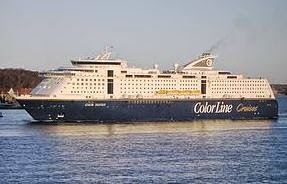
(Color Fantasy via en.wikipedia.org)
LMSD Color Fantasy (Passenger). MMSI 25718200, 2187,5 kHz DSC. Full data QSL and prepared verification letter confirmed. Received in 19 days (Ibold).

MNAA4 Highland Star (Platform Supply Vessel). MMSI 234235000, 2187,5 kHz DSC. Full data QSL and prepared verification letter confirmed. Received in 71 days (Ibold).

SEBR Obbola (Roll-On/Roll-Off Vessel). MMSI 265411000, 2187,5 kHz DSC. Full data QSL and prepared verification letter confirmed. Received in 51 days (Ibold).

SYBE Astrea (Special Purpose Vessel). MMSI 240691000, 2187,5 kHz DSC. Full data QSL and prepared verification letter confirmed. Received in 98 days (Ibold).

VQHF3 CEFAS Endeavour (Research Vessel). MMSI 235005270, 2187,5 kHz DSC. Full data QSL and prepared verification letter confirmed. Received in 52 days. Ship position
was alongside Lowestoft on the North Sea, the most easterly point of the United Kingdom (Ibold).

Vietnam
Voice of Vietnam, 6175 kHz. Full data map/TNVN logo card, unsigned. Received in eight weeks for e-report to vovworld@vov.org.vn. Postal address: Overseas Service, Voice of Vietnam, 45 Ba Trieu, Hanoi, Vietnam (Zamora) Station website with streaming audio http://www.vovworld.vn

Voice of Vietnam, 6175 kHz for Spanish service via WHRI Cypress Creek, SC. Partial data QSL did not include the transmitter site, unsigned. "Tarjeta de Verificacion" Ken Giang QSL in Spanish for an e-mail follow-up to english@vovnews.vn. Total time one year, 43 days after email follow-up (Kusalik).

Euro Free Radio

Crazy Wave R  (Germany) shortwave@gmx.de 
I AM R (Italy) report@iamradio.am 
Lazer Hot Hits (Ireland) studio@laserhothits.co.uk 
R Akenzo akenzoteam@hotmail.com 
R Altrex radioaltrex@hotmail.com 
R Atlantic 2000  atlantic2000international@gmail.com 
R Casanova  radiocasanova@hotmail.com
R Enterprise (Italy) enterpriseradio@hotmail.com
R Europe (Italy) radioeurope@iol.it
R Mi Amigo (Spain)  info@radiomiamigo.es 
R Pioneer  pioneeram@hotmail.com 
R Scotland  radioscotland@hotmail.com 
R Spaceshuttle  spaceshuttleradio@yahoo.com 
R Studio 52 (Netherlands) studio52@planet.nl 
R Superclan superclanradio@yahoo.com 
R Waves Int'l (France) rwaves@free.fr 
Shortwave Gold  shortwavegold@gmail.com
Sonnet R Europe sonnetradio@hotmail.com 
Time R timeradio.shortwave@gmail.com 
Tower R (Netherlands) radiotower@home.nl 

Weekly Propagation Forecast Bulletins


Product: Weekly Highlights and Forecasts
:Issued: 2015 May 04 0612 UTC
# Prepared by the US Dept. of Commerce, NOAA, Space Weather Prediction Center
# Product description and SWPC web contact www.swpc.noaa.gov/weekly.html
#
#                Weekly Highlights and Forecasts
#
Highlights of Solar and Geomagnetic Activity 27 April - 03 May 2015

Solar activity was at very low to low levels during the period. Very low levels were observed on 27 April and on 02 May. Solar activity was in decline during the beginning of the period as Region 2331
(S10, L=021, class/area Dai/240 on 26 Apr) rotated around the SW limb on 29 April. Only isolated low level C-class flaring was observed for the majority of the period until new Region 2335 (S15,
L=192, class/area Dai/220 on 02 May) rotated around the SE limb on 30 April. This region slowly developed in both area and magnetic class during its first few days on the visible disk and culminated
in seven C-class flares; the largest of which was a C2 flare at 01/0257 UTC. Other activity of note included an 18 degree filament eruption, centered near S46E09, observed lifting off the visible
disk between 02/1500-1830 UTC. Associated with this eruption was a partial-halo coronal mass ejection (CME) first observed in SOHO/LASCO C2 imagery at 02/2036 UTC with an approximate speed of 473 km/s. Although the majority of the ejecta appeared to be southward of the ecliptic plane, WSA/ENLIL modelling of the event showed a potential impact after midday on 06 May. 

No proton events were observed at geosynchronous orbit.

The greater than 2 MeV electron flux at geosynchronous orbit was at normal to moderate levels. Moderate levels were observed on 27-29 April and again on 02-03 May. 

Geomagnetic field activity was mostly quiet through late in the period. At approximately 30/0515 UTC, total field showed an increase from 6 nT to 11 nT with a weak increase in solar wind speed from approximately 280 km/s to 350 km/s. Further increases in speed to around 450 km/s occurred on 01 May as a weak, positive polarity coronal hole high speed stream (CH HSS) became geoeffective. CH HSS influence continued through the end of the period. The geomagnetic field responded with quiet to unsettled conditions on 02-03 May. 

Forecast of Solar and Geomagnetic Activity 04 May - 30 May 2015

Solar activity is expected to be at very low to low levels with a chance for M-class (R1-R2, Minor-Moderate) flare activity from 04-21 May and again from 28-30 May with the return of old Regions 2322 (N11, L=116) and 2325 (N05, L=050). 

No proton events are expected at geosynchronous orbit.

The greater than 2 MeV electron flux at geosynchronous orbit is expected to be at normal to moderate levels with high levels possible from 07-08, 13-21, and 29-30 May due to CH HSS activity. 

Geomagnetic field activity is expected to be at quiet to unsettled levels from 05-07 May with active periods likely on 06-07 May due to a combination of CH HSS effects and the arrival of the 02 May CME by mid to late on 06 May. Unsettled to active conditions with likely minor storm periods (G1-Minor) are expected from 12-15 and 17-20 May due to a recurrent CH HSS. A weak CH HSS is expected to become geoeffective from 27-30 May causing quiet to unsettled conditions. 

Product: 27-day Space Weather Outlook Table 27DO.txt
:Issued: 2015 May 04 0613 UTC
# Prepared by the US Dept. of Commerce, NOAA, Space Weather Prediction Center
# Product description and SWPC web contact www.swpc.noaa.gov/wwire.html
#
#      27-day Space Weather Outlook Table
#                Issued 2015-05-04
#
#   UTC      Radio Flux   Planetary   Largest
#  Date       10.7 cm      A Index    Kp Index
2015 May 04     115           5          2
2015 May 05     115           8          3
2015 May 06     120          15          4
2015 May 07     120          10          3
2015 May 08     125           5          2
2015 May 09     125           5          2
2015 May 10     130           5          2
2015 May 11     135           5          2
2015 May 12     140          25          5
2015 May 13     140          20          5
2015 May 14     135          20          5
2015 May 15     130          12          4
2015 May 16     130           8          3
2015 May 17     125          12          4
2015 May 18     125          20          5
2015 May 19     120          12          4
2015 May 20     115           8          3
2015 May 21     115           5          2
2015 May 22     115           5          2
2015 May 23     115           5          2
2015 May 24     110           5          2
2015 May 25     110           5          2
2015 May 26     110           5          2
2015 May 27     115          10          3
2015 May 28     120          10          3
2015 May 29     120           8          3
2015 May 30     120           8          3
(NOAA)