Showing posts with label AWR Wavescan. Show all posts

Sunday, January 05, 2025

The Incredible Story Behind the First Transistor Radio


How the Regency TR-1 helped Texas Instruments launch its semiconductor business
                        By Professor Allison Marsh, University of South Carolina

Jeff: Today we feature the incredible story behind the first transistor radio, which has been researched and written by Professor Allison Marsh at the University of South Carolina, and which was first published last year in the journal of the Institute of Electrical Electronics Engineers, to whom we are grateful. Here’s Ray Robinson, in Los Angeles.

Ray: Thanks, Jeff. Imagine if your boss called a meeting in May to announce that he’s committing 10 percent of the company’s revenue to the development of a brand-new mass-market consumer product, made with a not-yet-ready-for-mass production component. Oh, and he wants it on store shelves in less than six months, in time for the holiday shopping season. Ambitious, yes. Kind of nuts, also yes. But that’s pretty much what Pat Haggerty, vice president of Texas Instruments, did in 1954. The result was the Regency TR-1, the world’s first commercial transistor radio, which debuted 70 years ago last October. The engineers delivered on Haggerty’s audacious goal, and manufacturing division and its electronics work. By 1951, Haggerty’s division was significantly outpacing GSI’s geophysical division, and so the Dallas-based company reorganized as Texas Instruments to focus on electronics.

Meanwhile, on 30 June 1948, Bell Labs had announced John Bardeen and Walter Brattain’s game-changing invention of the transistor. No longer would electronics be dependent on large, hot vacuum tubes. The U.S. government chose not to classify the technology because of its potentially broad applications. In 1951, Bell Labs began licensing the transistor for US$25,000 through the Western Electric Co. Haggerty bought a license for TI the following year. TI was still a small company, with not much in the way of R&D capacity. But Haggerty and the other founders wanted it to become a big and profitable company.

And so they established research labs to focus on semiconductor materials and a project-engineering group to develop marketable products. Haggerty also hired Gordon Teal from Bell Labs, who’d been with them for 22 years. Although Teal wasn’t part of the team that invented the germanium transistor, he recognized that it could be improved by using a single grown crystal, such as silicon. Haggerty was familiar with Teal’s work from a 1951 Bell Labs symposium on transistor technology. Teal happened to be homesick for his native Texas, so when TI advertised for a research director in the New York Times, he applied, and Haggerty offered him the job of assistant vice president instead. Teal started at TI
on 1 January 1953.

And 15 months later, Teal demonstrated the first silicon transistor, and he presented his findings 3½ weeks later at the Institute of Radio Engineers’ National Conference on Airborne Electronics, in Dayton, Ohio. The audience was astounded to hear that TI had not just one but three types of silicon transistors already in production.

The TR-1 became a product in less than 6 months This advancement in silicon put TI on the map as a major player in the transistor industry, but Haggerty was impatient. He wanted a transistorized commercial product now, even if that meant using germanium transistors. On 21 May 1954, Haggerty challenged a research group at TI to have a working prototype of a transistor radio by the following week; four days later, the team came through, with a breadboard containing eight transistors.
Haggerty decided that was good enough to commit $2 million — just under 10% of TI’s revenue — to commercialize the radio.

Of course, a working prototype is not the same as a mass-production product, and Haggerty knew TI needed a partner to help manufacture the radio. That partner turned out to be Industrial Development Engineering Associates (IDEA), a small company out of Indianapolis that specialized in antenna boosters and other electronic goods. They signed an agreement in June 1954 with the goal of announcing the new radio in October. TI would provide the components, and IDEA would manufacture the radio under its Regency brand.

Germanium transistors at the time cost $10 to $15 apiece. With eight transistors, the radio was too expensive to be marketed at the desired price point of $50 (more than $580 today, which coincidentally is about what it’ll cost you if you can find a good one on eBay). Vacuum-tube radios were selling for less, but TI and IDEA figured early adopters would pay that much to try out a new technology. Part of Haggerty’s strategy was to increase the volume of transistor production to eventually lower the per-transistor cost, which he managed to slash to about $2.50.

By the time TI met with IDEA, the breadboard was down to six transistors. It was IDEA’s challenge to figure out how to make the transistorized radio at a profit. According to Richard Koch, IDEA’s chief engineer on the project, TI’s real goal was to make transistors, and the radio was simply the gimmick to get there. In fact, part of the TI–IDEA agreement was that any patents that came out of the project would be in the public domain so that TI was free to sell more transistors to other buyers.

At the initial meeting, Koch, who had never seen a transistor before in real life, suggested substituting a germanium diode for the detector (which extracted the audio signal from the desired radio frequency), bringing the transistor count down to five. After thinking about the configuration a bit more, Koch


eliminated another transistor by using a single transistor for the oscillator/mixer circuit. The final design was four transistors set in a superheterodyne design, a type of receiver that combines two frequencies to produce an intermediate frequency that can easily be amplified, thereby boosting a weak signal and decreasing the required antenna size. The TR-1 had two transistors as intermediate-frequency amplifiers and one as an audio amplifier, plus the oscillator/mixer. Koch applied for a patent
for the circuitry the following year. The radio ran on a 22.5-volt battery, which offered a playing life of 20 to 30 hours and cost $1.25. (Such batteries were also used in external power packs for hearing aids, the only other consumer product to use transistors up to that point.)

TI’s original prototype

While IDEA’s team was working on the circuitry, they outsourced the design of the TR-1’s packaging to the Chicago firm of Painter, Teague, and Petertil. Their first design didn’t work because the components didn’t fit. Would their second design be better? As Koch later recalled, IDEA’s purchasing agent, Floyd Hayhurst, picked up the molding dies for the radio cases in Chicago and rushed them back to Indianapolis. He arrived at 2:00 in the morning, and the team got to work. Fortunately, everything fit this time. The plastic case was a little warped, but that was simple to fix: they slapped a wooden piece on each case as it came off the line so it wouldn’t twist as it cooled.

How each radio was assembled by hand: https://youtu.be/kKln6zTy4C8 On 18 October 1954, Texas Instruments announced the first commercial transistorized radio. It would be available in select outlets in New York and Los Angeles beginning 1 November, with wider distribution once production ramped up. The Regency TR-1 Transistor Pocket Radio initially came in black, gray, red, and ivory, priced $49.95. Other colors were added later: green, mahogany, lavender, pearl white, meridian blue, powder pink, and lime.

The TR-1 got so-so reviews, faced competition Consumer Reports was not enthusiastic about the Regency TR-1. In its April 1955 review, it found that transmission of speech was “adequate” under good conditions, but music transmission was unsatisfactory under any conditions, especially on a noisy street or crowded beach. The magazine used adjectives such as whistle, squeal, thin, tinny, and high-pitched to describe various sounds — not exactly high praise for a radio. It also found fault with the on/off switch. Their recommendation: wait for further refinement before buying one. The engineers at TI and IDEA didn’t necessarily disagree. They knew they were making a sound-quality trade-off by going with just four transistors. They also had quality-control problems with the transistors and other components, with initial failure rates up to 50 percent. Eventually, IDEA got the failure rate down to 12 to 15 percent.


Unbeknownst to TI or IDEA, Raytheon was also working on a transistorized radio — a tabletop model rather than a pocket-sized one. That gave them the space to use six transistors, which significantly upped the sound quality. Raytheon’s radio came out in February 1955. Priced at $79.95, it weighed 4½ pounds and ran on four D-cell batteries. That August, a small Japanese company called Tokyo Telecommunications Engineering Corp. released its first transistor radio, the TR-55. A few years later, the company changed its name to Sony and went on to dominate the world’s consumer radio market.

The legacy of the Regency TR-1
The Regency TR-1 was a success by many measures: it sold 100,000 units in its first year, and it helped jump-start the transistor market. But the radio was never very profitable. Within a few years, both Texas Instruments and IDEA left the commercial AM radio business; TI to focus on semiconductors, and IDEA to concentrate on citizens band radios. Yet Pat Haggerty estimated that this little pocket radio pushed the market in transistorized consumer goods ahead by two years. It was a leap of faith that worked out, thanks to some hard-working engineers with a vision.
Back to you, Jeff.
(Ray Robinson/AWR Wavescan)

YouTube Video - Assembling Transistor Radios 1955


Wednesday, October 16, 2024

Nostalgic look at K-BIG


Special thanks to Ray Robinson and Jeff White for sharing this nostalgic story on K-BIG

Jeff: Today Ray Robinson brings us some interesting historical notes regarding the offshore beginnings and nautical connections of one of Southern California’s best-known stations – KBIG, or ‘K-BIG’.  As an AM station in the early 1950s, it created a distinctive presence by broadcasting from a popular passenger ferry, the S.S. Catalina, while plying the waves of the Pacific to and from the island of the same name.  Here’s Ray to tell us more.

Ray: Thanks, Jeff.  I’ve lived in the Los Angeles area for 40 years now, and throughout that time, K-BIG has been a fixture on the FM dial at 104.3 MHz.  The station has been through many ownership and format changes during its lifetime, but what many people don’t realize is that it started out not on the FM band, but as an AM station, and not actually on the California mainland at all.  So, let’s go back to the beginning, and I have to thank Dr. Martin van der Ven in Germany, an occasional contributor to this program, for some of this material today.

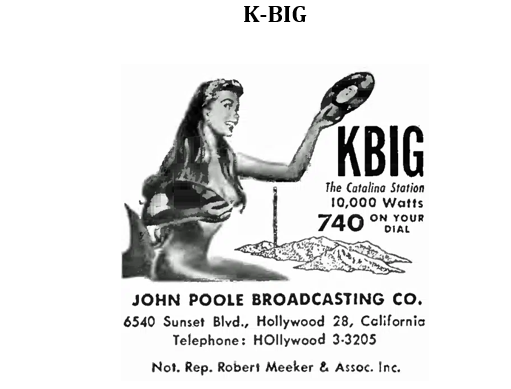
K-BIG was founded by John H. Poole in 1952 and began broadcasting in the June of that year from Catalina Island some 23 miles off the coast of California, and 26 miles from the Port of Los Angeles, to its north.  The island itself is 22 miles long and 8 miles wide, covering an area of some 75 square miles.  It’s administered as part of Los Angeles County, and the principal town on the island is Avalon.


Known as "The Catalina Station", Poole knew K-BIG would have wide coverage of Southern California by broadcasting the station's directional 10,000-watt signal across ocean water.  And indeed, K-BIG was heard from Santa Barbara in the north to south of the Mexico border, a 200-mile stretch of the California coastline, including a large audience in Los Angeles.  In 1958, the station adopted the theme tune ‘Twenty Six Miles (Across the Sea)’ by The Four Preps.

The station became popular as it presented an island theme and scheduled music, news, and commercials differently than its competitors.  Poole claimed people knew that if they changed stations during a commercial, they would always find something interesting on K-BIG, which mostly played a mix of popular music genres, including Big Band, Jazz and contemporary hits.  But they also provided news updates and a few talk shows, including the notable “Catalina Conversations,” which featured interviews with local celebrities, island residents, and visitors.

The station was a daytimer to protect KCBS 740 in San Francisco, and operated only from local dawn to dusk.  The K-B-I-G call letters were selected in honor of the station's Chief Announcer, Carl "Mr. Big" Bailey, who hosted the station’s morning shows from sign-on until noon in its early days.  He got the moniker “Mr. Big” due to his 6’10” frame which was truly exceptional in the 1950’s.

The station’s studios and transmitter were located on Catalina Island, while the business office was situated at 6540 Sunset Boulevard in Hollywood, where Poole also built additional studios for production and auxiliary purposes.

Carl Bailey – ‘Mr. Big’ – was a prominent figure in the radio industry, and he wanted more than anything to help John Poole create a station that would stand out in the crowded Southern California market.  And so, in the mid-and late-1950s, he often broadcast live on weekends from a passenger ferry, the S.S. Catalina, which had been carrying as many as 3,800 passengers a day on the 2½ hour voyage between the Port of Los Angeles and Avalon since 1924.


Many K-BIG listeners traveled alongside regular passengers on the journey to Avalon, and Carl would interview some of them during the voyage and when disembarking from the ship.  The passengers knew that their families were often eagerly waiting to hear if they had completed the voyage safely.  Through K-BIG AM 740, they were sometimes able to hear their loved ones’ voices.  The station also hosted occasional live performances by various artists aboard the S.S. Catalina, creating a unique and intimate concert experience that was broadcast to listeners.  The offshore broadcasts were a strategic move to capture the listeners’ imagination and leverage the established reputation and iconic status of the ferry.

Of course, the station didn’t actually transmit from the S.S. Catalina (other than their studio-to-transmitter link), but merely used it as the base for some very unusual, and I dare say romantic, live outside broadcasts. 

In November 1957, while aboard the sea-going S.S. Catalina, Carl Bailey got in touch with the pilot of a plane circling above.  The aircraft, from the Los Alamitos Naval Air Station, was ‘tracking’ the ship for radar spotting practice, and the DJ described it to listeners of his regular sea-going program.  Coincidentally, the airmen were using K-BIG as a navigational fix, and when Carl called to the plane to dip a wing if they were tuned in, the pilot complied!  When he returned to Los Alamitos, the pilot wrote a letter thanking the disc jockey for the Navy plug and invited Carl to visit the Naval Air Station.  This he subsequently did and provided listeners with a full report of the conducted tour he received.

A year later, in November 1958, K-BIG launched a new promotion to draw attention to its 740 kHz position on the dial.  The 740th passenger boarding the S.S. Catalina each day at Los Angeles harbor for the cruise to Avalon was awarded prizes, including lunch, dancing, and sightseeing for two, to make the island visit more enjoyable.  Carl Bailey interviewed the lucky winners each day by ship-to-shore radiophone from Avalon on weekdays, and in person on his ‘Catalina Cruise’ broadcast from the ship on Saturdays and Sundays.

A memorial on Wrigley Plaza along the waterfront in Avalon on Catalina Island honors Carl “Mr. Big” Bailey (who passed away in 1984), saying he’s considered to be “the first sea-going disk jockey in the world”. 

On February 15, 1959, Poole launched KBIQ at 104.3 on the FM band in Los Angeles, simulcasting its AM sister station K-BIG.  In 1963, the call was changed to KBIG-FM, and the station added a staff of "K-BIG Singers", who would sing the station's jingles and also record station albums to offer to listeners.

Later in the 1960’s, to improve efficiency, the island location was reduced to just a transmitter facility, with the chief engineer residing on-site, while K-BIG’s AM programming originated from Hollywood and was sent to the Catalina transmitter via a microwave link.

In 1968, KBIG-AM and FM were bought by Bonneville International for $2 million.  The new owners continued with a ‘beautiful music / easy listening’ format playing mainly instrumentals.  It sounded like this on October 13th, 1979:

The following year, in 1980, Bonneville sold the AM station on 740 kHz to Crawford Broadcasting, which has operated a daytime-only Christian talk format on that frequency ever since as KBRT, or ‘K-BRITE’, with the 10 kW transmitter remaining on Catalina Island to this day.

By the early 1990’s the FM station was playing ‘today’s hits and yesterday’s favorites’:

Today, the FM station is owned by iHeartMedia and transmits with 65,000 watts.  It plays contemporary adult hits from the 90’s to now, branded as ‘104.3 MYfm’, and identifies simply as KBIG, having dropped the –FM suffix in 2013.


Sunday, October 06, 2024

Early Wireless Stations in Japan - Part 1

Part 1


Jeff:    The edition of Wavescan that airs on the first Sunday of each month usually includes a DX Report from the Japan Shortwave Club, presented by Yukiko Tsuji.  But it occurred to us that we haven’t visited the story of domestic broadcasting in Japan for quite some time, and have only occasionally covered Japanese shortwave broadcasting during the Second World War.  So, this week Ray Robinson tells the story of early wireless and medium wave stations in Japan.


Ray:   Thanks, Jeff.


Early Wireless Stations in Japan


It was in 1889, six years before Marconi, that the first wireless experiments took place in Japan.  The first public demonstration of wireless was given by Hantaro Nagaoka at the University of Tokyo.


Two experimental stations were subsequently established by the Japanese Navy, and these were listed in 1902 as being in Tokyo and Yokohama, just a few miles apart.  Subsequent listings show another experimental station in Nagasaki in 1906.  That station was apparently a forerunner to a larger and more permanent station at the same location.


By 1908, two stations were active with maritime communications, located at Nagasaki and Choshi.  The Choshi station used the callsign JCS.  Ambitiously, up to a dozen more wireless stations were in the planning stages, but it seems not all of those came to fruition.


By 1913, eight wireless stations were in use, all identified in Morse Code with "J" callsigns, such as JOS at Osezaki and JTS at Tsunoshima, as well as the previously mentioned JCS at Choshi.  Many of these operated on longwave.


During 1914, radio interests in the United States established two very large wireless stations for communication across the Pacific.  These twin stations were located near San Francisco, California and Kahuku, Hawaii.  It was the intent that they would subsequently be able to exchange messages with a large new station still under construction near Yokohama, Japan.


Just one year later, on July 27, 1915, the new high-powered wireless station, actually  located near Yokohama at Funabashi on Tokyo Bay, was officially opened with service to the United States via Kahuku, Hawaii.  Two months later again, the transmission of wireless messages from Japan was extended to many additional countries via communication links with wireless stations located in eastern Siberia.


Formal government use of the new wireless communication system linking the United States and Asia was recognized when official messages were exchanged between the Mikado in Japan and President Woodrow Wilson in the United States on November 5, 1916.


However, the new Trans-Pacific Wireless Service was then interrupted for a couple of years due to World War I, and it was re-opened again on December 19, 1918, with the Tokyo station adopting the callsign JSDA.


Now, you might ask, what form of code was used by the operators of the wireless stations in Japan?  By the time wireless stations were established, Morse Code was already three quarters of a century old.  The original telegraph code was developed by Samuel Morse and Alfred Vail sometime before 1840, and when wireless stations were established, the spark transmitters talked to each other in Morse Code.  That is, if they were conversing in English.  As needs arose, various modifications were made to standard Morse Code to accommodate alphabetic variations, in for example, German, Spanish and Russian.


But because Japanese is written very differently as a pictographic language, it became necessary to develop a system of code that could be understood in that language.  And that indeed became very complicated.


But for international communication between Japan and other countries, Morse Code in English was generally used.  And for maritime communication with international shipping, much of the Morse Code communication was conducted using standard maritime codes.


However, by the early 1920’s, four major factors began to bring about significant changes in electronic communication in Japan.  These factors were:

1.     the manufacturing and availability of radio tubes/valves,

2.     the subsequent development of valve transmitters which permitted the transmission of speech,

3.     the introduction of radio program broadcasting in many countries, including Japan, and

4.     the use of high frequencies, or shortwave, for international communication.


Because of these factors, many of the longwave spark wireless stations in Japan were either converted to valve operation, or were eliminated as no longer necessary.


And thus ended the nearly twenty year period of wireless telegraphic communication in Japan, domestically using a very different form of Morse Code.


Early Medium Wave Stations in Japan

 It was in 1922 that experimental telephony in Japan began, with the availability of newly developed radio valves (or tubes).  Initially, these experiments were carried out on high frequencies, that is shortwave, though coverage was achieved only over short distances.

 Interestingly, the first Japanese radio broadcasting station was erected, not in Japan, but in China.  This station was constructed in Japan using Japanese-made equipment, and it was installed at Shuang Chaio, some eight miles from Peking, or Beijing, as it is known today.  This medium wave broadcasting station was inaugurated on June 29, 1924.

 The first transmission of radio broadcast programs in Japan itself began on March 1, 1925, with a test broadcast from a temporary station located on Atago Hill in Tokyo.  A photograph from that era shows that the Minister for Communications in the national government heard this broadcast.  This first temporary radio broadcasting station was officially inaugurated three weeks later on March 22 with a program that included classical European and Japanese music.

Four months later, on July 12, 1925, a permanent radio broadcasting station for Tokyo was inaugurated at Atagoyama.  The main 1 kW transmitter was made in the United States, though the reserve transmitter was locally assembled, by the staff at the radio station itself.  At the time, there were just three thousand five hundred radio receivers in operation in the Tokyo area.

 Similar stations were constructed in Osaka and Nagoya, and these were both officially opened during the same year 1925.

 The callsigns and details for these three radio stations were:

JOAK

Tokyo

1 kW

800 kHz

JOBK

Osaka

.5 kW

780 kHz

JOCK

Nagoya

1.5 kW

833 kHz

 The system of letters used for the callsigns in early radio stations in Japan is quite intriguing.  Taking the first station, JOAK, as an example, the letter J obviously stood for Japan.  The second letter, O, may have stood for Oceania, which was part of the callsign identification for radio stations in several countries in the Pacific in those days.  And the final letter K, probably stood for Kyokai, a Japanese word that was later incorporated into the official name for the Japanese radio broadcasting service, NHK, Nippon Hoso Kyokai.

 Interestingly, the third letter in the callsign system indicated the chronological order in which the station was established.  Thus JOAK was the first station, JOBK was the second, and JOCK was the third, etc., right on down through the English alphabet.

 By the mid-1930’s, they had used up the twenty six letters in the English alphabet and new callsigns were issued, this time ending in the letter G instead of K; and subsequently, many other letters also.

 In fact, by the mid-1930’s, more than thirty medium wave stations were on the air throughout Japan and these stations were regularly heard in the United States, New Zealand and Australia.  Several of the main stations in the large cities were by that time operating a second program channel under the same callsign with a number appended, for example:

Tokyo

JOAK1 on 870 kHz and JOAK2 on 590 kHz

Osaka

JOBK1 on 690 kHz and JOBK2 on 940 kHz

Nagoya

JOCK1 on 730 kHz and JOCK2 on 990 kHz

 In August 1936, many of the broadcasting stations in Japan relayed the Berlin Olympics live from Germany.

 Radio stations in Japan have always been prolific verifiers of reception reports from listeners.  Although there are several undated QSL cards from Japan in the Heritage QSL Collection now being scanned in Australia, it is probable that the earliest is dated on May 31, 1931 from the key station in the NHK network, JOAK in Tokyo.

 This QSL card shows that station JOAK was on the air by that time with a power of 10 kW.  It has a small black and white photo of their studio and transmitter building.  In red is a small ornamental picture, the size and shape of a postage stamp, and it is very reminiscent of the American EKKO QSL stamps from the same era.

 Many of the QSL cards from Japan also show an artistic picture, or an actual photo, of the famous Mt. Fuji.  Many cards also show photos of the radio broadcasting station, the building, the antenna towers, and the studio facilities.

 Interestingly, one of these early Japanese QSL cards shows a short text in the international Esperanto language.  This card was printed for use as a verification for station JOAK in Tokyo, but it was modified for use by a small relay station, JOJK in Kanazawa, with 3 kW on 423 metres, 710 kHz.  The text in Esperanto reads: Oni korespondas per Esperanto.  Translated into understandable English, it reads: We correspond in Esperanto.

 Back to you, Jeff. 


Saturday, October 05, 2024

Radio Weddings - Part 10


Special thanks to Ray Robinson and Jeff White for sharing this story from a recent edition of Wavescan

Jeff:  Over the past couple of years, we have presented a series of items under the title ‘Radio Weddings’.  The last, part 9, was in April 2023.  Today we present one more item in this series, perhaps the most famous radio wedding of them all – the one that took place on board the offshore station Radio Caroline North in September 1966, and was broadcast live on air to millions.  Here’s Ray Robinson with the story.

Ray: Thanks, Jeff.  Last week, we brought you the history of the offshore station Radio Caroline, from its earliest beginning in 1964, right up to its current legal operation in the UK with solar-powered medium wave, and two complementary channels that are heard on DAB and world-wide via webstreams.

Back in 1966, the station was operating from two radio ships – the MV Mi Amigo which was anchored off the southeast coast of England broadcasting Radio Caroline South, and the MV Caroline which was anchored in Ramsay Bay off the northeast coast of the Isle of Man in the middle of the Irish Sea, broadcasting Radio Caroline North.  It was on that second service, Radio Caroline North, that our story today took place.

One of the station’s DJ’s went by the name of Mick Luvzit.  He was born in 1942 in Portage La Prairie, Manitoba, Canada, about 30 miles west of Winnipeg, with a birth name of Arthur McGurk.  But he was later adopted, and at the age of 5, his name was changed to William James Brown.  He grew up to be a talented musician and singer, and worked for a number of Canadian stations before moving to the UK, including CKY, CHWO, CHIC, CHUM and CFGM.

In the spring of 1966 he made a record called ‘Long Time Between Lovers,’ which was released on the Decca label on June 10th.  That same month he joined Radio Caroline South, but after a few weeks transferred up to the north ship where more DJ’s were needed.  He was an immediate hit with the listeners, and received over 1,000 fan letters during his first week on air.  

While working on Caroline North, Mick met Janet Teret, sister of another DJ on the station, Ray Teret.  They began dating, and fell in love.  There was soon talk of a marriage; Mick formally proposed, and Janet accepted.  Late one night, senior DJ Tony Prince was talking to the captain, Maarten Gips, and learned that he had the authority to marry people on board the ship.  Tony rushed down to Mick’s cabin, and woke him up at 2am.  He suggested they should capitalize on the romantic idea of being married at sea by a ship’s captain, and tie the knot on board the MV Caroline.  And, of course, it would also be very good promotion for the station, Radio Caroline North.  Tony said Mick loved Jan beyond words, and they started planning for a September wedding on board the ship.

On the day of the wedding, just about 58 years ago on Tuesday 20th September 1966, there was heavy fog around the Isle of Man, and Janet and the wedding party were delayed getting out to the radio ship as the tender Essex Girl initially couldn’t leave port.  Visibility had to be reasonably clear after high tide, so the tender could get out and find the radio ship offshore.  They did eventually make it out in the late afternoon, however, and the ceremony went ahead, broadcast live on air with a commentary from the Caroline North news chief, Graham Webb.  It was conducted by the captain Maarten Gips, and because the ship was registered in Panama, legally the wedding was taking place in that country.

The ceremony began with the captain calling the marrying couple and witnesses together.  He then said that he had received a written and signed request from Mr. Brown (Mick’s real name) and Miss Teret stating that they wished to be married according to the laws of the Republic of Panama, and that he had accepted such request.

The Panamanian consulate in London had already provided the relevant section of the country’s civil code to be read out during the ceremony.

The best man was Jerry Leighton, another of Mick’s fellow DJ’s, and the bride was given away by her brother, Ray, as her parents had been delayed even getting to the Isle of Man by the fog-bound airport in Douglas.

So what did it all sound like.  Obviously we can’t play the whole thing, but here are a few clips to give you a taste, starting with senior DJ Tony Prince who was on air that afternoon.

For the next 10 months after the wedding, Mick continued to present his afternoon show ‘Mick’s 3-6’ on Radio Caroline North.  Then in the summer of 1967, Mick and Janet went on vacation back to Mick’s native Canada, and decided to settle there.  They had a daughter, Jelisse Caroline Brown, but, sadly, the marriage was not to last.  They were divorced during the seventies, although they did remain friends.

Mick was heard on several stations in the Vancouver area in the 80’s and 90’s including CKST and CKLG.  In 2000 he was living in Abbotsford, British Columbia, presenting the morning show on Praise 106.5, a Christian station located just across the US border in Washington State.  In 2007 he suffered a heart attack and underwent quadruple heart bypass surgery.  Although he did recover from that, heart problems persisted.  In November 2010 he was known to have been busy writing a script for a documentary on addiction to alcohol and drugs, but sadly he died of heart failure in New Westminster, British Columbia on 8th December 2012, aged just 70.

In an online post, his ex-wife, Janet, said:  “Many thanks for the tribute to Mick who passed away suddenly on Saturday, December 8.  Jelisse and I will miss him terribly. He had many struggles with his heart condition but always kept a very positive outlook on life.  He wanted to live, but God had a plan for him.  Rest peacefully till we meet again.  Love, your family.”
Back to you, Jeff.
(Ray Robinson/AWR Wavescan)


Thursday, October 03, 2024

AFN News in Times of Tragedy


Special thanks to Ray Robinson and Jeff White for sharing this story from a recent edition of Wavescan


Jeff:  A few weeks back at the beginning of August, we brought you the story of the early beginnings of AFN in Europe.  Perhaps as portrayed in the movie ‘Good Morning Vietnam’, there has been a general misconception that news carried on AFN or other AFRTS services was subject to government censorship.  While that may have been the case in the active theater of war in which AFVN operated, it has not been the case with AFN since the end of World War II.  However, AFN certainly had its challenges with news coverage in times of tragedy, and Ray Robinson again brings us a story about this, which was first published in AFN’s Silver Jubilee magazine in 1968.

Ray: Thanks, Jeff.  At 1934 hours local time on the evening of 22 November 1963, a short, one-sentence news item clacked out of a teletype machine in the AFN studios in Frankfurt, Germany.  Quote – “Dallas, Nov. 22 (UPI) – Three shots were fired at President Kennedy’s motorcade today in Downtown Dallas.” – Unquote.

Thus, quietly, began one of the biggest programming challenges of AFN’s 25-year history.

Up until that moment, this had been a normal day at AFN.  In fact, it had been unusually quiet on the news scene.  The President’s visit to Texas had been getting quite a bit of play on the newscasts mainly because there wasn’t much else to report.  The biggest activity of that day had little to do with the broadcasting routine.  The program directors from around the Network were in Frankfurt for a conference.

Chief of Program Operations, Don Brewer, was giving a big dinner party at the Terrace Club in honor of the program directors.  Cocktails were being served at 1934 hours.  Station commander Lt. Col. Robert Cranston had spent the day in Heidelberg meeting with his superiors.  He was still there at 1934 hours.

At the studios, MSG Lloyd Eyre was presenting the program ‘Music in the Air’, an hour of uninterrupted dinner music.  The newsroom was lightly staffed.  Work was soon to begin on the big 2200 newscast, but most of the staffers were still at supper.  European Editor (later News Director) David Mynatt was in a neighboring office making final preparations for the program ‘Report from Europe’.  It was to be aired right after ‘Music in the Air’ at 2000 hours, calling in AFN correspondents from around Europe.  SP4 John Grimaldi was keeping an eye on the teletypes.

Ominous Bells
Grimaldi noticed the item from Dallas almost immediately.  He was very interested but quite rightly did not push the panic button.  The story did not say anybody had been hit by the shots.  And it still was nearly half an hour until the next news broadcast.  The best thing to do was stand by the machine and watch for further developments.

The bells on the machine clanged at 1939 and Grimaldi saw it rap out the stunning news.  He stiffened in disbelief.

“FLASH     FLASH     KENNEDY SERIOUSLY WOUNDED PERHAPS FATALLY BY ASSASSINS BULLET.”

Grimaldi tore off the copy and ran to Mynatt who was on the telephone to an engineer in France.  “Kennedy’s been shot!”

“Aw, come on” said Mynatt.  The man in France agreed it was a joke.  One look at the copy though, and Mynatt’s jocular mood changed.  Without another thought, he ran down the corridor to the studio and told Eyre to put him on the air.

Emotional Voice
AFN listeners got the news at 1941.  As it later developed, this was 11 minutes after the assassination and less than two minutes after the flash had been received in the AFN newsroom.

‘Music in the Air’ faded and Mynatt’s voice came on steadily as he said: “Ladies and Gentlemen, we interrupt this program for a special news bulletin.  President Kennedy, on a visit to Dallas, Texas, has been reportedly seriously wounded – perhaps fatally.”

Then his voice broke with emotion as he said: “We’ll have more as soon as it is received here at AFN.”

Eyre’s voice displayed no emotion at all as he said:  “Ladies and gentlemen, we continue with the program in progress.”  ‘Music in the Air’ resumed.

PD’s Contacted
There was a strict rule at AFN that only the program director or his deputy could authorize the interruption of a program for a news bulletin.  Mynatt knew perfectly well that he was violating this rule.

The news spread rapidly through the building.  Somebody heard it on the monitor down in the lunchroom and spread the alarm.  Newsmen left their food on the table and dashed upstairs.  Somebody tried to get hold of Program Director Brewer at the Terrace Club but it was no easy job.  First you had to wait for them to answer at the club office.  Then somebody had to check which of several parties was AFN’s.  Then he had to go there and try to find Brewer whom he did not know.  It took agonizing minutes.

Another bulletin moved on the teletype giving more details.  Mynatt grabbed it and made a second unauthorized seizure of the airwaves.  “Again, we interrupt this program with more word on what has happened in Texas.  President Kennedy and Governor John B. Conally of Texas were cut down by an assassins bullet as they toured Downtown Dallas in an open automobile.  Mrs. Kennedy is reported to have jumped up and grabbed Mr. Kennedy.  She cried ‘oh no!’  Then the motorcade sped on.”

Somebody heard the report in Heidelberg and relayed the word to Col. Cranston.  He tried to get through to the station on the telephone.

When ‘Music in the Air’ signed off at 2000 hours, these two bulletins were all that had been put on the air.  The next regularly scheduled program was a newscast, ‘Report from Europe’ reporting on European events of the day.  Mynatt, with nothing else prepared, went through with this scheduled newscast, but including more brief special bulletins as they were received.  Between those special bulletins, unfortunately listeners heard the workaday news of European politics which must have seemed rather irrelevant at that time.

‘Report from Europe’ signed off at 2015.  By that time, Brewer had been reached at the Terrace Club and the party had instantly dissolved.  He and all the other officials of the Network headed back to the studios.

President is Dead
Brewer gave the order on the phone that all normal programming was to be suspended until the story was wrapped up.  At 2015, AFN switched to a format of music and bulletins, but it only lasted about five minutes.  Mynatt immediately checked and found that the Armed Forces Radio and Television Service (AFRTS) was picking up and transmitting by shortwave a CBS report direct from Dallas.  It was put on the air.

And so it was at about 2025 AFN listeners got the first definite news the President was dead.  The voice of newsman Allan Jackson was slow and grave as he said: “Ladies and gentlemen, the President of the United States is dead.  John F. Kennedy died of wounds received in assassination in Dallas less than an hour ago.  We repeat.  It has just been announced that President Kennedy is dead.”

Atlantic Cable
By now after many frustrating delays, Col. Cranston had finally gotten through to the Network from Heidelberg.  He gave two orders:
1) start arranging immediately for cable connections to the U.S., and
2) make arrangements to keep the station on the air all night.
He was on his way back and would be there in an hour.

The Atlantic cable was engaged with a minimum of delay.  This was fortunate, because shortwave reception was not good that night.  It was alright during the first few minutes of its use, but it deteriorated rapidly after that to below broadcast quality.

The Network remained on the air through a long active night.  Outstations were instructed to remain with the Network until further notice.  Off-duty announcers and engineers were tracked down and told to come in for extra shifts.  In the days that followed, the staff did an excellent job.  The backbone of the operation was the Network coverage from the States.  AFRTS switched from one network to another, presenting whichever it thought was producing the most interesting coverage at the moment.  And thanks to the Atlantic Cable, listeners heard it as clearly as though they had been in their living rooms back in the USA.

Aftermath
During the next four days, AFN listeners heard interviews with assassination witnesses and with the police after the arrest of Lee Harvey Oswald.  They heard reports of the return to Washington of the coffin, the swearing in of Lyndon B. Johnson as President and the new President’s request for “your help – and God’s.”

AFN was carrying a live report of Oswald’s prison transfer when he was shot down by Jack Ruby before the astonished eyes of the announcer.  Finally, the Network carried the full drama of the funeral.  This Washington observance was one of the first live television events to be relayed to Europe via satellite.  Many Americans watched the event on German or French TV, but alongside AFN radio providing a commentary in English.

In 1963, the Atlantic Cable cost $4 a minute, and the Network stayed with it for four days.  Round-the-clock coverage ceased after the funeral, but AFN programming was subdued for weeks afterwards.  Christmas programming was introduced about the middle of December, and then after the holidays, the Network returned fully to normal.

There were other tragic events that AFN covered, such as the second Kennedy assassination in June 1968, and at all times, the Network endeavored to bring the news to its listeners ‘fast and factual’ without any government intervention of censorship in any way.

Back to you, Jeff.
(Ray Robinson/AWR Wavescan)

Monday, September 30, 2024

Radio Caroline – Update


Special thanks to Ray Robinson and Jeff White for sharing this story from a recent episode of Wavescan

Jeff: Many people worldwide are familiar with the name ‘Radio Caroline’ – the offshore ship-based station which first broke the monopoly of BBC radio in the UK in the 1960’s.  They may be less familiar with the fact that the station has continued to operate down through the decades, and is not only still a presence on the airwaves in Great Britain to this day, but is actually thriving with now two full-time channels on a variety of platforms.  Ray Robinson in Los Angeles has been a presenter on one of those channels for over four years now, so here he is with an updated profile of the station.

Ray: Thanks, Jeff.  Yes, the potted history of Radio Caroline goes something like this.

The station was founded by an Irishman, Ronan O’Rahilly who, as a record promoter and pop group manager, had been frustrated that neither the BBC nor Radio Luxembourg would play his records.  His solution was to start his own station, and Radio Caroline first began test transmissions on Good Friday, March 27th, 1964.  Regular programming started the following day at 12 noon.

The station used as its broadcasting base a converted 763 ton Danish passenger ferry, the MV Fredericia, which the station renamed the M.V. Caroline.  Initially the ship was anchored in the North Sea about 5 miles off the coast of Felixstowe, Essex on the southeast coast of England.  She was well outside the then three mile territorial limit, so although the station was unlicensed, it wasn’t breaking any British laws, and quickly built a huge audience.

Some six weeks later in May 1964, Caroline was joined by a competitor station, Radio Atlanta, broadcasting from the MV Mi Amigo a few miles further down the coast.

The MV Caroline had two 10 kW transmitters putting out a combined power of 20 kW on 1520 kHz, while the MV Mi Amigo had a single 10 kW transmitter on 1495 kHz.  Both could comfortably reach the eastern side of London with their signals.  

But instead of duplicating each other’s footprint, the following month the two commercial stations decided to merge, and on 4th of July 1964, the original Caroline ship set off on a voyage around the south coast of England and then north through the Irish Sea to a new anchorage off Ramsay Bay in the Isle of Man, from where she broadcast as Radio Caroline North.  This gave the station coverage of north Wales, northwest England, southern Scotland, and large parts of Northern Ireland and the Irish Republic.  The Radio Atlanta ship stayed put, but changed her branding to Radio Caroline South, with coverage of large parts of East Anglia, London and the Home Counties.  The two stations remained on the same frequencies, although both now announced the rhyming ID as ‘Caroline on 199’ – even though in reality the north ship was on 197 meters and the south ship was on 201.

Both stations were managed out of the same office in London, and shared the same jingle package and had some pre-recorded programming in common.  Most programming though was presented live from the ships, and DJ’s did transfer from one ship to the other from time to time as needed.  In 1965, the stations adopted the American ‘Good Guys’ format, and they became very successful commercially.

In one hair raising incident, the south ship dragged her anchor during a storm in January 1966, and floundered on the beach at Frinton, Essex.  All the DJ’s and crew were safely rescued, but the ship had to be taken to Zaandam, the port of Amsterdam, for a refit, including the installation of an additional 50 kW transmitter, and an increase in height of the antenna mast.  When she returned to resume broadcasting a couple of months later, the frequency used was now 1187 kHz, 253 meters, which again was announced in rhyming style as ‘Caroline on 259’.

Over a dozen more stations were launched around the British coasts over the period from 1964-1967, until eventually the British government passed the Marine Offences (Broadcasting) Act, which made it illegal for British citizens or companies to advertise on offshore stations, or to support them in any way.  The act went into effect at midnight on August 14th 1967 for the UK, and on August 31st 1967 for the Isle of Man, which is not part of the United Kingdom.  All the other stations closed down on or before the act became law, but Ronan O’Rahilly decided that Radio Caroline would continue.

The station’s offices were moved to Amsterdam, and arrangements were made for the tendering of the south ship from The Netherlands, and of the north ship from Dundalk in the Republic of Ireland.

Most British DJ’s left the stations, but a few stayed along with one on the north ship who was a Canadian citizen.  New DJ’s who were prepared to flout the law were quickly recruited, however, and by the end of 1967, the south ship, now identifying as Radio Caroline International, had arguably one of the strongest DJ lineups of any of the offshore stations.  Advertising from international companies was difficult to come by, though, and most income was then derived from payments from record promoters for plugged records.  In March of the following year, 1968, the Wijsmuller tug company which had been providing tendering services to both vessels hijacked the two ships by cutting their anchor chains and towing them back to Amsterdam, as security for unpaid bills.

There the ships languished for four years until 1972, when they were put up for auction.  The north ship ended up being scrapped, but the south ship, the MV Mi Amigo, was bought by a supporter of the station, and after negotiations with Ronan O’Rahilly, it was taken back out to sea off the Dutch coast, and relaunched as Radio Caroline, initially with test transmissions from September 1972, and with regular programming back on the familiar wavelength of 259 meters from December 23rd.   Here’s DJ Crispian St. John on Christmas morning, 1972:

Various pop and rock programming styles were experimented with over the next couple of years, and the station finally changed from Top 40 to an album format, which it has largely stuck to right up to the present.  In August 1974, the Dutch government introduced its own Marine Offences Act, at which point the MV Mi Amigo was moved back across the North Sea to an anchorage 12 miles offshore in the Thames Estuary in a somewhat sheltered channel between two enormous sandbanks.  The base of operations was then officially moved to Spain, although in practice Ronan largely ran the station on a clandestine basis from offices he leased quietly in London.

Radio Caroline then continued to broadcast successfully throughout the 70’s, often using both the 50 kW and 10 kW transmitters on the Mi Amigo to carry different programming on separate frequencies.  Most of the funding for the station during this period came from a daytime Dutch language service which used a loophole in the Dutch anti-piracy laws by reading advertising placed in a print magazine.  Interference problems in 1977 forced another change of the main frequency, from 1187 first to 953 kHz, and then to 962 kHz, announced as 319 meters.

In March 1980, however, the elements finally achieved what two governments had been unable to, and put the station off the air once again.  The Mi Amigo lost her anchor in a storm, drifted onto one of the sandbanks, and sank in the Thames Estuary with her antenna mast proudly poking out of the sea, still pointing skyward.  Again, all the DJ’s and crew were safely rescued, this time taken off the ship during the storm by a lifeboat that had been standing by.  During 1981 and 1982, some short term illegal land-based transmissions were made by shortwave and medium wave, while options were evaluated for getting back on the air permanently.

Financial backing was eventually secured for the purchase and outfitting of a new ship, the former Icelandic trawler the MV Ross Revenge, and this was able to return Caroline to the air with a new 50 kW RCA transmitter in August 1983.  The Ross Revenge sported an amazing 300’ antenna mast – the tallest that was ever erected on any of the offshore stations.  The last voice heard from the Mi Amigo on the night it sank was that of DJ Tom Anderson.  So to demonstrate the continuity of the station here he is again, now with the relaunch at 12 noon on Saturday August 20th, 1983 from the Ross Revenge.

In October 1987, a rare hurricane hit the southeast of England putting many radio and TV stations off the air.  But amazingly, Radio Caroline was one of the few that was able to continue uninterrupted transmissions.

The hurricane had caused damage to the ship, even though it wasn’t realized at the time.  It had weakened the guy wiring system holding the antenna mast in place, and had caused some of the wires to become perilously slack.  The result was that in a relatively minor storm the following month, November 1987, the antenna mast came crashing down over the side of the ship.  Over the following months, a new antenna system was constructed at sea using shorter masts, and the station carried on.  Even a raid by the Dutch authorities in August 1989 when much of the studio and broadcast equipment on board was destroyed, only put the station off the air for a couple of months – Caroline was back by the October, albeit on low power.

By 1990, a dedicated team of DJ’s was still keeping the station running, and from a listener’s standpoint, there was little evidence that anything was seriously wrong.  However, supplies on board were running extremely low, of diesel fuel, food and water, and eventually the station had to close in the November of that year.  The MV Ross Revenge remained at sea with a caretaker crew for another year, until she lost her anchor in a storm and grounded on the Goodwin Sands in November 1991.  She became one of the very few ships to survive that experience, and was eventually salvaged and towed into Dover harbor.

Throughout the 1990’s, Radio Caroline ran a series of some 13 low power one-month special-event broadcasts, under what the British Office of Communications, or OFCOM, licensing authority calls Restricted Service Licenses.  All of these were broadcast from the studios onboard the ship, which was towed to various quayside locations around the Thames Estuary region.  Most were on FM, although a couple used AM, including the last in 2004.

In addition to this, the station leased time on several satellite services during the 90’s, and started its own satellite channel in 1998.  A full time Internet webstream was begun in June 2000, and the station hasn’t looked back since.  For some years it was carried on the WorldSpace satellite service, which gave it coverage of most of Europe, Africa and Asia.  But eventually, the satellite services were dropped, in favor of expanded use of DAB in the UK, and in 2016, a secondary channel was launched called Caroline Flashback, which has an oldies format with music from the late 50’s to the early 80’s.

In December 2017, the station was given the opportunity to use an antenna at the former BBC World Service facility at Orfordness on the Suffolk coast, but using their own transmitter on the former BBC frequency of 648 kHz.  This is licensed by OFCOM as a community station, but a power increase from 1 to 4 kW was subsequently approved, and the station is once again heard on AM on both sides of the North Sea.  In the early 2020’s, a solar panel array was installed, such that during the daytime, the transmitter is entirely solar powered, and excess power generated is sent into the grid.  Caroline is believed to be the only solar-powered AM radio station in the UK.  The major need now is for the MV Ross Revenge to be dry docked, so that a number of issues can be dealt with, and over $200,000 has so far been raised from supporters for that purpose.

Radio Caroline has a very dedicated listener base, with several regional support groups, one of which is being held in the Southampton area this coming Wednesday evening, September 11th.  I and a number of other Caroline presenters are planning to be there, and I’ll be running an offshore radio themed pub-style quiz.  If you’re in southern England, I’d love to see you there, and if you want more information please email me – at either wavescan@yahoo.com, or rayrobinson@carolineflashback.co.uk.  Back to you, Jeff.
(Ray Robinson/AWR Wavescan)

For videos on Radio Caroline, go to YouTube at: https://www.youtube.com/results?search_query=radio+caroline

Monday, August 12, 2024

Shortwave Radio in Haiti

 
4VEH QSL

Special thanks to Ray Robinson and Jeff White for sharing this week's Wavescan feature on Haiti ... a country we wish was still on shortwave !!

Jeff: The small independent nation of Haiti in the Caribbean regularly features in news stories, but not for good reasons.  It’s one of the poorest countries on Earth, has a high crime rate, and seems to lurch from one crisis to another – be it earthquake, hurricane, or political upheavals of their own making.  Some have called it the “Basket Case of the Caribbean.”  But, on this occasion here in Wavescan, we thought we’d take a look back at shortwave broadcasting in that country, in years gone by.  Here’s Ray Robinson in Los Angeles to tell us more.

Ray: Thanks, Jeff.  The country of Haiti occupies the western third of the island of Hispaniola which is located in the Caribbean between Cuba and Puerto Rico.  Haiti is French and Creole-speaking, and the Dominican Republic, in the central and eastern side of the island, is Spanish-speaking.

The total area of Haiti is a little over 10,000 square miles, roughly in a horseshoe shape, with the arms pointing to the west.  The total population is around 11½ million, and the capital city is Port-au-Prince.

The radio scene in Haiti began a little over 100 years ago when the US Navy established a wireless communication station in Port-au-Prince with the callsign NSC.  Subsequent communication stations were erected by the Haitian government and these were given the callsigns HHM, HHW and HHZ.

The first radio broadcasting station in Haiti appeared on the radio dial in 1927 with the callsign HHK, and this station was also located in the capital city.  Station HHK was a government facility, and it was licensed with 1 kW on 830 kHz AM.

Shortwave broadcasting began in Haiti eight years later in 1935, when the Haitian Automobile Association established a station that was given three different callsigns, one for each of the three licensed channels.  This station was heard in North America and Europe under the callsigns HH2R, HH2S and HH2T.  However, the first Haitian shortwave station that was heard in the South Pacific was HH3W, which was noted five years later, in 1940.

In the year 1946, ambitious plans were announced by a commercial organization in France for the establishment of a powerful station in Haiti that would give radio coverage to almost the entire planet.  This station, with a commercial world service, was planned with three transmitters at 50 kW each.  However, that august announcement was the last that was ever heard of this project.

Over the years, a large number of small shortwave stations were established in Haiti, and these have been on the air with programming mainly in French, Spanish and English.  Each of these small stations was usually a shortwave relay from a regular medium wave station, though on occasions a truly international service was heard from a few stations.  The target areas for an international service were usually other island nations in the Caribbean basin.

The power output of the shortwave stations in Haiti was usually around 1 kW or less, though a couple of stations were on the air at times with 10 kW.  Some of these stations also issued QSL cards which these days are quite rare.

It was at the beginning of the year 1950 that the callsigns of all radio stations in Haiti were changed from the original prefix HH to the new prefix 4V.  Thus, for example, the station mentioned earlier, HH2S, became 4V2S.

Over the years, more than 60 different callsigns have been noted on shortwave in Haiti, but the era with the greatest number of shortwave stations was in the 1960’s and 1970’s, with more than 20 on the air at that time.  The second longest running shortwave station was 4VWA, which operated for more than half a century as Radio Citadelle.  This station finally closed in 1992.

But, the station with the longest tenure, and the one that is by far the best known beyond the borders of Haiti, is the gospel station 4VEH.  Situated in the perennially difficult political climate of Haiti is this small and exotic radio station which began its days as a shortwave station and is today still heard on medium wave and FM.

It was on the northern coast of Haiti, at Cap Haitien, that Haiti's best known shortwave station was first established more than 70 years ago.  This station, 4VEH, with the slogan “La Voix Évangélique d’Haiti” or, "The Evangelical Voice of Haiti", was founded in 1950 specifically as a shortwave station by Rev. G.T. Bustin.  This unique station made its first broadcast on June 2, 1950 and at the time it used a small transmitter radiating just 400 watts on the unusual channel 9884 kHz.

Both the studios and transmitter for this new station were located at first in the back rooms of the church building of the “East and West Indies Bible Mission” at Vaudreuil in northern Haiti.  At the time, there were several other shortwave stations located in Haiti, though most operated from the capital city area, Port-au-Prince.

Subsequent to its inauguration, and with the evidence of success for this bold new venture, new studios were established and a new transmitter building was constructed for 4VEH.  The transmitter base was located seven miles away in the salt flats at Petite Anse, across the bay from Cap Haitien.  A 10 watt FM link between the studios in Vaudreuil and the transmitter at Petite Anse came into service in 1965.

To celebrate their 5th anniversary and to honor the 25th anniversary of the International Shortwave Club in London, 4VEH made a series of special DX broadcasts on May 21 and 22, 1955.  Three different channels in the 31 metre band were used, and attempts were made also to use two other shortwave transmitters for the occasion.

In 1958, just eight years after its inauguration, station 4VEH was taken over by the missionary organization OMS International, with its world headquarters in Indianapolis.  The station, originally established to broadcast the Gospel to the Caribbean, continued under its new ownership with regular programming in French, Spanish and English to Haiti and neighboring islands.

At its peak of operations, 4VEH was on the air with a total of eight transmitters radiating on allocated frequencies in the shortwave, medium wave and FM bands.  These were generally lower powered units, though for many years they operated two 10 kW units simultaneously.  During its era as a shortwave broadcaster, reception reports were received from all areas in the United States, as well as from many other countries in Europe, the Americas and the Pacific.  Two shortwave antennas were in use: a simple dipole, and a two element delta beamed towards Florida.

Gospel station 4VEH left the international shortwave bands in 1982, but continued to use the 60 metre tropical band.  Here’s a clip of the station on 4930 kHz at 0730 Eastern on Sunday, September 2nd, 1984.

< Audio Clip - 1984 09 02 Sun 0728-0730 - R 4VEH (Cap Haitien, Haiti 4930kHz) >

Then in 1992, like Radio Citadelle, 4VEH also left the shortwaves.  But unlike Radio Citadelle, that wasn’t the end of 4VEH.  The station continued to be heard locally on medium wave and FM.  And although it continued to use “4VEH” as its name, that call sign was actually only ever assigned to their shortwave transmitter, which of course it was no longer using.  For some years, it was affectionately known as “The Right Station with the Wrong Callsign.”  But eventually, they switched to using the call sign for their medium wave transmitter, “4VEF”, as their name instead.

Currently, the American headquarters for radio station 4VEF are located in Florida.  So what is probably the most famous radio station in Haiti can still be heard on the air today, with 10 kW on 840 kHz AM, and on 94.7 MHz FM.  In fact, 4VEF’s medium wave transmitter is one of half a dozen Haitian medium wave stations still listed as active in the 2024 WRTH.

And before we leave Haiti, we should also mention that the Adventist radio station in Haiti, together with the Adventist university and the Adventist hospital, all found it necessary to modify their activities due to the social unrest in the country.  The Adventist radio station, 4VVE (Voix de L’Esperance), began operation on 1560 kHz AM with 10 kW in 1988, and also had an FM outlet in parallel on 89.7 MHz from 2001.  But, the medium wave transmitter closed in 2010, and the last listing for the FM was in 2022.

Gospel station 4VEH was indeed an exotic shortwave station in an exotic tropical location.  In bygone years it was much sought after by distant international radio monitors who wanted a picturesque QSL card from this fascinating island nation in the blue Caribbean.

Back to you, Jeff.
(AWR/Wavescan)