Research
into the early usage of wireless communication in Morse code indicates that
India was one of the very first countries in the world to establish wireless
stations for the practical conveyance of important messages. The first cluster of these early wireless
stations in India was installed on the eastern edge of the Indian sub-continent
in what is now the state of West Bengal, and the era was way back during the
very early 1900s.
 |
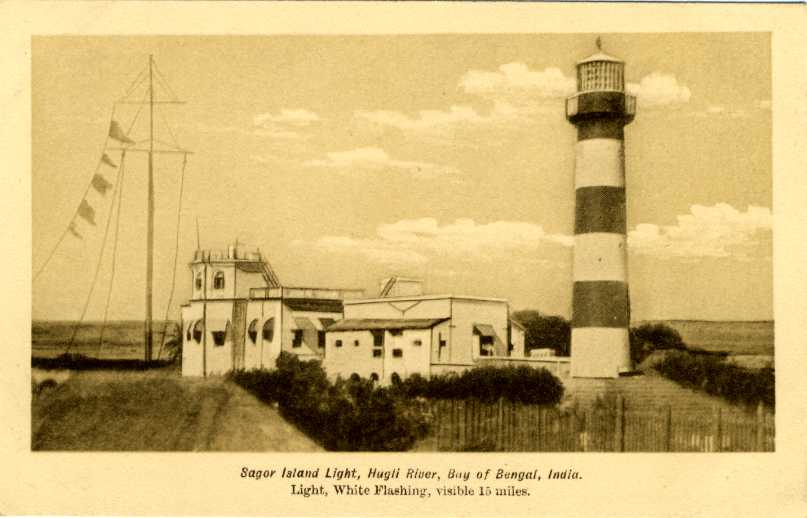
| Saugo Island Lighthouse |
Saugo Island is a large mainly silt
island that lies at the eastern edge of the Hooghly River in the delta areas
south of the massive city of Calcutta-Kolkata.
During the past 40 years or more, something like half of the island has
been washed away, due to storms and rising ocean levels.
As a matter of interest, the Saugor
Island Lighthouse became famous in 1934 when a rocket containing special postal
mail exploded overhead. Most of the
scattered items of postal mail were recovered, and the lighthouse keeper
postmarked them in the lighthouse.
But, back to the wireless scene . . . what would now be described as a primitive
spark wireless station was installed on Saugor Island in 1902. It would be suggested that this new wireless
station was installed at the lighthouse on Saugor Island. The antenna system was attached to a mast
standing 120 feet tall.
Two way communication in Morse code was
achieved between Saugor Island and another equally primitive wireless station
that was installed on a government control ship, the Eastern Channel Lightship,
in 1902. This ship was stationed further
out into the Bay of Bengal at Sandheads, a cluster of low mainly silt islands
near which was the gathering point for incoming shipping.
These ships were awaiting the small
pilot vessel to take them one by one into the wharves at the city of
Calcutta. Initially, the wireless call sign on board the Lightship was
ROS, though subsequently the call was changed to VWS.
Two years later (1904), new and
upgraded equipment was installed on Saugor Island; and additionally, a new set
of equipment was also installed on a newly built pilot vessel that had just
been obtained from England, the Fraser.
Give a few more years, and another
wireless station was installed at Diamond Harbour in the waterways of Calcutta
itself. This station was moved soon
afterwards to nearby Budge Budge, and subsequently again, to Calcutta
South.
The original call sign of this
Calcutta station was ROC, though soon afterwards it became WCA. However, another change of call sign provided
what has since become a permanent call sign for the maritime communication
station in the Calcutta-Kolkata area, the now well known VWC. This station is still on the air to this day,
with weather information, time signals, and shipping communication.
In August 1904, another set of three
wireless stations was installed across the other side of the Bay of
Bengal. These three stations were
installed at Diamond Island in Burma-Myanmar;Table Island in the Andamans; and
Port Blair, also in the Andamans.
The key station in this threesome
was located on Diamond Island, Burma which is not to be confused with Diamond
Harbour in Calcutta. This Burmese
station was installed on Diamond Island which is located at the delta mouths of
the Irrawaddy River, and it was intended for communication with Port Blair in
the Andaman Islands.
The original 1904 transmitter on
Diamond Island was rated, strange as it may seem to us today, at ½ hp horse power, though in March of
the following year (1905) a 3 hp transmitter was installed. The original calls ign for the Diamond Island
wireless station was ROD, and this was changed to VTD around the time when
World War 1 began (1914).
Initially, the location for the
destination wireless station in this threesome was intended to be Ross Island,
just three miles east of Port Blair on South Andaman Island. At the time, the British administration of
the Andaman Islands was located on Ross Island.
However, an assessment study
demonstrated that there was no suitable location for the wireless antenna
system on small Ross Island, so the project was transferred to the “mainland” on South Andaman
Island. The actual location for the Port
Blair wireless station was at Aberdeen, immediately north of the women’s
prison.
Initially, the wireless equipment
was installed temporarily in a small cluster of tents. The first transmitter for Port Blair was
rated at ½ hp, and the
allotted call sign was ROP. During a
series of test transmissions on November 1, 1904, station ROP was heard clearly
with a set of similar equipment aboard the ship Minto in Port Blair
Harbour. Nearly 8 weeks later on
December 22 (1904), direct communication was achieved between stations ROP Port
Blair and ROD Diamond Island.
In January (1905), construction work
was completed on the brick buildings for the wireless station at Port Blair and
the electrical equipment was transferred from the tents into the new
substantial facility. In March (1905), a
new 3 hp transmitter was also installed here at Port Blair. The Port Blair call sign was also changed
around the time when World War began (1914) and ROP became VTP.
Back during that same era, an
intermediate relay station between ROD Diamond Island and ROP Port Blair was
installed on a small island in the lengthy chain of islands that run down south
from the Irrawaddy delta in Myanmar to Sumatra in Indonesia. Generally speaking, the intermediate relay
station was identified as Table Island, though in reality it was installed on
the much smaller Slipper Island.
Strangely, there are two small
islands in this same chain of islands that are identified on the map as Table
Island; and back then, the location for each was given as the Andaman
Islands. One Table Island is located
just off the east coast of North Andaman Island. This Table Island is a mile long; it is less
than a quarter mile wide; it is shaped like the Australian boomerang; it has
never been inhabited; and there never was a historic wireless station on that
island.
The other Table Island is in the
Coco Islands belonging to Burma, not in the Andaman Islands belonging to
India. However back then, all of the
islands in the chain of islands running down south from the Irrawaddy delta in
Burma/Myanmar towards the island of Sumatra in Indonesia were known as the Andamans. And in addition, during the earlier colonial
era, Burma itself was administered as part of British India.
This Table Island is an irregularly
shaped island that is situated a little north of Great Coco Island. An iron lighthouse was installed on the
southwest edge of Table Island in 1867, and it can still be seen on Google
Earth to this day.
Slipper Island is a very small
island to the west of Table Island and it is connected by a sand bar that is
above water level at low tide. On November 30, 1904, a small party of
wireless personnel arrived at this Table Island in order to choose a suitable
location for the intermediate wireless relay station. However, they chose Slipper Island instead
because it was as far west as possible.
On January 11 of the next year
(1905), installation of the new wireless station, the ½ hp transmitter under the call sign
ROI, was completed, and next day Morse Code communication was made with station
ROD Diamond Island. Three weeks later on
January 30 (1905), all three stations achieved satisfactory intercommunication
in Morse Code: ROD Diamond Island, ROI Slipper Island, and ROP Port Blair.
As with Diamond Island and Port
Blair, a new 3 hp transmitter was installed on Slipper Island in March (1905),
and Slipper Island was given a new call sign in 1914; ROI became VTT.
That was the story of the wireless
stations in East India during the era before World War 1. When the war began (August 1914) there were 5
wireless stations in two different networks in regular service in the Bay of
Bengal area:-
1. VWC Calcutta, VWS Sandheads
2. VTD Diamond Island,
VTT Slipper-Table Island (Andamans), VTP
Port Blair
(AWR-Wavescan 448)