Wednesday, June 18, 2008

Wind-up radios banned in Zimbabwe


Wind-up radios are 'tools of subversion'

Authorities in Zimbabwe have banned wind-up receivers, a favourite among nongovernmental organisations seeking to promote access to information in rural areas. Their presence has often spawned listening clubs accused of tuning in on “illegal” foreign news bulletins broadcast on shortwave. Batteries are almost unavailable in Zimbabwe. Along with satellite dishes, ownership of a wind-up radio is enough to land villagers in trouble. “They have been warned that they must hand in those radios. It has become a subversive tool,” says Rob Jamieson, chairperson of the Southern Africa Editors’ Forum. “It is quite shocking to see the situation in Zimbabwe. No professional media in Zimbabwe can operate,” says Jamieson, who was part of a week-long mission that went to Zimbabwe.
(Source: ZWNews via R Netherlands Media Network Weblog)

New QSL offer from Radio Free Asia

As a reminder to our blog readers, Radio Free Asia has announced that RFA is offering its 21st QSL card honoring German physicist and radio pioneer, Heinrich R. Hertz. This is the second QSL card in their “radio pioneer” series. Heinrich Rudolph Hertz (1857 - 1894) was the first to broadcast and receive radio waves. He demonstrated the existence of electromagnetic waves by building equipment that not only produced radio waves, but also detected them. His experiments with electromagnetic waves led to the development of the wireless telegraph and the radio. His name is also used for radio and electrical frequencies; hertz (Hz). The QSL card will be issued for all valid RFA reception reports from April 1 to June 30, 2008.

Future QSL cards will include other radio pioneers like Nikola Tesla, Reginald Fessenden, and others. RFA encourages listeners to submit reception reports. Reception reports are valuable to RFA as they help the station evaluate the signal strength and quality of transmissions. RFA confirms all accurate reception reports by mailing a QSL card to the listener. RFA welcomes all reception report submissions at www.techweb.rfa.org/ (follow the QSL REPORTS link) not only from DX’ers, but also from its general listening audience. Reception reports are also accepted by email at qsl@rfa.org and for anyone without Internet access, reception reports can be mailed to:
Reception Reports
Radio Free Asia
2025 M. St. N W - Suite 300
Washington DC 20036 USA

Upon request, RFA will also send a copy of the current broadcast schedule and a station sticker
(Source: Richard D`Angelo/DXplorer)

Former radio announcers cite contemporary Voice of Free Indonesia announcers

Old radio hands reunite, fault gap in foreign language skills

Former radio announcers of the Voice of Free Indonesia (VOFI) have criticized contemporary announcers for their low proficiencies in foreign languages, especially English. “They must improve their language skills because the radio programs are broadcast all over the world,” Zuraida “Ida” Rosihan Anwar said on Monday.
“Most announcers used to speak more than one foreign language like Dutch, English, French and German, fluently. Today, I see current announcers have limited capacity to speak foreign languages. They should train more,” said Ida, who speaks English and Dutch. Ida, 84, was one of the VOFI’s first announcers.
She was speaking at a talk show to celebrate the spirit of independence in conjunction with the radio station’s 62nd anniversary with several of her former colleagues.
Read complete story from The Jakarta Post at:
http://www.thejakartapost.com/news/2008/06/17/old-radio-hands-reunite-fault-gap-foreign-language-skills.html
(Source: R Netherlands Media Network Weblog)

Insight Central Europe website temporarily suspended

The Insight Central Europe website http://incentraleurope.radio.cz/ice is not operating. A banner reads "We're sorry to inform you that the Insight Central Europe web site has been temporarily suspended. We hope to be back in action in November. Thank you for your understanding. The Insight Central Europe team."

You can still listen to Insight Central Europe here:
http://incentraleurope.radio.cz/ice/listen
Or catch a poadcast at:
http://oe1.orf.at/podcast/

Insight Central Europe is the weekly roundup of news and features from Austrian Radio, Polish Radio External Service, Radio Prague, Radio Budapest, Radio Slovakia International, and Radio Slovenia International. As well as the shortwave offerings, normally heard on Saturdays at 1205 UTC via Polish Radio External Service, it is available on CBC Overnight on local Monday mornings at 0430 UTC.
(Source: Mark Coady via ODXA)

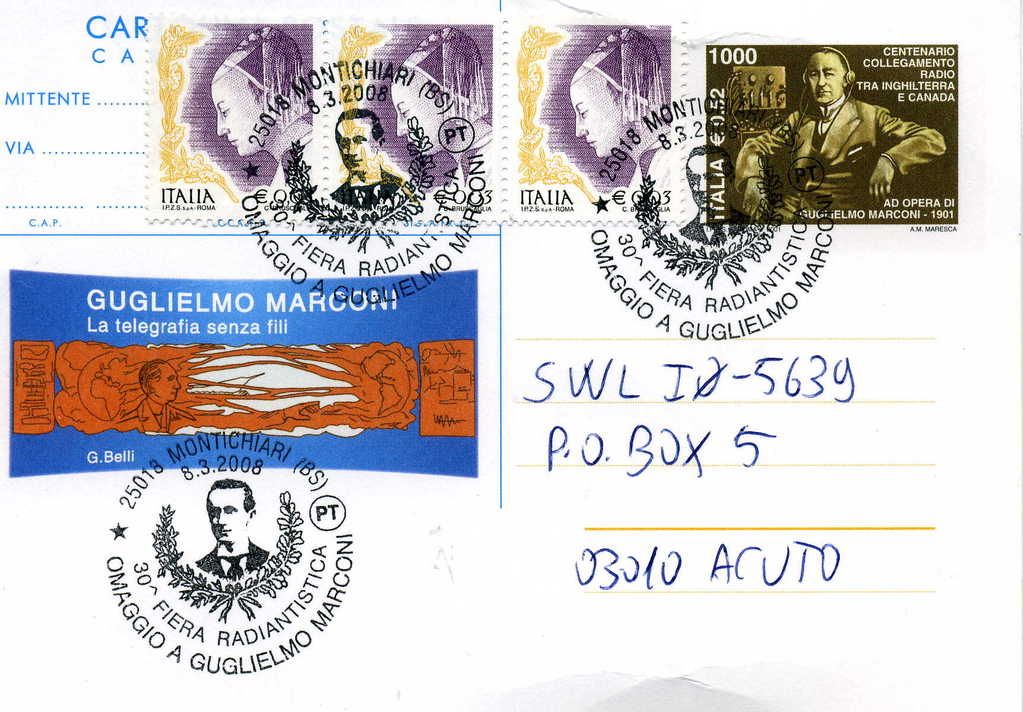
Marconi Special Stamp and Card


I have received from the Italian Posts the special philatelic stamp with Guglielmo Marconi from the 30th radio exposure of Montichiari (BS).
The picture with the special card to commemorate the 100 years of the first transoceanic transmisison is available here: http://i259.photobucket.com/albums/hh311/francesco1958/File0359.jpg
(Source: Francesco via Larry Van Horn)

Frequency change from Radio Sweden

Because of schedule changes, Radio Sweden will no longer be relaying programs from Swedish Radio's domestic service between 20:00 and 21:00 hrs UTC. They're being replaced with Radio Sweden programming, which means that the English broadcast to Africa at 20:30 hrs UTC will also be carried on medium wave 1179 and shortwave 6065 kHz to Europe. They will return to the previous schedule on August 18, 2008.
(Source: Alokesh Gupta, India)

Tuesday, June 17, 2008

WWCR - A08 summer revisions


USA, WWCR - A08 English summer revisions
Nashville, Tennessee


All times UTC - broadcast targeted to North America

0000-0100 5070 5935 7465 9980
0100-0200 5070 5935 7465 9980

0200-0300 3215 5070 5890 5935
0300-0400 3215 5070 5890 5935
0400-0500 3215 5070 5890 5935

0500-0600 3215 5070 5890 5935
0600-0700 3215 5070 5890 5935
0700-0800 3215 5070 5890 5935
0800-0900 3215 5070 5890 5935

0900-1000 5070 5890 5935 9985
1000-1100 5070 5890 5935 15825
1100-1200 5935 7490 9980 15825
1200-1300 7490 9980 13845 15825
1300-1400 7490 9980 13845 15825
1400-1500 7490 9980 13845 15825
1500-1600 7490 9980 13845 15825
1600-1700 9980 12160 13845 15825
1700-1800 9980 12160 13845 15825
1800-1900 9980 12160 13845 15825
1900-2000 9980 12160 13845 15825
2000-2100 9980 12160 13845 15825
2100-2200 7465 9980 12160 13845
2200-2300 5070 7465 9980 13845
2300-0000 5070 7465 9980 13845
(Source: Gayle Van Horn/Monitoring Times SW Guide/WWDXC BC-DX May 24)

Breaking News: Back to Battle in Chad

Chad - Rebels take third town
Chadian rebels claimed to have taken the town of Biltine, some 750 kilometres from the capital of Ndjamena, their stated objective, on Monday. Biltine is the third town rebel forces have taken since their offensive against President Idriss Deby’s government began on 11 June. Additional story at: Radio France International website: www.rfi.fr/actuen/articles/102/article_714.asp

Chad town 'under attack by Sudan'
The Chadian government has accused Sudan's army of attacking a town on their border after days of rebel raids. Communications Minister Mahamat Hissene told the BBC that the garrison town of Ade had been attacked by ground troops supported by helicopters. Mr Hissene said the fighting was continuing and confirmed a rebel raid on the smaller town of Am Zoer. Last month, Sudan accused Chad of helping a Darfur rebel group attack a city just outside the Sudanese capital.
Additional story from BBC News:
http://news.bbc.co.uk/2/hi/africa/7459025.stm

Chad accuses Sudan of attacking eastern border
By Finbarr O'Reilly
Reuters
Tuesday, June 17, 2008; 8:22 AM
ABECHE, Chad (Reuters) - Chad accused Sudan's army of attacking a town on its eastern border on Tuesday and blamed its neighbor for Chadian rebel raids which have disrupted international aid operations to help thousands of refugees. Additional story from Washington Post:
http://www.washingtonpost.com/wp-dyn/content/article/2008/06/17/AR2008061700695.html

Chad Rebels Vow to Push on Despite Peacekeepers
VOA News http://www.voanews.com/english/2008-06-15-voa22.cfm

Rebels advancing on Chad capital
Radio Netherlands Worldwide News reports: Rebels in Chad are continuing their march towards the capital N’Djamena.The move follows heavy fighting around the city of Goz Beida, 75 kilometres from the Sudanese border. The rebels, who want to overthrow President Idriss Deby, are threatening to occupy the capital within a few days. Radio Nationale Tchadienne is normally well heard in Europe in the evenings on 4905 kHz. This is a frequency worth monitoring in the coming days.
(Source: R Netherlands Media Network Weblog)

Current shortwave schedule

Rdif. Nationale Tchadienne, N'Djamena-Gredia
4905 / (check 7120 kHz)
0427-0730 UTC 4905 kHz (French, Arabic, vernaculars)
1600-2130 UTC 4905 kHz (French, Arabic, vernaculars)
1700 Arabic news
1900 French news
Station identification as; "Tchad"
(Source: DBS Survey 2008)

Recent loggings of Chad on shortwave
All times UTC *sing-on sign-off*

7120, Rdif. Nationale Tchadienne, N'Djamena-Gredia; 2225-2232*, June 14, African music. Sign off with national anthem. Poor in noisy conditions. (Brian Alexander, PA/June 15)

7120, Rdif. Nationale Tchadienne, N'Djamena-Gredia; *0433-0505, June 15, abrupt sign on with local African music. French announcements. Local choral music. Poor. Weak at sign on under a strong BBC but slowly improved to a fair level by 0445 but mixing with co-channel BBC. (Brian Alexander, PA/June 15)

7120, Rdif. Nationale Tchadienne, N'Djamena-Gredia; 0450-0530, June 14, local African music. French talk. Poor to fair mixing with co-channel BBC. (Brian Alexander, PA/June 14)

4904.97, Rdif. Nationale Tchadienne, N'Djamena-Gredia; 0431-0450, May 29, local Afro-pop music. French talk. Fair to good. (Brian Alexander, PA/May 29)

4905, Rdif. Nationale Tchadienne, N'Djamena-Gredia; 0550-0601. French service. Native tribal music with lots of drumming and mentions of Chad. Into Middle Eastern language language at 0600. Signl S7/fair. (J Wood, TN/May 08)

Additional coverage on Chad from Shortwave Central Archives:
Blog Logs
Chadian national radio operating from temporary studio/Feb. 2008
Chad radio and TV back on the air/Feb. 2008
Breaking News: National Radio destroyed in Chad/Feb. 2008
Rebels put Chad off the air/Feb 2008
Hot Spot DXing: Chad/Feb. 2008

WEWN - A08 summer schedule

USA, WEWN Global Catholic Radio
Vandiver, Alabama

All times UTC
Target Areas: af (Africa) as (Asia) me (Middle East) eu (Europe)

0100-0200 11520me
0200-0300 11520me
0300-0400 11520me
0400-0500 11520me
0500-0600 11520me
0600-0700 7570eu
0700-0800 7570eu
0800-0900 9355as
0900-1000 9355as
1000-1100 9355as
1100-1200 11560as
1200-1300 11560as
1300-1400 11560as
1400-1500 15855as
1500-1600 15855as
1600-1700 15855as
1700-1800 15855as
1800-1900 15855as
1900-2000 17595af
2000-2100 17595af
2100-2200 17595af
2200-2300 15665af
2300-0000 15665af
(Source: Gayle Van Horn/Monitoring Times-SW Guide)

DXers Unlimited - mid week edition June 17-18

Radio Havana Cuba
Dxers Unlimited
By Arnie Coro CO2KK

Hi amigos radioaficionados, welcome to the mid week edition of Dxers Unlimited at a moment when the 2750 megaHertz solar flux is very near to the lowest ever recorded levels since 1947, when Professor Arthur Covington of Canada started to monitor the Sun at microwave frequencies on a daily basis. Solar flux was at 65 units , a value very close to the minimum ever recorded. So, as may realize the daytime maximum useable frequency curve is showing a very slow build up, and is peaking at extremely low values, with the typical highest possible frequency propagating via the F2 layer not reaching higher than about 20 to 24 megaHertz and that´s for very short periods of time.

More about the very low solar activity and how it may be actually enhancing sporadic E layer propagation at the end of the program.

Item Two: Handling the daily influx of e-mail sent by Dxers Unlimited listeners around the world is quite a task amigos ! But I do enjoy it a lot, because some very interesting topics are suggested, questions asked allow me to provide useful answers not only for the person or persons who sent the question, but also for many other listeners of the program… You can send your signal reports , QSL requests for station verification of reception radio hobby related questions , and comments about the show. Send them to inforhc at enet.cu, again inforhc at enet.cu... Or VIA AIR MAIL, send your postcards and letters to Arnie Coro, Radio Havana Cuba, Havana, Cuba.

Now here is Item Three of the mid week edition for Tuesday June 17 and Wednesday June 18th UTC days…Software defined radios are now becoming more and more both builder and user friendly… Several kits now available provide prospective homebrewers with a much faster way of assembling a software defined radio than what may be possible by attempting to buy or ask for all the required electronic components to make a Software Defined receiver or transceiver… For advanced radio hobbysts familiar with assembling electronic projects, I think that experimenting with software defined radios will provide a lot of very interesting results, and open up new ways of enjoying our hobby.

Item Four: Indoor antennas are useful when there is bad weather and you do need to communicate. More about indoor antennas for emergency communications in just a few seconds, when Dxers Unlimited´s mid week edition continues after a station ID.

I am Arnie Coro, radio amateur CO2KK in Havana…
……..

Si amigos ! You are listening to the mid week edition of your favorite radio hobby program, Dxers Unlimited with yours truly Arnie Coro … Here is now our technical topics section on indoor antennas for emergency communications .

Indoor antennas are no match to well installed outdoor ones, but under some very special circumstances, your only option for providing the antenna required by your radios may be to carefully select the best location inside a building and proceed to install an indoor antenna system.

I have seen extremely well designed indoor antennas that provide those who use them with very effective reception and transmission. In order to make this description a bit more flexible, my concept of an indoors antenna system includes those that are installed in balconies and attached to balcony rails.

At CO2KK , my amateur radio station, there are not one, but five different indoor antennas that see almost constant daily use.

Let me describe them for you in detail:

Number One :The telescopic whips used on my three portable multi-band receivers…

Number Two: A dual band 2 meters and seventy centimeters vertical monopole antenna that is used for monitoring the two local 2 meters FM repeaters, and also to make local contacts on that band and on 70 centimeters.

The number Three indoor antenna is a MOXON rectangle for the two meters band that is installed , when needed, on a camera tripod so that it can be aimed in the direction of the station or repeater I want to contact.

Number Four indoor antenna is a one meter diameter 19 millimeters tubing copper loop…Yes, it is tuneable magnetic loop that covers from 10 to 30 megaHertz for reception and that allows transmission on the 30, 20, 17,15 , 12 and 10 meters band, so this is in my opinion the most compact six band antenna that one can imagine. It is manually tuned, and YES, you have to retune it everytime that you need to shift frequency by even a few kiloHertz , but it allows me to be on the air , especially on 10 meters when the band is open and I don´t want to connect the outdoor beam because the presence of thunder clouds in the sky.

Finally my Fifth but not less important indoor antenna is another magnetic loop optimized for the 6 meters or 50 megaHertz band and that is kept close to a picture window. I use this smaller loop to monitor for possible 6 meters DX during the sporadic E season, that here in Cuba happens to coincide with the peak of the summer thunderstorm season….

An interesting fact about the use of indoor antennas is that their performance is very much related to the type of material used for building your home. An antenna located inside an attic that is high above the ground and has no metal elements inside its walls, will show a much better performance than an identical system that is installed inside a room of a house built with brick walls and a reinforced concrete roof. Signals , both the ones to be received and those transmitted will suffer from severe attenuation , reaching values of many decibels as compared with an identcial antenna inside the wooden wall and roof attic !!!

Please remember that just a small antenna is better than a telescopic whip or a rubber duck helically loaded whip… something that applies for both short wave and VHF operation.

Even a short length of hookup wire attached to your portable radio´s antenna and placed as near as possible to a window, or even just dropped from the window or balcony will make quite a difference , although careful placement of the indoor or semi-indoor antenna is necessary in order to reduce the pick up of interference from home appliances of all types…

If you need advice on installing an indoor antenna , just drop me an e-mail and I´ll try to provide you with advice according to
the frequencies involved and the type of building .
……

This is Dxers Unlimited´s mid week edition and now here is ASK ARNIE, la numero UNO, the number one most popular section of the program… Listener Gabriel from Atlanta , Georgia, USA, wants to know what´s the best time or times of the day to pick up Sporadic E skip signals… He says in his e-mail: Arnie, I agree with you that HF , that is short wave propagation is worst than ever… Having listened to international broadcasts for the past 30 years, I have never before experienced such poor propagation conditions. Recently I became interested in FM broadcast band Dxing, one of those 84 ways of enjoying the radio hobby that you have described. And Gabe continues his e-mail describing his nice vintage Scott FM tuner that has an ECC88 cascode RF amplifier and outperforms his two other solid state FM receivers in a very significant way… Gabe says that he is using two antennas for FM Dxing, one is a commercial log periodic fed with 300 ohms low loss foam dielectric line, and the other antenna was built following instructions provided in one of my articles about the TTFD published by CQ-VHF Magazine many years ago.

Gabe ends his nice e-mail message with the question that I repeat now ¨¨ Arnie, what are the best times for Sporadic E summer DX ¨¨… Well amigo Gabriel,or Gabe as you like to be called, it is an interesting fact that Sporadic E propagation events can happen at anytime of the day, but they do show ,during the summer months a much higher probability of happening from about 9 in the morning or a little earlier local time, to about an hour before noon, and again, there is another period of higher probability of E skip from about three to four o´clock in the afternoon to just after sunset, again, I am talking about local time…

But be aware that in my more than 50 years of Dxing via sporadic E skip, I have made two way contacts on the 10 and 6 meter bands at two or three o´clock in the morning, as well as at one o´clock in the afternoon, when normally you don´t see E skip happening… By the way , we may soon be loosing one of the best sources of early warning of Sporadic E skip events , at least here in the Caribbean, and the USA, when next year the analog TV stations in the United States of America will shut down, and be replaced by digital technology signals !!! so for those Dxers, both TV and amateur radio VHF enthusiasts that don´t have bought a digital TV or a converter box, the familiar pattern of venetian blinds atop a fringe area TV channel two or even a local powerhouse when the band is really open will be a thing of the past…

That´s why amigo Gabe, amateur radio 10 and 6 meter band beacons will become much more important for us to learn when E skip is present !!! I hope that this reply answers your question and congratulations on your nice FM broadcast band Dxing setup amigo !!!

FM broadcast band Dxing is quite a challenge for people living in metropolitan areas where cross modulation problems are a tremendous problem… but those of you living away from the big cities and having a good receiver or FM tuner can still enjoy FM broadcast band DX events both via tropospheric ducting or Sporadic E.
……………

Technical Tips, yes Technical Tips here at Dxers Unlimited´s mid week edition… For your radio hobby enjoyment… Here is the first one: Whenever you buy or get a free piece of old equipment, be it full of vacuum tubes or solid state devices… NEVER, , again NEVER connect it to the power line if it is an AC operated radio, before making a very detailed visual inspection INSIDE… Look for electrolytic capacitors that may be leaking , signs of overheated transformers, and in the case of equipment in long storage signs of mildew and humidity damage.

After the visual inspection, if no signs of those typical problems are found, then phase two of a start up procedure for gear in long term storage will be to carefully test all the electrolytic capacitors using an Equivalent Series Resistance or ESR meter… go one by one, be patient and you will be rewarded usually with the detection of one or more capacitors that will need to be replaced… Proceed to replace them, and when powering up the equipment use a variable voltage autotransformer to carefully provide AC to the radio… I usually start with 25 volts and leave it there for a number of hours… jump then to 50 volts and monitor the AC current drawn by the radio under the revival process…after about a day at 50 volts, it will be usually safe to raise the voltage o 100 volts and watch for any signs of overheating or excessive current drawn from the variable

voltage transformer …Just before I forget… in older vacuum tube radios, it will always a good idea to replace all the paper dielectric bypass capacitors too… a time consuming procedure, but one that will save you from having to replace much more expensive and hard to find components !!!...

And now as always at the end of the show, here is Arnie Coro´s Dxers Unlimited´s HF plus low band VHF propagation update and forecast…. Bottom low solar activity, extremely low F2 layer maximum useable frequencies, while plenty of E skip events are happening over North America, the Caribbean, Central America and Europe with some unique DX on 6 meters from half way around the world coming to the surprise of long time operators on the so called MAGIC BAND---The effective sunspot number at 15 hours UTC Tuesday was an extremely low ZERO TWO <… A close look at the Sun shows we still have the remains of old sunspot 998, but we have are seeing a sunspot group, 999. This one is almost on the sun's equator and like 998 has a a clear cycle 23 magnetic signature. The flux has dropped to a bottom low level of 65 units and the K index was lower at just 4, units at around 14 UTC Tuesday with the solar wind well over 700 kilometers per second but it's unlikely we'll have auroral conditions in the near future. Due to the higher solar wind there may be some disturbance from minor geomagnetic storming especially towards the poles.

One final note that is causing concern among solar scientists..
Unfortunately it looks like we have a lot further to go before we can be certain that we have actually reached the minimum of cycle 23 yet !!!
(Arnie Coro)

Monday, June 16, 2008

Zimbabwean opposition station adds broadcast tranmission


Voice of the People, a Zimbabwean opposition station via Talata-Volondry, Madagascar, has begun a new transmission from 1100-1200 UTC in English on 11695 kHz from June 1, 2008. The broadcast in targeted to South Africa 250 kW / 265 deg.

Radio VOP began broadcasting in June 2000, ten days before the Zimbabwean parliamentary elections held on June 24-25, 2000. The station continues to promote peace in the ongoing troubled political times with hopes of building a democratic society. Station is reportedly being jammed by the Zimbabwe government.

Correspondence may be directed to:

Radio Voice of the People
P.O. Box 5750
Harare
Zimbabwe

Reception Report: voxpozim@yahoo.com.uk
Website: http://www.vopradio.co.zw/
Website: (24 hour news site) http://www.radiovop.com/
Email: voxpop@ecoweb.co.zw
(Source: World QSL Book & DX Mix News # 525)

Albania frequency adjustments from June 12


The following frequencies changes from Radio Tirana are effective from June 12, 2008

All times UTC

1730-1800 7460 SHI 100 kW / 300 deg to Western Europe , deleted in Italian Mon-Sat

1800-1830 new freq 7430 SHI 100 kW / 300 deg to Western Europe, retimed in Italian Mon-Sat

1805-1835 1458AM FLA 500 kW / 338 deg to Western Europe (ex 1800-1830 UTC German Mon-Sat)

2000-2030 new freq 7465 SHI 100 kW / non-dir to U.K. (ex 7460) in English Mon-Sat

2030-2200 new freq 9395 SHI 100 kW / 310 deg to Western Europe (ex 9390) in Albanian Daily

2300-0030 new freq 9345 SHI 100 kW / 310 deg to North America (ex 9390) in Albanian Daily (R BULGARIA DX MIX News, Ivo Ivanov, via wwdxc BC-DX June 16/ DX Mix news #525 via wb, Germany)

VT Communications schedule adjustment

Via South Africa in English
Southern Sudan Interactive Radio Instruction to Eastern Africa
1300-1330 UTC on new frequency 15760 MEY 250 kW / 005 deg Mon/Wed/Fri (ex 15485)
(R BULGARIA DX MIX News, Ivo Ivanov, via wwdxc BC-DX June 16/ DX Mix News #525 via wb, Germany)

Deutsche Welle changes German service frequency


via Sri Lanka from June 10, 2008

German 1600- 1800 UTC new freq 15485 TRM 250 kW / 255 deg to Central Africa (ex 17650)
(R BULGARIA DX MIX News, Ivo Ivanov, via wwdxc BC-DX June 16/ DX Mix News #525 via wb, Germany)

WYFR-Family Radio Worldwide expands English broadcast


Additional transmissions in English noted as;

Via United Arab Emitaes & United Kingdom

All times UTC

1800-2000 on 11775 SKN 250 kW / 165 deg to Western Europe
1900-2000 on 9685 DHA 250 kW / 260 deg to Western & Central Africa
(R BULGARIA DX MIX News, Ivo Ivanov, via wwdxc BC-DX June 16/ DX Mix news #525 via wb, Germany)

Radio Sweden English A08 summer schedule update


All times UTC

English to Europe, Africa and Middle East
1430-1500 on 13820
1530-1600 on 11595, from June 12 back on old 11590
1730-1800 on 6065 Wed-Fri
2030-2100 on 7395
2130-2200 on 6065

English to Asia & Pacific
0230-0300 on 11550
1330-1400 on 15735
1430-1500 on 13820

English to Australia
2130-2200 on 7420

English to North America
0130-0200 on 6010
0230-0300 on 6010
1230-1300 on 15240
1430-1500 on 15240
2230-2300 on 9800 DRM
(R BULGARIA DX MIX News, Ivo Ivanov, via wwdxc BC-DX June 16/ DX Mix news #525 via wb, Germany)

Radio Japan changes multilingual frequencies


Germany
Frequency changes of Radio Japan NHK World via Media Broadcast

All times UTC

1300-1345 new freq 15215 WER 500 kW / 075 deg to South Asia in Bengali (ex 17595)
1345-1430 new freq 15215 WER 500 kW / 090 deg to South Asia in Hindi (ex 17595)
1430-1515 on 17595 WER 500 kW / 090 deg to SoAs in Urdu, co-channel Radio Exterior-Espana in Spanish
(R BULGARIA DX MIX News, Ivo Ivanov, via wwdxc BC-DX June 16/ DX Mix News #525 via wb, Germany)

Radio Sweden multilingual A08 summer schedule update


All times UTC

Arabic to Middle East
1730-1800 on 11555 Mon-Fri

Assyrian to Middle East
1600-1630 on 11590 Thu/Fri

Belarussian to Europe
1730-1800 on 6065 Sat-Tue

Kurdish to Middle East
1630-1700 on 11590 Mon-Fri

Persian to Middle East
1600-1630 on 11590 Mon-Wed

Romany to Europe & Middle East
2030-2100 on 5850 Sat
2100-2130 on 5850 Sat/Sun

Russian to Europe & Asia
1200-1230 on 15525
1300-1330 on 12075
1400-1430 on 12085
1630-1700 on 7480
1830-1900 on 6065
1930-2000 on 6065

Swedish to Europe, Africa & Middle East
0400-0600 on 6065*Mon-Fri
0400-0500 on 9490*Mon-Fri
0500-0805 on 9490*Sat
0600-0700 on 9490*Mon-Fri
0700-0900 on 9490*Sun
1445-1615 on 6065*Mon-Fri
1445-1600 on 6065*Sat
1500-1530 on 11595, from June 12 back on old 11590
1600-1630 on 7480
1700-1730 on 6065
1700-1730 on 11555 Mon-Sat
1800-1830 on 6065 13710
1900-1930 on 6065
2000-2030 on 7395
2000-2100 on 6065*
2100-2130 on 6065
*relay HS-1

Swedish to Asia & Pacific
1200-1215 on 15735 Mon-Fri
1200-1230 on 15735 Sat/Sun
1315-1330 on 15735 Mon-Fri

Swedish to Australia
0200-0230 on 11550
1215-1230 on 15735 Mon-Fri
1300-1315 on 15735 Mon-Fri
1300-1330 on 15735 Sat/Sun
1400-1430 on 13820 15735
2100-2130 on 7420

Swedish to South America
0000-0030 on 9490
0300-0330 on 9490
1800-1830 on 13710

Swedish to North America
0100-0130 on 6010
0200-0230 on 6010
1300-1330 on 15240
1500-1530 on 15240
(R BULGARIA DX MIX News, Ivo Ivanov, via wwdxc BC-DX June 16/ DX Mix news #525 via wb, Germany)

Iran replace Japanese service frequency

VOIRI/ IRIB has made the following frequency change for their Japanese service.

2100-2157 UTC on new frequency 11765 SIR 500 kW / 053 deg. (ex 11655 to avoid Radio Australia in English on 11660 kHz)
(R BULGARIA DX MIX News, Ivo Ivanov, via wwdxc BC-DX June 16/ DX Mix Nws # 525 via wb, Germany)

Sunday, June 15, 2008

Japanese assistance to Bhutan Broadcasting Service

Bhutan
Monday, June 2: The Japanese government will be giving a grant assistance of about Nu. 240 million to the . BBs in exchange of notes to formalizethe grant was signed in New Delhi On Friday, May 30. It was signed by Bhutan's Ambassador Lyonpo Dago Tshering and the Japanese Ambassador Hideaki Domichi. The money that will be given to BBS will be used to enhance programme production and news coverage by upgrading facilities and equipment, setting up a master control system and establishing transmission system for the BBS bureau offices.
(BBS via Alokesh Gupta, India)