Showing posts with label Africa. Show all posts

Monday, June 03, 2013

Focus on Africa - Sierra Leone

Radio Broadcasting in the Land of the Mountain Lion -  4: Relay Services

From the very earliest days, the various radio broadcasting services in Sierra Leone were very dependent upon the relay of available programming from other sources as a supplement to that which was produced locally in their own studios.  For a lengthy period of nearly three-forth's century, the BBC London was heard over local distribution in Freetown.
            Beginning at the time when the cable radio service was implemented in 1934, most of the programming that was provided by wire to the connected homes in Freetown was an off air relay from the BBC in London, their Empire Service and their services to Africa on shortwave.  The cable system was in operation for some thirty years and the BBC programming was piped into the rediffusion system with the insertion of very little local productions, and that quite frequently just for special events.
            For a total of sixty six years, the BBC programming was heard in Sierra Leone consecutively via:-
                        Cable radio
                        Experimental shortwave from Freetown
                        SLBS itself from the shortwave station at Hill Station
                        SLBS shortwave from Goderich & Waterloo
                        SLBS on mediumwave from Goderich

            In recent years, right up to the present time, the BBC is still heard on radio in Sierra Leone, though now via dedicated FM relay stations in Freetown and the regional city Kenema.
            According to the information in several editions of the World Radio TV Handbook, the next relay service heard in Sierra Leone was provided, strangely enough, by Radio Moscow.  An off air relay of their news bulletin in English was heard on shortwave and mediumwave at 1700 UTC daily for a period of some fifteen years, beginning around 1968.  This programming was carried by all of the active transmitters in Sierra Leone at the time; mediumwave from Goderich and shortwave from Goderich & Waterloo.
            Shortly after the commencement of the relays of English news from the Radio Moscow World Service, a similar relay of news from the Voice of America was introduced into the programming from the Sierra Leone Broadcasting Service.  Initially, this was one bulletin of VOA news each day, though beginning around 1975, the duration of the daily relays from the VOA was increased.
            The WRTVHB shows the scheduling of VOA news at 1530 & 1600 UTC on all active transmitters in Goderich & Waterloo, shortwave & mediumwave.  However, it is quite possible that this relay from the Voice of America was actually continuous for at least an hour back during that era. 
            The SLBS relay of VOA programming ended simultaneously with the end of relay programming from the BBC & Radio Moscow, though these days VOA is heard on FM in Freetown 102.4 MHz.  There are no known FM relays in Freetown from Radio Moscow.
            The experimental programming from Deutsche Welle in Germany was on the air irregularly from the 250 kW shortwave transmitter at Waterloo in 1974 & 1975.  Station announcements in this DW programming were given in English, French & German, and the broadcasts identified the transmitter location as Waterloo.  These test broadcasts also included news and music.
            No information is given as to how the Deutsche Welle programming from Germany was received for rebroadcast in Sierra Leone.  It would be possible for this programming to be on pre-recorded discs or tape, or on live relay from regular DW programming, or via telephone lines from Germany, or even by local production at the SLBS studios in Freetown.
            However, two key items in the programming that was broadcast from Waterloo on behalf of Deutsche Welle would seem to indicate that the programming was prepared in the DW studios in Cologne in Germany and apparently fed to Freetown via a live relay from a communication transmitter.  The inclusion of the Waterloo identification would indicate specific programming, not a relay of regular programming; and the inclusion of news bulletins would indicate a live relay.  It is known that on a few occasions over the years, Deutsche Welle programming was carried via unannounced communication transmitters. 
            Only one QSL is known for the DW test broadcasts from Waterloo and that was received by Wendel Craighead of Prairie Village, Kansas in the United States for his reception report dated January 28, 1975.  This broadcast was heard on 5980 kHz and the programming consisted of news and music, with station announcements in English, French, and German, and specific identification of the Waterloo location.
            We could also mention that the United Nations also produced radio programming for broadcast into Sierra Leone, as did the Hirondelle Foundation in Switzerland which was also in some ways associated with the United Nations.
            On May 18, 2000, a total consignment of radio equipment was imported into Sierra Leone, and just four days later, the FM transmitter was inaugurated on 103 MHz.  This new station was identified as Radio UNAMSIL, Radio United Nations Mission to Sierra Leone. 
            Soon afterwards a 1 kW Harris shortwave transmitter was inaugurated on 6140 kHz, though the signal was usually noted slightly off channel around 6138 kHz.  The studios for this new station were installed in the Mammy Yoko Hotel at Aberdeen Beach Freetown; and the station was on the air twenty four hours daily.   
            Nine years late, that is in 2009, the station left the air; some of the programming was absorbed into the official SLBS government station and some of the equipment was donated to a local public service radio station.  A few international radio monitors were fortunate enough to receive a form letter QSL in response to reception reports on their shortwave channel.
            However, a couple of years before the termination of Radio UNAMSIL, the organization Hirondelle of Switzerland, established a radio broadcasting service for Sierra Leone.  This organization established a radio broadcasting studio in the Fourah Bay College of the University of Sierra Leone in Freetown. 
            This new broadcasting station was inaugurated in February 2007 under the slogan, Cotton Tree News.  In the center of Freetown there is a large and very old Cotton Tree, several hundred years old, and it is a national symbol for Sierra Leone, commemorating freedom for their people.  
            Initially, the broadcast of the programming from Cotton Tree News was heard in Freetown on FM, and throughout Sierra Leone via a relay on international shortwave.  The FM service was on the air twenty four hours daily with two channels in use, 103 MHz & 107.3 MHz.  The broadcast on shortwave was via the BBC relay station on Ascension Island for just half an hour daily on the channel 9525 kHz, though another channel 13760 kHz was in interim usage for just a short period of time.
            Two years after the inauguration of Cotton Tree on shortwave, a replacement relay was taken into usage, Rampisham in England on 11875 kHz.  The shortwave relays were discontinued in 2011, though the FM programming is still on the air on the single channel 107.3 MHz.
            We could also mention two other radio stations that were part of the broadcasting scene in Sierra Leone.  In 1991, a mobile transmitter under the legal government callsign for Liberia, ELBC, was on the air as the Voice of Peace, Harmony & Reconciliation.  The well known Danish international radio monitor Anker Petersen states that it was operated by the West African Peace Keeping Force.
            This mobile transmitter was actually located not in Liberia, but just across the border in Sierra Leone.  No channel is given though, as to whether it was operating on mediumwave or shortwave. 

            Then in May 2009, the American radio magazine, Monitoring Times, listed a new Gospel station at 10 kW for use on shortwave, though it apparently never got beyond the licensing stage.
(AWR Wavescan/NWS 222 via Adrian Peterson)


Monday, January 28, 2013

Focus on Africa


Radio Broadcasting in the Land of the Mountain Lion

As we have mentioned previously here in Wavescan, we are planning to present many topics throughout this year 2013 as part of our project, “Focus on Africa”.  We would like to encourage the shortwave scene in Africa, broadcasting as well as listening and DX clubs, and our opening feature today is another interesting topic about radio broadcasting in one of the countries of Africa. 

            The title for this feature is “Radio Broadcasting in the Land of the Mountain Lion”, and if you have already guessed that this country is Sierra Leone, you would be correct.  It was a Portuguese explorer, Pedro da Cintra, who visited coastal Africa in the year 1462 and he gave the name Sierra de Leao in Portuguese to this territory.  Some time subsequently, the territory name was changed to the Italian version, Sierra Leone, which means of course, Lion Mountain.

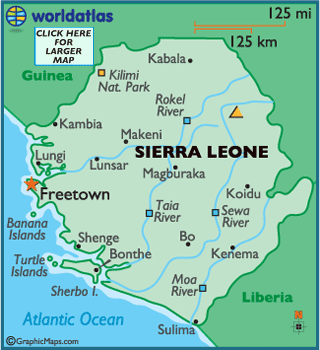
            The country of Sierra Leone is located towards the bottom of the western bulge in the continent of Africa.  It is in the shape of a rough circle about 200 miles across, with an Atlantic coastline of 250 miles.  The capital city is Freetown, and the Freetown Harbour is listed as the world’s 3rd largest natural harbor.

            The total population is around 7 million, made up of 16 different ethnic groups, though English is the national language.  Their major natural exports are diamonds, titanium & gold.

            Somewhere around 500 BC, the earliest settlers to migrate into the area were African tribals; and a thousand years later, this area became a major slave center for the Portuguese, Dutch, French & British empires.  However, on March 11, 1792, England established the colony of Freetown for freed slaves from the British Empire.  Sixteen years later, the settlement was annexed as a British Crown Colony.

            Sierra Leone gained its independence in 1961, and 10 years later it was declared a republic.   However, a disastrous civil war broke out in 1991, and this catastrophic era lasted for eleven years, ending only quite recently, in 2002.

            The radio broadcasting scene in Sierra Leone began in the earlier part of the 1930s as cable radio, or as it was known at the time, a rediffusion service.  The newly appointed governor, Sir Arnold Hodson, had recently transferred from the Falkland Islands, where he had already established a similar system. 

            The new cable radio for Freetown was inaugurated on May 7, 1934 at 7:00 pm when Governor Hodson spoke into a microphone at Wilberforce Memorial Hall and declared the system open.  This was the 1st cable radio system in West Africa, and subsequently Governor Hodson established his 3rd rediffusion service in Accra in the Gold Coast soon after he was transferred there to serve as governor.

            The cable radio system in Freetown was distributed by wire to the residents and the daily programming was mainly a relay of BBC programming received on shortwave, with occasional local inserts.  At the height of its success some 20 years later, the Freetown Rediffusion Service with 2300 subscribers was described as healthy & vigorous, though it should be noted that reception by cable in the homes could be variable, particularly during the rainy monsoon season.  Freetown cable radio came to an end in 1963, soon after independence by which time radio broadcasting was somewhat regularly in service. 

            Actually, the first wireless station in Sierra Leone was activated somewhere around 1921, when Morse Code spark equipment was installed in Freetown.  This facility, under the callsign VPU, was installed in the cable terminal of the African Direct Telegraph Company in Freetown.

            Then, in December 1947, a new shortwave communication station was installed in Freetown, with a 1 kW voice transmitter, a Marconi SWB-8E from Chelmsford in England.  This station, under the callsign ZHV5, was established for inter-African communication with Bathurst Gambia, Lagos Nigeria & Accra Ghana.

            Station ZHV5 was logged in Australia on 8125 kHz, and the station was noted requesting reception reports on its transmissions.  Initially, this new shortwave station was on the air on Monday mornings only.

            As far as the radio broadcasting scene is concerned, consideration was given to this matter in 1949 when the British government allocated a large sum of money to expand the radio studio at the cable radio station and install a radio transmitter.  Two years later, experimental broadcasts went on the air from a 300 watt transmitter on 9630 kHz in Freetown.  We could guess that this was in reality a series of test broadcasts from the communication transmitter ZHV.  However, after a few weeks on the air, this radio broadcasting service was terminated in July 1951 due to lack of funding. 

            Four years later, another financial grant from London enabled the construction of a new radio studio at Pemba Road, New England, Freetown, together with a 5 kW transmitter at Hill Station on the edge of Freetown.  This new radio broadcasting service was inaugurated in 1956, with the station under the jurisdiction of the government Public Relations Department, the studio & transmitter under the Posts      & Telegraph Department, and programming mainly taken from large recorded discs from the BBC in London.

            Very soon after this station was inaugurated, with 5 kW on the familiar 3316 kHz, it was heard in Sweden for which a QSL letter was issued.

            At this stage, a radio man from England was installed as the Director of Broadcasting, and that’s where we take up the story of radio broadcasting in Sierra Leone next time.
(AWR Wavescan/NWS205 via Adrian Peterson)

Monday, March 09, 2009

Radio Romania International to begin English service to Africa

As of 29 March 2009, Radio Romania International’s English Service will start broadcasting programs to Central Africa at 1100-1200 UTC on 15430 and 11790 kHz.

From the same date, the English broadcast to Western Europe currently at 1200-1300 UTC will be on the air an hour earlier, at 1100-1200 UTC on 11775 and 15210 kHz.
(Source: RRI website/R Netherlands Media Network Weblog)

Wednesday, August 27, 2008

Blog Logs - A closer look at Africa


The following logs, represent what DXers and monitoring from African stations on
shortwave. What are you hearing, blog readers?
Gayle Van Horn

All times UTC // parallel frequency *sign-on sign-off*

Burkina Faso
5030, Radio Burkina, 2345-0002*, Aug 21-22.French talk. Sign off with national anthem at 0000. Weak. Signal Poor withsplattter from Cuba 5025. (Brian Alexander, PA)

Chad
4905 RD. Natle. Tchadienne, Grevia, 1702-..., 12 Aug, Arabic, news, and still in this language at 1800; 45433 but improved later.(Carlos Goncalves-POR, wwdxc BC-DX TopNews Aug 14) (WWDXC Top News/BC-DX #874)

Djibouti
4780 Radio TV de Djibouti, Arta, 1842-2040, 14 Aug, Vernacular,talk prgr, phone-ins,..., songs at 2030 when fluttery; s/off at 2100;SINPO 55343.(Carlos Goncalves-POR, wwdxc BC-DX Top News Aug 19)(WWDXC Top News/BC-DX #874)

Equatorial Guinea
15190 Radio Africa, Malabo, 1905-1912, August 18, English,long religious talk by male in English, Identification by male as:“...in Radio Africa....”. SINPO 24432 (Arnaldo Slaen, Argentina)

5005, Radio Nacional, Bata, 2215-2258*,Aug 22, Spanish talk. Afro-pop music. Sign off with national anthem at 2255. Threshold signal at tune-in but improved to a fair level by sign off. (Brian Alexander, PA)

Ethiopia
7110 Radio Ethiopia, *0259-0325, Aug 15, short IS on electronic keyboard.Chimes at 0300 & Amharic talk. Short breaks of techno music. Some Horn of Africa music at 0303. Afro-pops. Fair. Very weak \\ 5990, 9704.18.(Brian Alexander-PA-USA, HCDX Aug 15)

Guinea
7125 Radio Conakry, Conakry-Sofon. Aug 17 French/local dialects 0904-0917
Announcer talks to musical bridge returning to talks. Voice and percussion music with a long instrumental session to announcers and 0916 to musical bridge. Poor signal at SINPO 24432.(Lucio Otavio Bobrowiec-BRA. HCDX Aug 17)

Madagascar
5010 Radio Nasionaly Malagasy, Ambohidrano, 1334-1423, Aug 13. Program in French or a similar sounding vernacular, playing Hi-life music/singing and calypso type songs. Began with light All India Radio nterference, but gradually dropped out. Recently have often checked this frequency and only found AIR here until today, so this was a nice surprise. A change to their schedule? (Kouji Hashimoto-JPN, JPNpremium Aug 15)(WWDXC Top News/Bc-DX # 874)

Mali
7284.5 Radio Mali silent today, 12 Aug, but active on 9635.(Carlos Goncalves-POR, wwdxc BC-DX TopNews Aug 14)(WWDXC Top News/BC-DX #874)

Mauritania
4845 & 7245 Radio Mauritanie, Nouakchott. Still inactive on these HF frequencies, but does remain active on \\ 783.(Carlos Goncalves-POR, wwdxc BC-DX Top News Aug 14)(WWDXC Top News/BC-DX #874)

7245 Radio Mauritanie, Nouakchott, finally reactivated as checked at around
1500 on 18 Aug; 4845 also active.(Carlos Goncalves-POR, wwdxc BC-DX TopNews Aug 18)((WWDXC Top News/BC-DX #874)

Nigeria
15120 Voice of Nigeria, Lagos, 1915-1922, August 18, English.Announcers talk to brief news items, music and return to announcer. SINPO 24332. (Arnaldo Slaen, Argentina)

Zambia
13650 Radio Christian Voice verified once again with a full data logo card in 116 days direct from Zambia indicating that the transmitter is a Continental 418F. Postal mailing address is Radio Christian Voice (Zambia) Ltd., Private Bag E606, Lusaka, Zambia. (Rich D'Angelo-PA-USA, DXplorer Aug 19) ((WWDXC Top News/BC-DX #874)

13590, CVC Lusaka, 1126-1140, Aug 19, English. Easy-listening music over un-identifiedco channel interferrence. Station is presumed top be China's CRI. CVC promos at 1130, followed by announcers banter. Signal poor. (Scott Barbour-NH)

Saturday, January 26, 2008

African logging observations


German member Stefan Schliphacke has been in Uganda and made a lot of DX-ing Jan 04-10 in his new house 20 km. SW of Kampala. Read the full and extraordinary story in the next SWN. Several items are found below and here are some of his observations about the general reception conditions particularly on MW:

"Local sun set in Uganda is at 1915 local / 1615 UTC respectively and fade in of stations starts around UTC 1430. Having electricity in place, it turned out however, that the power was at very low level in the whole area and voltage for my AOR was just not enough from around 1915 until 2315 local time due to local power consumption from neighbouring houses. Consequently I had to interrupt my listening activities and start again later. Generally the band looks less crowded compared to Europe. The main pest are the Arabs. Being in Uganda I realised what a huge amount of transmitters broadcast from these countries, most of them being on 24hours schedules nowadays unfortunately. While north-west Africans did not cause so many problems, stations from Sudan and Egypt are very strong even those having 5 or less kilowatts of power. Also Saudi-Arabia gets through very well and almost of these stations are being heard. After the sign off of the stations from Kenya, Tanzania and Uganda at 2100 / 2110 UTC, I started to go after West and South Africa but with limited results unfortunately. After 2300 only few Africans remain and stations from the Middle East show up on lots of frequencies.

I was surprised that Pakistan and India had not been heard but this might have resulted from conditions and the relatively short aerials. From late evening and through the night Europe was audible astonishingly good. I logged some of them only. Especially Spain and France showed up with most of there frequencies and had stable and strong signals. I mentioned a couple of these stations in the log section. I would wish the opposite way when in Europe would look the same, hihi. During the night lots of stations from South America showed up on about 30 channels, mostly weak, some quite strong, but I did not pay attention to it. Local sunrise takes place at 0615 / 0315 UTC respectively and propagation lasted until around 0830 / 0530 UTC."

Djibouti
Since the agreement made with the US government concerning the R Sawa braodcasts from this little country, the usage of 1170 MW was stopped – a good decision because 1170 is blocked from the Sawa station in Al-Dhabbiya / UAE all day long anyway nowadays. The broadcasts are aired in Arabic on 1116 MW in // to 4780. When signing on at 0300 there is Quran in // with 1539MW which afterwards has Afar programme. I cannot say anything in regard of the programme during the day, but in the afternoon both channels have Arabic until 1600 when 1539MW goes into Afar again and 1116MW remains with Arabic. I did not make out any trace of the French programme listed, but this might be on the air later on, because due to local power supply shortage, I was not able to listen at 1615-2100. (Schliephacke)

Eritrea
837 and 945 MW. These are both active. The schedule is slightly different however, because the morning sign off is at 0400 instead of the 0330 listed in EMWG and WRTH. This makes it even harder to catch these stations in Europe due to propagation. (Schliephacke)

Kenya
All frequencies checked when in Uganda. Programmes, times and usage of frequencies a listed in the WRTH and in EMWG. The one and only exception is the General Service in English from the city of Garissa on 639 kHz which is off the air at present. During the whole period of time by the beginning of January 2008 the programme format seemed not to be effected from the actual crisis in this country. It was only once on a Sunday morning when a discussion programme in English with youngster participants was aired for 60 minutes around midday talking about the political situation. (Schliephacke). Can I suppose that 4915 also was heard ? (Ed)

Mozambique
When I was in Uganda I could make record of three stations only: R Mocambique Manica, via Chimoio (1026 MW? Ed) presumed only (50kW), R Mocambique Zambezia, via Quelimane on 1179 MW (50 kW) and R Mocambique Niassa, via Lichinga on 1260 MW (50 kW). I never heard these stations ID-ing as “emissora provincial”, but “Radio Mocambique” + State / Department instead i.e. “Radio Mocambique Niassa”. I wondered why the other stations did not show up. The Niassa station just by the way radiates a very powerful signal and they were audible until 0430 UTC =0730 local time, what is perfect daylight in Uganda already. (Schliephacke)

Nigeria
Most of the time available by the beginning of January I invested to check the MW frequencies from Nigeria. I scanned the channels between 2115 (after sign off from Kenya, Tanzania and Uganda) until 2330 and again in the morning at their listed sign on time 0430. The result was very poor – only one station came through: Borno State Broadcasting on 756 MW at around 2245 until sign off at 2300, quality was fair. Afterwards the other station listed from Niger State (to sign off at 2330) was not there. The time to check frequencies when in Uganda was limited to one week, to short to have evidence, but I am still of the opinion, that a number of these stations are either silent or work on very much reduced powers and not on their nominals 25/50/100 kW. This might also explain, why a investment plan for re-organizing the MW usage along with a Japanese company was decided from the Nigerian government recently as reported in MWN. (Schliephacke)

Sudan
From my listening post next to Kampala, I checked the frequencies of the Sudanese Radio as well. Reception in Kampala is of course “local-like” and I did not pay to much attention to these stations. The EMWG is accurate, I found all stations active, sometimes being a bit “off channel”. Worth mentioning: R Peace in Arabic on 963 MW from Khartoum with a 100 kW, I checked if there is a English Programme as it was on SW (no longer active there) in the 1800-1900 time span, but only Arabic programmes aired. Southern Sudan R is a station from Juba. They broadcast in local African languages, not Arabic or Sudanese Arabic at least at the time I listened. They have English news along with messages to NGO people etc. aired 1430-1445, the English sounds a little bit “Pidgin”-like though. (Schliephacke)

Tanzania
The situation regarding the usage of the MW seems to be quite stable, transmitters from almost every site are active like listed in WRTH and EMWG. Only exception is the FS frequency 1035 MW which is not in use. I doubt that there is any FS any longer at all. The Radio One channels 1440 MW in English and 1323 MW in Swaheli are also there and both very powerful even just radiating 10 kW. (Schliephacke)

Uganda
Being in Kampala I checked the Ugandan MW frequencies of the Uganda Broadcasting Corporation. While almost all of the neighbouring countries Kenya and Tanzania’s station are active, the situation in Uganda is totally different. From the listed transmitters only two are active which are as follows: Butebo 729 MW Blue network (listed as Red network 100 kW), but irregularly, and Kampala Red Network as listed (20kW) (909 MW ?. Ed) in // with 7195 (daylight) and 4976 (evening and mornings). This might explain that there is a investment plan existing with a Japanese company to reorganize the usage of the MW and invest in new transmitters as reported in MWN recently. (Schliephacke)
(Source: DX Window #342 via Anker Petersen DSWC Intl)