Showing posts with label BBC. Show all posts

Thursday, March 12, 2026

BBC adds extra mediumwave frequency to Iran


Cris Greenway from the U.K. reports the following:

Alongside the existing 702 (from Oman) and 1395 (from Armenia), the BBC has now added 720 (from Cyprus) and 1296 (from Tajikistan) for its Persian broadcasts. 

Thursday, June 19, 2025

Antarctic Midwinter Broadcast 2025 celebrates 70th Anniversary Edition, on June 21

 
photo via BBC
ANTARCTICA / U.K.   
The annual midwinter broadcast to British Antarctic Survey staff in Antarctica will be broadcast on Saturday, 21 June.

Tune in Saturday, June 21, 2025, from 2130-2200 UTC, the BBC World Service will broadcast its annual midwinter broadcast to Antarctica for British Survey (BAS) staff stationed at UK bases during the southern hemisphere's midwinter day. In 2024, the broadcast was transmitted on 9585 and 11685 via Woofferton, UK, and 9870 from the Ascension Island relay. 

A slightly shorter version will be carried the same day from 1832-1900 UTC on BBC World Service English streams online as well as via DAB in the UK.

This special 70th Anniversary broadcast, unlike anything else in the BBC World Service, is dedicated to the BAS teams overwintering in Antarctica. Programming features messages from family and friends at home, along with music requests from the station in Antarctica. As the BBC notes, "For decades it has been part of the traditional midwinter celebration." 

Test broadcasts were recently observed on June 14, 2025, at 2030 UTC as:
 5960 kHz - UAE
 9575 kHz - Ascension
12065 Woofferton UK

BBC may use these frequencies on Saturday.:
Additional information is available at: https://www.bbc.co.uk/programmes/w3ct7zyv
(The Spectrum Monitor-Bits & Bytes June 2025/WWDXC Top Nx 1621/19 Jun 2025)

Thursday, July 25, 2024

Radio 2 ‘golden oldies’ spin-off station on hold amid rivals’ complaints

 
BBC told to carry out public interest test after commercial competitors said new channel would hit their audience


The BBC’s plans to launch a Radio 2 “golden oldies” spin-off station have hit the buffers after commercial rivals complained to the media regulator.

In February, the BBC announced that Radio 2 planned to target older listeners with a new online channel, which would feature music from the 50s to the 70s, as well as “some of the people who shaped the cultural landscape at the time”.

Radio 2 remains the UK’s biggest station with 13.2 million weekly listeners, despite a decline in audience since Ken Bruce’s departure last year. In recent years, along with Bruce, Graham Norton, Chris Evans, Vanessa Feltz and Simon Mayo have left the station, while DJs such as Vernon Kay, Scott Mills and Zoë Ball have joined the fold.

The BBC had hoped to launch its new online station – which is not automatically subject to the same level of scrutiny as analogue or digital stations – on BBC Sounds as soon as this month. An internal BBC investigation found it would not have a significant negative effect on its competitors.

additional story at: 

Friday, April 26, 2024

Agence France Presse: Junta-led Burkina Faso Suspends BBC, Voice Of America For Two Weeks


Ouagadougou (AFP) – Burkina Faso has suspended the BBC and Voice of America radio networks from broadcasting after they aired a rights report accusing the army of attacks on civilians in its battle against jihadists.

The British and US broadcasters are the latest international media organisations to be targeted since Captain Ibrahim Traore seized power in the West African country in a September 2022 coup.

"The programmes of these two international radio networks broadcasting from Ouagadougou have been suspended for a period of two weeks," Burkina's communications authority, the CSC, announced late on Thursday.

It said the decision had been taken because BBC Africa and the VOA had aired and also published a report on their digital platforms "accusing the Burkina army of abuses against the civilian population".

Additional story at: https://www.france24.com/en/live-news/20240426-junta-led-burkina-faso-suspends-bbc-voice-of-america-for-two-weeks

Thursday, February 22, 2024

BBC chief pledges to keep ‘all local radio services’ amid £500m cost-cutting


The broadcaster has been reassessing its priorities over the last year as it seeks to make huge savings.
Naomi Clarke

BBC director-general Tim Davie has confirmed that he plans to keep “all the local radio services” as the corporation continues to implement cost-saving measures.

The broadcaster has been reassessing its priorities over the last year as it seeks to make £500 million of savings after coming under financial strain due to the licence fee being frozen and inflation rising.

The proposed plans for local radio stations to share more content and transmit fewer programmes unique to their areas resulted in BBC local journalists taking strike action last year.

Additional story at: 

Thursday, February 08, 2024

Radiocentre releases comment on BBC plans


Below is a statement from Radiocentre on the BBC’s plans to launch new brand extensions on DAB+ and BBC Sounds that were announced on Wednesday 7th February.

A Radiocentre spokesperson said:

These new proposals are an attempt to directly imitate the recent success of commercial stations that already provide these genre stations following years of significant investment made by our sector.

Despite the polished BBC press release, when one peels back the veneer, the BBC are, yet again, attempting to compete directly with commercial radio stations, interfering with the market and failing to provide distinct public value. UK audiences are very well catered for with more choice than ever, especially for music spin-off stations.

Senior leaders at the BBC – Tim Davie, Charlotte Moore, Jonathan Wall and Lorna Clarke – don’t seem to acknowledge that this is not what the BBC, with its taxpayer funding, are supposed to be doing. They are required to provide services that are truly additional, distinct and incremental to what is already provided by commercial operators, not duplicate it.

We would like to know where the money is coming from to fund these new services. The BBC often say that they need more funding to sustain current services and that they have already cut costs to the bone – including recently cutting back news and local radio funding. What are the BBC cutting to fund these new unnecessary services?

Ofcom should reject these proposed market interventions that would just offer duplicate services and not deliver against the BBC’s obligations, at the same time as harming commercial innovation.


Radiocentre is the industry body for commercial radio in the UK. We work on behalf of more than 50 stakeholders who represent over 90 per cent of commercial radio in terms of listening and revenue. Our remit also encompasses all kinds of broadcaster-owned and operated audio, including podcasts and on-demand streaming services provided by commercial radio. 
Our mission is to get industry influencers and decision-makers to See Radio Differently.

(Mike Terry/BDXC)

Monday, February 05, 2024

Celebrating 100 Years of the ‘Pips’


Published by t_thornes
February 5, 2024

It was on 5th February 1924, at 9.30pm, that the iconic BBC ‘pips’ were broadcast for the first time. Serving as a time signal for 100 years, the six distinctive pips are still broadcast on flagship BBC stations BBC Radio 4 (formerly BBC Home Service) and BBC World Service at the top of each hour to this day. However, the pips remain an accurate time signal only on analog broadcasts such as FM and longwave because of the considerable – and variable – delay on digital signals such as DAB radio and online streaming.

Live broadcasting is an important part of the BBC’s output, with around 50% of programs on Radio 4 being transmitted live rather than pre-recorded. The BBC prides itself in providing up-to-date news coverage throughout the day across its radio networks, and in-depth reporting from sporting events such as Wimbledon tennis and Test Match cricket. It also produces world-class coverage of national events such as the King’s Coronation in 2023.

Friday, December 08, 2023

BBC overhauls American website amid broader overseas push


The BBC on Tuesday relaunched its North American website as a part broader push to grow its business and audiences in the U.S. and abroad, BBC Studios' CEO of global distribution Rebecca Glashow tells Axios.

Why it matters: The move comes as the storied public broadcaster faces increased pressure from U.K. regulators over public funding.

The country's prime minister on Sunday said a proposed £500 million cut to BBC's budget are "welcome."

Monday, July 10, 2023

BBC Singapore relay to close 16 July


BBC Transmission Center at Kranji Closing July 16

Link at YouTub4e: https://www.youtube.com/watch?v=UBgmNNbvsM

Thursday, January 19, 2023

An alternative plan proposed to reshape and network Local BBC Radio stations


The BBC has changed some of its proposals for program sharing across its local radio network with extra shows and revised pairings of stations.

Jason Horton, Director of Production, BBC Local says the corporation has made the changes to the original proposal following feedback from staff and audiences.

However, local programming will still only air from 6am to 2pm on weekdays, although there will be 20 different regional shows instead of 18 from 2pm to 6pm.

An additional show has been introduced in the West to allow Bristol & Somerset to pair, with a separate show for Gloucestershire & Wiltshire. The BBC has also added a show in the South to create a standalone show for Solent, alongside a shared programme for Berkshire and Oxford.

At the weekend, the plan now is to increase the number of weekend daytime shows from 12 to 18 between 10am and 2pm on Saturday and Sunday mornings.

These changes include moving CWR to pair with WM; Stoke to share with other West Midlands stations and moving Northampton to share with East stations. Cumbria has moved to share with North West stations and Lincolnshire has moved to share with Yorkshire stations on weekend breakfast.

Future plans for dedicated programming on BBC Local Radio for Black and Asian audiences have also been announced. Community shows will move from their traditional single Sunday evening slot to new programmes on Monday and Friday evenings. The number of stations featuring community programming will increase from 20 to 33.

BBC Introducing and BBC Upload programs, will be broadcast as part of the schedule on Thursday and Saturday evenings. In addition, there will be more prominence to new music artists on BBC Sounds and across the schedule.

Jason Horton: “Our goal over the next 12 months is to modernise our BBC Local services in England to strengthen our online provision for communities across the country. We have listened carefully to the feedback we have received about proposed changes to BBC Local Radio programming. 
“As a result, we are making a number of amendments to the original plan in order to strike the best possible balance between live and on-demand services.” 

Major cuts and programme sharing were announced in October last year https://radiotoday.co.uk/2022/10/31/major-cuts-in-jobs-and-local-shows-planned-for-local-bbc-radio/ which proposed, for the first time across the network, the share the majority of radio programs between stations. 

A recent NUJ BBC England consultative ballot closed last Friday with 90% saying they would support action short of a strike and 80% would support strike action. Separately, over 300 people also expressed an interest in voluntary redundancy across BBC Local.
(Radio Today 18 January

BBC moves forward with plans to modernize local services
(BBC Media Centre 18 January)

Saturday, December 12, 2020

Frequency updates from BBC and WRMI

 All times UTC

Armenia
Effective: 14 December 2020
Frequency change of BBC via Yerevan, Armenia
Effective: 14 December 2020 
0100-0200 5945 ERV 300 kW / 100 deg to SoAs English, ex 5970


USA
Changes of WRMI, registered in HFCC Database
Additional frequency, probably via WRMI transmitter #4:
0000-2400 on  4980 RMI 100 kW / 160 deg to LaAm 

WRMI 5 change of azimuth/target area from December 14:
0000-2400 on  5950 RMI 100 kW / 355 deg to ENAm English and canceled 5950 RMI 100 kW / 285 deg to MEXI English
(DXB 10 Dec)


Tuesday, August 13, 2019

BBC to pull all radio services from TuneIn UK platform

Radio Today

12 August 2019
BBC radio stations will no longer be available from TuneIn in the UK via services such as Amazon Echo, Google Home speakers and smartphone apps from the end of August.

The BBC and TuneIn have suddenly failed to reach a data-sharing agreement after 15 years of working together in the UK.

Listeners are now required to sign in to hear BBC Radio stations online, so the BBC is unhappy that TuneIn grants access without registration, and withholds data on who is listening.

Kieran Clifton, Director, BBC Distribution & Business Development explains more to RadioToday: “Our live radio streams are only coming off TuneIn on platforms where an alternative way of listening is easily available.

“We want our programs, products and services to be the best they can be. And a major way we ensure that is by using meaningful data. Data is more and more important – as it helps us to make more types of programs we know people like, and equally importantly, identify gaps in our commissioning to ensure we’re making something for all audiences.

“We also use the data collected about what you watch, listen to or read online to offer personalised programme recommendations – and make our services even more tailored to you.

“When we make our programs available via third parties, we ask that those platforms either allow you to sign into your BBC account – or provide us with meaningful data directly. Unfortunately, TuneIn doesn’t do either of these, so we couldn’t reach a data sharing agreement with them.”

BBC Radio services via TuneIn on some devices, where it’s neither technically or economically practicable to demand a sign-in window, will continue for now. These include TuneIn on SONOS speakers and some older connected radios.

Users in the UK listening to BBC Radio via smart devices are urged to download the specific BBC app for each device.

Podcasts will remain on TuneIn, as will all live radio services outside the UK.
https://radiotoday.co.uk/2019/08/bbc-to-pull-all-radio-services-from-tunein-uk-platform/
(BDXC)

Tuesday, July 10, 2018

BBC's Global audience rises to 376 million


Date: 22.06.2018     Last updated: 27.06.2018 at 14.26
Category: World Service
The BBC is reaching a record weekly audience of 376m people, new figures published today reveal.
The figures - the Global Audience Measure (GAM) - show how many adults the BBC reached weekly with its news and entertainment content in the year 2017/18.
The BBC World Service, which has just undertaken its biggest expansion since the 1940s, has seen its audience increase by 10m, to 279m.
The total global news audience has risen by a million, to 347m.
The GAM shows the way people access their news is continuing to change around the world. With the increased availability of cheap smartphones around the world, audiences are continuing to switch to digital platforms for news. Overall, online news website audiences have grown by four million, with social media audiences up by nine million.
The English language international website, BBC.com, continues to perform well even in competitive markets like the USA, adding two million weekly users this year.
More people listen directly to World Service English via the internet than by any other method - a total of 27m. And World Service English podcasts now reach one million people every week.
Additional story at: http://www.bbc.co.uk/mediacentre/latestnews/2018/bbc-global-audience

Monday, April 09, 2018

The Radio Scene on a Small Island with a Large Volcano

(via On the Shortwaves)
During the past year 2017 here in Wavescan, we have presented many topics associated with the radio scene in the Middle Americas, that is in Central America and the Caribbean.  However, due to the fact that we still have many unpresented topics from these areas, we plan to continue with Focus on the Middle Americas during this entire coming year 2018.  We trust that you will appreciate and enjoy the information that we will present in all of these coming topics regarding the radio scene in these very colorful countries and islands.

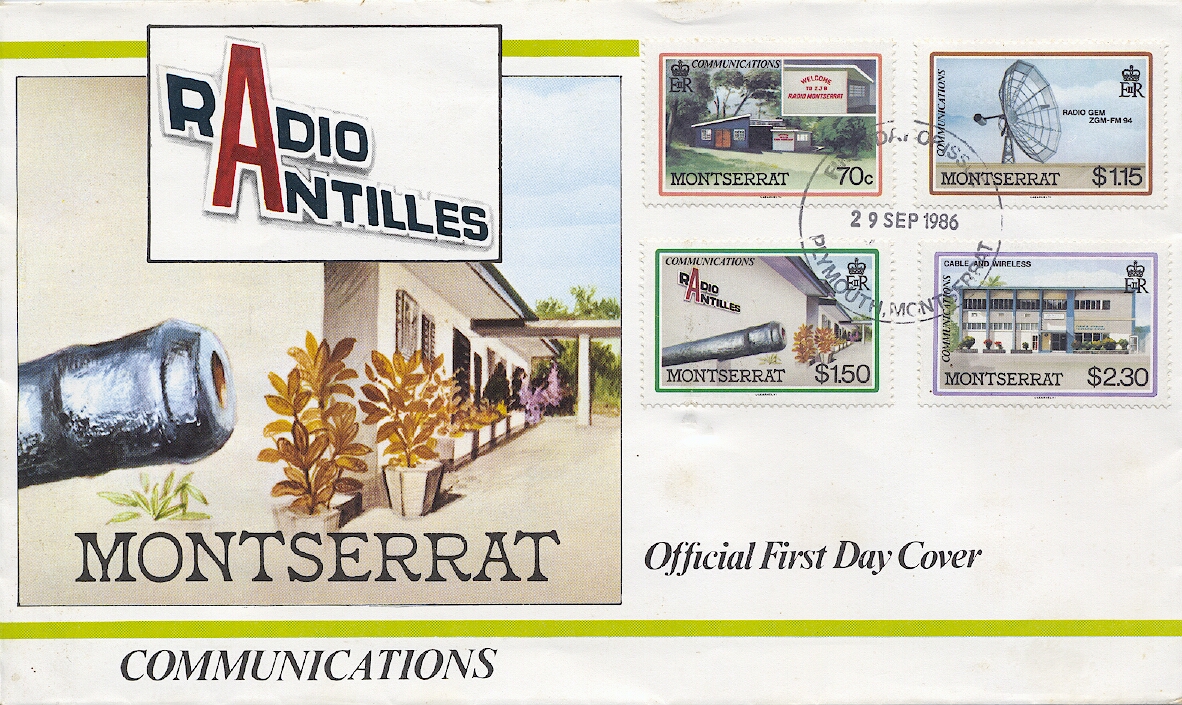
Our opening topic for our first presentation in the New Year 2018 takes us into the Caribbean, an area that was devastated during last year’s hurricane season. We return to the radio scene on the small island with the large volcano; it is the story of Radio Antilles, the shortwave station that relayed the programming of both Deutsche Welle in Cologne Germany and the BBC in London England.

 On April 20, 1963, the Radio Antilles Corporation was formed, and five months later the government granted a radio broadcasting license. Much of the electronic equipment for the Montserrat station came from the previous Radio Africa in Tangier, Morocco and it was installed and operated with co-operation from the staff of Radio Andorra in Europe. Some eight years later (1971), Radio Deutsche Welle in Germany injected a massive cash flow into Radio Antilles, and as a major shareholder/new owner of the station they took over the operation of the large facility.  When DW engineers arrived on Montserrat in 1971, they found two shortwave transmitters at 15 kW each already installed.  They soon afterwards installed an additional shortwave transmitter at 50 kW among the medium wave transmitters on the ground floor of the two story building on the lower south west coast of the island of Montserrat. 

 In March 1977, Radio Antilles was taken into regular service as a relay station for the programming of Deutsche Welle in Cologne Germany and for the BBC in London England.  However, just four years later (1981), the BBC withdrew from their usage of Radio Antilles, and eight years later again (1989), Deutsche Welle Montserrat was closed.  Soon afterwards, the electronic equipment was removed from the isolated country building, and the building was ultimately inundated by lava overflow from a nearby volcano, so much so, that the exact location of the building is now indiscernible. However at the same time as Radio Antilles was under development as a relay station for Deutsche Welle and the BBC, a new joint operation was under installation on the nearby island of Antigua.  The development of this new international shortwave relay station was staged under the auspices of a joint holding company, the Caribbean Relay Company. After a series of surveys on several of the Leeward and Windward Islands, Antigua was chosen because of its strategic location, together with sufficiently level ground that would be satisfactory for a large antenna farm.  A tract of land, 240 acres, was procured near Seaview Farm in the center of the island of Antigua.

 The BBC designed and constructed the transmitter station, they installed four Marconi transmitters at 250 kW each Model BD272, and they erected seven antenna towers supporting 18 curtain antennas. The locally available electrical power was somewhat unreliable, so the BBC installed five electrical power generators, each a Ruston at one megawatt, which was sufficient to power the entire station with one always available on standby. The first transmitter was taken into service on November 1, 1976, and the other three were activated during the following year (1977). Original planning called for two transmitters and nine antennas each, for the BBC and Deutsche Welle. However, as the scheduling was developed and implemented as time went by, it appears that the programming of both shortwave organizations, the BBC and Deutsche Welle, was carried by all four of the transmitters, though at approximately half time each. 

Due to budget cuts, the BBC-Deutsche Welle relay station on Antigua was closed on March 26, 2005. Initially, the Caribbean relay station endeavored to find other clients who were willing to broadcast to the Americas from their shortwave station. However, there are no known additional relays from the Antigua station, and all that we can presume is that all usable equipment was removed and the property was sold off.  


We cross over now to the Dutch islands in the Caribbean, and in particular to Curacao and Bonaire. Around the year 1960, Trans World Radio TWR gave consideration to constructing a large shortwave/medium wave station on the island of Curacao. However, the entire project was soon afterwards transferred to the nearby island of Bonaire. Construction at TWR Bonaire began in September 1963, and the first test broadcasts on shortwave began almost a year later in August 1964. The very first shortwave frequency for the new TWR was 5955 kHz under the official Dutch call sign PJB. Beginning in November 1964, the new Bonaire shortwave station broadcast the programming from Trans World Radio and it also relayed programming from Radio Netherlands in Hilversum Holland. However, Radio Netherlands ended their relay via TWR soon after their own shortwave station on Bonaire was inaugurated.

On June 30, 1993, TWR closed down the usage of their two shortwave transmitters on Bonaire, one at 50 kW and another at 250 kW, and shipped them off to Swaziland for incorporation into their African shortwave station. In various configurations, a medium wave station at TWR has remained on the air on Bonaire, and the space that was previously occupied by the shortwave transmitters now houses power generators that provide electricity for the island.  

 Test transmissions from the new relay station operated by Radio Netherlands on the island of Bonaire began in March 1969.  At the height of its total capability RN Bonaire contained 3 shortwave transmitters at 250/300 kW, 21 antennas on 17 towers, and 6 power generators at 500 kW each. With the changing winds of fortune in the international shortwave world, Radio Netherlands Bonaire was closed on June 30, 2012. The station was totally dismantled and all that remains of this once majestic shortwave station is just an open field. 

 Radio Havana Cuba was organized as a government operated international shortwave facility in 1963. At that stage, four shortwave transmitters at 100 kW were installed at their shortwave station at Bauta near Havana, two from Russia and two from BBC (Brown Boveri Company) Switzerland.

These days, Radio Havana Cuba operates a total of three shortwave sites with 16 shortwave transmitters rated at 50 kW, 100 kW and 250 kW. The shortwave station known as the Caribbean Beacon is located on the island of Anguilla, a small British island in the eastern Caribbean. In June 1991, Dr. Gene Scott bought the medium wave station Caribbean Beacon, and he installed a new Continental 100 kW shortwave transmitter at the same Sandy Hill site.

The antenna system was previously in use with shortwave KGEI at Belmont in California. The new shortwave Caribbean Beacon was inaugurated in December 1996, though it was hounded by subsequent local fears about radiation problems for more than a year. During the year 2008, the shortwave station in Utah that was previously on the air under the callsigns KUSW and then KTBN was closed and the electronic equipment was shipped to Anguilla for incorporation into the Caribbean Beacon.

 As we mentioned previously here in Wavescan, the Caribbean Beacon was damaged in the recent hurricanes that swept through the Caribbean islands. The station has since been noted back on the air with test broadcasts, and it is doing its best to maintain its international shortwave service.   

 This has been the story of six international shortwave stations in the Caribbean.  A total of four have come and gone: Deutsche Welle-BBC Montserrat and Antigua, Trans World Radio and Radio Netherlands on Bonaire.  Two still remain: Radio Havana Cuba with 16 transmitters, and the Caribbean Beacon on Anguilla with 1 at 100 kW, hanging on tenuously after the onslaught of the recent hurricanes.
(AWR Wavescan 463)

Monday, January 29, 2018

BBC begins Horn of Africa broadcast


Effective: 29 January 2018

All times UTC

1730-1830 on 7595, 11720 and 12065
1830-1930 on 9855 and 15490
1730 Amharic
1750 Oromo
1810 Tigrinya
1830 Amharic (repeat of 1730)
1850 Oromo (repeat of 1750)
1910 Tigrinya (repeat of 1810)
(BDXC)

Tuesday, August 22, 2017

BBC set to close additional medium wave transmitters

by Doug Irwin
LONDON — Ten BBC local radio stations will lose at least one AM transmitter this coming January as part of the BBC’s Delivering Quality First plan.
BBC Radio Devon, Radio Lancashire and BBC Essex will be heard on fewer frequencies; BBC Radio Sussex, Surrey, Humberside, Wiltshire, Nottingham, Kent, and Lincolnshire will no longer be accessible on medium wave at all, according to radiotoday.co.uk.

Additional story at: http://www.radiomagonline.com/around-the-world/0020/bbc-to-shut-down-additional-medium-wave-transmitters/39162

Friday, May 05, 2017

Another BBC Shortwave Station is Closed

BBC - Nakhon Sawan, Thailand tower
The latest edition of the Australian DX News alerted us to the fact that the BBC has closed its East Asia Relay Station at Nakhon Sawan in northern Thailand.  Additional news reports about the closure of this important BBC shortwave relay station have subsequently circulated widely on the internet.
            According to a news release issued by the BBC in London, the last day of operation for their relay station in Thailand was December 31 last year, at the end of their lease which was not renewed.  The BBC states that they have not been able to come to an agreement with the Thai government over programming issues, but in any case the BBC has now closed the station due to financial difficulties.                   Even this station has been completely silent right throughout this year thus far, the closure of this important BBC shortwave station seems to have largely escaped the attention of the international radio world.  In our program today, we plan to present the story of this BBC Far East Relay Station during its nearly ten year operation from Hong Kong, and in a coming program, we plan to present the story of their subsequent station in Thailand.  
            Planning for the Hong Kong relay station began during the 1970s.  However in 1981, the Managing Director of BBC External Broadcasting, Douglas Muggeridge, expressed frustration that the entire project may be abandoned due to unavailability of funding. 
            Nevertheless, even though it was known in advance that the station could expect a life span of no more than ten years, the managing authorities finally decided to go ahead with the project in Hong Kong while planning also for the construction of a subsequent station in another at the time undetermined country.
            The location for the new BBC East Asia Relay Station was in an area of undeveloped jungle in the New Territories at Tsang Tsui, some 75 miles north west of downtown Hong Kong.  It was an isolated location with no nearby public transportation. 
            A very compact site was chosen for the construction of the transmitter building and the erection of five self supporting antenna towers.  The towers were arranged in an east-west row and they supported four multi-band curtain antennas with passive reflectors. 
            Each antenna could be slewed electronically at plus or minus 14o for coverage into northern China and Japan.  A row of hills obstructed propagation to the south, but in any case the station was needed for programming only to the north.
            Construction work at the Hong Kong transmitter site began in February 1985 at a total cost of $11 million.  Two Marconi transmitters at 250 kW, Model B131, were installed and the first test transmission began more than two years later at 0400 UTC on August 6, 1987 on 15280 kHz.  Full time operation began six weeks later on September 27.
            Programming delivery from London was by satellite to Hong Kong Telecom and then by fibre optic cable to the station.  Programming was broadcast in three major language streams, Chinese, Japanese and English, with two programs on the air simultaneously at any one time.
            The station was an efficient computer controlled unattended operation with only twelve employees, just one of whom was a foreigner, a BBC manager from England.  As a touch of humor, it was stated that the local protective dog was also a BBC employee, due to the fact that the manager fed it from BBC funding.
            On the political scene, it was agreed that the one time British colony of Hong Kong would revert to China in June 1997.  Consequently, the BBC planned to remove and ship out all usable equipment and demolish the building in advance of the transfer of the territory to Chinese sovereignty. 
            The final broadcast from the BBC East Asia Relay Station in Hong Kong occurred at the end of November 1996.  The actual location of this shortwave station seems to be a green area among the jungle trees, visible on Google Maps at 113 55 18 57 E & 22 25 04 02 N.
            Many QSL cards were issued from the BBC East Asia Relay Station, quite often local Hong Kong postcards with a rubber stamp on the text side containing the QSL details.  At one stage, a printed QSL card showed a photo of the antenna system at Tsang Tsui.

            Two months after the station was closed, the towers were down and the two transmitters were already crated, ready for shipment to another destination, which turned out to be a new BBC station in Thailand.  And that station is now also off the air.  The story of this station is planned as our topic here in Wavescan, quite soon.
(AWR Wavescan/NWS 247)

Friday, February 17, 2017

BBC to Expand Audio Content Globally


The broadcaster hopes to use its vast radio archives to attract more listeners
by James Careless

OTTAWA — Nothing less than “a Netflix of the spoken word”: That is what BBC Director-General Lord Tony Hall promised on Nov. 23, 2016, when he announced the BBC’s plans to offer its full archive of audio content to online listeners around the world.

“The BBC makes the best radio in the world ... and we have an extraordinary wealth of audio riches at our disposal,” said Lord Hall during his keynote address to the Voice of the Listener and Viewer Autumn Conference in London. With our world-class content, we could use our current output and the richness of our archive to create a Netflix of the spoken word. It’s one of the things that will help the BBC carry the full weight of Britain’s culture and values, knowledge and know-how to the world in the years ahead — and say something really important about modern Britain.”

Additional article at: http://www.radioworld.com/global/0007/bbc-to-expand-audio-content-globally/339089
(photo/BBC & Radio World)

Thursday, March 03, 2016

Tough Nut: BBC Plans a North Korean Service


by Kim Elliott
The BBC has confirmed its intention to create a radio service for North Korea, although, despite a recent report, a start date for this service has not been set. North Korea’s recent test of what it described as a hydrogen bomb, and its launch of a long-range missile, have instilled urgency to the BBC’s plans.
BBC specifies that this will be a radio service rather than the multimedia operation that is typical in 21st-century international broadcasting. In North Korea’s tightly controlled media environment, there really is no alternative to radio to get information to all but the most elite layer of the country’s population. 
North Korea can be reached by medium wave (“AM”) and shortwave radio. Medium wave is preferred because radios with this band are more typical than those with shortwave bands. Medium wave transmitters that can reach North Korea are in short supply, however. One such transmitter in Russia, previously used by international broadcasters, has been dismantled. China will not supply MW transmitters to BBC for obvious geopolitical reasons. Japan has no history of hosting relay transmitters for international radio stations. With the business case for medium wave radio declining in Japan as it is in the rest of the world, perhaps this opportunity for revenue will be re-explored.
Additional story USCAnneberg/USC Center on Public Diplomacy at: http://uscpublicdiplomacy.org/blog/tough-nut-bbc-plans-north-korean-service

Monday, January 19, 2015

Underwater Radio

The Radio Ship Radio Mi Amigo (rogermathew.com)
It is known that at least five radio broadcasting stations, or major components thereof, are lying at the bottom of the ocean in the ship that was carrying the equipment at the time.  Four of these sunken ships were due to enemy action, and one was the result of a fierce winter storm. 
            Back in the year 1940, soon after the onset of the European Conflict, a 100 kW shortwave transmitter, manufactured at the Marconi company in Chelmsford England, was shipped out to Singapore Island.  It was intended that this transmitter would be installed at a new shortwave station still under construction, adjacent to the early Radio Malaya station at Jurong on the western side of Singapore island.  When activated, this station was to act as a relay for the BBC London, with coverage into Asia and the Pacific.
            However, due to an attack by an enemy submarine, the ship was sunk en route and the entire cargo was lost, including the electronic equipment for the new BBC shortwave relay station.  Instead, a 50 kW RCA shortwave transmitter was subsequently consigned to Singapore, but before it could be activated, it was removed and taken to Barbados in the Caribbean where it was installed for Cable & Wireless at Bearded Hall under the callsign VPO.
            Back in the year 1941, plans were laid for the installation of a megapowered mediumwave station at a secret underground location near Crowborough in England.  This station was intended to  beam surreptitious programming in various languages to continental Europe, and also to act as a BBC relay station for coverage into the same continental areas. 
            At the time, a super powered 500 kW transmitter was nearing  completion at the RCA factory in Camden New Jersey which had been ordered by NBC for mediumwave WJZ at Bound Brook, New Jersey.  However, the FCC had imposed a 50 kW power limit for mediumwave stations in the United States and NBC-WJZ no longer needed this huge transmitter.
            China demonstrated an interest in procuring this megalithic transmitter, but while negotiations were still underway, the British government arranged to purchase it and have it shipped across the Atlantic.  The transmitter was re-engineered for 600 kW, disassembled into smaller units, crated and stowed separately into several different ships.
            One of these cargo ships, carrying the antennas and towers, was sunk in the Atlantic by an enemy submarine and the equipment was lost.  Very hurriedly, new towers and antennas were manufactured in the United States and freighted across the Atlantic where it was all installed above ground for the underground American transmitter, known as Aspidistra, at Crowborough.  
            During the latter half of the European Conflict, PWI Press Wireless International, manufactured and shipped across the Atlantic numerous transmitters, large and small, for use in islandic and continental Europe.  Some of these shipments contained their famous 40 kW shortwave transmitter, and other shipments contained complete mobile radio broadcasting stations.  The mobile stations usually contained a 400 watt transmitter, always capable of high speed Morse Code, and sometimes also capable of voice transmission. 
            Much of this radio equipment was manufactured at their new factory quite near to their large shortwave station at Hicksville on Long Island, New York and then shipped across the Atlantic.  PWI states that at least one of these mobile stations was sunk by an enemy submarine in 1944, and that station still lies to this day on the floor of the Atlantic Ocean.    
            Also in the year 1944, Lord Louis Mountbatten expedited the construction of a large shortwave station at Ekala, a dozen miles north of Colombo in Ceylon, as it was known in those days.  A large shipment of radio equipment, including electronic items from the Marconi factory at Chelmsford and redundant antenna systems from the Isle of Wight, were shipped out from England. 
            However, the entire consignment was lost to enemy submarine action in the Indian Ocean off the coast of Sri Lanka.  Ultimately, a new consignment of equipment was sent out from England, and this was installed at the SEAC installation at Ekala, where it was in use for many years for the relay of programming by the BBC London, the Voice of America and Adventist World Radio.  This SEAC station also carried programming on behalf of SLBC, the Sri Lanka Broadcasting Corporation.
            Back in 1965, Ronan ORahilly in England ordered a 50 kW mediumwave transmitter from Continental Electronics in Dallas Texas for installation on the ship Mi Amigo, which was on the air at the time as the famous pirate radio station, Radio Caroline.  During that era, Continental was constructing several 50 kW mediumwave transmitters, Model 317C, for various clients.
            However, the BBC suddenly needed two 50 kW mediumwave transmitters for its new Central Africa Relay Station at Francistown in Botswana and entrepreneur ORahilly agreed to allow the BBC to take the No 12 transmitter that he had ordered.  The BBC also took an additional unit, No 13, so ORahilly agreed to accept transmitter No 14 in this series which he installed on board the Mi Amigo.
            Some 15 years later, on March 19, 1980, the ship Mi Amigo encountered a Force 10 storm and she drifted for 10 nautical miles before running aground on the Long Sand Bank.  The ship sank next day where she now lies in 10 feet of water in the Thames Estuary out from London. 

            The 50 kW mediumwave transmitter also went down with the ship, and that is where it lies to this day, at the shallow bottom of the North Sea!    
(AWR Wavescan/NWS 308)