Showing posts with label propagation. Show all posts

Monday, July 16, 2018

DXers Unlimited weekend edition, Sunday July 15, 2018


Radio Havana Cuba
Dxers Unlimited' - weekend edition for Sunday July 15 2018
By Arnie Coro, CO2KK

Hola amigos radioaficionados all around the world, listening now to the weekend edition of Dxers Unlimited, coming to you via our SIXTY meters Tropical Band and Short Wave transmitters operating on the 49, 41, 31, 25 , 22 , 19 and 16 meterss bands and also by the streaming audio via Internet and  via the Hispasat 1D geostationary satellite on the transponder 79 vertical polarization...

I am your host Arnaldo, Arnie, Coro, radio amateur CO2KK and now here is item one of today's show....

Current news in the world of short waves .... that are not good at all ...The very bad conditions of short wave radio  continue due to the very low solar activity ... Day after day the solar disk visible from the Earth is completely blank, without a single magnetically active zone, that is without sunspots. On Saturday, July 14, 17 consecutive days had passed without any sunspots being observed. The records of the solar radiation flow in the band of 10.7 meters of wavelengths, continues below 75 units. the ionosphere is not receiving the necessary energy to offer the possibility of long-distance communications via the daytime F2 layer.

More news ... follows the extraordinary progress in the use of digital communications mode called FT8 ... Although the exchange between stations is very limited to 13 characters per contact, it is possible to communicate when the conditions of radio propagation are extremely bad , because the algorithm for capturing the signals manages to receive when those signals are below the noise. Although it is not as sensitive as the JT65 mode, the exchange is done in much less time.

FT8 is the name of this new communication software that continues in development under the baton of Nobel Prize winner Joseph Taylor K1JT author of a whole family of digital programs for communication

The well-known WINDOM antenna of the first years of amateur radio has a current version, which has received several names, of which the most popular is the CAROLINA WINDOM ... whose installation is facilitated because the feed point is located more near to the station because of its asymmetric construction. Several Cuban radio amateurs are successfully using the variants of the Carolina Windom in a version that makes it possible to operate from 80 to 10 meters using a simple tuner or antenna tuner.

The lack of original factory battery packs for the portable transceivers of the two-meters and seventy-centimeters bands is being solved by Cuban radio amateurs by adapting the rechargeable lithium batteries used in cellular telephones to give power to the popular handie talkies, the stations described in amateur radio licenses as personal mobile sets .... The connection of two or three lithium batteries in series makes it possible to feed those equipment that are so important in emergencies. As an additional advantage is that lithium batteries have much greater capacity to store energy and do not have the harmful memory effect  that is observed in nickel cadmium batteries .... The construction of an automatic charger for lithium batteries  has become popular from an original  Cuban design that has proven to be highly reliable .

ASK ARNIE... is now on the air... this is the most popular section of Dxers Unlimited according to your e'mail messages, letters and even while having a QSO with my amateur radio station CO2KK Today's question came from Argentina, where amigo Raul listens via the Internet streaming audio. He tells me in his e mail about the excellent results achieved with a one and half meter diameter circular magnetic loop antenna made using the special low loss coaxial cables that go by the trade mark HELIAX.... He tunes the antenna with a homebrew butterfly capacitor and asks how he could use more power fed to the antenna by replacing the butterfly capacitor... Amigo Raul , your best possible option is to try to obtain a vacuum variable capacitor rated at no less than fifteen thousand volts, because you can then feed about one hundred watts full carrier power to the magnetic loop without running the risk of arc overs...

I also want to remind you and all other users of magnetic loops for transmitting to keep the antennas at a good distance from your operating position, in order to avoid very intense electromagnetic fields... Using a magnetic loop far from the operating position implies the addition of a remote tuning mechanism that is essential when you want to change frequencies... As a side note, a friend that enjoys using the digital communications modes, tunes his antenna to the popular parking spots for the FT8 mode and he does not need to retune the antenna....

Si amigos magnetic loop antennas deserve much more attention by both short wave listeners and amateur radio operators... when you chances of installing a large size external antennas are next to zero SOUND : SHORT MUSICAL INTERVAL The World Football Cup acted as a good reason to put on the air many amateur radio stations using special callsigns with the number 18 included in the callsigns as well as the acronymn >FIFA for international federation of amateur football...
On 10 meters, despite the poor propagation conditions , several of those stations attracted the attention of those devoted fans of the twenty eight megaHertz or 10 meters band...
Here are some of the stations heard on 10 meters last Monday

AO18FWC, 7X2FIFA, CN18FWC, ER18FIFA, 7X2VFK, PZ5RA, K2K, KH1/KH7Z, K2J, II9FIFA, E70FIFA, HZ18FWC, GI6XX, ZB2JK/P, IS0DCR, 2W1ACM, SV6DBG/B, OE18FIFA, IS0HQJ, EA3FYO.

The other interesting news about low band VHF propagation was that the across the North Atlantic Path between the eastern coast of North America and the British Isles saw a record breaking sporadic E multiple opening that took the maximum usable frequency up to 88 megaHertz... a very rare event by all standards.. On the 21st of June, an also fantastic opening made possible for several Cuban 6 meters band operators to work a number of Japanese stations using CW and Single Side Band....
Due to the lengthy period with a totally blank Sun we may expect more sporadic E layer openings during the second half of July

And now amigos at the end of the show, be on the lookout for more sporadic E skip openings and somewhat better local nighttime propagation on the HF bands...

ee you all at the middle of the week edition of Dxers Unlimited, Tuesday and Wednesday UTC days , just after the half hour RHC English newscast...
Send your signal reports and comments to inforhc at enet dot cu or via air mail to Arnie Coro, Radio Havana Cuba, Havana, Cuba
(Arnie Coro/R Habana Cuba)

Monday, March 05, 2018

Weekly Propagatin Forecast Bulletins


Product: Weekly Highlights and Forecasts
:Issued: 2018 Mar 05 0116 UTC
# Prepared by the US Dept. of Commerce, NOAA, Space Weather Prediction Center
# Product description and SWPC web contact www.swpc.noaa.gov/weekly.html
#
#                Weekly Highlights and Forecasts
#
Highlights of Solar and Geomagnetic Activity 26 February - 04 March 2018
Solar activity reached low levels on 02 Mar due to an isolated C1 flare from Region 2700 (N06, L=328, class/area=Cro/30 on 26 Feb), which was the only active region with sunspots this period. Solar activity was very low throughout the remainder of the period and no Earth-directed CMEs were observed. No proton events were observed at geosynchronous orbit.

The greater than 2 MeV electron flux at geosynchronous orbit reached high levels on 26-27 Feb and 03 Mar and moderate levels were observed on 28 Feb and 01-02 Mar. Normal levels were observed on 04 Mar.

Geomagnetic field activity reached active and G1 (Minor) geomagnetic storm levels on 27 Feb due to the influence of a negative polarity CH HSS. Generally quiet and quiet to unsettled conditions were
observed throughout the remainder of the period.

Forecast of Solar and Geomagnetic Activity 05 March - 31 March 2018
Solar activity is expected to be very low throughout the outlook period. No proton events are expected at geosynchronous orbit. The greater than 2 MeV electron flux at geosynchronous orbit is
expected to reach high levels on 18-25 Mar and moderate levels are expected on 17, and 26-30 Mar. Normal flux levels are expected for the remainder of the outlook period. Geomagnetic field activity is expected to reach G1 (Minor) geomagnetic storm levels on 18, 22 and 26 Mar due to the influences
of multiple recurrent, CH HSSs. Active levels are expected on 15-17 and 21 Mar with generally quiet and quiet to unsettled conditions likely through the remainder of the outlook period.

Product: 27-day Space Weather Outlook Table 27DO.txt
:Issued: 2018 Mar 05 0116 UTC
# Prepared by the US Dept. of Commerce, NOAA, Space Weather Prediction Center
# Product description and SWPC web contact www.swpc.noaa.gov/wwire.html
#
#      27-day Space Weather Outlook Table
#                Issued 2018-03-05
#
#   UTC      Radio Flux   Planetary   Largest
#  Date       10.7 cm      A Index    Kp Index
2018 Mar 05      68           5          2
2018 Mar 06      68           5          2
2018 Mar 07      68           5          2
2018 Mar 08      68           8          3
2018 Mar 09      68           8          3
2018 Mar 10      68           5          2
2018 Mar 11      68           5          2
2018 Mar 12      68           5          2
2018 Mar 13      68           5          2
2018 Mar 14      68          10          3
2018 Mar 15      68          12          4
2018 Mar 16      70          12          4
2018 Mar 17      72          15          4
2018 Mar 18      72          18          5
2018 Mar 19      72           5          2
2018 Mar 20      72           5          2
2018 Mar 21      72          12          4
2018 Mar 22      72          18          5
2018 Mar 23      72          10          3
2018 Mar 24      72           5          2
2018 Mar 25      72           8          3
2018 Mar 26      72          20          5
2018 Mar 27      72           5          2
2018 Mar 28      72           5          2
2018 Mar 29      72           5          2
2018 Mar 30      70           8          3
2018 Mar 31      68           8          3
(NOAA)

Tuesday, January 02, 2018

Weekly Propagation Forecast Bulletins


Product: Weekly Highlights and Forecasts
:Issued: 2018 Jan 01 0250 UTC
# Prepared by the US Dept. of Commerce, NOAA, Space Weather Prediction Center
# Product description and SWPC web contact www.swpc.noaa.gov/weekly.html#
#                Weekly Highlights and Forecasts
#
Highlights of Solar and Geomagnetic Activity 25 - 31 December 2017
Solar activity was very low throughout the period. Region 2692 (N18, L=087, class/area=Eai/160 on 24 Dec) was the only numbered active region this period, but the region was without sunspots and
unproductive through most of the week. No Earth-directed CMEs were observed this period.

No proton events were observed at geosynchronous orbit.

The greater than 2 MeV electron flux at geosynchronous orbit reached high levels on 27 and 29 Dec with moderate levels observed through the remainder of the period.

Geomagnetic field activity reached active levels on 26 Dec due to the influence of a negative polarity CH HSS. Quiet and quiet to unsettled levels were observed throughout the rest of the week.

Forecast of Solar and Geomagnetic Activity 01 January - 27 January 2018

Solar activity is expected to be at very low levels throughout the outlook period.

No proton events are expected at geosynchronous orbit.

The greater than 2 MeV electron flux at geosynchronous orbit is expected to reach high levels on 02-06, 14-19, and 23-24 Jan. Moderate flux levels are expected through the rest of the outlook period.

Geomagnetic field activity is likely to reach G1 (Minor) geomagnetic storm levels on 01 and 13 Jan, with active periods likely on 02, 08, 14, 20 and 27 Jan, due to the effects of multiple, recurrent CH HSSs. Quiet and quiet to unsettled geomagnetic field activity is expected throughout the remainder of the outlook period.


Product: 27-day Space Weather Outlook Table 27DO.txt
:Issued: 2018 Jan 01 0250 UTC
# Prepared by the US Dept. of Commerce, NOAA, Space Weather Prediction Center
# Product description and SWPC web contact www.swpc.noaa.gov/wwire.html#
#      27-day Space Weather Outlook Table
#                Issued 2018-01-01
#
#   UTC      Radio Flux   Planetary   Largest
#  Date       10.7 cm      A Index    Kp Index
2018 Jan 01      68          25          5
2018 Jan 02      68          15          4
2018 Jan 03      68           8          3
2018 Jan 04      68           5          2
2018 Jan 05      70           5          2
2018 Jan 06      70           5          2
2018 Jan 07      70          10          3
2018 Jan 08      70          12          4
2018 Jan 09      70           6          2
2018 Jan 10      70           5          2
2018 Jan 11      70           5          2
2018 Jan 12      70           5          2
2018 Jan 13      72          22          5
2018 Jan 14      72          16          4
2018 Jan 15      72           6          2
2018 Jan 16      72           5          2
2018 Jan 17      72           5          2
2018 Jan 18      72           5          2
2018 Jan 19      72           5          2
2018 Jan 20      72          12          4
2018 Jan 21      72          10          3
2018 Jan 22      72           8          3
2018 Jan 23      72           6          2
2018 Jan 24      72           5          2
2018 Jan 25      70           5          2
2018 Jan 26      68           5          2
2018 Jan 27      68           6          4
(NOAA)

Thursday, December 28, 2017

Weekly Propagation Forecast Bulletins


Product: Weekly Highlights and Forecasts
:Issued: 2017 Dec 25 0211 UTC
# Prepared by the US Dept. of Commerce, NOAA, Space Weather Prediction Center
# Product description and SWPC web contact http://www.swpc.noaa.gov/weekly.html
#
#                Weekly Highlights and Forecasts
#
Highlights of Solar and Geomagnetic Activity 18 - 24 December 2017

Solar activity was at very low levels throughout the period. Region 2692 (N18, L=087, class/area=Eai/160 on 24 Dec) was the only active region with sunspots this period and produced multiple low and mid-level B-class flares throughout the week. No Earth-directed CMEs were observed. No proton events were observed at geosynchronous orbit.The greater than 2 MeV electron flux at geosynchronous orbit reached high levels on 18-23 Dec with moderate levels observed on 24 December.

Geomagnetic field activity reached active levels early on 18 Dec in response to the influence of a recurrent, positive polarity CH HSS. Quiet to unsettled conditions were observed on 19 and 23-24 Dec and generally quiet conditions were observed throughout the remainder of the week under a nominal solar wind regime.

Forecast of Solar and Geomagnetic Activity 25 December - 20 January 2018

Solar activity is expected to persist at very low levels throughout the period.  No proton events are expected at geosynchronous orbit.

The greater than 2 MeV electron flux at geosynchronous orbit is expected to reach high levels on 26-30 Dec, 02-06 and 14-19 Jan. Normal and normal to moderate greater than 2 MeV electron flux values are expected throughout the remainder of the forecast period.  Geomagnetic field activity is likely to reach G1 (Minor) geomagnetic storm levels on 01 and 13 Jan with active levels expected on 25 Dec and 02, 08, 14 and 20 Jan under the influences of multiple, recurrent CH HSSs. Quiet and quiet to unsettled conditions are expected throughout the remainder of the forecast period.

Product: 27-day Space Weather Outlook Table 27DO.txt
:Issued: 2017 Dec 25 0211 UTC
# Prepared by the US Dept. of Commerce, NOAA, Space Weather Prediction Center
# Product description and SWPC web contact http://www.swpc.noaa.gov/wwire.html
#
#      27-day Space Weather Outlook Table
#                Issued 2017-12-25
#
#   UTC      Radio Flux   Planetary   Largest
#  Date       10.7 cm      A Index    Kp Index
2017 Dec 25      75          12          4
2017 Dec 26      75           8          3
2017 Dec 27      75           5          2
2017 Dec 28      75           5          2
2017 Dec 29      75           5          2
2017 Dec 30      74           5          2
2017 Dec 31      72          10          3
2018 Jan 01      72          25          5
2018 Jan 02      72          15          4
2018 Jan 03      72          10          3
2018 Jan 04      72           5          2
2018 Jan 05      72           5          2
2018 Jan 06      72           5          2
2018 Jan 07      72          10          3
2018 Jan 08      72          12          4
2018 Jan 09      72           6          2
2018 Jan 10      72           5          2
2018 Jan 11      72           5          2
2018 Jan 12      72           5          2
2018 Jan 13      74          22          5
2018 Jan 14      75          16          4
2018 Jan 15      75           6          2
2018 Jan 16      75           5          2
2018 Jan 17      75           5          2
2018 Jan 18      75           5          2
2018 Jan 19      75           5          2
2018 Jan 20      75          12          4
(NOAA)


Tuesday, May 23, 2017

Weekly Propagation Forecast Bulletins

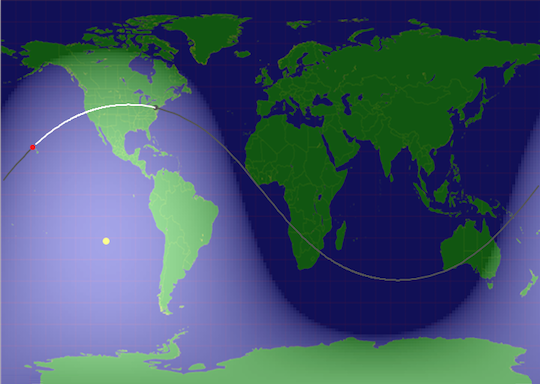
Propagation Globe (NASA)
Product: Weekly Highlights and Forecasts
:Issued: 2017 May 22 0235 UTC
# Prepared by the US Dept. of Commerce, NOAA, Space Weather Prediction Center
# Product description and SWPC web contact www.swpc.noaa.gov/weekly.html#
#                Weekly Highlights and Forecasts
#
Highlights of Solar and Geomagnetic Activity 15 - 21 May 2017

Solar activity was very low throughout the reporting period. Region 2659 (N14, L=038, class/area=Dao/040 on 21 May 2017) was the most omplex region; however, it has produced no significant flare activity. No Earth-directed CMEs were observed in available coronagraph imagery.

No proton events were observed at geosynchronous orbit.

The greater than 2 MeV electron flux at geosynchronous orbit ranged from normal to high levels, with a peak flux of 13,000 pfu at 21/1710 UTC. Normal levels were observed on 15 May and moderate levels were observed on 16-19 May. In response to a negative polarity CH HSS, high levels were observed on 20-21 May.

Geomagnetic field activity was at quiet to active levels. Quiet to active levels were observed on 15 May. Conditions decreased to quiet to unsettled levels on 16-17 May under nominal solar wind conditions. A SSBC produced quiet to active levels on 18 May and quiet to unsettled levels on 19 May. The subsequent onset of a negative polarity CH HSS, with peak observed winds between 700-750 km/s, produced unsettled to active conditions on 20 May and quiet to unsettled levels on 21 May.

Forecast of Solar and Geomagnetic Activity 22 May - 17 June 2017

Solar activity is expected to be very low with a slight chance for  C-class flare activity throughout the outlook period.

No proton events are expected at geosynchronous orbit.

The greater than 2 MeV electron flux at geosynchronous orbit is expected to range from normal to very high levels. Moderate levels are likely on 01-10 Jun and 12-15 Jun; high levels are likely on 22 May, 27-31 May, and 16-17 Jun; very high levels are likely on 23-26 May. Elevated levels of electrons  are in response to multiple, recurrent, CH HSSs. The remainder of the outlook period is likely to
observe normal background levels.

Geomagnetic field activity is expected to be at quiet to G1 (Minor) storm levels. Active conditions are likely on 22 May with unsettled conditions likely on 23-24 May due to the waning effects of a negative polarity CH HSS. Quiet conditions are then likely to prevail from 25 May-09 Jun under a nominal solar wind regime. An increase to active conditions is likely on 10-11 Jun from a positive
polarity CH HSS. Quiet conditions are again likely on 12-13 Jun. A SSBC is expected to cause unsettled conditions on 14 Jun. A subsequent negative polarity CH HSS is likely to cause active conditions on 15 Jun, G1 (Minor) conditions on 16 Jun, then active conditions as the CH HSS wanes on 17 Jun.

Product: 27-day Space Weather Outlook Table 27DO.txt
:Issued: 2017 May 22 0235 UTC
# Prepared by the US Dept. of Commerce, NOAA, Space Weather Prediction Center
# Product description and SWPC web contact www.swpc.noaa.gov/wwire.html
#
#      27-day Space Weather Outlook Table
#                Issued 2017-05-22
#
#   UTC      Radio Flux   Planetary   Largest
#  Date       10.7 cm      A Index    Kp Index
2017 May 22      74          12          4
2017 May 23      76           8          3
2017 May 24      76           8          3
2017 May 25      76           5          2
2017 May 26      76           5          2
2017 May 27      76           5          2
2017 May 28      74           5          2
2017 May 29      74           5          2
2017 May 30      72           5          2
2017 May 31      72           5          2
2017 Jun 01      72           5          2
2017 Jun 02      72           5          2
2017 Jun 03      72           5          2
2017 Jun 04      70           5          2
2017 Jun 05      70           5          2
2017 Jun 06      70           5          2
2017 Jun 07      70           5          2
2017 Jun 08      70           5          2
2017 Jun 09      72           5          2
2017 Jun 10      72          10          4
2017 Jun 11      72          12          4
2017 Jun 12      74           5          2
2017 Jun 13      74           5          2
2017 Jun 14      74           8          3
2017 Jun 15      74          10          4
2017 Jun 16      74          20          5
2017 Jun 17      74          12          4
(NOAA)

Monday, January 23, 2017

Weekly Propagation Forecast Bulletins

Product: Weekly Highlights and Forecasts
:Issued: 2017 Jan 23 0615 UTC
# Prepared by the US Dept. of Commerce, NOAA, Space Weather Prediction Center
# Product description and SWPC web contact www.swpc.noaa.gov/weekly.html 
#
#                Weekly Highlights and Forecasts
#
Highlights of Solar and Geomagnetic Activity 16 - 22 January 2017

Solar activity was at low levels due to a C9/1f flare observed at 21/0726 UTC from Region 2628 (N12, L=173, class/area Dao/210 on 22 January). Region 2628 was responsible for additional C-class flaring on 21 January. The rest of the period was at very low levels. No Earth-directed coronal mass ejections were observed. 

No proton events were observed at geosynchronous orbit.

The greater than 2 MeV electron flux at geosynchronous orbit was at normal to moderate levels with high levels observed on 16-17, and 20-22 January. The largest flux value of the period was 3,090 pfu observed at 16/1935 UTC. 

Geomagnetic field activity ranged from quiet to active levels over the period. Solar wind parameters were indicative of background conditions to start the period. Early on 18 January, wind speed began to increase as a positive polarity coronal hole high speed stream (CH HSS) became geoeffective. Wind speed reached a maximum value of 651 km/s at 19/0320 UTC and total field peaked at 17 nT at 18/0605 UTC before gradually decreasing throughout the remainder of the period. The geomagnetic field was at quiet levels on 16-17 January, quiet to active levels on 18-19 & 21 January, and quiet to unsettled levels on 20 & 22 January. 

Forecast of Solar and Geomagnetic Activity 23 January - 18 February 2017

Solar activity is likely to be low with a slight chance for M-class flares on 23-31 January and 14-18 February due to the flare potential in Region 2628. Very low levels are expected on 01-13 February. 

No proton events are expected at geosynchronous orbit.

The greater than 2 MeV electron flux at geosynchronous orbit is expected to be at normal to moderate levels with high levels likely on 23-27 January, 01-13 February, and again on 16-18 February due to CH HSS influence. 

Geomagnetic field activity is expected to be at unsettled to active levels on 23, 27-31 January, 01-07 February and 14-18 February with G1 (Minor) geomagnetic storm levels likely on 03 February due to recurrent CH HSS effects. 

Product: 27-day Space Weather Outlook Table 27DO.txt
:Issued: 2017 Jan 23 0615 UTC
# Prepared by the US Dept. of Commerce, NOAA, Space Weather Prediction Center
# Product description and SWPC web contact www.swpc.noaa.gov/wwire.html
#
#      27-day Space Weather Outlook Table
#                Issued 2017-01-23
#
#   UTC      Radio Flux   Planetary   Largest
#  Date       10.7 cm      A Index    Kp Index
2017 Jan 23      85           8          3
2017 Jan 24      83           5          2
2017 Jan 25      82           5          2
2017 Jan 26      80           5          2
2017 Jan 27      80          12          4
2017 Jan 28      80          15          4
2017 Jan 29      78           8          3
2017 Jan 30      77          10          3
2017 Jan 31      77          12          4
2017 Feb 01      76          16          4
2017 Feb 02      76          18          4
2017 Feb 03      75          20          5
2017 Feb 04      75          16          4
2017 Feb 05      75          12          4
2017 Feb 06      75          10          3
2017 Feb 07      75           8          3
2017 Feb 08      76           5          2
2017 Feb 09      77           5          2
2017 Feb 10      77           5          2
2017 Feb 11      77           5          2
2017 Feb 12      77           5          2
2017 Feb 13      78           5          2
2017 Feb 14      79          15          4
2017 Feb 15      81          10          3
2017 Feb 16      83          10          3
2017 Feb 17      83           8          3
2017 Feb 18      83           8          3
(NOAA)

Monday, December 07, 2015

Weekly Propagation Forecast Bulletins


Product: Weekly Highlights and Forecasts
:Issued: 2015 Dec 07 0214 UTC
# Prepared by the US Dept. of Commerce, NOAA, Space Weather Prediction Cwww.swpc.noaa.gov/weekly.htmlenter
# Product description and SWPC web contact www.swpc.noaa.gov/weekly.html
#
#                Weekly Highlights and Forecasts
#
Highlights of Solar and Geomagnetic Activity 30 November - 06 December 2015

Solar activity was at low levels. Regions 2458 (N10, L=356, class/area Dao/160 on 24 Nov), 2462 (N09, L=216, class/area Hax/40 on 04 Dec), 2463 (S11, L=205, class/area Dao/130 on 05 Dec) and 2464
(S12, L=189, class/area Axx/10 on 05 Dec) each produced C-class flares. The largest event of the period was a C4/Sf at 1702 UTC on 04 December. No Earth-directed coronal mass ejections were observeduring the period. 

No proton events were observed at geosynchronous orbit.

The greater than 2 MeV electron flux at geosynchronous orbit was normal levels on 30 November and reached moderate levels on 01 December. High levels were observed from 02-04 December before
returning to moderate levels for the remainder of the period. 

Geomagnetic field activity was quiet to active with an isolated minor storm period from 0600-0900 UTC on 30 November due to effects from a positive polarity coronal hole high speed stream (CH HSS).
Quiet to active levels were observed on 01 December as HSS influence continued. Predominately quiet conditions were observed from 02-04 December with some unsettled periods on 02 and 04 December. Quiet to active levels returned on 05 December due to effects from a co-rotating interaction region (CIR) ahead of a second positive polarity CH HSS. Unsettled to active conditions dominated 06
December with an isolated minor storm period observed from 0900-1200 UTC. 

Forecast of Solar and Geomagnetic Activity 07 December - 02 January 2016

Solar activity is expected to be at very low to low levels throughout the forecast period. 

No proton events are expected at geosynchronous orbit.

The greater than 2 MeV electron flux at geosynchronous orbit is expected to be at normal to moderate levels for the majority of the period with high levels likely on 08-09 December, 11-15 December and
29-31 December following anticipated recurrent CH HSS events. 

Geomagnetic field activity is expected to reach minor storm levels on 07 and 08 December due to continued effects from a positive polarity CH HSS. Predominately unsettled to active conditions are
expected to from 09-13 December with minor storm periods possible as HSS effects persist. Mostly quiet levels are expected from 14-26 December. Quiet to active conditions are likely on 27 and 28
December due effects from a second recurrent CH HSS followed by quiet to unsettled conditions on 29 December as influence subsides. Quiet conditions are expected on 30-31 December. Unsettled to active conditions are expected on 01 January with minor storm levels likely on 02 January as a third recurrent CH HSS moves into a geoeffective position. 

Product: 27-day Space Weather Outlook Table 27DO.txt
:Issued: 2015 Dec 07 0214 UTC
# Prepared by the US Dept. of Commerce, NOAA, Space Weather Prediction Center
# Product description and SWPC web contact www.swpc.noaa.gov/wwire.html
#
#      27-day Space Weather Outlook Table
#                Issued 2015-12-07
#
#   UTC      Radio Flux   Planetary   Largest
#  Date       10.7 cm      A Index    Kp Index
2015 Dec 07     100          25          5
2015 Dec 08     100          20          5
2015 Dec 09     105          15          3
2015 Dec 10     105          15          3
2015 Dec 11     105          15          3
2015 Dec 12     105          15          3
2015 Dec 13     105          15          3
2015 Dec 14     105           8          3
2015 Dec 15     105           5          2
2015 Dec 16     100          10          4
2015 Dec 17      95           8          3
2015 Dec 18      95           5          2
2015 Dec 19     100           5          2
2015 Dec 20     100           5          2
2015 Dec 21     100           5          2
2015 Dec 22     100           5          2
2015 Dec 23     100           5          2
2015 Dec 24     100           5          2
2015 Dec 25     100           5          2
2015 Dec 26     100           5          2
2015 Dec 27      98          18          4
2015 Dec 28      95          15          3
2015 Dec 29      95          10          3
2015 Dec 30      98           5          2
2015 Dec 31     100           5          2
2016 Jan 01     105          15          3
2016 Jan 02     105          20          5
(NOAA)

Monday, August 11, 2014

Weekly Propagation Forecast Bulletins

Product: Weekly Highlights and Forecasts
:Issued: 2014 Aug 11 0136 UTC
# Prepared by the US Dept. of Commerce, NOAA, Space Weather Prediction Center
# Product description and SWPC web contact www.swpc.noaa.gov/weekly.html
#
#                Weekly Highlights and Forecasts
#
Highlights of Solar and Geomagnetic Activity 04 - 10 August 2014

Solar activity was at low levels throughout the period. The largest event of the period was a C4/1n flare on 08 Aug at 1701 UTC from Region 2135 (N11, L=129, class/area=Dho/250 on 08 Aug). Regions 2130 (S07, L=229, class/area=Dkc/290 on 31 Jul) and 2132 (S21, L=212, class/area=Eac/230 on 08 Aug) produced only low-to-mid level C-class flare activity and were the most prominent regions of this period. 

No Earth-directed coronal mass ejections (CMEs) were observed this period, however, a far-sided full-halo CME was observed in SOHO LASCO coronagraph imagery between 1555-1636 UTC on 08 Aug. This CME was associated with flare activity from old Region 2126 (S09, L=327). 

No proton events were observed at geosynchronous orbit.

The greater than 2 MeV electron flux at geosynchronous orbit was at normal levels on 04-05 Aug with normal to moderate levels observed on 06-10 Aug, reaching a maximum flux value of 908 pfu at 1640 UTC on 07 Aug. 

Geomagnetic field activity was at quiet levels on 07 and 09 Aug with quiet to unsettled levels observed on 04-06, and 08 Aug. Quiet conditions with an isolated period of active conditions (1800-2100 UTC) were observed on 10 Aug, with the active period resulting from the influence of a negative polarity coronal hole high speed steam. 

Forecast of Solar and Geomagnetic Activity 11 August - 06 September 2014

Solar activity is expected to be low throughout the outlook period.

No proton events are expected at geosynchronous orbit.

The greater than 2 MeV electron flux at geosynchronous orbit is expected to be at normal to moderate levels throughout the outlook period. 

Geomagnetic field activity is expected to be quiet for 12, 14-21, 23, 25-27, 30 Aug , and 03-05 Sep. Quiet to unsetteld conditions are expected for 11, 13, 22, 24, 28-29 Aug, 01-02, and 06 Aug due to weak influence from coronal hole high speed streams (CH HSS). Quiet to active conditions are expected for 31 Aug due to moderate CH HSS effects. 

Product: 27-day Space Weather Outlook Table 27DO.txt
:Issued: 2014 Aug 11 0137 UTC
# Prepared by the US Dept. of Commerce, NOAA, Space Weather Prediction Center
# Product description and SWPC web contact www.swpc.noaa.gov/wwire.html
#
#      27-day Space Weather Outlook Table
#                Issued 2014-08-11
#
#   UTC      Radio Flux   Planetary   Largest
#  Date       10.7 cm      A Index    Kp Index
2014 Aug 11     105           8          3
2014 Aug 12     105           5          2
2014 Aug 13     100           8          3
2014 Aug 14     100           5          2
2014 Aug 15      95           5          2
2014 Aug 16      95           5          2
2014 Aug 17      95           5          2
2014 Aug 18      95           5          2
2014 Aug 19      95           5          2
2014 Aug 20      95           5          2
2014 Aug 21     100           5          2
2014 Aug 22     110           8          3
2014 Aug 23     115           5          2
2014 Aug 24     115           8          3
2014 Aug 25     120           5          2
2014 Aug 26     120           5          2
2014 Aug 27     125           5          2
2014 Aug 28     130           8          3
2014 Aug 29     125           8          3
2014 Aug 30     125           5          2
2014 Aug 31     125          12          4
2014 Sep 01     125          10          3
2014 Sep 02     125           8          3
2014 Sep 03     120           5          2
2014 Sep 04     115           5          2
2014 Sep 05     110           5          2
2014 Sep 06     110           8          3
(NOAA)

Learn more about propagation at Tomas Hood's excellent website. The live reference resource site for solar
and geomagnetic data and images at : http://propagation.hfradio.org/

Sunday, November 14, 2010

Shortwave Blog Bytes

All times UTC

Propagation tutorial
Here is and excellent tutorial on LF and HF radiowave propagation written by Steve G0KYA and Alan G3NYK: http://www.southgatearc.org/news/november2010/propagation_ebook.htm . I endorse it 100% .
(Thomas F. Giella, NZ4O, Lakeland, FL, USA)

Radio Canada Int'l adjust frequency
Via U.K. in French from Nov 11:
1900-2000 new freq 9510#SKN 300 kW 177 deg to Africa, ex 9670 to avoid NHK/Radio Japan in Japanese.
# co-ch 1930-2000 Sat BVBN in French and Adja to WeAF
(R BULGARIA DX MIX News, Ivo Ivanov, via wwdxc BC-DX TopNews Nov 13/DX Mix News 651)

Sudan raids radio station reporting on Darfur
By Rebecca Hamilton
Thursday, November 11, 2010

At a market stall in southern Sudan, Darfuri trader Omer Saleh, 45, turned up the volume on his small battery-operated radio. Radio Dabanga, he said - the Dutch-based service that transmits Darfur news by local journalists through shortwave frequencies into Sudan - "is the only way I can know what is happening at home."
Additional story at Washington Post http://www.washingtonpost.com/wp-dyn/content/article/2010/11/10/AR2010111007123.html
(Arnaldo Slaen, Buenos Aires, Argentina)

Vanuatu heard on parallels
Radio Vanuatu noted on 7260, November, 12 0754-0805. Pop music, female in English talks “Radio Vanuatu..week end.” Romantic music, short tribal music, male talks. Noted on parallel 3945, SINPO 33333 (Lúcio Otávio Bobrowiec, Embu SP Brasil/Cumbre DX)

WWCR adjust frequency
USA WWCR#1 in English from Nov 7:
2100-0100 new freq 7465 WCR 100 kW 046 deg, ex 3255
0100-0200 new freq 7490 WCR 100 kW 046 deg, ex 3255
(R BULGARIA DX MIX News, Ivo Ivanov, via wwdxc BC-DX TopNews Nov 13/DX Mix News 651)

Tuesday, August 03, 2010

Propagation Alert: Will it hit Earth?


On August 1, 2010, the Solar Dynamics Observatory (SDO) observed a beautiful prominence eruption that may hit Earth and cause a geomagnetic storm. As the solar cycle progresses and the Sun becomes more active there will be many more opportunities to observe the causes of space weather. Want to see what happens? Follow the event at spaceweather.com.

And from the Spaceweather website:

On August 1st, the entire Earth-facing side of the sun erupted in a tumult of activity. There was a C3-class solar flare, a solar tsunami, multiple filaments of magnetism lifting off the stellar surface, large-scale shaking of the solar corona, radio bursts, a coronal mass ejection and more.

High-latitude sky watchers should be alert for auroras tonight. One and possibly two coronal mass ejections (CMEs) are heading toward Earth, propelled by the solar eruptions of August 1st (see below). NOAA forecasters estimate a 10% chance of major geomagnetic storms and a 45% chance of at least some geomagnetic activity when the clouds arrive on August 3rd and 4th.

And finally this report from our good friend Tomas Hood

At approximately 0855 UTC on August 1, 2010, a C3.2 magnitude soft X-ray flare erupted from NOAA Active Sunspot Region 11092 (1092).

At nearly the same time, a massive filament eruption occurred. Prior to the filament's eruption, NASA's Solar Dynamics Observatory (SDO) Atmospheric Imaging Assembly (AIA) instruments revealed an enormous plasma filament stretching across the sun's northern hemisphere. When the solar shock wave triggered by the C3.2-class X-ray explosion plowed through this filament, it appears to have caused the filament to erupt, sending out a huge plasma cloud (a coronal mass ejection, or CME).

A shock wave can be seen emerging from the origin of the X-ray flare and sweeping across the sun's northern hemisphere into the filament field. The impact of this shock wave may well have propelled the filament into space. The movies (see links, below) seem to support the conclusion that both eruptions, occurring together, are linked, despite the approximately 400,000 kilometer distance between the flare and the filament eruption. How can this be? While we cannot always see the magnetic field lines between solar features (magnetic field lines are not visible unless there is plasma trapped along these field lines), we can assume from this event
that huge connecting field lines existed between the sunspot region and the filament in the sun's northern hemisphere.

This is an amazing event. A complex series of eruptions involving most of the visible surface of the sun has occurred, ejecting plasma toward the Earth. This coronal mass ejection (CME) rides the solar wind. Depending on the speed of the solar wind and the ejected plasma, this cloud will reach Earth's magnetosphere sometime between August 3 and August 5. High-latitude sky watchers should be alert for auroras. Radio communications by way of the ionosphere may become degraded soon after the CME arrives, and the degraded conditions may last for up to three days.

First view at the 304-Angstrom wavelength by SDO/AIA:
http://www.youtube.com/watch?v=VyaqxKkSCpU

Second view at the 171-Angstrom wavelength by SDO/AIA:
http://www.youtube.com/watch?v=HW_-yQY6YlA

Source: SDO/AIA

73 de NW7US, Tomas David Hood ( http://tomas-david-hood.com/ )

Facebook:

Main NW7US Page: http://hfradio.org/
Twitter Space WX : @hfradiospacewx
Twitter NW7US : @NW7US

Podcast: http://podcast.hfradio.org/ (restarting Summer 2010)

Linux User #32405 - Since 1996

Monday, October 26, 2009

Best Solar Prop Shop on the Net


If you are looking for the latest and greatest propagation and solar information I highly recommend the Solarcycle24.com website. VE3EN has put together some of the best web solar and propagation information sources onto one webpage for use by the radio hobby community.

If you are involved in the radio hobby and are advanced enough to know, use and understand how propagation works, then this site is a must visit and bookmark. I use it everyday. Go to http://www.solarcycle24.com/.

Saturday, September 05, 2009

Are Sunspots Disappearing?


Another day with a spotless sun.

Author: Dr. Tony Phillips | Credit: Science@NASA

The sun is in the pits of the deepest solar minimum in nearly a century. Weeks and sometimes whole months go by without even a single tiny sunspot. The quiet has dragged out for more than two years, prompting some observers to wonder, are sunspots disappearing?

"Personally, I'm betting that sunspots are coming back," says researcher Matt Penn of the National Solar Observatory (NSO) in Tucson, Arizona. But, he allows, "there is some evidence that they won't."

Penn's colleague Bill Livingston of the NSO has been measuring the magnetic fields of sunspots for the past 17 years, and he has found a remarkable trend. Sunspot magnetism is on the decline.

"Sunspot magnetic fields are dropping by about 50 gauss per year," says Penn. "If we extrapolate this trend into the future, sunspots could completely vanish around the year 2015."

This disappearing act is possible because sunspots are made of magnetism. The "firmament" of a sunspot is not matter but rather a strong magnetic field that appears dark because it blocks the upflow of heat from the sun's interior. If Earth lost its magnetic field, the solid planet would remain intact, but if a sunspot loses its magnetism, it ceases to exist.

"According to our measurements, sunspots seem to form only if the magnetic field is stronger than about 1500 gauss," says Livingston. "If the current trend continues, we'll hit that threshold in the near future, and solar magnetic fields would become too weak to form sunspots."

"This work has caused a sensation in the field of solar physics," comments NASA sunspot expert David Hathaway, who is not directly involved in the research. "It's controversial stuff."

The controversy is not about the data. "We know Livingston and Penn are excellent observers," says Hathaway. "The trend that they have discovered appears to be real." The part colleagues have trouble believing is the extrapolation. Hathaway notes that most of their data were taken after the maximum of Solar Cycle 23 (2000-2002) when sunspot activity naturally began to decline. "The drop in magnetic fields could be a normal aspect of the solar cycle and not a sign that sunspots are permanently vanishing."

Penn himself wonders about these points. "Our technique is relatively new and the data stretches back in time only 17 years. We could be observing a temporary downturn that will reverse itself."

The technique they're using was pioneered by Livingston at the McMath-Pierce solar telescope near Tucson. He looks at a spectral line emitted by iron atoms in the sun's atmosphere. Sunspot magnetic fields cause the line to split in two—an effect called "Zeeman splitting" after Dutch physicist Pieter Zeeman who discovered the phenomenon in the 19th century. The size of the split reveals the intensity of the magnetism.

Astronomers have been measuring sunspot magnetic fields in this general way for nearly a century, but Livingston added a twist. While most researchers measure the splitting of spectral lines in the visible part of the sun's spectrum, Livingston decided to try an infra-red spectral line. Infrared lines are much more sensitive to the Zeeman effect and provide more accurate answers. Also, he dedicated himself to measuring a large number of sunspots—more than 900 between 1998 and 2005 alone. The combination of accuracy and numbers revealed the downturn.

If sunspots do go away, it wouldn't be the first time. In the 17th century, the sun plunged into a 70-year period of spotlessness known as the Maunder Minimum that still baffles scientists. The sunspot drought began in 1645 and lasted until 1715; during that time, some of the best astronomers in history (e.g., Cassini) monitored the sun and failed to count more than a few dozen sunspots per year, compared to the usual thousands.

"Whether [the current downturn] is an omen of long-term sunspot decline, analogous to the Maunder Minimum, remains to be seen," Livingston and Penn caution in a recent issue of EOS. "Other indications of solar activity suggest that sunspots must return in earnest within the next year."

Whatever happens, notes Hathaway, "the sun is behaving in an interesting way and I believe we're about to learn something new."

Tuesday, June 23, 2009

New solar Cycle 24 sunspot group emerges

Posted 22 June, 2009 at
http://www.kn4lf.com/kn4lf5.htm and http://www.kn4lf.com/kn4lf72.htm

A new solar Cycle 24 sunspot group emerged in the SW quadrant of the Sun near S22E41. Later, NOAA/SWPC should assign it #11023, with a beta magnetic signature.

It appears that solar cycle 24 has finally come alive.
Thomas F. Giella, NZ4O
Lakeland, FL, USA
nz4o@arrl.net

LF/MF/HF/VHF/UHF Frequency Radiowave Propagation Email Reflector: 1. http://lists.contesting.com/mailman/listinfo/spaceweather
NZ4O Daily Solar Space Weather & Geomagnetic Data Archive: http://www.kn4lf.com/kn4lf5.htm
NZ4O Daily LF/MF/HF/6M Frequency Radiowave Propagation Forecast & Archive: http://www.kn4lf.com/kn4lf6.htm
NZ4O 160 Meter Radio Propagation Theory Notes: http://www.kn4lf.com/kn4lf8.htm
NZ4O Solar Cycle 24 Forecast Discussion & Archive: http://www.kn4lf.com/kn4lf72.htm

Sunday, June 14, 2009

Amateur radio propagation forecast


Sunspot numbers from May 31 through June 5 ranged from 13 to 23, then the Sun was blank for two days, followed by sunspot numbers of 12 for both June 8 and 9. This fleeting sunspot was number 1020, and like last week's spot, 1020 had the magnetic signature of a new Cycle 24 spot. Alas, it was another of the frequent sunspots we've seen lately which appear briefly, then vanish.
The last Cycle 23 spot was number 1016, which appeared April 29-30.

Leonard Halversen, WA2AMW of Princeton, New Jersey asked how Cycle 24 spots are differentiated from Cycle 23 spots, and we last mentioned this in Propagation Forecast Bulletin ARLP044 from 2008, so now is a good time to go over it again.

The sunspots have a magnetic signature. As you watch them move from left to right, they lead with a dark patch in front and a white tail in the rear. That is how Cycle 24 spots appear above the equator, and it is just the opposite south of the Sun's equator. Also, new cycle spots tend to appear at higher northern or southern latitudes away from the equator, while old cycle spots appear nearer the equator.

Go to http://sohowww.nascom.nasa.gov/data/realtime/ to look for images. Click on the "Search and Download Images" link, and select MDI Magnetogram from the image types. Try entering start/end dates of April 28 and April 30 of this year, and click Search. Select one of the links from the middle of the list, and note that the sunspot on the right side is near the equator, indicating a spot from the old cycle, and that it leads with black on the right. Because it is
slightly below the equator, this indicates a Cycle 23 spot. If it were above the equator, a Cycle 23 spot would lead with white on the right side.

Now go back and search dates June 1 through June 3. Note that you can up the resolution to 1024 from 512. Select one of these images, and note the large sunspot above the equator has a Cycle 24 signature.

Still more comments arrived this week about how dead bands may be an illusion. Guy Cossette, VA2WT of Saint Roch de Mekinac in Quebec wrote to tell us about his 80 and 40 meter operation. Using 100 watts CW and a 40 meter dipole, he worked Crete, Cyprus and Tunisia
at 2200z and he also worked Cyprus on 80 meters at 2300z.

Ken Sturgill, WS4V in Marion, Virginia says he likes to use the intelligent features at http://www.ve7cc.net/ . If you wish, you can set it for the countries you are looking for, and you can also set it to only accept spots from tipsters in your country, so you get the spots you can work. He recommends hitting the "Tell Cluster" button often, so the info isn't lost. He also recommends reading the manual.

Jim Sullivan, N7TCF of Phoenix, Arizona likes to use "DX Sherlock," at http://www.vhfdx.net/spots/map.php. He uses it to check out band conditions, mainly on 6 meters. One feature I like is the Es MUF tab, where you can see the MUF in various places. I believe this data comes from ionospheric sounders (ionosondes), which fire a sweeped RF signal straight up and then measure the strength and frequency of the signals bouncing back.

Mark Lunday, WD4ELG of Hillsborough, North Carolina sent a link to a nice map mash-up of 6 meter beacon stations at, http://www.k9mu.com/map/.


Mark wrote:
"I have also been experimenting with WSJT weak signal software from Joe Taylor, K1JT. It's pretty neat to tinker with meteor scatter on 6 meters, and very challenging with my modest station. But I have really gotten addicted to JT65A mode on 20 meters. There always
seems to be somebody on the air in the vicinity of the calling frequency of 14076 kHz, and I have worked some terrific DX that I normally would struggle with from here with 20 watts. I have also heard DU on JT65A for the first time ever on any band or mode! All of my QSOs have been with 40 watts or less, mostly with 20 watts. In just two months of part-time operation, I have worked 25 countries on JT65A including VK, JA, CX, lots of Europeans. Also, I worked ZS6 on 80 meter WSJT last weekend! There were horrendous thunderstorms all up and down the east coast, but the software decoded just fine. I could barely see the DX on the WSJT spectrum
waterfall, and decoded his CQ almost by accident while doing something else in the shack."

For this week, geomagnetic conditions should remain very quiet. Solar flux is estimated to be about 68, rising above 70 June 24 through July 1.

If you would like to make a comment or have a tip for our readers, email the author at, k7ra@arrl.net .

For more information concerning radio propagation, see the ARRL Technical Information Service web page at, http://www.arrl.org/tis/info/propagation.html. For a detailed
explanation of the numbers used in this bulletin, see http://www.arrl.org/tis/info/k9la-prop.html. An archive of past propagation bulletins is at, http://www.arrl.org/w1aw/prop/ .

Monthly propagation charts between four USA regions and twelve overseas locations are at http://www.arrl.org/qst/propcharts/ .

Instructions for starting or ending email distribution of this bulletin are at http://www.arrl.org/w1aw.html#email .

Sunspot numbers for June 4 through 10 were 17, 13, 0, 0, 12, 12, and 0 with a mean of 7.7. 10.7 cm flux was 71, 70.1, 69, 68.9, 69, 69.1, and 69.2 with a mean of 69.5. Estimated planetary A indices were 6, 6, 5, 6, 4, 3 and 5 with a mean of 5. Estimated mid-latitude A indices were 5, 5, 2, 3, 2, 2 and 2 with a mean of 3.
NNNN
/EX
(Dave Raycroft/ODXA)

Wednesday, October 01, 2008

Spotless Sun: Blankest Year of the Space Age

Astronomers who count sunspots have announced that 2008 is now the "blankest year" of the Space Age.

As of Sept. 27, 2008, the sun had been blank, i.e., had no visible sunspots, on 200 days of the year. To find a year with more blank suns, you have to go back to 1954, three years before the launch of Sputnik, when the sun was blank 241 times.

FULL STORY at
http://science.nasa.gov/headlines/y2008/30sep_blankyear.htm?list1066509

This is what a spotless sun looks like.

Wednesday, March 26, 2008

"The Sun awakens in the early dawn of Sunspot Cycle 24"


Bulletin from Tomas Hood, NW7US:

"The Sun awakens in the early dawn of Sunspot Cycle 24"

During the week of March 24, the Sun became quite active. This, after many months of long stretches of quiet, sunspot-less days. March 25 images of the sun revealed a train of sunspots, NOAA AR 0987 (a beta configuration), 0988 (a beta configuration), and 0989 (an alpha configuration). For many months prior, there would be an occasional sunspot, if any at all. These three sunspots indicate a sun that is waking up; there was even a strong M1-class solar flare on March 25, the first such strong flare in a long period of quiet (the last such flare was mid-2007).

The M1.7 magnitude flare originated in sunspot 0989, which was on the very edge of the sun, not facing us. As this sunspot group rotates into what is known as "geo-effective" position, it may well cause intense radio blackouts and storms, while also strengthening the ionosphere, in turn creating great DX opportunities on higher HF frequencies during non-radio blackout periods. Radio blackouts occur during solar flares.

On the same day, March 25, the solar flux (10.7-cm flux index) rose from the low 70's to the high of 89 (as of the time this is being written), and the flare caused minor storming and a radio blackout on HF. This is a great trend for those interested in using the high frequencies for radio communications. As we now move away from sunspot cycle minimum to the peak of cycle 24, sometime in the next
three to five years, activity will increase. With this increase in activity will come better HF propagation on the higher portions of HF, while also bringing an increase in radio blackouts and geomagnetic storminess that is part of an active cycle.

We're in for the exciting start of a new solar cycle! Some forecasters speculate that this solar cycle will not be too active. I still hold to one early forecast that speculates that the cycle may be a very active and exciting one. Time will tell!

DX note: the forecast for March 26, 27, 28: Solar Flux expected to reach 90 to 95. This will increase higher frequency propagation on most DX paths. This is a time to be on the radio.
(c) Tomas Hood, NW7US
Contributing editor:
CQ Magazine, CQ VHF, Popular Communications

A point of clarification:

While these three sunspots "are cycle 23 spots based on their polarities", never-the-less, my bulletin does not state that these sunspots are actually cycle 24 spots. Rather, I am pointing to the new level of activity as a possible "waking up" of the sun after a long period of quiet. And, that this could signal the gradual increase of solar activity expected of a newly starting cycle.

Experts are not yet totally agreeing on the statistical end of cycle 23 - but are speculating that February 2008 was the statistical end. Whether or not these sunspots are oriented correctly to belong to a new cycle is not, in my opinion, as "important" to a radio operator as is the actual 10.7-cm flux levels, and the occurrence of space weather (flares, sunspots, and so forth). No one knows, yet, the certain end and start points. We'll know when we can look back at the data.

Anyhow - some people are purists. I'm being nudged in my discussions about the orientation of these spots. They are not reversed. So, they must not be cycle 24's. However, that was not my point, and I still hold that, in terms of the statistical end point (probably in Feb 2008), this new level is part of the sun's waking moments. Take a look at the forecasted Flux levels for the next few days. 95!!!

That's great for a radio operator on HF. Regardless of the orientation of the sunspots... And yes, we probably will see some very quiet points again. I'll venture, though, that they will be shorter and shorter as we move farther into 2008.
- NW7US, Tomas
(c) Tomas Hood, NW7US
Contributing editor:
CQ Magazine, CQ VHF, Popular Communications
(HCDX 26 March 2008)