Monday, February 24, 2014

Weekly Propagation Forecast Bulletins


Product: Weekly Highlights and Forecasts
:Issued: 2014 Feb 24 0820 UTC
# Prepared by the US Dept. of Commerce, NOAA, Space Weather Prediction Center
# Product description and SWPC web contact www.swpc.noaa.gov/weekly.html
#
#                Weekly Highlights and Forecasts
#
Highlights of Solar and Geomagnetic Activity 17 - 23 February 2014

Solar activity reached moderate levels with two M-class flares observed during the week. An M3/Sn was observed on 20 Feb at 0756 UTC from Region 1976 (S15, L=320, class/area=Cho/270 on 18 February). A Type II radio sweep (estimated shock velocity 915 km/s), a Tenflare (420 sfu), and an asymmetric full-halo coronal
mass ejection (CME) were observed with this event. Most of the ejecta with this cornal mass ejection (CME) appeared to be directed westward with a minor Earthward component. On the same day, Region 1982 (S10, L=207, class/area=Ekc/570) produced a C3/Sf flare at 20/0335 UTC associated with a Type II radio sweep (estimated shock velocity 1432 km/s), a Type IV radio sweep, and an asymmetric full-halo CME with most of the ejected directed eastward with a minor Earthward component. Region 1982 was the largest region on the disk during the week, the most magnetically complex (beta-gamma), and the most productive. It was responsible for 11 C-class events and 30 optical flares. 

Old Region 1967 (S12, L=12) was responsible for a C7 flare at 22/1550 UTC and was at least partially responsible for a long-duration M1 flare at 23/0610 UTC. During the M-flare, GOES-15 SXI imagery suggested that old Regions 1967 and 1977 (S10, L=294)flared simultaneously. Subsequent SOHO LASCO C2 coronagraph imagery
showed coronal mass ejections (CMEs) from both region locations with the larger of the two coming from behind the west limb. Throughout the week, old Region 1967 was the source of many CMEs while behind the east limb. 

In addition to the CMEs associated with the flares, a 45-degree filament erupted from the southeast quadrant during 18/0015 - 0158 UTC associated with an Earth-directed, asymmetric, full-halo coronal mass ejection (CME). Analysis of coronagraph imagery suggested the ejecta was moving at 695 km/s, with most directed southward. 

The greater than 10 MeV proton flux at geosynchronous orbit reached the S1 (Minor) threshold at 20/0850 UTC, reached a peak of 22 pfu at 20/0925 UTC, and dropped below the S1 event threshold at 20/1125 UTC as a result of the M3/Sn flare at 20/0756 UTC from Region 1976. 

The greater than 2 MeV electron flux at geosynchronous orbit reached high levels on 20/0906 UTC and again on 21/1700 UTC. High levels were subsequently observed again on the 22nd and 23rd. Peak flux during the week was 2780 pfu observed on 23/1455 UTC. 

Geomagnetic field activity reached major storm levels as successive coronal mass ejections battered the magnetosphere during the past week and produced the most extended period of planetary major storm conditions since June 29, 2013. ACE data indicated the arrival of a CME at approximately 19/0309 UTC, likely associated with a faint full-halo CME on Feb 16. Wind speed jumped from about 380 to 500
km/s with the arrival and remained elevated for the rest of the period (peak 546 km/s at 19/1747 UTC). IMF Bt (total field intensity) increased from 8 to 15 nT with the CME arrival and remained enhanced for the rest of the day (peak 18 nT at 19/0658 UTC), with a gradual decrease after approximately 19/1500 UTC. The
Bz component of the IMF was southward at around -8 nT prior to the arrival, then became further southward following the arrival (maximum reading of -15 nT at 19/0358 UTC). IMF Bz remained southward until approximately 19/0830 UTC, then became variable until approximately 19/1300 UTC, followed by mostly northward Bz conditions. IMF Phi data indicated a variable solar-sector orientation during the period. EPAM data showed a gradual increase during the latter half of the day, likely indicating the approach of the CME observed on Feb 18. In response to the arrival of the CME, the magnetic field reached major storm conditions during 19/0300 - 1500 UTC, with severe storm levels detected at high latitudes. Activity decreased to quiet to unsettled levels after 19/1500 UTC. 

A second shock arrived at approximately 20/0251 UTC, most likely associated with the filament eruption on 18 Feb. Solar wind speed at the ACE spacecraft jumped from about 500 to 640 km/s and was accompanied by a 6 nT increase in IMF Bt, and a southward turn of the Bz component of the IMF (minimum -14 nT at 20/0507 UTC). Wind speed peaked at 743 km/s at 20/0440 UTC with this CME passage, followed by a gradual decrease to about 500 km/s by the end of the period. A geomagnetic sudden impulse was observed at 20/0329 UTC (31nT, Boulder USGS magnetometer) associated with the CMEs arrival at Earth. Major storm levels prevailed from 03-12Z, followed by a minor storm period. Severe storm cinditons were recorded at some
high-latitude stations. 

Finally, the 20 Feb CME likely arrived around 23/0230 UTC. Solar wind speed was initially steady in the 420 - 440 km/s range and increased to around 520 km/s during transient passage. Total field strength values were steady near 5 nT and began a slow rise to 11 nT during CME passage while the Bz component remained predominately north throughout the period. The phi angle began the period in a negative (toward) sector and underwent minor rotation and variability to a positive (away) sector during transient passage. The CME arrival produced unsettled to active geomagnetic conditions with minor to major storm conditions for half the day at high latitudes. 

Forecast of Solar and Geomagnetic Activity 24 February - 22 March 2014

Solar activity is expected to be at low to moderate levels, with high levels of activity likely through 16 March, with the return of Old Regions 1967 (S13, L=112) at the beginning of the period, and 1974 (S12, L=354) after 03 March. STEREO EUVI imagery suggests these regions have maintained their levels of activity. 

No proton events are expected at geosynchronous orbit, however, the threat will increase during the transit of Old Region 1974, particularly after 09 March. 

The greater than 2 MeV electron flux at geosynchronous orbit is expected to be at normal to moderate levels for most of the forecast period. High flux levels are anticipated on 09-10 March in response to a coronal hole high speed stream. 

Geomagnetic field activity is expected to be at quiet to unsettled levels in the absence of any transient activity. There is a chance for active conditions 28 Feb-01 March in response to a positive polarity coronal hole high speed stream. A slight chance of active levels exists on 09 March in response to another high speed stream. 

Product: 27-day Space Weather Outlook Table 27DO.txt
:Issued: 2014 Feb 24 0820 UTC
# Prepared by the US Dept. of Commerce, NOAA, Space Weather Prediction Center
# Product description and SWPC web contact www.swpc.noaa.gov/wwire.html
#
#      27-day Space Weather Outlook Table
#                Issued 2014-02-24
#
#   UTC      Radio Flux   Planetary   Largest
#  Date       10.7 cm      A Index    Kp Index
2014 Feb 24     175          10          3
2014 Feb 25     175           8          3
2014 Feb 26     175           5          2
2014 Feb 27     180           5          2
2014 Feb 28     175          15          3
2014 Mar 01     170          15          3
2014 Mar 02     165           5          2
2014 Mar 03     170           5          2
2014 Mar 04     175           5          2
2014 Mar 05     175           5          2
2014 Mar 06     180           5          2
2014 Mar 07     180           5          2
2014 Mar 08     180           5          2
2014 Mar 09     180          10          3
2014 Mar 10     175           5          2
2014 Mar 11     160           8          3
2014 Mar 12     145           5          2
2014 Mar 13     145           5          2
2014 Mar 14     150           5          2
2014 Mar 15     150           5          2
2014 Mar 16     150           5          2
2014 Mar 17     150           5          2
2014 Mar 18     155           5          2
2014 Mar 19     155           5          2
2014 Mar 20     155           5          2
2014 Mar 21     160           5          2
2014 Mar 22     165           5          2
(NOAA)

Thursday, February 20, 2014

Annual broadcast slated for February 21


Germany

15215  Annual Transmission from Radio Öömrang via MBR.

Friday 21 February 2014
Annual shortwave broadcast of Radio Öömrang from Amrum Island, German North Frisian Islands

Schedule in 2013 was 1600-1659 UTC on 15215 kHz via Media Broadcast in Frisian dialect, German and English.

A reply in response to this year's planned broadcast:

Many thanks for your kind email. We would like to confirm that Radio Öömrang also will broadcast their
annual transmission on 15215 kHz by using the same time slot 1600-1659 UTC as last year, on Friday, February 21, 2014.

As always, reception reports are most welcome, send to:

QSL-Shortwave@ media-broadcast.com

Please take note of my new contacts:

MEDIA BROADCAST GmbH
Erna-Scheffler-Strasse 1
51103 Koeln
Germany
www.media-broadcast.com
(Walter Brodowsky-D, Head of MBR Short-wave, Senior Expert Sales)
(wb, Germany)

The program Radio Öömrang (Radio Amrum) is broadcast annually on February 21 (a North Frisian holiday) The program was founded by the radio amateur Arjan Kolzow on the island of Amrum in North Germany. The first shortwave broadcast was in 2006. The program is in the North Frisian language (Öömrang dialect) as well as Standard German . It is aimed to the descendants of North Frisian immigrants in North America.

Tuesday, February 18, 2014

Radio Free Asia Releases 2014 Olympiad QSL Card


Radio Free Asia announces its 52nd QSL card. This latest design commemorates the 2014 Winter Olmpiad in Sochi, Russia which will be held February 7-23., 2014. The Games always bring people together from around the world in peace and harmony to respect universal moral principles. This new design shows an adaption of Radio Free Asia's Olympic pin, as created by RFA's Brian Powell, originally used for the 2008 Beijing Olympics. This latest version adds a sable cap to the panda design. The QSL design is used to confirm all valid reception reports from January 1 - March 31, 2014

RFA is a private, nonprofit corporation that broadcasts news and information to listeners in Asian countries where full, accurate, and timely news reports are unavailable. Created by Congress in 1994 and incorporated in 1996, RFA currently broadcasts in Burmese, Cantonese, Khmer, Korean to North Korea, Lao, Mandarin, the Wu dialect, Vietnamese, Tibetan (Uke, Amdo, and Kham), and Uyghur. RFA strives for accuracy, balance, and fairness in its editorial content. As a ‘surrogate’ broadcaster, RFA provides news and commentary specific to each of its target countries, acting as the free press these countries lack. RFA broadcasts only in local languages and dialects, and most of its broadcasts comprise news of specific local interest.  More information about Radio Free Asia, including our current broadcast frequency schedule, is available at www.rfa.org.


RFA encourages listeners to submit reception reports.  Reception reports are valuable to RFA as they help us evaluate the signal strength and quality of our transmissions. RFA confirms all accurate reception reports by mailing a QSL card to the listener.  RFA welcomes all reception report submissions at http://techweb.rfa.org (follow the QSL REPORTS link) not only from DX’ers, but also from its general listening audience.  If you have a smart phone, feel free to use the QR code below to access the automated reception report system and submit your reception reports to the web site. 

Reception reports are also accepted by email at qsl@rfa.org and by mail to:

            Reception Reports
            Radio Free Asia
            2025 M. Street NW, Suite 300
            Washington DC 20036
            United States of America. 

Upon request, RFA will also send a copy of the current broadcast schedule and a station sticker.

(A.J. Janitschek/RFA)

Radio Free Asia - B13 Winter Schedule

Effective: 27 October 2013 - 29 March 2013

All programming targeted to Asia

All times

Burmese                  
0030-0130   12115 15700 17835
1230-1400   11795 12105 13735
1400-1430   11795 12105
1630-1730    9940

Cantonese                
1400-1500   13690
2200-2300    9780

Khmer                    
1230-1330   17735
2230-2330   11850

Korean                  
1500-1700     648  5855  7210 11585
1700-1900     648  5855  9720
2100-2200     648  7460  9385 11995

Lao                      
0000-0100   15690
1100-1200    9325 15120

Mandarin                
0300-0600   11980 15665 17690 21700
0600-0700   11980 15150 15665 17690 21700
1500-1600    6020  9495  9790 11945
1600-1700    7415  9455  9915 11945
1700-1800    6020  7415  9355  9455
1800-1900    5865  7415  9355  9455
1900-2000    1098  5865  6020  6095  9355  9455
2000-2100    1098  5865  6020  6095  7495  9355  9455
2100-2200    1098  6095  7495  9355  9455
2300-2400    9585  9825 11775

Tibetan                  
0100-0200    9670 11695 13620 15610 17730
0200-0300    9670  9700 11695 15520 17730
0600-0700   17515 17675 21610 21680
1000-1100    9690 15140  17810
1100-1200    7470  9350 11545 15375
1200-1400    7470  9350 11590 12050 15375
1500-1600    5825  9955 11640 11865
2200-2300    6005  7470  9835
2300-2400    6010  7470  7550  9875

Uyghur                  
0100-0200    7480  9480  9645  9690 17805
1600-1700    5830  7310  9725 12015

Vietnamese              
0000-0030    9920 11805 15170
1400-1430    1503 12130 13735 15310
1430-1500   12130 13735 15310
2300-2330    1503
2330-2400    1503 11605 11805 15170
 (A.J. Janitschek)
(reformatted by Gayle Van Horn/International SW Broadcast Guide, available via Amazon Kindle.)

Saturday, February 15, 2014

Frequency Update - International Shortwave Broadcast Guide: February 15, 2014


This is the fifth series of schedule updates for the 2013-2014 Winter - International Shortwave Broadcast Guide. The 684 page Teak Publishing shortwave radio hobby e-book can be purchased at Amazon.com for US$4.99. The e-book is available at:
http://http://www.amazon.com/International-Shortwave-Broadcast-Winter-2013-2014-ebook/dp/B00H8X7LHM/

All time references are UTC and frequencies are in kHz (kilohertz) // indicates a parallel frequency.
Broadcast are daily unless otherwise indicated.

County/Station
Language
Hrs/freq/info

Armenia, Public R of Armenia
Revised winter schedules
Arabic
1900-1930  4810me
Assyrian
1530-1545  4810me
Azeri
1145-1200  4810me
1200-1215  4810me
Farsi
1430-1500  4810me
Kurdish
1545-1615  4810me
Turkish
1200-1215  Sat/Sun  4810me
1215-1230  4810me
Yezidi
1500-1530  4810me

Bolivia, Yatun Ayllu Yura/R Yura
Correct station name is Radio Yura

Bolivia, R San Miguel
4700do (ex 4699do)

Canada, Bible VO BCN
Farsi (revised svc)
1530-1730  11600as (ex 1700-1900)
1800-1830  12150 (delete)

China, China R International
Cantonese
0700-0757  17875as (add)
0700-0800  17875as (ex 11640as)
2300-0000  5905as (delete)
Esperanto
1100-1157  9460as (add)
Hindi
1700-1757  5975af // 7375as (add)
Indonesian
0830-0927  15115as (add)  17705as (add)
Japanese
1000-1057  13735as (add)
2300-2357  13655as (add)
Russian
1300-1357  9665as (add)
Tamil
0200-0257  17505as (add)
0300-0357  13600as  (ex 15430as)

Clandestine, Denge Kurdistane
Kurdish
1600-2000  7390me (ex 11510me)

Clandestine, Echo of Hope/VO Hope
0555-0000 6250as (add) // 3985as, 6003as, 6348as

Clandestine, Ictimai R  (add new entry)
Azeri
1100-1157  9677as
1300-1403  9677as

Clandestine, LV de la Resistencia
Spanish
1400-1415  6215usb (add)
1900-1945  6215usb (add)

Clandestine, R Free Chosun
Korean
1300-1400  9300as (delete)

Clandestine, R Medrek/R Forum
Tigrinya
1700-1800  thas  11720af (add)

Clandestine, VO Martyrs (Freedom)
Korean
1600-1700  7525as (add) // 7515as
1700-1730  7525as (add) // 7515as

Clandestine, VO Tibet
Chinese
1200-1215  15543as (ex 15542as)
1215-1230  15537as (ex 15548as)
1300-1315  9318as (ex 9317as)
1315-1330  9323as (ex 1315-1345  9322as)
1330-1345  9323as (add)
1345-1400  9328as (ex 9323as)
Tibetan
1230-1245  15568as (ex 15588as)
1245-1300  15573as (ex 15582as)
1300-1315  15573as (ex 15582as)
1315-1330  11518as (ex 1315-1345  15577as)
1330-1345  11513as (add)
1345-1400  11513as (ex 11517as)
1400-1415  11507as (ex 11523as)
1415-1430  11507as (ex 11523as)

Cuba, R Havana Cuba
English
0500-0600  5040ca (add) 6100am (add)
Spanish
1200-1500  12010ca (ex 11690sa)
1500-1600  12010ca (ex 11690sa)

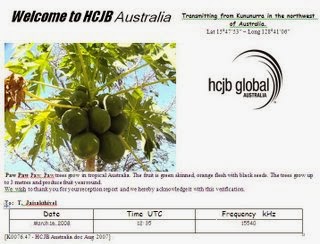
Ecuador, Ecuador, HCJB/LV de los Andes
New name for station is Reach Beyond
After 82 years HCJB as an organisation is changing its name to Reach Beyond.
This will include the Australian shortwave station but that transition will happen
over the next 12 months. Right now the station is still called HCJB Australia.
The call letters HCJB will (eventually) only occur in Ecuador, South America where
the whole broadcasting mission began.

France, R France International
French
0800-0900  15150af (add)

Germany, Deutsche Welle
Dari
1330-1400  15700as (add)
Hausa
1300-1400  17860af (ex 12070af)
Pashto
1400-1430  15700as (ex 9440as)
Portuguese
1930-2000  11800af (ex 7305af)
Urdu
1430-1500  9440as (delete)

Germany, R Prague
German
1630-1700  3985eu (add) //  6005eu (add)
2000-2030  3985eu (add)

India, AIR/External Svc
English
1530-1545  11740 (add, irregular broadcast)
Russian
1700-1715  11620as // 9595as

India, TWR India
Bengali
1315-1330  Sat  9790as (ex 5955as)
Bhili
1500-1515  Sat/Sun  9670as (ex 5955as)
Bondo
1330-1345  Sun  9790as (ex 5955as)
Braj Basha
1315-1330  f  9790as (ex 5955as)
Bundeli
1345-1415  Sat  9925as (ex Braj Basha 1345-1400)
Chodri
1445-1500  Sat/Sun  9925as (ex 5955as)
Dhodiya
1515-1530  wt  9670as (ex 5955as)
Gamit
1500-1515  mtw  9670as (ex 5955as)
Garhwali
1330-1345  Sat  9790as (ex 5955as)
Haryanvi
1330-1345  f  9790as (ex 5955as)
Ho
1300-1315  Sat  9790as (ex 5955as)
Kashmiri
1330-1345  w  9790as (ex h 5955as)
Kharia
1400-1415  Sun  9925as (ex 5955as)
Kui
1245-1300  Sat  9790as (ex 5955as)
Kumaoni
1300-1315  Sun  9790as (ex 5955as)
Kuruk
1345-1400  Sun  9925as (ex 5955as)
1415-1430  hfa  9925as (ex 5955as)
Magahi
1415-1430  sm  9925as (ex 5955as)
Maithili
1330-1345  mt  9790as
1345-1415  mtwhf  9925as (EX 5955as)
Mewadi
1315-1330  wh  9790as (5955as)
Mewari
1315-1330  mta  9790as (add)
Mouchi
1515-1530  mt  9670as (5955as)
Mundari
1415-1430  tw  9925as (ex 5955as)
Sadri
1430-1445  Sat/Sun  9925as (ex Sadari 5955as)
Santhali
1245-1300  Sun  9790as (5955as)
Sindhi
1430-1500  mtwhf  9925as (5955as)
Tibetan
1330-1345  h  9790as (ex 5955as)
Urdu
1500-1530  6115as (delete)
1530-1600  9670as (add)
Vasavi
1500-1515  hf  9670as (ex 5955as)

Italy, IRRS/Euro Gospel R/Warra Wangelaa
Bantu/English
1530-1600  Sun  15190af (add)
Oromo
1500-1530  Sat  15515af (add)
Somali
1500-1530  f  15515af (add)

Japan, R Japan/NHK World
Bengali
1300-1345  13615as (ex 12035as)

Morocco, R Mediterranee Intl
Arabic/French
0000-2300  9575va  (ex 9579va)

Nigeria, VO  Nigeria
English
0900-1000  15120af (ex 9690af)
Hausa
0730-0800  7255af (add)
2100-2200  11770af (add)

Poland, Polish R/External Svc
German
1700-1730  3985eu (add)
2030-2100  3985eu (add)

Russia
Russia, VO Russia
English
0800-0900  DRM  9625eu  11635eu
0900-1000  DRM  9625eu  11635eu
1000-1100  9560as (ex 21800as)
1000-1100  DRM  9625eu (ex 9560eu) // 12035as
1100-1200  DRM  9625eu // 12035as (ex 9560as)
1100-1200  9560as (ex 21800as)
1300-1400  9560as (add)
1500-1600  5900as (delete)
1600-1700  5900as (delete)
Russian
0200-0300  9790as (add)
0300-0400  9790as (add)

Russia, Tatarstan Wave/R Tatatarstan
All broadcast have been cancelled, station no longer on the air

Singapore, TWR Asia
English/Tagalog
1200-1300  15160as (ex English only)

Slovakia, Slovakia, R Slovakia Intl
German
1600-1630  3985eu  6005eu (add)
1930-2000  3985eu (add)

Spain, R Exterior de Espana
Spanish
1300-1400  21640ca (add) (ex 21630ca)
1400-1500  21640ca (add) (ex 21630ca)
1500-1600  21640ca (add) ex 21630ca)
1600-1700  Sat/Sun  21640ca (add) ex 21630va

Suriname, R Apintie
Dutch/English/Sranang/Hindi
0700-0800  irreg  4990do
0800-0900  irreg  4990do
1800-0000  irreg  4990do

Swaziland, TWR Africa
Kunama
1800-1830  Sun  5935af (add) ex Kuanyama)
Tigre
1800-1830  Sat  5935af (add)
Tigrinya
1800-1845  mtwhf  5935af (add)

Tunisia
RTV Tunisia/ Radio Tunisienne
Relays on shortwave have ceased

UK, FEBA Radio
Baluchi
0215-0230  mtw  7315as (add)
Sindhi
0215-0230  tha  7315as (add)
Urdu
0200-0215  mtwhfa  9750as (delete)
0200-0215  7315as (add)
0215-0230  Sun  7315as (ex 9750as) (ex 0200-0215 Sun 9750as)

UK, IBRA R/R Ibrahim
Oromo
1700-1730  9540af (add)
Singo
1700-1730  17500af (add)

Ukraine, R Ukraine Intl
German
1830-1930  3985eu (add)
2100-2200  3985eu (add)

Uruguay, R Nacional SODRE
Station is not listed in WRTH 2014, information is based on loggings
Spanish
2000-2100  irreg  6125do
2100-2200  irreg  6125do
2200-2300  irreg  6125do
2300-0000  irreg  6125do

USA, AFN/AFRTS
English
0800-2000  5765usb (delete)
2000-0800  13362usb (delete)

USA, Overcomer Ministry (via WWCR)
English
0600-1000  mtwhfa  3215eu (broadcast cancelled)
1000-1100  5890ca (ex 5980na)
1100-1200  5890ca (ex 5980na)
1200-1300  mtwhf  5890ca (ex daily)
2000-2100  9980ca (add)
2100-2200  9980ca (ex Sat/Sun)
2200-2300  9980ca (ex mtwhf)
2300-0000 mtwhf  9980ca (add)

USA, R Free Europe/R Liberty
Russian
1900-2000  7225as (ex 9515as)

USA, VO America
English
0030-0100  9380as (add) // 12015as (add)
0930-1000 Sat/DRM  5745na (add)
1400-1500  mtwhf  7580as (ex 7520as)
1500-1600  7580as (add) // 9900as (add)
2230-2300  9905as (add)
2300-0000  5810as (add) // 9900as (add)
Kurdish
1700-1800  9705me (add)

USA, VOA/R Ashna
Dari
1500-1530  17580as (ex 11595as) // 11825as 12140as
1500-1600  12140as (delete)

USA, VO America/Learning English
English/Special
0030-0100  9380as (add)
0030-0100  12015as (ex 11695va)

USA, WBCQ Monticello ME
English
0800-1100  delete 7490am
Spanish
2200-2230 w  7490va (add) (ex 2200-2300 smtwhf  7490am)

USA, WHRI Cypress Crk SC/Overcomer Ministries
English
0600-0800  7490eu (ex 7520eu)
0830-1000  Sun  11565pa (ex 0900-1100)
1000-1200  11565pa (add) (ex 1030-1100 Sun & 1100-1200 7520eu)

USA, WINB Red Lion PA
English
Note: From March 1, 2014 WINB will broadcast the entire schedule 9265 kHz

0000-0300  9265 INB 050 kW 242 deg to CeAM English Daily
0300-0330  9265 INB 050 kW 242 deg to CeAM English Sat-Thu
1215-1300  9265 INB 050 kW 242 deg to CeAM English Sun
1300-1500 13570 INB 050 kW 242 deg to CeAM English Sun
1500-1715 13570 INB 050 kW 242 deg to CeAM English Sat/Sun
1715-2145 13570 INB 050 kW 242 deg to CeAM English Daily
2145-2200 13570 INB 050 kW 242 deg to CeAM English/Spanish Mon-Fri
2145-2200 13570 INB 050 kW 242 deg to CeAM English Sat/Sun
2200-2330  9265 INB 050 kW 242 deg to CeAM English Daily
2330-2400  9265 INB 050 kW 242 deg to CeAM English Tue-Sun
2330-2400  9265 INB 050 kW 242 deg to CeAM Spanish Mon

USA, WRMI Okeechobee FL/Overcomer Ministries
English
0000-0600  7570na (delete)
0300-0400  9495ca (ex 13695am)
0600-0700  9495ca (ex 7470na)
0700-1000  9495ca (ex 7570na)
0800-0900  9495ca (ex 9840af)
0900-1000  9495ca (ex 9840af)
1000-1600  11825sa (delete) 9955ca (delete)
1000-1100  9495ca // 9690ca
1100-1200  9955ca (ex 9690ca)
1100-1600  11825sa (delete)
1200-1300  11825sa (delete)
1600-2200  11825sa (delete)
1800-1900  7730eu (add) // 9690na 9955na
2100-2200  7730eu (delete)
2200-2300 mtwhf  7730 (delete)
2200-2300   7570na  (broadcast hour cancelled)
2300-0000   7570ca (broadcast hour cancelled)

USA, WRMI/Okeechobee FL (ex WRMI/Viva Miami/Okeechobee FL)
Revised schedule
English/Spanish
0000-0100  9495am
1100-1400  9955sa
1400-1500  9955na
2200-0600  9955sa
2100-2200  7730eu

USA, WWCR Nashville TN
Spanish
2200-2300  mtwhf  6115na (ex English 2200-2300 6115eu)

Vatican City State, Vatican R
Chinese
1230-1300  mtwhfs  11875as (ex 11865as)
1230-1300  Sat  11875as (11865as)
1300-1315  Sat  11875as (11865as)
German
1730-1745  mtwhfa  3985eu (add)


Yemen, Rep of Yemen R
English
1800-1900  6135me (add)

****************************

Legend
Days:
m (Monday)
t (Tuesday)
w (Wednesday)
h (Thursday)
f (Friday)
a/Sat (Saturday)
s/Sun (Sunday)
DRM  Digital Radio Mondiale

Target Areas:
af (Africa)
am (Americas)
as (Asia)
ca (Central America)
do (domestic)
eu (Europe)
me (Middle East)
sa (South America)
va (various)

Friday, February 14, 2014

Unique Radio Russian Navy

Belarus / Russia

Uninque Radio Russian Navy Celebrated the 50th Anniversary.

It is one of two Russian military bases on the territory of Belarus. Three hundred meter tower antennas above the forest attracted the attention of not only the residents of nearby villages. Triangle antenna field with more than
kilometer dimensions is clearly visible even from space, and are looking at him and at the Pentagon. Located in the woods near Vileika, radio "Antey" - an important strategic element of the Navy of Russia. She is
responsible for communicating to the extra-long distances between the General Staff and ships and submarines in the waters of Atlanticheskogo, Indian and Pacific Oceans even. The secret to journalists allowed only on the anniversary, but managed to see only a small part of a large-scale complex. 80 kilometers of the antenna wires in the air and another 600 - underground. There's also a massive bunkers and tunnels to withstand a nuclear attack.

Expert Opinion Russian voenproma - after 50 years in radio have the potential for development. Olga Kildisheva, general director of the Russian Institute of High-Power Radio: "We have every opportunity to
breathe new modern life in the station, so she could perform all assigned functions and nothing would have yielded the most modern radio is not quite our allies." Extra long wave able to go around the entire Earth.
Signal reception is possible under water, which is important for nuclear submarines. Station "Antey" built during the time of the Cuban missile crisis, but now it is every day intrudes on alert. Together with the
Russian seafarers working here and Belarusians.

Yuri Savitchev, Head 43rd super long radio Russian Navy: "Our radio station like time represents the close proximity and affinity of our peoples. Because both Russian and Belarusian in the same ranks intrudes on combat duty, performing common tasks in the interests of our two countries -security of Russia and Belarus."

Gennady Kazakov, Head of the Armed Forces of the Republic of Belarus "reached full operational compatibility of military tactical management and technical compatibility of communications that perform joint
operational and combat missions. This was highlighted during the exercise West - 2013".

Now the military departments of Belarus and Russia implement a plan to build a united communication system the regional grouping. Go joint research and development and updating technology. A radio station in the Belarusian outback is still in touch with the world.
http://ont.by/news/our_news/00113619
(Moscow Information DX Bulletin, Weekly electronic publication # 878, Jan 28, 2014, Editor of the current issue: Alexander Dementyev-RUS, via RusDX Feb 2/WWDXC Top Nx 1150)

Wednesday, February 12, 2014

WINB back on the air from antenna damage


The winter weather did a bit of damage to our antenna feed line last night. We spent the whole morning working on it.  WINB is back on now and we are seeking reception reports.

We will QSL for audio file reports emailed to winb40th@yahoo.com.  I have WINB stickers that I will send to the first five people sending me a report.

73s,

Hans Johnson
Frequency Manager, WINB

Thursday, February 06, 2014

Blog Logs: South America

A sampling from shortwave monitoring

All times UTC/ frequency in kHz (kilohertz) // parallel frequency
* Sign-on  / Sign-off *

Logs edited for clarity

Bolivia

Observed on shortwave from within Bolivia and in the region-monitored from late December t0 February 4, 2014.
2210 Radio Mosoj Chaski, Quillacolla, Cochamba
4700 Radio San Miguel, Riberalta
4717 Radio Yura, Yura (not “Radio Yatan”, as reported elsewhere)
5580 Radio San José, San  José, de Chiquitos (very irregular)
5952.5 Radio Pio X II, Llallagua
6025 Red Patria Nueva, La Paz (not “Radio Patria Nueva,” as reported elsewhere)
6105 Radio Panamericana, La Paz
6135 Radio Santa Cruz, santa Cruz
All other stations listed off the air-some have been gone for a long time, others possibly or temporarily off the air, but at least one-Radio Juan XXIII from San Ignacio de Velasco, is planning a return to shortwave with a new transmitter. (Stig Hartvig Nielsen, Santa Cruz, Bolivia/HCDX)

3310, Radio Mosoj Chaski, Cochabamba 2330. Presumed Quechua text from announcer, audible just past 0010, which included bits of  Bolivian pan flute music. (R Pearson, St Augustine, FL)

4699.94, Radio San Miguel Riberalta 1003. Male announcer’s Spanish talk as possibly a religious sermon. Signal poor and weak. (Scott Barbour, NH)

4716.68, Radio Yatun Ayllu Yura 0001-0015. Spanish programming with promo and a local time check. Signal poor, but audible. (R Pearson, St Augustine, FL).

5580.4, Radio San José, San José de Chiquitos. 0005-0025. Male announcer’s text and talk interspersed with promo and musical ballad. Fair signal, but able to monitor. (R Pearson, St Augustine, FL).

5952.5, Radio Pio XII, Siglo XX, 0035. Spanish announcement to Andean music. Poor signal. Other Bolivians, Radio  Yatun Ayllu on 4716.7 and presumed Radio Mosoj Chaski on 3310, were also noted with very weak signals. (Sellers). Also heard at 0115, male/female chatting in Aymara with music interludes, SINPO 24432. (Bell/DXW 498)

6025.00,  R Patria Nueva, La Paz, 1017-1040. Program ”Game of Dakar Peace Calama” to do best listening. LSB interference from another station in AM, 44444. (Arrunátegui/DXW 498)

6105.35,R adio Panamericana, La Paz, 1110-1155. Program ”Manantial de Vida” (religious), advs: Seguridad Ciudadana,   ID: “Panamericana desde la Paz”, 44444. (Arrunátegui/DXW 498)

Brazil

4755.92, Imaculada Conceicaio 2312-2335. Weak audio at tune-in to various Portuguese announcements and music bits. Signal improving by 2320, better by 2330. Tentative jingle ID at 2334 to the tune of "Happy Birthday to You." Announcer’s talk during fair signal quality. (Scott Barbour, NH)

4774, ZYG207 Radio Congonhas, 2214-2235. Portuguese talk to pop music and station ID at 2234. SIO 253. (H Frodge, DXP/MARE 766)

4785, Radio Caiari Porto Velho 0928-0940. Light style music and ballads to male announcer between selections. Signal fair and improving. (Scott Barbour, NH)

4815.00, R Difusora, Londrina, PR, 2344-0020. Talk in Portuguese with congregation(?), ID: ”Difusora..”, music, 22222. (Arrunátegui and Wilkner). Also heard at 0102, Jan 09, slow choral music, male pastor in Portuguese with prayer, 35333. (Bell/DXW 486)

4825, Radio Canção Nova, Cachoiera Paulista, SP, 0337. Telephone numbers in Portuguese, programme anns, romantic pop, 35333. (Bell/DXW 486)

4845, Radio Cultural Ondas Tropicais, Manaus, AM, 2218-2235, Jan 18, soccer report in Portuguese, "Campeonato Pulista", 24322. (Méndez). Also heard at 0340, male/female announcers in Portuguese, trumpet fanfare, SINPO 25332. (Bell/DXW 486)

4875, Radio Difusora Roraima, Boa Vista, RR, 2216-2235.  Portuguese comments, 14321. (Méndez). Also heard at 0114,  up-tempo song of praise, into gospel music, SINPO 25333. (Bell/DXW 486)

 4875.1, ZYG810 Radio Roraima, 0034-0045. Portuguese talk to rock music. Station ID at 0045. Signal covered by LSB utility at 0035-0039. Signal fair in USB. SIO 352. (H Frodge, DXP/MARE 766)

4885.00, Radio  Dif. Acreana, Rio Branco, AC, 1035-1100.  "Radio Difusora Acraena", music, SINPO 33333. (Arrunátegui/DXW 486)

4885.019, Radio Club do Pará, Belém, 0434. S-8 signal strength in southern Germany, “ ... palabra problemas de Brasil...” (wb, WWDXC/Top Nx 1148)

4955, Radio Cultural Amauta Huanta 1035-1045. Choral musical ballad to brief announcements. Bits of music to same format through tune-out. Signal fair. (Scott Barbour, NH)

4985, Radio Brasil Central, Goiânia, GO, 0350. Male singer with slow romantic pop, heavy utility traffic, SINPO  31332. (Bell/DXW 498)

5939.83, R.Voz Missionaria, Camboriú, SC, 0820-0832. Popular song, a sound of a cock crowing in the morning and "Bom dia Bom dia" "Radio Voz Missionaria" at 0831, it became easy to receive after the period of Radio Rossii, SINPO 25332. (Wagai/DXW 498)

 5970, R Itatiaia, Belo Horizonte, MG, 0059. Male/female announcer’s chatting in Portuguese, advertisements, IDs, SINPO 54444. (Bell). Also heard at 0603-0640, comments in Portuguese, "Bom dia", SINPO 24322. (Méndez/9 DXW 498)


6010, Radio Inconfidência, Belo Horizonte, MG, 0105. Female speaker in Portuguese with federal announcement.  Slow pop song, SINPO 53444. (Bell). Also heard at 0705-0733, Brazilian songs, Portuguese comments. Interference from La Voz de tu Conciencia, SINPO 12221. (Méndez/DXW 498)

6080, Radio Marumby, Curitiba, PR, 0712-0722, Religious comments in Portuguese, SINPO 23222. (Méndez/DXW 498)

6120, Super Radio Deus é Amor, São Paulo, SP, 0735-0755, Portuguese religious comments, SINPO 24322 // with 11765. (Méndez/DXW 498)

6134.886, Radio Aparecida, Aparacida SP. Noted at 0508 with weak S-6 signal, undoubtedly Portuguese program, not Spanish. (wb, WWDXC/Top Nx 1148)

6134.9, Radio Radio Aparecida, Aparacida SP. Portuguese religious programming and prayers. Talking phone calls at 0055, followed by ID and promo. SIO 333. Station interference is likely Radio Santa Cruz on 6134.8 (H Frodge-DXP/MARE 766)

6135, Radio Aparecida, Aparacida SP. Noted 0855-0900 with musical ad at tune-in and passing mention of “Aparecida.” Time tips signal, then battling dominance with presumed Bolivia’s Radio Santa Cruz at *0900. Radio Aparecida, Aparacida SP. (wb, WWDXC/Top Nx 1148)


6180, Radio Nacional de Amazonia 2241. Male announcer’s Portuguese talk and many mentions about Brazil. Presumed this is Radio Nacioal de Amazonia. (BC, MI/MARE 766).

9645.377, ZYE957 Radio Bandeirantes, São Paulo, SP. Programming not religious, but rather nice mixed Brazilian music program at 0543. S-5 weak to fair signal level. (wb, WWDXC/Top Nx 1148)

9664.369, Radio Voz Missionária, Camboriú, 0550. weak to fair signal quality, nice Brazilian religious canção singer. Noted on // 5939.839 kHz, also S-5 signal. (wb, WWDXC/Top Nx 1148)

9664.74 Radio Voz Missionária, Camboriú, 0348-0400+. Tentative on this station, noting exhortive male in Portuguese with mentions of Brazil. SIO 322 in AM, much better in USB due to 9660 kH splash // 5939.85 SIO 442+ with splash interference from 5935 via WWCR. (Harold Frodge-DXP/MARE 766).

9818.900, Radio Nove de Julho, São Paulo, SP at 0552. Signal disturbed by sideband splash interference. (wb, WWDXC/Top Nx 1148)

11735, Radio Transmundial, Santa María, RS, 0955-1022, Portuguese religious comments, "Amigos ouvientes de Transmundial", 24322. (Bell and Méndez/DXW 498)

11915, Radio Gaúcha, Porto Alegre, RS, 2302-2311, News in Portuguese, then time check, sports, commercials,  and a promo mentioning "Rádio Gaúcha" 2307, S5-9. (Robins/DXW 498)

11925.2, adioR Bandeirantes, Sao Paulo, SP, 0729, Male speaker in Portuguese with IDs, music clips, local song, ads. SINPO 35423. (Bell/DXW 498)

Colombia
5910, Alcaravan Radio, 0020. Station ID in Spanish as “Alcaravan Radio” into Spanish song. Stumbled across the station ID as I tuned into the frequency. (BC, MI/MARE 766). Noted this station at 0508-0516 with traditional Latin American music. Lots of time checks and Ids (which mentions their AM frequency in 1530 kH AM. Decent signal. (Wolfish, Burnt River/MARE 766).

Ecuador

6050.00, HCJB, Pichincha, *0825-0850. Tuning music, anthem, ID in Quichua, "HCJB Quito, AM 690, 6050 onda corta", time signals at 0830, Andean music and comments in Quichua, 44444. (Méndez). Also heard at 1040-1110, with religious porgram in Quechua with Spanish music, ID: “HCJB presenta a través en español  de la biblia”, SINPO 44444. (Arrunátegui/DXW 498)

Peru
3329.8, Ondas del Huallaga, 2325-2358. Spanish text from announcer for very poor signal. Just as poor on subsequent daily checks. (R Pearson, St Augustine, FL)

4774.94, Radio Tarma, Tarma, 2306-0025,Spanish talk, pop song, ID, 25232. (D'Angelo/FCDX, Nilsson and Petersen). Also heard at 1050-1115, huayno music, ID: "Desde Radio Tarma del Perú hemos presentado”, program ”Confidencial música folclórica” national music, then give the Angelus (news), SINPO 33333. (Arrunátegui and D'Angelo/FCDX/DXW 498)

4774.91, Radio Tarma 1007-1023. Spanish talk to Latin American music between announcer’s items. Signal fair and clear. (Scott Barbour, NH)

4790, Radio Visión, Chiclayo 2355-0005. Presumed this station, as signal was very poor and fading. (R Pearson, St Augustine, FL).

4824.50, La Voz de la Selva, Iquitos. Noted at 2345-0020. Male/female duo’s Spanish conversation, and promo. Signal fair over recent monitoring as very poor. (R Pearson, St Augustine, FL).

4985, Radio Voz Cristiana. Surprised to find this one, and coming in fairly well. Equal in signal to Brasil Central. Noted at 2330-2335 with lively religious music. Lady’s religious sermon with mentions of “Madre de Dios, corazon y palabra.” Local time mentions to same program sermon format and rapid-paced music. Program break at 2356 for “canned” promos and a second mention of ‘internacional” and address in Huancayo. Additional mention of “Voz Cristiana y Francisco.” Promo with nice ID at 01:20 and 01:40. ID as “Radio Voz Cristiana.” (Dave Valko, PA/HCDX)

5024.92, Radio Quillabamba, Quillabamba, 2340, Decent signal before R Rebelde signs on. At 0026 Rebelde is very strong. (Nilsson). Also heard at 0111,  Cuba off air, female speaker in Spanish, SINPO 15331. (Bell/DXW 498)

6173.90, Radio Tawuantinsuyo, Cuzco;  7/01 2145-2210 SINPO 44444. Music cumbia peruana advs Plus Petrol con energía todo se puede. ID “Radio Tawuantinsuyo, la voz de la expresión andina, transmite desde Cusco, Perú” music. (Arrunátegui/DXW 498).

Suriname
4990, Radio Apintie, Paramaribo 0943-1000. Male announcer’s Dutch comments over music. Male/female hosts with promos and several Ids as, “always on ... always will be ... Radio Apintie.” Lite music at 0955 into male announcer’s text. Losing signal to local interference at 1000. Signal weak but clear, best heard in quite some time. Subsequent  logging on Jan 31, on 4990, 0659-0711. Various musical selections of pop, dance, and salsa with brief announcer in Dutch at 0701 and 0708. Signal very good. (Scott Barbour, NH)

Uruguay

6125, Radiodiffusión Naciona SODRE. Transmitting to CX Radio Uruguay, Montevideo at 20:42-21:02 in Spanish. Report from the Dirección Nacional de Meteorología, governmental announcements, complete station ID which included the list of relay stations in FM in different cities such as; Cologia, Bella Unión, Artigas, Salto, Paysandu and Mercedes. Newscast of “informe Nacional Tercera Edición” at 20:50. Continued news about Argentina and Uruguay. Station ID as, “las emisoras de Radiodifusión Nacional del Uruguay...vuelven a sus respectivas programaciones...Radio Uruguay, 1050 AM.” Additional station identification as, “somos Radio Uruguay, 1050 AM...Radiodifusión del Uruguay.” SINPO 44433. Log in rural town of Fatima, located 61 kms from Ciudad Autónoma de Buenos Aires with a Sony ICF 2010 and EWE antenna. (Arnaldo Slaen, Argentina/playdx)

Tuesday, February 04, 2014

QSLing National Holidays

Here is a neat little tip you may not have thought about when planning your listening schedule. All countries have national holidays, but have you considered listening to them on their special day or holiday? Listeners may find special programming or extended broadcast hours to honor that special day, holiday or event. Many listener's take advantage of this excellent opportunity by sending reception reports for the particular country on this special holiday.

Don't forget to mention in your station correspondence any special event or holiday you may have heard mentioned during the broadcast. The QSL Manager or other staff member will likely appreciate your interest in their country, and may send some extra memorabilia your way.

The pages that follow are my exclusive month-by-month listing of national holiday/independence days to assist you in monitoring various national celebrations. I have also added the country capital name and any variant spellings of the name as part of this listing. Entries marked with an asterisk (*) are national holidays. This list works very well, whether as a shortwave listener, AM/FM listener or an amateur radio operator.
(excerpt from QSLing the World by Gayle Van Horn. A Teak Publishing e-book available at Amazon at:

SLBC Sri Lanka QSL
February 2014 - National Holiday/Independence Day - Date / County and Capital

Sri Lanka Independence Day* (from UK) February 4 Colombo
New Zealand Waitangi Day* February 6 Wellington
Niue Waitangi Day* February 6 Alofi
Tokelau Waitangi Day* February 6 No official capital
Grenada Independence Day* (from UK) February 7 Saint George's
Iran Revolution Day* February 11 Tehran
Burma Union Day* February 12 Rangoon (Yangon)
Lithuania Independence Day* February 16 Vilnius
The Gambia Independence Day* February 18 Banjul
St. Lucia Independence Day* (from UK) February 22 Castries
Brunei National Day* February 23 Bandar Seri Begawan
Guyana Republic Day* February 23 Georgetown
Estonia Independence Day* February 24 Tallinn
Kuwait National Day* February 25 Kuwait
Dominican Republic Independence Day* (from Haiti) February 27 Santo Domingo
Egypt Independence (from UK)  February 28 Cairo

Monday, February 03, 2014

Weekly Propagation Forecast Bulletins


Product: Weekly Highlights and Forecasts
:Issued: 2014 Feb 03 0218 UTC
# Prepared by the US Dept. of Commerce, NOAA, Space Weather Prediction Center
# Product description and SWPC web contact www.swpc.noaa.gov/weekly.html
#
#                Weekly Highlights and Forecasts
#
Highlights of Solar and Geomagnetic Activity 27 January - 02 February 2014

Solar activity ranged from low to high levels during the summary period. Activity was dominated by Region 1967 (S13, L=114, class/area=Fkc/1510 on 02 Feb) with a total of 37 C-class and 19 M-class x-ray events. This active region was the return of old Region 1944 which produced a total of 44 C-class, 7 M-class and 1 X-class events during its last rotation. Region 1967 was first numbered on 27 January as it rotated onto the visible solar disk as a Dso/beta region. By 30 January, the region grew tenfold and was classified as a Fkc/beta-gamma-delta type group. The largest event of the period occurred on 30 January when Region 1967 produced an M6/2n flare at 30/1611 UTC. 

Accompanying this event was a 220 sfu Tenflare and a Type II radio emission (2161 km/s). An asymmetric halo coronal mass ejection (CME) was subsequently observed in SOHO/LASCO C2 coronagraph imagery which emerged from the SE limb at 30/1624 UTC. Analysis suggested the CME was moving at  approximately 1400-1500 km/s and had an Earthward component. Region 1968 (N10, L=112, class/area=Ekc/300 on 01 Feb) was the second largest region on the disk during the week and also productive. The largest flare from this group was an M2/1b flare at 02/0634 UTC. 

No proton events were observed at geosynchronous orbit.

The greater than 2 MeV electron flux at geosynchronous orbit was at normal levels. 

Geomagnetic field activity was at predomiantly quiet levels with isolated unsettled intervals early on 30 January and again late on 01 February. Solar wind parameters, as observed at the ACE satellite, indicated nominal wind speeds at 350 - 400 km/s through a majority of the period. A brief interval of 450 - 500 km/s was observed for about 10 hours from 29/0600 - 1600 UTC. During this same time period, the interplanetary magnetic field Bz varied between +/- 7 nT while total field reached 8 nT. Otherwise, the Bz component did not vary beyond +/- 5 nT with total field ranging between 2 - 6 nT. The phi component was in a predominately positive (away) orientation through about 01'1600 UTC when the field switch to a more negative (toward) orientation. A weak discontinuity was observed at the ACE satellite near the end of the summary field which might have indicated the arrival of the 30 January CME. 

Forecast of Solar and Geomagnetic Activity 03 February - 01 March 2014

No proton events are expected at geosynchronous orbit.

The greater than 2 MeV electron flux at geosynchronous orbit is expected. 

Product: 27-day Space Weather Outlook Table 27DO.txt
:Issued: 2014 Feb 03 0218 UTC
# Prepared by the US Dept. of Commerce, NOAA, Space Weather Prediction Center
# Product description and SWPC web contact www.swpc.noaa.gov/wwire.html
#
#      27-day Space Weather Outlook Table
#                Issued 2014-02-03
#
#   UTC      Radio Flux   Planetary   Largest
#  Date       10.7 cm      A Index    Kp Index
2014 Feb 03     195           8          3
2014 Feb 04     200           8          3
2014 Feb 05     205           5          2
2014 Feb 06     210           5          2
2014 Feb 07     205           5          2
2014 Feb 08     195           8          3
2014 Feb 09     180           8          3
2014 Feb 10     170           8          3
2014 Feb 11     160           5          2
2014 Feb 12     150           5          2
2014 Feb 13     140           5          2
2014 Feb 14     135           5          2
2014 Feb 15     130           5          2
2014 Feb 16     140           5          2
2014 Feb 17     145           8          3
2014 Feb 18     145           8          3
2014 Feb 19     145           5          2
2014 Feb 20     145           5          2
2014 Feb 21     145           5          2
2014 Feb 22     145           5          2
2014 Feb 23     150           5          2
2014 Feb 24     160           5          2
2014 Feb 25     170           8          3
2014 Feb 26     180           5          2
2014 Feb 27     185           5          2
2014 Feb 28     190           5          2
2014 Mar 01     200           5          2
(NOAA)

New decisions on the way for Deutsche Welle


"To achieve our goals for the next four years, we now need to create the program-related conditions," the director said at the 20th January before employees in Berlin and Bonn. The Board had on 17 January agreed on necessary measures programmliche. "They create the framework in which we implement our ideas of creative and modern journalism and position ourselves as a global information provider from Germany," said Limbourg.

It is intended to focus on English and on successful regional languages. English is the journalistic "flagship" and thus developed into an internationally competitive offer. DW wants their potential in the target group of global decision-makers and participants exploit the political opinion-forming process. At the same time the news surfaces are expanded in the German TV channel and structured the program clearer. The DW Director: "German is an important language for the DW." In the online sector a German-speaking community is built on dw.de and German courses are developed.

Additional story at: http://www.dw.de/deutsche-welle-beschlie%C3%9Ft-weichenstellungen-auf-dem-weg-zum-globalen-informationsanbieter/a-17373354

Update on Cuba's Radio Progreso


Message from Arnie about Radio Progreso Tropical 60 meter band station.

Dear amigo Wolfie:
Radio Progreso's successful test from October to December of 2013 using 4765 kHz frequency registered to Cuba at the ITU with 50 kW omnidirectional and high take off angle antenna was completed on the last
day of December and starting January 1 2014 it is now a permanent daily service 7 days a week.

Under study now is the possibility of extending the on the air time starting at 2300 UTC, so that the broadcast will be from 2300 to 0500 UT.

As regards to reports received and QSL verification, the station will issue a QSL card soon, and in the meantime listeners who report correctly the transmissions will receive a QSL letter.

Please note that the postal mailing address for the 60 meters Tropical Band reports is:

Radio Progreso
Atte: Transmision Banda Tropical
PO BOX 3042
Codigo postal 10300
La Habana
Cuba.

In the meantime I will continue to relay the e-mail messages sent via Radio Havana Cuba's inforhc@ enet.cu
to Radio Progreso's Chief Engineer Ing. Jose Antonio Fuentes Beltran that is going to be the person in charge of verifying and signing the QSL letters now and QSL cards when they come from the printer.

At this moment Cuba has on the air three short wave services Radio Havana Cuba in eight languages using frequencies on the 60, 49, 31, 25, 22, 19, and 16 meters bands.

Radio Rebelde  on 5025 kHz 60 meters band

Radio Progreso on 4765 kHz 60 meters band.

73 and DX
Prof. Arnaldo Coro Antich ( AKA Arnie Coro on the air)
Advisor / Senior Consultant to the Director General
Radio Habana Cuba
(via wb, wwdxc BC-DX TopNews Jan 29)
(WWDXC/Top Nx 1148/02 Feb)

HCJB Global Becomes Reach Beyond—a New Name and a New Call to Christians Worldwide


Reach Beyond’s Mission Manifesto articulates renewed passion and purpose in fulfilling the 82-year-old ministry’s efforts to reach the un reached


COLORADO SPRINGS, Colo.  – HCJB Global announced today that the 82-year-old ministry, founded in Quito, Ecuador is changing its name to Reach Beyond.  The new name and the release of the Reach Beyond Mission Manifesto are intended to encourage and challenge Christians worldwide to reach beyond their comfort zones and perceived limitations to share the love of Jesus in places where the gospel has seldom, if ever been heard.

The mission is defined by the tagline, “The Voice and Hands of Jesus.  Together.”  Through its “voice” ministries, the mission works with partners to use radio and modern media to make the gospel accessible in places where it typically isn’t available.

The “hands” ministries of the mission provide much-needed healthcare service in places where even common medical help isn’t readily available.  Reach Beyond “hands” ministries takes many forms including mobile community healthcare clinics, counseling centers in war torn areas, clean water projects and general hygiene training, all with an emphasis on demonstrating the love of Jesus to recipients of the care.

Reach Beyond also values partnership with local Christians, churches and ministry partners as its core way of operating, signified by the word “together” in its tagline.

“For more than 80 years our missionaries and partners have boldly been going to places where people have never had the opportunity to experience the love of God,” said Wayne Pederson, President and CEO of Reach Beyond.  “But now is the time to accelerate and multiply those efforts.  Through the use of modern media and healthcare we work arm in arm with partners to show people that a relationship with Jesus Christ can change their lives forever.”

The “Reach Beyond Manifesto” challenges believers to reach beyond borders and their own comfort level in an effort to accomplish the Great Commission. It serves as a declaration for how the renamed Reach Beyond wants to invest its time and efforts in making Christ known to the ends of the earth. It’s also a call — and a challenge — for other Christians to recommit themselves to the same effort.

To read and sign the Manifesto, visit www.reachbeyond.org.

 “With all the technology, knowledge and experience available to us today, there is no reason why we can’t make Christ known to everyone on the planet,” said Pederson. “We hope the ‘Reach Beyond Manifesto’ causes all like-minded Christians to renew their commitment to demonstrate God’s love as His ‘voice’ and ‘hands.’”

Founded in 1931 as World Radio Missionary Fellowship Inc., Reach Beyond has focused on making disciples of Christ around the world. With ministries in more than 100 countries, Reach Beyond equips partners to air Christian content in more than 120 languages and dialects. The name change also reflects the ministry’s ongoing international focus and commitment to reach areas where less than 2 percent of the population is Christian.

“Adaptability has always been a strength of the mission,” said Curt Cole, Executive Vice President of International Ministries.  “When the best model was to own a large hospital or broadcast over shortwave radio, the mission leveraged those strengths.  Today, technology and the world are changing, and we are adapting.  That’s why we place such a high premium on partnerships with local Christians.  They know their own culture and needs far better than we do.  If the need is for a small, community healthcare clinic or a local FM radio station, we’re committed to equipping the people with all the resources they need to reach their own people in their own culture.”

HCJB Global’s “Beyond the Call” radio program, on more than 1,000 stations around the U.S., will now be called “Reach Beyond.”

“The new name is much more than a brand change,” Pederson said. “Reach Beyond is a reflection of our ministry DNA. It’s about doing whatever is necessary to reach those who have never heard the name of Jesus. In essence, it’s a call to Christians to reach beyond their comfort zones and challenges them to actively participate in making Christ known among the nations.”

The organization hopes the “Reach Beyond Manifesto” will serve as a call to action for Christians to focus their attention and efforts on those areas of the world where Christ has yet to be proclaimed.

“We hear it every generation, but perhaps it’s more true now than ever,” Pederson said. “We are at a pivotal time in our history. We have the means and ability to spread the message of Jesus to everyone who is alive today. We can accomplish this by renewing our commitment and reorganizing our priorities. Reach Beyond wants to be on the forefront of this new gospel era and encourage others to join us in making Christ known in every country, city, village and community around the globe.”

For 82 years the passion of Reach Beyond (formerly HCJB Global) (www.reachbeyond.org) has been to make disciples of Christ. Using mass media, healthcare and partnership around the world, HCJB Global has ministries in more than 100 countries. The gospel is aired in more than 120 languages and dialects. Thousands of healthcare patients are meeting Jesus. Local believers are being trained as missionaries, pastors, broadcasters and healthcare providers.


Reach Beyond Frequently Asked Questions:

What is HCJB Global doing related to its name?
After many years of operating as HCJB in various forms, the ministry has changed its name to Reach Beyond.  Our mission has changed from being an Ecuador-centric mission to being a global, partnership driven ministry.  This expansion of our ministry has opened a door to cast a fresh expression of our vision under a new name as we reach out in the 21st century, providing hope through the message of Jesus Christ and physical care in His name.

Why would HCJB Global change its name after so many years?
Originally founded as World Radio Missionary Fellowship, the mission adopted the name HCJB World Radio and later, HCJB Global to refer people back to the call letters of our flagship station in Quito, Ecuador.  Over the years, the letters HCJB became synonymous with the ministry in Latin America.  However, as a growing global ministry, those letters no longer mean anything to people who do not know us.  Further, as we share our vision for the future, using a name that has little meaning actually hinders the effective communication of who we are and what we do.  Simply put, now is the time to cast our vision under a fresh identity.

Why “Reach Beyond?”
Reach Beyond is a ministry founded on core objectives that we call, “Global Ends.”  These objectives outline our mission to reach the unreached and under-engaged with the Good News of Jesus Christ through modern media and community healthcare.  The call of Christ on every believer is to reach out to those who don’t know Him.  To reach “beyond” is a challenge to everyone to go outside of their comfort zones to be a part in fulfilling the Great Commission.  That’s also why we’ve adopted the tagline, “The Voice and Hands of Jesus.  Together.”  Our goal is that His name would be made known among the nations, and people everywhere would have a chance to enter into a growing relationship with Him.

What about all the people who have known and respected HCJB Global?
God has given us a tremendous legacy of people who have served and partnered with us for more than 80 years.  Reach Beyond honors those people by building on the legacy they established and advancing it to the next generation of those who are compelled by Christ’s love to reach the unreached.

What is the vision of Reach Beyond?
As the name implies, our vision is really twofold.  First, we want to motivate and equip the Body of Christ to reach beyond borders, comfort zones, geographic, social, economic and religious barriers to make the name of Jesus known among the nations.  Second, we want to enable those who do not know Christ to reach beyond their circumstances to receive eternal hope found only in Him.  The specific motivators that drive this vision are found in our mission manifesto.

What is the Reach Beyond Mission Manifesto all about?
The Christian faith is more than a belief system.  It is a relationship with the Creator of the universe who came to redeem his fallen children.  The Reach Beyond Manifesto is a declaration of how we want to invest our lives in proclaiming the name of Christ to the ends of earth.  We invite like minded believers anywhere to join us in fulfilling the vision of this manifesto.  You can sign the manifesto at ReachBeyond.org

How does Reach Beyond accomplish its mission?
God has granted Reach Beyond three primary methods of accomplishing our mission:
1) Media – Since its inception in Quito, Ecuador, Reach Beyond (HCJB Global) has leveraged the power of media to reach into areas where the name of Christ is unknown, resisted or marginalized.  Today our media ministry includes AM/FM radio, shortwave radio, satellite broadcasts, Internet, social media and any other developing forms of modern communication.
2) Health and development - The world is filled with those who suffer the effects of poverty, violence, abuse, war and pain. At Reach Beyond we aim to bring comfort and help to those people as we share the Good news of Jesus Christ and present Him as the only answer to life's problems.  He is the one who heals and restores broken lives, bodies and minds.
3) Partnership – God’s Kingdom is multiplied when believers empower other believers to use their resources and talents to further the gospel in their own context and culture.  Reach Beyond equips local leaders, churches and ministries with the resources and training necessary to carry the Good News to the unreached.  

How is Reach Beyond funded?
Reach Beyond is funded by generous donors who are committed to being an integral part of fulfilling the Great Commission and taking the gospel to unreached people.  It is through their faithful partnership that Reach Beyond is able to equip and empower others around the world to share the gospel through media and healthcare.  You can join the Reach Beyond movement by visiting ReachBeyond.org.

Does Reach Beyond use missionaries to accomplish its mission?
Yes.  Reach Beyond has a dedicated team of missionaries working around the world to establish radio stations, develop healthcare clinics, conduct clean water projects, provide media training and a host of other functions.  Our missionaries are dependent on a vast network of faithful supporter who give so they can go where God has called them.  You can join a missionary support team by visiting ReachBeyond.org.

How is Reach Beyond structured?
Reach Beyond conducts its work using our Regional Offices and World Offices.  Regional Offices are staffed by Reach Beyond Missionaries who work to develop partnerships with local believers, churches and ministries to establish media and community healthcare ministries.  The primary mandate of World Offices is to represent the global ministry of Reach Beyond and to recruit missionaries in their home countries.  They also develop media and healthcare efforts in their areas conducted under their supervision.  Regional Offices are supported by the Ministry Service Center in Colorado Springs.  This offices support the global mission’s efforts through fundraising and administrative assistance.
(Derek Kickbush/HCJB Global Australia)


Confessions of a Retired Field Inspector


“I’m the first man they look for and the last they want to meet. It’s a chancy job, and it makes a man watchful … and a little lonely.”

A teenaged John Reiser stands outside his first place of radio employment, station WATT in Cadillac, Mich. Those words were part of Marshal Matt Dillon’s opening soliloquy in the radio version of “Gunsmoke” but could well apply to any of the hundreds of individuals who’ve served as FCC field inspectors.

No matter how “clean” your station might be, you have a panic response when that federal official unexpectedly shows up for a “visit.” It’s akin to seeing a blue light flashing in your rearview mirror even though you’ve done nothing wrong and the officer just wants you to get out of the way so he can pursue someone else.

John Reiser was among those who reviewed station logs and public files, counted spare tubes and tower lights, measured operating frequencies and percentages of modulation, and even carefully scrutinized transmitter meters for signs of a sticky movement.

- See more at: http://www.radioworld.com/article/confessions-of-a-retired-field-inspector/223354#sthash.XblvYC06.dp

Spy 'Number Stations' Still Baffle, Enthrall


By Christopher Friesen

In the early 1990s, at the end of the Cold War and before the onset of the Internet Age, you could tune across the shortwave bands and hear the monotonous drone of an automated woman’s voice calling out long strings of numbers in Spanish. “Siete — Quatro — Cinqo — Cinqo — Cinqo,” the voice would say, pause, and then switch to a new set of numbers.
These transmissions, which had started at the end of the Second World War, weren’t always in Spanish, nor were they always female. Other languages were used to broadcast entire strings of numbers, which many believed made up a coded message that could be heard by anyone with a shortwave radio. The consensus view at the time was they were meant for secret agents operating in foreign countries.
“We don’t know for sure what types of agents these messages are being sent to,” veteran numbers monitor Chris Smolinski told Radio World via email. ”We also don’t know for sure how the messages are encoded, although we have some theories.”
- See more at: http://www.radioworld.com/article/spy-%E2%80%98numbers-stations%E2%80%99-still-baffle-enthrall/223402#sthash.qDSPQrZv.dpuf

Saturday, February 01, 2014

Teak Publishing Adds Another New e-Publication to Their Growing Catalog

The International Shortwave Broadcast Guide is now available for purchase worldwide from Amazon.com at http://www.amazon.com/International-Shortwave-Broadcast-Winter-2013-2014-ebook/dp/B00H8X7LHM/


“War Revives Shortwave Radio's Appeal: Communications: Many consumers, eager for news from the Persian Gulf are snapping up machines that fell out of fashion long ago.” – Los Angeles Times 1991

That LA Times headline above says it all about the appeal even today of a radio hobby that is over 80 years old – Shortwave Radio Listening. 

So why shortwave radio? The best source of global information continues to be shortwave radio. Throughout the world, shortwave remains the most readily available and affordable means of communication and information. It lets you listen to voices from around the world. You'll also learn about the lives and concerns of people from all walks of life, from soldiers, to farmers, to retired scholars. It provides coverage nearly instantaneous of news and events from around the world.

If you live in the U.S., you can easily listen to shortwave broadcast stations from countries like North/South Korea, Iran, Australia, Cuba, China, New Zealand, Pakistan, India, Japan, England, Egypt, Tunisia, Oman, Saudi Arabia, Kuwait, United States and many other counties if you have a good shortwave receiver, and you know when and where to listen!

The new International Shortwave Broadcast Guide by Gayle Van Horn W4GVH, is that all important information resource you need to tap into the worldwide shortwave broadcast radio spectrum. It is a 24 hour station/frequency guide to all the stations currently broadcasting on shortwave radio. This unique shortwave resource is the only publication that offers a by-hour schedule that includes all language services, frequencies and world target areas for each broadcast station.

This new e-publication is an expanded version of the English shortwave broadcast guide formerly printed in the pages of Monitoring Timesmagazine over the last 20 years. This one of a kind electronic e-book will now be published twice a year to correspond with station seasonal time and frequency changes.

If you enjoy listening or monitoring HF shortwave stations, and you miss the monthly English frequency listings formerly published in the lateMonitoring Times magazine, and multilingual station listing in the old MTXpress electronic magazine, this valuable tool will now be your new guide to listening to the world.

Frequency updates between editions will be posted on her Shortwave Central blog at: http://mt-shortwave.blogspot.com/.

And, the good news is that you do not even need to own a Kindle reader to read Amazon e-book publications. You can read any Kindle book with Amazon’s free reading apps.

There are free Kindle reading apps for the Kindle Cloud Reader, Smartphones (iPhone, iTouch, Android, Windows Phone and Blackberry); computer platforms (Windows XP, Vista, 7 and 8 and Mac); Tablets (iPad, Android and Windows 8), and, of course, all of the Kindle family of readers including the Kindle Fire series. A Kindle e-book allows you to buy your book once and read it anywhere. You can find additional details on these apps by checking out this link to the Amazon website at www.amazon.com/gp/feature.html?ie=UTF8&docId=1000493771.

The International Shortwave Broadcast Guide is now available for purchase worldwide from Amazon.com at http://www.amazon.com/International-Shortwave-Broadcast-Winter-2013-2014-ebook/dp/B00H8X7LHM/
The price for this Winter 2013-2014 edition is US$4.99. Since this book is being released internationally, Amazon customers in the United Kingdom, Germany, France Spain, Italy, Japan, India, Canada, Brazil, Mexico and Australia can order this e-Book from Amazon websites directly servicing these countries. All other countries can use the regular Amazon.com website.

For additional information on this and other Teak Publishing radio hobby books, monitor the company sponsored Internet blogs – The Military Monitoring Post (http://mt-milcom.blogspot.com/), The Btown Monitor Post (http://monitor-post.blogspot.com/) andThe Shortwave Central (http://mt-shortwave.blogspot.com/) for availability of additional e-books that are currently in production.

You can view the complete Teak Publishing book catalog online at http://mt-shortwave.blogspot.com/Click on the Teak Publishing radio hobby e-book link at the top of the blog page.

You can learn more about the author by going to her author page on Amazon athttp://www.amazon.com/Gayle-Van-Horn/e/B0084MVQCM/.

The International Shortwave Broadcast Guide will have wide appeal to shortwave radio hobbyists, amateur radio operators, educators, foreign language students, news agencies, news buffs and many more interested in listening to a global view of news and events as they happen. 

If you are an amateur radio operator or shortwave radio enthusiasts, and want to hear what is happening outside the ham bands on that transceiver or portable shortwave radio in your shack, then this new e-book from Teak Publishing is a must in your radio reference library.