Showing posts with label World War I. Show all posts

Monday, October 15, 2018

Ancient DX Report -1915

Sinking of the Lusitania
During the year 1915, we find that World War I, was in full swing in Europe with its vicious animosities and hostilities. Germany declared unrestricted submarine warfare against shipping approaching the British Isles, England and its allies were defeated at the Gallipoli Peninsula, and both sides used poison gas as a weapon of war with widespread death and destruction.       

On January 19, the German forces made their first zeppelin air raid against the east coast of England. Zeppelins L3 L4 and L6 set off from their base at Fuhlsbüttel near Hamburg, though L6 encountered technical problems on the way and returned to base.  The other two zeppelins made their way across the North Sea with the intent of dropping their bombs on a military target. However, due to bad weather, instead they dropped their bombs on civilian locations near the coast in East Anglia, resulting in four deaths and damage to some residential housing and other structures.

A German submarine U28 sank the British passenger vessel RMS Falaba on March 28 at a location south of Ireland and 40 miles west of the coast of Wales, and among the many dead was an American citizen Leon Chester Thrasher. The submarine U48, the RMS Falaba, and another British ship trawler Eileen Emma, nearby were intercommunicating in morse code, with the submarine warning the trawler to remain clear. 

Less than six weeks later, the British ship RMS Lusitania was sunk at almost the same location by another German submarine U20 with the death of 1,198 passengers and crew, and 764 survivors. Before the Cunard liner left New York Harbor six days earlier, the German Embassy in Washington DC, placed advertisements in 50 American newspapers warning intended passengers of the possible danger in traveling across the Atlantic on the Lusitania.

The attack against the Falaba on March 28 (known in the United States as the Thrasher Incident) and the sinking of the Lusitania just 40 days later in a somewhat similar circumstance near the same location, brought the United States close to the brink of war. 

On April 22, German forces made the first major poison gas attack in the Great War against the Canadian sector in France. Five months later on September 15, the British took their turn at the usage of poison gas though with disastrous results; shifting winds caused 60,000 British casualties.

On April 25 ANZAC forces, the combined armies of Australia and New Zealand, landed on the Gallipoli Peninsula on the edge of the waterway between Europe and Asia and they took part in disastrous fighting against the Ottoman Empire. The fighting was so fierce that two bullets, one from each side, collided in mid air, one penetrating the other.  ANZAC Day, April 25 every year in both Australia and New Zealand, commemorates their participation. 

On the radio scene in 1915 set against that background, voice communication across the continental United States was first achieved on September 29 when AT&T president Theodore Vail spoke from the navy station NAA at Arlington Virginia and was heard by station NPG at Mare Island in California. This epic moment was also noted loud and clear at station UC in Pearl Harbor Hawaii.

Three weeks later the same station NAA was heard clearly at station FL on the Eiffel Tower in Paris when Engineer B. B. Webb spoke into the microphone. The NAA transmitter in use for this epic occasion, the first voice across the Atlantic, incorporated 300 valves (tubes) in its circuitry.

Earlier on July 9, the United States ordered the closure of the German Telefunken wireless station at Sayville on Long Island New York, due to the alleged transmission of belligerent messages. The United States navy took over the station and closed it, leaving a contingent of marines to guard it.  Soon afterwards though, station WSL was reopened and placed under stricter control.

During 1915, the 11 year-old Charles Litton set up his own amateur radio station in Redwood City; and Hiram Percy Maxim published the first issue of the amateur radio magazine QST. The three letters QST is a morse code abbreviation meaning “calling all stations”.  The Department of Commerce published the first issue of the Radio Service Bulletin in January. 

Three important callsigns were issued during the year 1915: Charles Herrold in San Diego was allotted the callsign 6XF for his Special Land Station; Hiram Percy Maxim was accorded the callsign 1ZM for his Special Land Station; and General Electric was granted the callsign 2XI for their experimental shortwave station located on Van Slyck Island in New York state. 

Four new experimental radio broadcasting stations were launched during this particular year, 1915. 
These stations were:
* Lee de Forest with station 2XG at his radio laboratory at 1391 Sedgewick Avenue in the Highbridge section of the Bronx in New York City.
* According to available information, radio station KUT at the University of Texas in Austin began broadcasting weather information and crop reports, in morse code.
* Robert Stull is said to have established a radio broadcasting station at the University of California in Berkeley.
* A radio station was established at the Hotel Ansonia in New York, apparently by the members of the recently formed Radio Club of America.

In other parts of the world, the United States Navy reported that they had already constructed a series of high powered wireless stations at many different locations, and that they were ready for active service. These new wireless stations were located in the Panama Canal Zone, Pearl Harbor Hawaii, Puerto Rico, Cavite in the Philippines, Guam, and Samoa.

On September 16, a Marconi wireless station was opened for service at Mt Pearl in St. John’s, Newfoundland. This station with the callsign BZM was powered by generators attached to two six cylinder diesel Gardiner engines, and the transmitter emitted 30 kW under the Poulsen arc system.
(AWR Wavecran/NWS 502)
(photo/wikipedia)

Wednesday, January 31, 2018

Ancient DX Report 1914


A little over one hundred years ago, a series of tragic events in continental Europe escalated into the beginning of what was subsequently described as the Great War, an international conflict that some said would ultimately be the war to end all wars.  On June 28, 1914, His Royal Highness the 50 year old Archduke Franz Ferdinand, Heir Presumptive to the throne of the ailing Austro-Hungarian Empire, was assassinated during a state visit to Sarajevo, the capital city of Bosnia.  His wife, Her Highness Sophie, the 46 year old Duchess of Hohenberg, was also killed at the same time.

The Royal Couple arrived by train in Sarajevo Bosnia from the nearby tourist town Ilidza on Sunday morning June 28, 1914, a bright sunny summer day.  They transferred to the back seat of a luxury motor car, the second in a motorcade of 6 vehicles, for a short journey which ultimately ended at the downtown City Hall building.  The sixth car in this royal parade was empty, simply as a standby for any of the others if they failed. En route, there was a failed attempt at assassination by grenade, though some personnel in the cavalcade and a few bystanders were injured in the event.  The car behind the royal couple in the official motorcade was damaged by the explosion of the grenade, and it no longer participated in the official events.

After the official welcome at the City Hall, the cavalcade of cars, now numbering only five, left with the intent of traveling to the hospital so that the royal couple could visit those who were wounded in the failed assassination attempt.  At this stage, the car that the royal couple traveled in was now the third in the cavalcade. The vehicle in which they traveled was a 1910 model Bois de Boulogne Double Phaeton Type 28/32 motor car made by Gräf & Stift in Vienna.  This vehicle, with engine number 287, was owned by Count Franz von Harrach, and it was licensed with an army identification plate showing A III-118. In a remarkable coincidence this vehicle identification number can be expressed as the date for Armistice Day at the subsequent end of World War 1 four years later:  A III-118 = A for Armistice, 11-11-18, that is November 11, 1918.

At around 10:45 am on that same fateful Sunday morning in 1914, the chauffeur Leopold Lojka by mistake took a wrong turn, and he then attempted to back the car onto the main thoroughfare, a difficult maneuver for the luxury Gräf & Stift vehicle.  At that stage, 19 year old Serbian nationalist Gavrilo Princi, who happened to be standing nearby, seized the opportunity to kill the royal couple. The would be assassin fired just two bullets. The first bullet penetrated the aluminium side of the motor vehicle and hit the Duchess Sophie in the abdomen; some say she was pregnant.  The second bullet hit Archduke Franz in the neck.  Both victims bled to death in the next few minutes.  The vehicle’s odometer read 8596 kilometers (5341 miles).  The young assassin Gavrilo Princi was arrested and brutally mistreated, and he died in prison four years later. That tragic event took place on Sunday morning June 28, 1914.  Exactly one month later, on July 28, Austria-Hungary declared war against Serbia, and Germany invaded France.  One week later again, England declared war against Germany.  World War 1!

Interestingly, some evangelical Protestants understand that both World War 1 and World War II were foretold in the Holy Scriptures.  Anne Graham Lotz, the daughter of Evangelical evangelist Billy Graham states in her book, “Expecting to See Jesus” (p 27): “World War I and World War II . . .  were predicted by Jesus when He warned, “Nation will rise against nation, and kingdom against kingdom.” What was the wireless scene in Europe at the time when the belligerent powers went to war?  Germany operated two major wireless stations at the time, both maritime, at Nauen and Eilvese.  During the year 1914, Germany rebuilt their station POZ at Nauen near Berlin with a new transmitter building, a massive new antenna system together with a recently installed new 100 kW ARCO wireless transmitter.  The wireless station at Eilvese near Hanover was a little smaller than the Nauen station, though it was still very effective for use in international wireless communication.
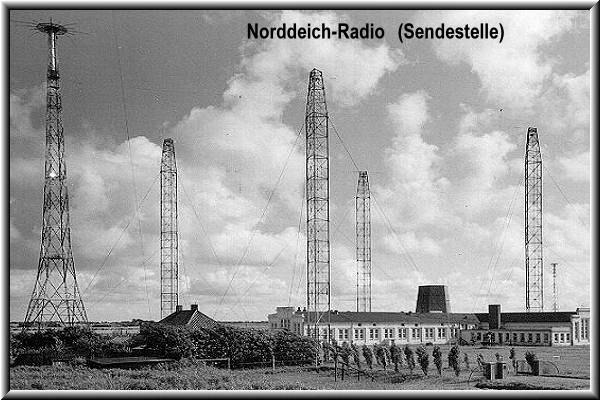
We might also refer to the lower powered 10 kW maritime station Nordeich Radio which was located near Kiel in Germany. 

At that time Nordeich Radio was on the air under its second consecutive callsign KAV.  (The original call was KND; and the more familiar call DAN was adopted in 1927.) At the very commencement of the 1914 war, Great Britain cut the German underwater cable systems across the Atlantic.  In order to communicate with the German colonies and German commercial interests in the Americas, Africa, and the South Pacific, intervening German naval vessels conducted a cascade relay of information in Morse Code between the German mainland and the distant German locations. During that early era of the Great War, the German navy used isolated and lonely Easter Island, half way between South America and the exotic islands of the South Pacific, as a safe rallying point.  For a short period of time, they even operated their own temporary wireless station ashore on Easter Island.    

Within the United States, the German Telefunken company had constructed two huge wireless stations; at Tuckerton on Hickory Island New Jersey with 200 kW, and Sayville on Long Island New York with 100 kW.  Station WCI WGG on Hickory Island (which was not actually an island but rather part of the New Jersey shoreline) communicated in Morse Code mainly with station OUI, the Eilvese wireless station near Hanover in Germany.  The Sayville station WSL communicated with mainly POZ in Nauen near Berlin.   

A map of the British Isles shows literally a hundred or more wireless stations in use in 1914, and they were scattered around the coastlines, with a few further inland.  Notable among those early wireless stations were the well known Marconi station at Poldhu (MPD & ZZ) and the Marconi stations on the Isle of Wight.  There was also the powerful new Marconi station MUU at Carnarvon in Wales.

 In addition, the English Marconi company had also installed, and in 1914 was operating, several important wireless stations in North America (and beyond), including:
  CB-VAS   Glace Bay   Cape Breton Island  Canada
  CE-VCE Cape Race  Newfoundland  (Canada)
  NFF  New Brunswick New Jersey  USA
  CC-WCC Cape Cod  Massachusetts USA
  PH-KPH Bolinas  California   USA
  KIE  Kahuku  Oahu   Hawaii
(AWR Wavescan 436)
photo: http://www.rundfunk-nostalgie.de/seefunk.html