Friday, April 27, 2018

Shortwave Radiogram schedules, Apri 27-30


Hello friends,


The first broadcast of Shortwave Radiogram program 45 is today (Friday) at 2030-2100 UTC on 7780 kHz from WRMI Florida. (Although reception tends to be difficult beyond eastern North America.)

Last weekend's experiment with six modes was interesting. Of the three fast Thor modes, Thor 100 seemed to be  less successful than Thor 50x1 and Thor 50x2. Of course, in difficult reception conditions, our "go to" MFSK32 mode prevailed over all the faster modes. Zach in Alabama had difficult reception of the Monday 0800-0830 UTC show, with these results:


📻
MFSK128: <10 span="">📻MFSK64: <15 span="">📻MFSK32: ~75% 📻Thor50x1: <15 span="">📻Thor50x2: <10 span="">📻Thor100: <5 br="">
Videos and audio of last weekend's (program 44) broadcast can be accessed as follows:

Name
Location
UTC Day
UTC Time
Freq kHz
Medium
URL
Kim
New York SDR
Friday
2030-2100
7780
Audio
Sefi
Israel
Saturday
1600-1630
9400
Video
BlackApple 62
Italy
Saturday
1600-1630
9400
Video
Ralf
Germany
Saturday
1600-1630
9400
Video
Mark
UK
Saturday
1600-1630
9400
Audio archive
Scott
Ontario
Sunday
2330-2400
7780
Video


See also this analysis by Roger in Germany of last weekend's Shortwave Radiogram, as well as IBC, KBC, and Broad Spectrum Radio digital broadcasts.

This weekend's Shortwave Radiogram will be simpler, with only two modes: MFSK32 and MFSK64.

Here is the lineup for Shortwave Radiogram, program 45, 27-30 April 2018, in MFSK modes as noted:

1:36 MFSK32: Program preview
2:45 White House rejects US press freedom downgrade*
11:15 ESA's Sentinel-3b satellite*
18:02 MFSK64: Nuclear accidents make mutant bugs and birds*
25:28 Image of Virginia bluebells*
27:42 MFSK32: Closing announcements


* with image

Please send reception reports to radiogram@verizon.net


Twitter: @SWRadiogram or https://twitter.com/swradiogram (check frequently during the weekend for listeners' results)


Shortwave Radiogram Program 45
(27-30 April 2018)

Friday
2030-2100 UTC
7780 kHz
9455 kHz
MFSK32
MFSK64
WRMI Florida
Saturday
1600-1630 UTC
9400 kHz
Space Line, Bulgaria
Sunday
2330-2400 UTC
7780 kHz
WRMI Florida
Monday
0800-0830 UTC

7730 kHz
5850 kHz
WRMI Florida


 The Mighty KBC transmits to Europe Saturdays at 1500-1600 UTC on 9400 kHz (via Bulgaria), with the minute of MFSK at about 1530 UTC (if you are outside of Europe, listen via websdr.ewi.utwente.nl:8901/ ).  And to North America Sundays at 0000-0200 UTC (Saturday 8-10 pm EDT) on 5960 kHz, via Germany. The minute of MFSK is at about 0130 UTC.  Reports to Eric: themightykbc@gmail.com . See also http://www.kbcradio.eu/ and https://www.facebook.com/TheMightyKbc/. (UTC 6 May KBC's new frequency at 0000-0200 UTC will be 9925 kHz.)

Italian Broadcasting Corporation (IBC)   Five minutes of MFSK32 is at the end of the 30-minute English-language “Shortwave Panorama,” per the schedule available here: http://ibcradio.webs.com/


Broad Spectrum Radio MFSK32 might be available Monday 0730-0800 UTC on 5850 and 7730 kHz from WRMI Florida, although I heard only music on those frequencies on 23 April.
Thanks for your reception reports! 


Kim

 Kim Andrew Elliott, KD9XB
Producer and Presenter
Shortwave Radiogram
Reporting on international broadcasting at https://twitter.com/kaedotcom

The Lonely Little American Radio Station in Pakistan: AFRTS Peshawar


In January of this year, we had the opportunity to see a movie in Malaysia right after the HFCC shortwave frequency conference there about the lawyer who negotiated the release of American pilot Francis Gary Powers who was shot down over the Soviet Union 58 years ago.  It was back on Sunday May 1, 1960, that Captain F. Gary Powers was shot down while flying a high altitude cold war spy mission over the Soviet Union, continental Russia. 

            While high over the city of Sverdlovsk, his plane was hit by the first of three Dvina S75 surface to air missiles that were fired from a launching pad near Kosulino on the edge of the Ural mountains.  What does all this have to do with an American radio station in Pakistan?  Here’s Ray Robinson with the answer.

            The plane began to spiral downwards, upside down with the nose pointing upwards, and Gary Powers was flung out into space as soon as he opened the canopy.  He floated down to Earth by parachute, hitting the ground rather hard, and he was immediately arrested.  Thus he was catapulted into the world’s news headlines, in what became known as the U2 Incident.

            The Gary Powers story began with a take-off at the American operated Peshawar Air Station at Badaber in a remote country area of Pakistan, some four miles south of the frontier city of Peshawar.  The aircraft was a Lockheed U2 plane, Model A, which had a capability of flying at 70,000 feet (13¼ miles high), way above interception by normal aggressive counter-measures.  This plane was more like a jet propelled glider than a regular airplane, and the Powers overflight of Russia under Operation Grand Slam, was the United States’ 24th deep-penetration overflight of Russian territory.

            The Peshawar Air Station (or PAS) at Badaber was established by the United States under the designation Project Sandbag in 1958 with the cooperation of the Pakistani president Ayub Khan.  The major purpose for this American facility during the Cold War was to provide electronic surveillance of the Soviet Union, and its total staff while operational was around 1300 personnel.

            This American airbase incorporated many western amenities for the benefit of their personnel, including a school for the children, swimming pool, bowling alley, a golf course and a shop that sold regular American products.  There was also a radio broadcasting station, and a TV station as well, on the base.

            The radio station was a unit of AFRTS, the American Forces Radio & TV Service, and it was inaugurated quite early in the development of the air base.  Originally, this radio station was operating with 10 watts on 850 kHz; though soon afterwards when newer equipment was installed, the operating channel was moved upwards to 870 kHz, with 25 watts.

            Programming for AFRTS PAS Peshawar was provided by local talent, recordings from AFRTS in the United States, and at times by off air relays on shortwave.  At the time when an international radio monitor who was living in Pakistan, visited this small AFRTS radio broadcasting station in 1968, it was no longer operating on mediumwave but on FM only at 107 MHz.  However, the WRTVHB does not show any FM listing for this station, only the two consecutive medium wave channels. 

            At the time of the visit, the station engineer stated that the base was due to close some time soon, and that the radio station would be closed also.  However, in spite of the pending closure, plans were in hand for the installation of additional upgraded equipment.  Right towards the end, with closure of the base looming on the horizon as personnel were transferring elsewhere, the TV station was closed, though the radio station continued on air, albeit at a lower programming level.

             The American air base, Peshawar Air Station, was taken into service on July 17, 1959, and it was officially closed a little more than a decade later on January 7, 1970.  The entire facility was handed over to the Pakistani air force, though the new owners never used it for flight activities, but only as a Vocational Training Center.

            Only one QSL was ever issued to verify the reception of AFRTS PAS Peshawar, and that was a generic card from AFRTS headquarters in the United States.
(AWR-Wavescan/NWS 476)
(photo/medium.com)

Wednesday, April 25, 2018

Grimeton Radio slated for May 1 broadcast

Grimeton Radio
World Heritage Grimeton Radio Station participates in the ERIH event WORK it OUT – Industrial culture, on May 1 and as part of the event we plan for the first SAQ transmission since 2016.

The transmitter start-up will begin at 11.30 (9.30 UTC) and the transmission will begin on 17,2 kHz CW at 12.00 (10.00 UTC). You can also watch a live video stream of the event on www.alexander.n.se

No QSL-cards will be given this time and no List of Reports will be constructed but we accept shorter Listeners Report to e-mail info@alexander.n.se.

We sincerely hope that all the SAQ transmission on 17,2 kHz will go as planned, but as always there is a reservation that the transmission is cancelled with short notice.
The Alexander association team @Grimeton, Sweden


Tuesday, April 24, 2018

Weekly Propagation Forecast Bulletins


Product: Weekly Highlights and Forecasts
:Issued: 2018 Apr 23 0149 UTC
# Prepared by the US Dept. of Commerce, NOAA, Space Weather Prediction Center
# Product description and SWPC web contact www.swpc.noaa.gov/weekly.html
#
#                Weekly Highlights and Forecasts
#
Highlights of Solar and Geomagnetic Activity 16 - 22 April 2018

Solar activity was very low. Region 2706 (N03, L=281, class/area Dao/130 on 22 Apr) produced the strongest flare of the period, a B5 at 20/1704 UTC. The region continued slow growth through the end of the reporting period. No Earth-directed CMEs were observed in available coronagraph imagery.

No proton events were observed at geosynchronous orbit. The greater than 2 MeV electron flux at geosynchronous orbit ranged from normal to high levels on 10-20 Apr; high levels on 22 Apr and
moderate to high levels for the remaining days of the reporting period. The peak flux observed was 24,100 pfu at 21/2120 UTC.

Geomagnetic field activity was quiet until 20 Apr, when unsettled to G2 (Moderate) geomagnetic conditions were observed in response to CIR ahead of a negative polarity CH HSS. Total field peaked at 23 nT around 20/0510 UTC and slowly declined to around 5 nT by late on 20 Apr. Solar wind speeds were increased from around 290 km/s to a peak of near 620 km/s during the HSS proper late on 20 Apr. The geomagnetic response decreased to quiet to unsettled conditions over 21 Apr and finally to quiet on 22 Apr as influence from the CH HSS waned.

Forecast of Solar and Geomagnetic Activity 23 April - 19 May 2018

Solar activity is expected to be very low throughout the forecast
period.
No proton events are expected at geosynchronous orbit. The greater than 2 MeV electron flux at geosynchronous orbit is expected to be at moderate to high levels on 23-30 Apr and 07-19
May; normal to moderate levels are expected from 01-06 May. Elevated levels of electron flux are expected due to the anticipation of multiple, recurrent CH HSSs.

Geomagnetic field activity is expected to reach unsettled levels on 26 Apr, 06 May, 09-10 May and 19 May; active levels are expected on 27 Apr, 07-08 Apr and 18 May; G2 (Moderate) geomagnetic storm conditions are likely on 17 May. All enhancements in geomagnetic field activity are associated with the anticipated influence of multiple, recurrent CH HSSs. The remaining days of the outlook
periods are expected to be mostly quiet.

Product: 27-day Space Weather Outlook Table 27DO.txt
:Issued: 2018 Apr 23 0149 UTC
# Prepared by the US Dept. of Commerce, NOAA, Space Weather Prediction Center
# Product description and SWPC web contact www.swpc.noaa.gov/wwire.html
#
#      27-day Space Weather Outlook Table
#                Issued 2018-04-23
#
#   UTC      Radio Flux   Planetary   Largest
#  Date       10.7 cm      A Index    Kp Index
2018 Apr 23      75           5          2
2018 Apr 24      75           5          2
2018 Apr 25      75           5          2
2018 Apr 26      75           8          3
2018 Apr 27      75          12          4
2018 Apr 28      75           5          2
2018 Apr 29      75           5          2
2018 Apr 30      75           5          2
2018 May 01      75           5          2
2018 May 02      75           5          2
2018 May 03      70           5          2
2018 May 04      70           5          2
2018 May 05      70           5          2
2018 May 06      70          10          3
2018 May 07      70          15          4
2018 May 08      70          12          4
2018 May 09      70          10          3
2018 May 10      70           8          3
2018 May 11      70           5          2
2018 May 12      70           5          2
2018 May 13      70           5          2
2018 May 14      70           5          2
2018 May 15      70           5          2
2018 May 16      70           5          2
2018 May 17      75          42          6
2018 May 18      75          12          4
2018 May 19      75           8          3
(NOAA)

Friday, April 13, 2018

Shortwave Radiogram schedules


Hello friends,

SSTV images are being transmitted from the International Space Station through 14 April. Some Shortwave Radiogram listeners have been posting their reception to @SWRadiogram -- or https://twitter.com/swradiogram.net . Two examples are from Merkouris in Greece and @Hal-Fi in California

On last weekend's Shortwave Radiogram, I was surprised by the mostly successful performance of the very fast (480 wpm) MFSK128 mode, even over some long-distance and noisy paths. The Olivia 64-2000 also prevailed even 9 dB under the music of Spike Jones. Next time I will set the level of the Olivia 64-2000 even lower.

See videos by Ralf in Germany, Scott in Ontario, and Martin in Mexico, And, of course, analysis by Roger in Germany.

Because the MFSK128 did so well, we will do it again this weekend, along with MFSK64 and the usual MFSK32, each with images. And a surprise mode might be lurking under the closing music.

Here is the lineup for Shortwave Radiogram, program 43, 13-16 April 2018, in MFSK modes as noted:

 1:37  MFSK32: Program preview
 2:50  MFSK128: New line drawings revealed in Peru*
 4:33  MFSK64: Mars Express gets in-orbit upgrade*
 9:30  MFSK32: The rise of wooden skyscrapers*
20:04  Foot-powered washing machine in production*
25:09  Farewell 2018 cherry blossoms*
26:56  Closing announcements


Please send reception reports to radiogram@verizon.net
And visit http://swradiogram.net
Twitter: @SWRadiogram
Facebook group: https://www.facebook.com/groups/567099476753304


Shortwave Radiogram Program 43
(6-9 April 2018)

Friday
2030-2100 UTC
7780 kHz
9455 kHz
MFSK128,
MFSK64,
MFSK32,
and maybe a surprise mode.
WRMI Florida
Saturday
1600-1630 UTC
9400 kHz
Space Line, Bulgaria
Sunday
2330-2400 UTC
7780 kHz
WRMI Florida
Monday
0800-0830 UTC

7730 kHz
5850 kHz
WRMI Florida


From Todd in New York ...
 The Mighty KBC transmits to Europe Saturdays at 1500-1600 UTC on 9400 kHz (via Bulgaria), with the minute of MFSK at about 1530 UTC (if you are outside of Europe, listen via websdr.ewi.utwente.nl:8901/ ).  And to North America Sundays at 0000-0200 UTC (Saturday 8-10 pm EDT) on 5960 kHz, via Germany. The minute of MFSK is at about 0130 UTC.  Reports to Eric: themightykbc@gmail.com . See also http://www.kbcradio.eu/ and https://www.facebook.com/TheMightyKbc/

Italian Broadcasting Corporation (IBC)  For the complete IBC transmission schedule visit  http://ibcradio.webs.com/  Five minutes of MFSK32 is at the end of the 30-minute English-language “Shortwave Panorama,” per the schedule below:


Thanks for your reception reports! 

Kim Andrew Elliott, KD9XB
Producer and Presenter
Shortwave Radiogram
Reporting on international broadcasting at https://twitter.com/kaedotcom
 

From the Isle of Music & Uncle Bill's Melting Pot schedules


From the Isle of Music, April 15-21:
April is Jazz Appreciation Month around the world, and we are going to celebrate by taking a look at some of the roots of modern Cuban Jazz in both Cuba and the United States. This week, we are going to listen to some important and historic recordings made in the United States as what we now call Afro Cuban Jazz was being born.


Four opportunities to listen on shortwave:
1. For Eastern Europe but audible well beyond the target area in most of the Eastern Hemisphere (including parts of East Asia and Oceania) with 100Kw, Sunday 1500-1600 UTC on SpaceLine, 9400 KHz, from Kostinbrod, Bulgaria (1800-1900 MSK)
2. For the Americas and parts of Europe, Tuesday 0000-0100 UTC on WBCQ, 7490 KHz from Monticello, ME, USA (Monday 8-9PM EST in the US). This has been audible in parts of NW, Central and Southern Europe with an excellent skip to Italy recently.
3 & 4. For Europe and sometimes beyond, Tuesday 1900-2000 UTC and Saturday 1200-1300 UTC on Channel 292, 6070 KHz from Rohrbach, Germany.


Uncle Bill's Melting Pot, Sunday, April 15, 2018
Episode 58 honors Jazz Appreciation Month by checking out some very early Jazz releases (including the "first" ones).
Sundays 2200-2230 UTC (6:00PM -6:30PM Eastern US) on
WBCQ The Planet 7490 KHz shortwave from the US to the Americas and parts of Europe
In recent weeks the signal has had a nice bounce to Spain, Italy and Switzerland as well as Iceland, Ireland and parts of the UK. Also audible in Brazil, Paraguay and points North.

William "Bill" Tilford, Owner/Producer
Tilford Productions, LLC
5713 N. St. Louis Av
Chicago IL 60659-4405
email: bill@tilfordproductions.com
phone: 773.267.6548
website: www.tilfordproductions.com

Tuesday, April 10, 2018

Weekly Propagation Forecast Bulletins


Product: Weekly Highlights and Forecasts
:Issued: 2018 Apr 09 0536 UTC
# Prepared by the US Dept. of Commerce, NOAA, Space Weather Prediction Center
# Product description and SWPC web contact www.swpc.noaa.gov/weekly.html#
#                Weekly Highlights and Forecasts
#
Highlights of Solar and Geomagnetic Activity 02 - 08 April 2018

Solar activity was at very low levels throughout the period with only a few low level B-class flare observed on 03 Apr from Region 2703 (S08, L=193, class/area Axx/010 on 31 Mar). No Earth-directed coronal mass ejections were observed.

No proton events were observed at geosynchronous orbit.

The greater than 2 MeV electron flux at geosynchronous orbit reached high levels on 02-04 Apr and at moderate levels on 05-08 Apr. The largest flux of the period was 2,150 pfu observed at 02/1915 UTC.

Geomagnetic field activity was mostly quiet with unsettled periods observed on 05 Apr. Solar wind speed began the period slightly enhanced near 470 km/s with total field around 4-5 nT. Solar wind
speed declined to near 320 km/s by 04 April before increasing briefly to near 450 km/s by late on 05 Apr. Total field increased to a maximum of 9 nT at 05/2130 UTC. By 07 Apr, solar wind speed had
decreased to 330-380 km/s while the total field decreased to 5 nT or less.

Forecast of Solar and Geomagnetic Activity 09 April - 05 May 2018

Solar activity is expected to be at very low levels throughout the forecast period.

No proton events are expected at geosynchronous orbit.

The greater than 2 MeV electron flux at geosynchronous orbit is expected to reach high levels on 12-30 Apr due to recurrent coronal hole high speed stream (CH HSS) influence.

Geomagnetic field activity is expected to be at unsettled to active levels on 10-16 Apr and again from 19-23 Apr with G1 (minor) storm levels likely on 10-11 Apr due to recurrent CH HSS effects.
Product: 27-day Space Weather Outlook Table 27DO.txt
Issued: 2018 Apr 09 0536 UTC
# Prepared by the US Dept. of Commerce, NOAA, Space Weather Prediction Center
# Product description and SWPC web contact www.swpc.noaa.gov/wwire.html
#
#      27-day Space Weather Outlook Table
#                Issued 2018-04-09
#
#   UTC      Radio Flux   Planetary   Largest
#  Date       10.7 cm      A Index    Kp Index
2018 Apr 09      67           8          3
2018 Apr 10      67          18          5
2018 Apr 11      67          18          5
2018 Apr 12      67          15          4
2018 Apr 13      67          12          4
2018 Apr 14      67          12          4
2018 Apr 15      67           8          3
2018 Apr 16      67           8          3
2018 Apr 17      67           5          2
2018 Apr 18      67           8          3
2018 Apr 19      67          15          4
2018 Apr 20      67          15          4
2018 Apr 21      67          15          4
2018 Apr 22      67          12          4
2018 Apr 23      68          10          3
2018 Apr 24      68           5          2
2018 Apr 25      68           5          2
2018 Apr 26      68           5          2
2018 Apr 27      68           5          2
2018 Apr 28      68           5          2
2018 Apr 29      68           5          2
2018 Apr 30      68           5          2
2018 May 01      68           5          2
2018 May 02      68           5          2
2018 May 03      68           5          2
2018 May 04      68           5          2
2018 May 05      68           5          2
(NOAA)

The Radio Scene on Van Slyck Island

About 160 miles north of New York City in upstate New York and just 20 miles northwest of the state capital Albany lies the city of Schenectady.  Back in the early 1700s when New York City was known as New Amsterdam, the whole upstate area was known as New Netherlands, and still to this day many of the place names there are of Dutch origin. 

Schenectady itself began as a Dutch settlement known as Van Slyck Island, an area of fertile farmland on the south side of the Mohawk River. Van Slyck as an island can still be seen on maps to this day, but few people realize its significance as the birthplace for a very early historic wireless station.

The original callsign for this almost unknown wireless station was 2XI; it was built in Schenectady, New York state, it was the first wireless station installed at the comparatively new factory operated by the General Electric Company, it is an acknowledged forerunner to the now well known giant mediumwave station WGY, and it was thus also the ancestor for the Voice of America shortwave relay stations, WGEA & WGEO.

It was in 1890 that the well known American inventor, Thomas Alva Edison, formed his wireless manufacturing company, Edison General Electric, in Schenectady, New York.  Two years later, and after a merger with Thomson-Houston, the company name was changed to the now very familiar General Electric. 

According to the encyclopedia, General Electric is now the 3rd largest company in the world with 1/3rd million employees.  Interestingly, the sprawling GE company in Schenectady, with its several hundred buildings, is listed with its own postal zipcode number, a quite unique number, 12345. 
 During the few weeks before Christmas each year, GE Schenectady, at their postcode address 12345, receives hundreds, even thousands, of letters from children who are writing to Santa Claus with their Christmas wish list.  All of these letters are answered.
   
The purpose for the experimental wireless station 2XI was for the testing, development and improvement of wireless transmitters.  The station was apparently in spasmodic use up until World War 1, when the vast majority of experimental wireless stations throughout the United States were closed. 

Then, in November 1920, the callsign 2XI was again re-issued to General Electric Schenectady for experimental shortwave research.  This unique call was finally deleted in April 1932.
 On February 20, 1922, a new mediumwave station was inaugurated at their manufacturing plant with 1½ kW on 360 m, 833 kHz.  The studio was installed in GE Building 36, and the transmitter was installed ½ mile away in GE Building 40, with the antenna towers on top. 

The callsign for this new mediumwave station was WGY, simply a sequentially issued callsign with no specific meaning.  However, the letters WGY were conveniently taken to signify: W for Wireless, G for General Electric, and Y for the last letter in SchenectadY.  Mediumwave WGY was in fact the second commercial radio station licensed in the USA, after WBZ in Springfield Massachusetts which was operated by Westinghouse

 Two years later, the WGY studios were moved into a new building at 1 River Road, and a new transmitter was installed into a new building identified as South Schenectady, a location that is still in use to this day.  Station WGY also became a super power station back in the pre-war days, with an experimental transmitter operating at 100 kW, and even at 200 kW.  The after hours test broadcasts on super high power were conducted under the callsign W2XAG.

In fact, the GE transmitter facility at South Schenectady was licensed with anywhere up to 3 dozen different callsigns for experimental usage in the longwave, mediumwave, shortwave, ultra-shortwave, FM & TV bands.  Some of these callsigns were noted on air and reported to radio magazines by international radio monitors living in North America, Europe, Latin America and the South Pacific.

For example, shortwave callsign W2XO was noted in the United States and Australia in the early 1930s on 12850 kHz with a program relay taken from mediumwave WGY.  Other callsigns noted by international radio monitors in the prewar era were W2XAC on shortwave 8690 kHz, W2XAG on mediumwave 379 m (790 kHz), W2XAH with 40 kW on longwave 300 kHz, and W2XAW on low band shortwave 2150 kHz.
 In addition, GE at South Schenectady also operated the following additional transmitters:
         * W2XCH on behalf of the local airport
         * International communication with South America on 9615 kHz under the callsign     W2XAT
         * The world’s 1st experimental TV station in the old mechanical system under the     callsign 2XB 1928
  * A communication channel on behalf of the local police authority. 
 They also installed a small 50 watt shortwave transmitter into a truck for use in the relay of programming from remote locations back to the WGY studios.  This 1924 remote unit was licensed as W2XJH.

In July 1924, GE was on the air for the 1st time with three transmitters in parallel.  These transmitters were WGY with 5 kW on 790 kHz; and two shortwave outlets, on 3 MHZ & 21 MHz, the highest frequency ever in use during that era.  The callsigns for the two shortwave channels were apparently W2XK & W2XAW.

By the middle of the following year, 1925, GE was on the air with a total of six transmitters; one mediumwave, one longwave and four shortwave.  Then during the end of the next year again, 1926, GE was operating 11 transmitters at their South Schenectady site.
 In fact, on one occasion in November, they placed seven of these transmitters on the air simultaneously, all carrying the same program relay from mediumwave WGY.  It was at this stage that GE described its transmitter facility in South Schenectady as the most powerful shortwave station in the world. 

Their receiver station for the reception of broadcasts and communication traffic from other shortwave stations, American as well as foreign, was installed at an isolated location some seven miles north of Schenectady, a dozen miles distant from the transmitter base.

Thus it is, that August 13 this year 2018 forms the 106th anniversary of the 1st GE wireless station 2XI located at Van Slyck Island Schenectady in New York state.
(AWR Wavescan/NWS 472)

Monday, April 09, 2018

Animals & Insects in Radio

Back a quarter of a century ago, a news bulletin from the shortwave service of Radio New Zealand International at 1200 UTC on 9700 kHz told an interesting story.  An American alligator had escaped from a shopping arcade in suburban Sydney, Australia, and despite intensive searching, it had not been refound.  Here’s Ray Robinson.

            Thanks, Jeff.  As far as is known, the sequel to this rather strange event was never broadcast, but it would be presumed that the offending alligator was indeed recaptured.  However, this intriguing news item over a distant shortwave station reminds us that animals and insects have played their part in radio broadcasting over the years.  Somewhat intrusively, we might add.

            Back around the middle of the year 1936, a shortwave station in Colombia, South America, was making contact with another shortwave station in the United States. The Colombian station was the shortwave facility of HJ1ABB at Barranquilla with 1 kW on 9555 kHz, and the American station was W2XAF at Schenectady in New York State with 40 kW on 9530 kHz. 

            During the transfer of a radio program from Colombia for rebroadcast in the United States, the Colombian station suddenly went silent.  It was revealed later that a pet crocodile had wandered into the transmitter building, and with one mighty side-swipe of its strong tail, it had successfully wrecked one of the large transmitting tubes, thus effectively putting the station off the air.  According to Radio Guide for February 29, 1936, station HJ1ABB was off the air for two weeks.

            In more recent times, in 1993, the Chief Engineer at the large shortwave station located at Cahuita in coastal Costa Rica reported that a lonely crocodile ventured onto their property.  This wandering animal was promptly removed before it could enter the list of undesirable animals that have successfully put a radio station off the air.  The Cahuita shortwave station with its five shortwave transmitters on the Caribbean coast of Costa Rica in Central America was successively owned by Radio Impacto, Adventist World Radio, and finally Dr. Gene Scott in California, before it was finally closed in 2009.

            Over a period of years, several Radio Engineers have reported in the American journal Radio World that they have discovered snakes in transmitter buildings, and sometimes even in the transmitters themselves.  One transmitter engineer reported that he once found two snakes in a 5 kW Harris medium wave transmitter model DAX5, and he shared his findings with two photos in Radio World.

            Another radio engineer found a nest of black snakes in a communication building.  He states that snakes like to enter transmitter buildings due to the warmth emanating from the transmitters.  He also states that scattering mothballs around the internal floor of the building can act as a deterrent against the entry of snakes.

            In an article in Radio World for September 25, 2002, Engineering Director Aaron Winski states that he cared for the technical needs of 18 radio stations in Illinois and Wisconsin.  On one occasion, he received an emergency phone call from a radio station in Rushville, Illinois, that was off the air.
            Initially, Winski states, he could find no obvious reason as to why the station had been knocked off the air.  However, when he opened the door to the power supply, he found a snake that had been cooked as it crawled across the terminals of the power supply.  Although the station was not identified in the Radio World feature article, yet the context of the information would suggest that this radio station was an AM medium wave facility.

            Over in Africa back in the year 1988, the evening announcer at Radio Uganda in Kampala was just about to sign off for the evening at the end of the 10 pm news bulletin.  Right at that stage, a five foot long snake slithered into his broadcast booth.  Announcer Francis Bbaale, suddenly exclaimed on air, “Good Night”, and he quickly switched the station off, four minutes earlier than usual. The local newspapers reported that the snake was successfully despatched.

            In tropical lands, the agile mongoose can successfully kill a large snake.  However, on the main Hawaiian island of Oahu, a mongoose successfully knocked a country mediumwave station off the air.  The station was KLEI, the regional location was Kailua, the station was a 10 kW facility on 1130 kHz, and the year was 1982.  The unfortunate mongoose was electrocuted when it crawled across the large insulator at the base of the antenna tower.

            On shortwave, WRMI the large 14 transmitter shortwave station located near Lake Okeechobee in the center of the peninsular state of Florida, reports that: “At any given time, there are as many as 200 cattle on the ranch.  There is also a variety of other wildlife, including alligators, snakes, deer, wild hogs, armadillos, skunks, as well as many different kinds of insects and birds.”

            Radio World in 2014 published a color photograph of an interesting scene, taken by Thais White, wife of WRMI owner Jeff White, with this notation:  “Beside the transmitter building, a cow relaxes beside a pond, which it shares with a few alligators.”

            Well, Jeff – we can’t beat that at Voice of Hope.  In Zambia, we do have cattle that graze on the antenna field.  Here at KVOH, our transmitter building is on the top of isolated Chatsworth Peak, and we have had a few rats crawl into the high voltage power supply and unfortunately cook themselves, but to my knowledge, none has ever actually taken us off the air.  Fortunately we do not have to contend with either crocodiles or alligators in California.

            Well, Ray, I can tell you one more story about animals and radio transmitters.  In 1983, I was at the Association of North American Radio Clubs, or ANARC, Convention in Washington, DC.  At the time I produced a daily one-hour program called Radio Earth which was broadcast on the shortwave station Radio Clarin on 11700 kHz in the Dominican Republic. 

            One night during the convention, I gathered a group of people in my hotel room to do a live program by telephone during our Radio Earth program.  I called the station in Santo Domingo to establish communication just before the program was due to begin at the top of the hour. 

            I had a small portable shortwave receiver in my hotel room, and we were monitoring the station listening for the ID and our cue to begin the broadcast.  But just a few seconds before we were due to begin, the signal of Radio Clarin went off the air.  I got on the phone and spoke with Rudy Espinal in Santo Domingo, and he told me that the engineer at their transmitter site told him that a “cacata” had been electrocuted inside the transmitter and shorted it out. 

            I asked him what a “cacata” was, as I had never heard of that before.  He said he didn’t know the word in English, but it was a type of “araña,” which means spider.  I wondered how a spider could short out a transmitter. 

            A few weeks later, I visited the Radio Clarin transmitter site an hour or so outside of Santo Domingo in the middle of a sugarcane field, and I saw the largest spider I had ever seen -- a type of gigantic hairy tarantula -- on the ground just outside the transmitter building. 

            I didn’t know whether it was alive or dead, so I just jumped over it to get inside the building.  I asked Rudy, who was with me at the time, what it was, and he said, “That’s a cacata.”  Now I really believed that a spider could short out a shortwave transmitter.
(AWR Wavescan/NWS 475)

The Radio Scene on a Small Island with a Large Volcano

(via On the Shortwaves)
During the past year 2017 here in Wavescan, we have presented many topics associated with the radio scene in the Middle Americas, that is in Central America and the Caribbean.  However, due to the fact that we still have many unpresented topics from these areas, we plan to continue with Focus on the Middle Americas during this entire coming year 2018.  We trust that you will appreciate and enjoy the information that we will present in all of these coming topics regarding the radio scene in these very colorful countries and islands.

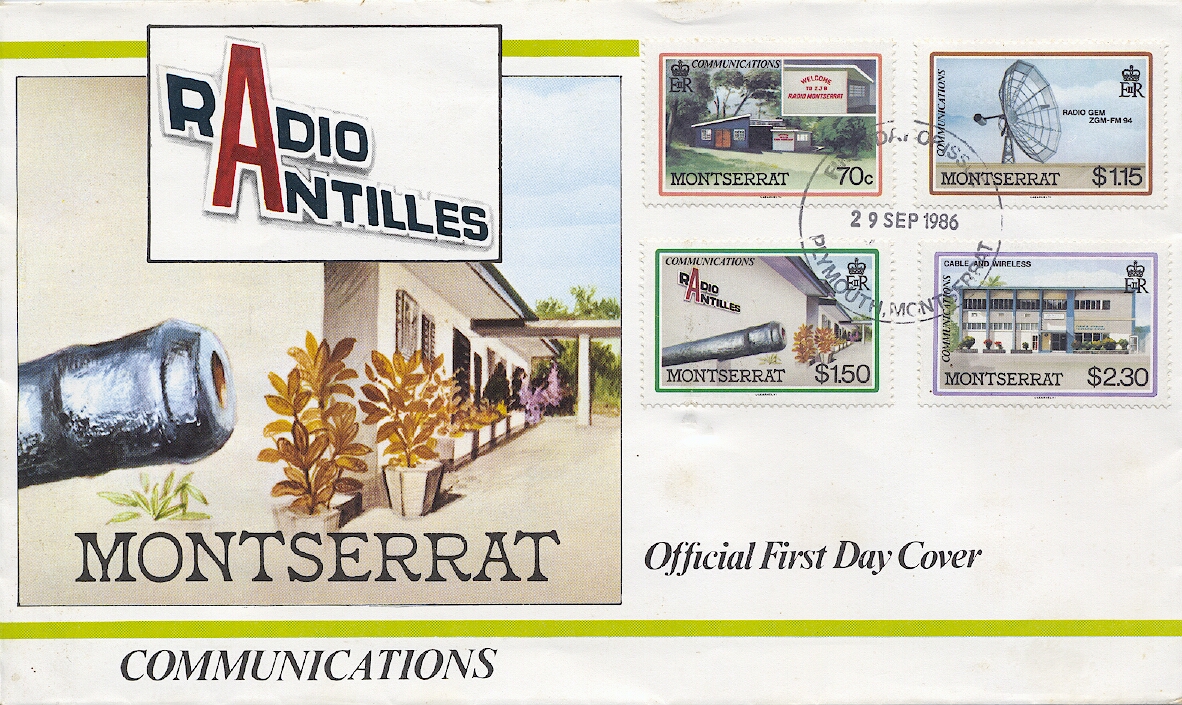
Our opening topic for our first presentation in the New Year 2018 takes us into the Caribbean, an area that was devastated during last year’s hurricane season. We return to the radio scene on the small island with the large volcano; it is the story of Radio Antilles, the shortwave station that relayed the programming of both Deutsche Welle in Cologne Germany and the BBC in London England.

 On April 20, 1963, the Radio Antilles Corporation was formed, and five months later the government granted a radio broadcasting license. Much of the electronic equipment for the Montserrat station came from the previous Radio Africa in Tangier, Morocco and it was installed and operated with co-operation from the staff of Radio Andorra in Europe. Some eight years later (1971), Radio Deutsche Welle in Germany injected a massive cash flow into Radio Antilles, and as a major shareholder/new owner of the station they took over the operation of the large facility.  When DW engineers arrived on Montserrat in 1971, they found two shortwave transmitters at 15 kW each already installed.  They soon afterwards installed an additional shortwave transmitter at 50 kW among the medium wave transmitters on the ground floor of the two story building on the lower south west coast of the island of Montserrat. 

 In March 1977, Radio Antilles was taken into regular service as a relay station for the programming of Deutsche Welle in Cologne Germany and for the BBC in London England.  However, just four years later (1981), the BBC withdrew from their usage of Radio Antilles, and eight years later again (1989), Deutsche Welle Montserrat was closed.  Soon afterwards, the electronic equipment was removed from the isolated country building, and the building was ultimately inundated by lava overflow from a nearby volcano, so much so, that the exact location of the building is now indiscernible. However at the same time as Radio Antilles was under development as a relay station for Deutsche Welle and the BBC, a new joint operation was under installation on the nearby island of Antigua.  The development of this new international shortwave relay station was staged under the auspices of a joint holding company, the Caribbean Relay Company. After a series of surveys on several of the Leeward and Windward Islands, Antigua was chosen because of its strategic location, together with sufficiently level ground that would be satisfactory for a large antenna farm.  A tract of land, 240 acres, was procured near Seaview Farm in the center of the island of Antigua.

 The BBC designed and constructed the transmitter station, they installed four Marconi transmitters at 250 kW each Model BD272, and they erected seven antenna towers supporting 18 curtain antennas. The locally available electrical power was somewhat unreliable, so the BBC installed five electrical power generators, each a Ruston at one megawatt, which was sufficient to power the entire station with one always available on standby. The first transmitter was taken into service on November 1, 1976, and the other three were activated during the following year (1977). Original planning called for two transmitters and nine antennas each, for the BBC and Deutsche Welle. However, as the scheduling was developed and implemented as time went by, it appears that the programming of both shortwave organizations, the BBC and Deutsche Welle, was carried by all four of the transmitters, though at approximately half time each. 

Due to budget cuts, the BBC-Deutsche Welle relay station on Antigua was closed on March 26, 2005. Initially, the Caribbean relay station endeavored to find other clients who were willing to broadcast to the Americas from their shortwave station. However, there are no known additional relays from the Antigua station, and all that we can presume is that all usable equipment was removed and the property was sold off.  


We cross over now to the Dutch islands in the Caribbean, and in particular to Curacao and Bonaire. Around the year 1960, Trans World Radio TWR gave consideration to constructing a large shortwave/medium wave station on the island of Curacao. However, the entire project was soon afterwards transferred to the nearby island of Bonaire. Construction at TWR Bonaire began in September 1963, and the first test broadcasts on shortwave began almost a year later in August 1964. The very first shortwave frequency for the new TWR was 5955 kHz under the official Dutch call sign PJB. Beginning in November 1964, the new Bonaire shortwave station broadcast the programming from Trans World Radio and it also relayed programming from Radio Netherlands in Hilversum Holland. However, Radio Netherlands ended their relay via TWR soon after their own shortwave station on Bonaire was inaugurated.

On June 30, 1993, TWR closed down the usage of their two shortwave transmitters on Bonaire, one at 50 kW and another at 250 kW, and shipped them off to Swaziland for incorporation into their African shortwave station. In various configurations, a medium wave station at TWR has remained on the air on Bonaire, and the space that was previously occupied by the shortwave transmitters now houses power generators that provide electricity for the island.  

 Test transmissions from the new relay station operated by Radio Netherlands on the island of Bonaire began in March 1969.  At the height of its total capability RN Bonaire contained 3 shortwave transmitters at 250/300 kW, 21 antennas on 17 towers, and 6 power generators at 500 kW each. With the changing winds of fortune in the international shortwave world, Radio Netherlands Bonaire was closed on June 30, 2012. The station was totally dismantled and all that remains of this once majestic shortwave station is just an open field. 

 Radio Havana Cuba was organized as a government operated international shortwave facility in 1963. At that stage, four shortwave transmitters at 100 kW were installed at their shortwave station at Bauta near Havana, two from Russia and two from BBC (Brown Boveri Company) Switzerland.

These days, Radio Havana Cuba operates a total of three shortwave sites with 16 shortwave transmitters rated at 50 kW, 100 kW and 250 kW. The shortwave station known as the Caribbean Beacon is located on the island of Anguilla, a small British island in the eastern Caribbean. In June 1991, Dr. Gene Scott bought the medium wave station Caribbean Beacon, and he installed a new Continental 100 kW shortwave transmitter at the same Sandy Hill site.

The antenna system was previously in use with shortwave KGEI at Belmont in California. The new shortwave Caribbean Beacon was inaugurated in December 1996, though it was hounded by subsequent local fears about radiation problems for more than a year. During the year 2008, the shortwave station in Utah that was previously on the air under the callsigns KUSW and then KTBN was closed and the electronic equipment was shipped to Anguilla for incorporation into the Caribbean Beacon.

 As we mentioned previously here in Wavescan, the Caribbean Beacon was damaged in the recent hurricanes that swept through the Caribbean islands. The station has since been noted back on the air with test broadcasts, and it is doing its best to maintain its international shortwave service.   

 This has been the story of six international shortwave stations in the Caribbean.  A total of four have come and gone: Deutsche Welle-BBC Montserrat and Antigua, Trans World Radio and Radio Netherlands on Bonaire.  Two still remain: Radio Havana Cuba with 16 transmitters, and the Caribbean Beacon on Anguilla with 1 at 100 kW, hanging on tenuously after the onslaught of the recent hurricanes.
(AWR Wavescan 463)