Showing posts with label global radio. Show all posts

Sunday, December 30, 2018

Monitoring for Radio Bila Hora broadcast on New Year's Eve


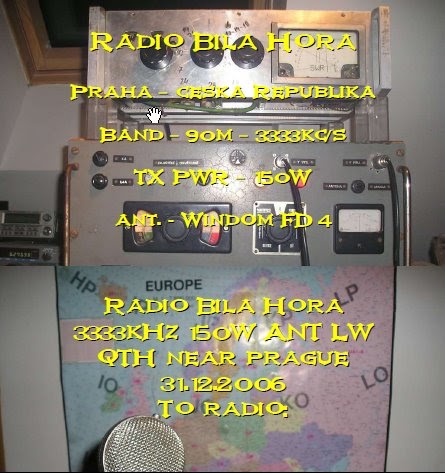
Hobbyist are speculating if the Euro pirate, Radio Bila Hora will recommence their annual New Year's Eve broadcast for 2018. If the station follows suit as in past years, they should broadcast on 3381.260 kHz. The station has also broadcast on 3334.82 kHz.

Last year's broadcast was logged from 1500 - 2330 UTC, and heard from remote SDR units in Germany, Hungary, Norway, and Sweden. The station's power at one time, was reported as 150 watts, and the transmitter was constructed by one of the radio operators. The exact location is unknown, but was mentioned as "outside the territory of the Czech Republic." The 2017 broadcast included two anthems played at 2300, speech segments, pop and local Czech music.

The 2017 broadcast also included a pre-recorded program presented by the former Czechoslovak pop singer, Richard Adams who was very popular in the 1950's and 1960's. Mr. Adams died in 2017 at age 86. He prepared the program for Radio Bila Hora several years ago, and the station presented it in his memory.

The station's English ID as, "Radio White Mountain," is a reference to the historical significance of the Battle of White Mountain, the most famous battle in Czech history.

The email address to send reception reports was rbb@email.cz

For a sample of previous programming, refer to You Tube videos at:

https://www.youtube.com/watch?v=zKnBaUGPydA

https://www.youtube.com/watch?v=k_B8Ie1OjfU

https://www.youtube.com/watch?v=4CHEoDnS0lo

https://www.youtube.com/watch?v=vg6oG5eXCkY


Friday, November 30, 2018

WRMI begins new program on November 30


WRMI begins airing a new program, Supreme Master TV (suprememastertv.com), on November 30 at 1500-1800 UTC on 15,770 kHz seven days per week. Additional hours of SMTV may appear on other WRMI frequencies at other times. 

SMTV originates in Vietnam and broadcasts in English and a variety of other languages. The programs promote issues such as world peace, veganism, animal rights and global warming. Sample program titles include: Cinema Scene, Healthy Living, Science and Spirituality, Nature's Beauty, and Secrets of the Universe. 

You can also hear various types of music, including music from Vietnam. Your comments and reception reports on this new program are welcome at info@wrmi.net.

(Jeff White/WRMI 29 Nov)

Friday, November 23, 2018

From the Isle of Music & Uncle Bill's Melting Pot schedule, Nov-25-Dec 1


From the Isle of Music, November 25-December 1:
This week, our special guest is Diego Gutierrez, whose album Palante el Mambo! won the Fusion category in Cubadisco 2018 and was nominated in the Tropical Fusion category of the Latin GRAMMY awards this year. Additionally, we will listen to recordings by the other Latin GRAMMY winners and nominees from Cuba, many of whom were also Cubadisco winners and/or nominees.
The broadcasts take place:

1. For Eastern Europe but audible well beyond the target area in most of the Eastern Hemisphere (including parts of East Asia and Oceania) with 100Kw, Sunday 1500-1600 UTC on SpaceLine, 9400 kHz, from Kostinbrod, Bulgaria (1800-1900 MSK)

2. For the Americas and parts of Europe, Tuesday 0100-0200 UTC (New UTC) on WBCQ, 7490 kHz from Monticello, ME, USA (Monday 8-9PM EST in the US). This has been audible in parts of NW, Central and Southern Europe with an excellent skip to Italy recently.

3-4. For Europe and sometimes beyond, Tuesday 1900-2000 UTC and Saturday 1200-1300 UTC (New CETs) on Channel 292, 6070 KHz from Rohrbach, Germany.


Uncle Bill’s Melting Pot, November 25 and 27, 2018
Episode 89 takes us to Spain, including an innovative new interpretation of Carmen.
The transmissions take place:
1. Sunday 2300-2330 UTC (NEW UTC) (6:00PM -6:30PM Eastern US) on WBCQ The Planet 7490 kHz from the US to the Americas and parts of Europe

2. Tuesday 2000-2030 UTC (NEW CET) on Channel 292, 6070 KHz from Rohrbach, Germany for Europe. If current propagation conditions hold, the broadcast should reach Iceland AND Western Russia due to a long skip.

Also recommended:
Marion’s Attic, a unique program produced and hosted by Marion Webster featuring early 20th Century records, Edison cylinders etc played on the original equipment, comes on immediately before UBMP on Sundays from 2200-2300 UTC on WBCQ 7490 kHz.
William "Bill" Tilford, Owner/Producer
Tilford Productions, LLC

Monday, November 12, 2018

Weekly Propagation Forecast Bulletins


Product: Weekly Highlights and Forecasts
:Issued: 2018 Nov 12 0247 UTC
# Prepared by the US Dept. of Commerce, NOAA, Space Weather Prediction Center
# Product description and SWPC web contact www.swpc.noaa.gov/content/subscription-services
#
#                Weekly Highlights and Forecasts
#
Highlights of Solar and Geomagnetic Activity 05 - 11 November 2018

Solar activity was at very low levels. The solar disk remained spotless. However, spots emerged late on 11 Nov near N05E13, but remained unnumered. No Earth-directed CMEs were observed.

No proton events were observed at geosynchronous orbit.

The greater than 2 MeV electron flux at geosynchronous orbit was at moderate to high levels on 05-09 Nov, normal to moderate levels on 10 Nov and normal to high levels on 11 Nov.

Geomagnetic field activity ranged from quiet to G2 (Moderate) storm levels during the period due to a pair of recurrent CH HSSs. The solar wind enviroment was enhanced on 05 Nov due to a positive
polarity CH HSS. Wind speeds peaked at 610 km/s at 05/0506 UTC and the Bz component saw a maximum deflection of -8 nT at 05/0406 UTC. During this timeframe, unsettled to G2 (Moderate) geomagnetic conditions were observed. 06 Nov began a downward trend to a more nominal solar wind regime as CH HSS influence waned. Wind speeds decreased to a low of 400 km/s at 07/0611 UTC. Quiet to isolated active conditions were observed from 06-08 Nov. Mostly nominal conditions continued until early on 09 Nov with arrival of a SSBC/CIR ahead of a negative polarity CH HSS. Density reached a maximum of 18.17 particles per cubic cm at 09/1530 ahead of the CIR.
Total field reached a maximum of 14 nT at 10/0600 UTC and the Bz component reached a maximum deflection of -8 nT at 10/0821 UTC. The negative polarity CH HSS arrived early on 10 Nov with wind speeds just over 600 km/s, which continued to be geoeffective through 11 Nov. Field conditions were at quiet to isolated active levels from 09-11 Nov.

Forecast of Solar and Geomagnetic Activity 12 November - 08 December 2018

Solar activity is expected to be at very low levels through the forecast period (12 Nov-08 Dec).

No proton events are expected at geosynchronous orbit.

The greater than 2 MeV electron flux at geosynchronous orbit is expected to be at high levels 12 Nov-16 Nov due to CH HSS influence. An extened period of normal levels is expected 18 Nov-01 Dec due to nominal solar wind environment conditions. Mostly high levels are likely 02-08 Dec with the return of a pair of recurrent CH HSSs.

Geomagnetic field activity is expected to be slightly enhanced 12 Nov-14 Nov, with a chance for isolated active levels possible, due to a geoeffection, negative polarity CH HSS. Quiet to unsettled
conditons are expected 15 Nov-30 Nov under a nominal solar wind regime. Unsettled conditions are likely 01 Dec-08 Dec, with a chance of a few active periods, due to a pair of recurrent CH HSSs.

Product: 27-day Space Weather Outlook Table 27DO.txt
:Issued: 2018 Nov 12 0247 UTC
# Prepared by the US Dept. of Commerce, NOAA, Space Weather Prediction Center
# Product description and SWPC web contact www.swpc.noaa.gov/content/subscription-services
#
#      27-day Space Weather Outlook Table
#                Issued 2018-11-12
#
#   UTC      Radio Flux   Planetary   Largest
#  Date       10.7 cm      A Index    Kp Index
2018 Nov 12      70          12          3
2018 Nov 13      70          10          3
2018 Nov 14      70           8          3
2018 Nov 15      70           5          2
2018 Nov 16      70           5          2
2018 Nov 17      70           5          2
2018 Nov 18      70           5          2
2018 Nov 19      69           5          2
2018 Nov 20      68           5          2
2018 Nov 21      68           5          2
2018 Nov 22      68           5          3
2018 Nov 23      68           5          2
2018 Nov 24      68           5          2
2018 Nov 25      68           5          2
2018 Nov 26      68           5          2
2018 Nov 27      68           5          2
2018 Nov 28      68           5          2
2018 Nov 29      68           5          2
2018 Nov 30      68           5          2
2018 Dec 01      68          15          4
2018 Dec 02      68          30          5
2018 Dec 03      69          10          3
2018 Dec 04      69          10          3
2018 Dec 05      70           8          3
2018 Dec 06      69           8          3
2018 Dec 07      69          12          3
2018 Dec 08      70          12          3
(NOAA)

Radio Communications Dashboard/Space Weather Overview: https://www.swpc.noaa.gov/communities/radio-communications

Tuesday, October 23, 2018

Blog Logs - Observations from Spain


Manuel Méndez, Lugo, Spain
Logs in Reinante
Tecsun S-8800, cable antenna, 8 meters

All times UTC


BRAZIL
4875.2, Radiodifusora Roraima, Boavista, 0318-0325, 19-10, Portuguese, comments. SINPO 25432.

4885, Radio Clube do Pará, Belém, 0457-0515, 19-10, Brazilian songs, ID. “Radio Clube, Clube da Madrugada”. SINPO 35433.

4985, Radio Brasil Central, Goiania, 0457-0510, 20-10, Brazilian songs. Very weak. Interference from teletype stations. SINPO 12311.

6080, Radio Marumby, Curitiba, 0648-0703, 20-10, Portuguese, religious comments and songs. Very weak, best on LSB. SINPO 14311.

6135.1, Radio Aparecida, Aparecida, 0645-0658- 20-10, Portuguese, religious program “Com a Mae Aparecida”. SINPO 25322.

10000, Time Signal Station Observatorio Nacional, Rio de Janeiro, 0809-0815, 21-10, time signals, female voice announcements: “Observatorio Nacional, 5 horas, 10 minutos, 10 segundos”. SINPO 23322.

15190, Radio Inconfidencia, Belo Horizonte, 0845-0910, 19-10, Brazilian songs, Portuguese, comments, ID. “Rede Inconfidencia de Radio...”, “Trem Caipira”. SINPO 25322.

CONGO
6115, Radio Congo, Brazaville, 1716-1725, 18-10, French, comments. SINPO 15321. Also 1735-1750, 20-10, African songs, French, id. “Radio Congo”, comments. SINPO 14221.

GERMANY
3975, Shortwave Radio, 1740-1753, 20-10, pop songs in English. 6160 out off air. According to its website www.shortwaveradio.de “6160 is currently off air for maintenance until further notice”. SINPO 25432.

6070, Sonnet Radio Europe, 2000-2030, 19-10, id. “Sonnet Radio Europe”, pop songs, English, comments. SINPO 34433.

6150, Radio Marabu, Dattlen, 0630-0645, 20-10, English, comments, male, pop songs, id. “Radio Marabu”. SINPO 25422.

GUATEMALA
4055, Radio Verdad, Chiquimula, 0450-0458, 20-10, religious comments and songs, English. Best on LSB. SINPO 15321.

GUINEA
9650, Radio Guinea, Conakry, 0701-0740, 20-10, French, religious program “La Voix de ’Evangile”, “Un programme de l’eglise protestante de Guinée”, 0730 ID. “Radio Guinée”, African songs. SINPO 45444. Also *0731-0750, 21-10  opening with catholic religious program “Le Jour du Seigneur”. French. SINPO 44444.

INDIA
4950, AIR, Kashmir, 1720-1728, 20-10, Hindi songs. SINPO 15321.

4970, AIR, Shillong, 1708-1717, 18-10, Hindi comments. Very weak, barely audible. SINPO 15321.

5010, AIR, Thiruvananthapuram, 1715-1723, 18-10, Hindi songs. SINPO 15422

5040, AIR, Jeypore, 1724-1727, 20-10, Hindi songs. SINPO 15321.

INDONESIA
3325, RRI, Voice of Indonesia, Palangkaraya, 1702-1724, 18-10, carrier and some comments audibles on LSB. SINPO 15311.Also 1714-1737, 19-10, carrier and some comments in Spanish audibles on LSB. Very weak, barely audible. SINPO 15311.

LIBERIA
6050, ELWA Radio, Monrovia, 0629-0637, 19-10, English, religious comments. SINPO 15321.

MEXICO
6185, Radio Educación, Ciudad de México, 0457-0517*, 19-10, music, id. at 0500, anthem, music, and at 0507 relaying Radio France International news in Spanish. SINPO 15321.

NIGERIA
7255, Voice of Nigeria, Ikodoru, 0635-0655, 21-10, African songs, Hausa, comments. SINPO 25432.

9689.9, Voice of Nigeria, Ikodoru, *1757-1815, 19-10, tuning music, ID. “Voice of Nigeria en English”, news, comments. SINPO 32432.

ROMANIA/ITALY
7290, Radio City via IRRS, Saftica, *1759-1820, 19-10, tuning music, “This is IRRS short wave signing on”, “Radio City, the station of the cars”, “Radio Ciudad, la voz de los autos”, pop songs and comments in English. SINPO 35433.
(HCDX)

Monday, October 22, 2018

Peace Party & SAQ Transmission on October 24


Grimeton, Sweden
A roaring machine, morse code and Irish folk music – celebrate the UN Day of October 24 at the World Heritage Site Grimeton!


Man’s quest for contacts and faster relationships between each other is tireless. A proof of this are the many attempts made to put a telegraph cable on the bottom of the Atlantic before the seemingly impossible project was finally landed – the connection between Europe and America was established, from Ireland to Newfoundland, and opened for telegram traffic in August 1866 .

We celebrate this great event in international relations by sending out a peace message to the world with the long-wave transmitter SAQ and then a concert in the Irish folk spirit with the Varberg band Green Hill.

Evening program:

18.00 The world heritage opens
18.30 (16.30 UTC) all visitors are greeted welcome  and the long wave transmitter SAQ is started
19.00 (17.00 UTC) a peace message is sent out*
19.15 (ca) concert with Green Hill

Free entrance. Arrive in time as there are limited amount of seats.

Welcome!
The transmission is on 17,2 kHz CW. 

You can also watch a live video stream of the transmission on www.alexander.n.se.

No QSL-cards will be given this time and no List of Reports will be constructed but we accept shorter Listeners Report to e-mail info@alexander.n.se.

*The world heritage site Grimeton is a living cultural heritage. All transmissions with the long-wave transmitter SAQ are therefore preliminary and may be cancelled with short notice. 

 (BDXC)
(photo/HCDX)

Saturday, October 20, 2018

Radio Exterior of Spain expands its broadcasts on Shortwave


Starting on Sunday, 28 October 2018

Increase of four hours in the transmission that was previously made from Monday to Friday

Radio Exterior de España, the international channel of RNE,  will broadcast  eight hours a day from Monday to Sunday at Onda Corta starting on October 28th . It supposes an increase of four hours in the transmission that was previously made from Monday to Friday.

With this increase, Radio Exterior of Spain begins a  new stage that reinforces its programming with new spaces of its own production  that will enhance the task of public service and promote and disseminate Spanish culture and language, in short, it contributes to place Spain in the global horizon of the time in which we live.

"En clave turismo", "A golpe de bit", "Without a doubt", "Said with music" and "Tiempo flamenco" are incorporated into a consolidated program with spaces such as "Españoles en la mar", "Marca España" , "Punto de enlace", "Mundo solidario", "Artesfera", "Open Europe", "America today", "Africa today" or "Asia today". Programs to which is added the emblematic "A language without borders" that, once recovered for programming, will continue with its mission to take Spanish to any corner of the world.

From a technical point of view, Radio Exterior de España will broadcast its programming from Monday to Friday, for West Africa and the South Atlantic, the Middle East, the Indian Ocean and Gran Sol, from 4 pm to 24 hours UTC (Coordinated Universal Time), say, from 17 to 01 official Spanish time.

The emission frequencies:

-  West Africa and South Atlantic, 11,685 Khz., Band 25 meters .

-  Middle East, Indian Ocean and Gran Sol, 12,030 Khz, 25 meter band .

Towards North and South America, Radio Exterior de España will broadcast short-wave, from Monday to Friday, from 19:00 to 03:00 UTC, that is, from 20:00 to 04:00, the official Spanish time.

The emission frequencies:

-  South America, 11,940 Khz, band of 25 meters .

-  North America and Greenland, 9,690 Khz, 31 meter band .

On Saturdays and Sundays, the RNE International Channel will transmit its signal from 15 to 23 hours UTC, that is, from 16 to 24 official Spanish hours. The emission frequencies and the coverage areas are the following:

- West Africa and South Atlantic, 11,685 Khz, band of 25 meters.

- South America, 11,940 Khz, band of 11,940 meters.

- North America and Greenland, 9,690 Khz, 31-meter band.

- Middle East, Indian Ocean and Gran Sol, 12,030 Khz, 25 meter band.

In addition to eight hours per day of shortwave transmission, Radio Exterior de España broadcasts its 24-hour uninterrupted programming through the Internet, DTT, mobile applications and satellite:

- Ses Astras 1M: frequency 11.626.5 MHz. Vertical polarization.

- Hispasat 1E: frequency 12,052 Mhz. Vertical polarization.

- Asiasat 5: frequency 3,700 Mhz. Vertical polarization.

- Eutelsat 5 West A: frequency 3,727 Mhz. Right circular polarization.

- Intelsat Galaxy-23: frequency 4,191.35 Mhz. Vertical polarization.

The changes in programming and frequencies are effective from October 28, 2018 to March 31, 2019.
(A Gupta/Radio Activity/http://www.rtve.es/radio/20181019/radio-exterior-espana-amplia-emisiones-onda-corta/1821780.shtml

From the Isle of Music & Uncle Bill's Melting Pot schedules, Oct. 21-27, 2018


From the Isle of Music, October 21-27:

Our special guest this week is Samuel Formell, leader of the legendary Los Van Van, whose new album Legado won a Special Prize in Cubadisco 2018..
The transmissions take place:

1. For Eastern Europe but audible well beyond the target area in most of the Eastern Hemisphere (including parts of East Asia and Oceania) with 100Kw, Sunday 1500-1600 UTC on SpaceLine, 9400 kHz, from Kostinbrod, Bulgaria (1800-1900 MSK)

2. For the Americas and parts of Europe, Tuesday 0000-0100 UTC on WBCQ, 7490 KHz from Monticello, ME, USA (Monday 8-9PM EST in the US). This has been audible in parts of NW, Central and Southern Europe with an excellent skip to Italy recently.


3-4. For Europe and sometimes beyond, Tuesday 1900-2000 UTC and Saturday 1200-1300 UTC on Channel 292, 6070 KHz from Rohrbach, Germany.
Also recommended:
Jetzt geht’s los! (Here We Go!), an excellent program of early German Jazz produced by Radio Ohne Nahmen, comes on right before FTIOM on Tuesdays from 1800-1900 UTC on Channel 292.


Uncle Bill’s Melting Pot, October 21 and 23
Instant replay: Episode 84 will feature some different types of recent music from the United States
The transmissions take place:


1. Sundays 2200-2230 UTC (6:00PM -6:30PM Eastern US) on
WBCQ The Planet 7490 kHz from the US to the Americas and parts of Europe


2. Tuesdays 2000-2030 UTC on Channel 292, 6070 KHz from Rohrbach, Germany for Europe. If current propagation conditions hold, the broadcast should reach from Iceland to Western Russia, Scandinavia down to North Africa and the Middle East, AND a long bounce to parts of New Zealand.


Also recommended:
Marion’s Attic, a unique program produced and hosted by Marion Webster featuring early 20th Century records, Edison cylinders etc played on the original equipment, comes on immediately before UBMP on Sundays from 2100-2200 UTC on WBCQ 7490 kHz.
William "Bill" Tilford, Owner/Producer
Tilford Productions, LLC

Monday, October 15, 2018

Widespread Drought in Australia: Kangaroos in Canberra - The Medium Wave Scene


Quite recently here in Wavescan, Jeff White WRMI and Jerry Plummer WWCR at the HFCC meetings in Slovakia were commenting on the fact that the water level in the Beautiful Blue Danube as it flows through the city of Bratislava was quite low, due to drought conditions in continental Europe. 

Another country that is undergoing a widespread drought is Australia, and in particular, the state of New South Wales, together with neighboring areas in adjoining states.

So severe is the Australian drought, that some farmers are feeding their flocks and herds, cattle and sheep and pigs, with fruits and seeds in an endeavor to keep them alive.  In addition, multiple truck loads of hay at up to $3,000 a load have been driven 2,000 miles across the continent from Western Australia to the drought stricken areas in the east.

Some historians are stating that the current drought in Australia is the worst since the beginning of European settlement.  Some small towns, under enforced strict rationing, are now trucking in water for local usage. 

There is a danger now that hydroelectric power in some areas will soon fail due to an insufficient flow of water.  The water levels for the mighty Snowy River Hydroelectric Scheme are so low that electricity rationing is predicted for this coming (southern) summer.

A strange situation has developed in the city of Canberra, the national capital, which is located in the Australian Capital Territory, midway in the east between Sydney and Melbourne.  Mobs of hungry and thirsty kangaroos have invaded the city and they are feeding on the grass they can forage in parks, home front lawns, roadway verges and sports grounds.  Some sympathetic householders have even been offering food and water to the invading kangaroos that almost seem to feel at home in their new surroundings.  Kangaroos in Canberra!

A map of the area shows that motorists can enter Canberra on any of half a dozen major highways.  However, regardless of the direction of entry into Canberra, the most prominent tourist attraction is obviously Black Mountain Tower, or Telstra Tower as it is known these days.  The Black Mountain Nature Park is home to a 100 different bird species, 500 different plant species, and 5,000 different insect species.

Telstra Tower was officially opened in 1980, and these days there are several TV and FM stations broadcasting from this elevated position.  In fact, there is so much radio frequency energy in the nearby area from all of the FM, TV and communication transmitters, that a prominent sign warns motorists that they may have difficulty opening their cars and starting the engine with the usage of the wireless key fob.

An elderly man may sometimes be seen assisting stricken motorists.  The car door can be opened by removing the manually operated key from inside the key fob.  Then, a sheet of aluminium foil is placed on three of the car windows to restrict the flow of radio frequency energy, and voila, the car engine can then be started. 

The first mediumwave station in Canberra was 2CA which began as a small 50 watt experimental operation on 1050 kHz back in 1930.  This new radio broadcasting station was installed by Jack Ryan in the back room of his electrical and radio shop at 42 Giles Street in the suburb of Kingston.

As a commercial station, 2CA was then transferred three years later (1933) to Radio Hill in the southern corner of suburban Fyshwick.  A few isolated remnants from this old 2CA installation are still in place in the small tree covered area, though they are almost hidden from view by sand, debris and vegetation. 

Then later again, a few months before the beginning of World War II in 1939, a new 2 kW transmitter was installed for 2CA adjacent to the PMG-ABC radio station on Bellenden Street, between the suburbs of  Mitchell and Kaleen.  A new 2 kW transmitter was installed at this location, and it is stated that their famous Blaw-Knox aerial tower was the first in Australia.

Another medium wave commercial station on the air in Canberra is 2CC which was inaugurated in 1975, 45 years subsequent to the original 2CA.  This second station 2CC was independent from the original 2CA station, with separate offices and staff personnel.  However, the two stations have always operated from a combined transmitter facility adjacent to the ABC-PMG transmitter station at Gungahlin.

During the years in between the inauguration of the two commercial medium wave stations (1931 and 1975), two government operated medium wave stations were launched for coverage of Canberra city and the Australian Capital Territory.  These were stations 2CY in 1938 with 10 kW on 850 kHz, and 2CN in 1953 with 2 kW on 1540 kHz.

Both of these ABC stations are still heard today on medium wave; 2CN with 5 kW on 666 kHz and 2CY with 10 kW on 846 kHz, though 2CY was granted a change of callsign to the generic 2RN in 1990.  Interestingly, as last noted by an experienced radio tourist, both stations provide an excellent signal on their initial harmonics in the medium wave band, 1332 and 1692 kHz respectively .

 In addition, to the two older medium wave stations, the ABC brought out a half century old medium wave from the proceedings of Federal Parliament and subsequently regularly updated bulletins of international, national and regional news were added. 

Station 2PB in Canberra these days is heard only on FM.  The only transmitter site for the three ABC medium wave stations in Canberra is on Bellenden Street Gungahlin between the suburbs of Mitchell and Kaleen.

In addition to the three ABC stations and two commercial stations, there have been more than half a dozen other medium wave broadcasting stations on the air in Canberra and its suburban areas during the past many years.

These additional medium wave stations have each served a smaller clientele with programming for varied interests, such as in various European and Asian languages, major sports games, and short term major events.

These days, there are currently four major medium wave stations on the air in Canberra (ABC 2CN & 2RN, commercial 2CA & 2CC), together with half a dozen other stations each with a specialized listenership.  There is no word as to which station is preferred by the kangaroos!
(AWR/Wavescan-NWS 502)

Thursday, October 11, 2018

BBC Loses Pride of Place as Top UK Radio Platform


(via BBC) 
Defections of star BBC announcers to private radio signal changing times

James Careless, 05 Oct 2018
LONDON — The defections of top-rated BBC Two radio morning show host Chris Evans and BBC Radio 4 news host Eddie Mair to privately-owned Virgin Radio and LBC respectively, signal that the BBC is losing its status as the United Kingdom’s top radio platform.

Thomas Falconer, radio industry researcher at IBISWorld, a market research firm with offices around the globe, attributes the BBC’s declining status to changes within the UK’s radio industry; both outside of and within the public broadcaster.

According to Falconer, BBC Radio’s greatest undoing has been the U.K.’s transition to digital radio and the wealth of new content options the medium is offering U.K. listeners.

Additional story from Radio World: https://www.radioworld.com/news-and-business/bbc-loses-pride-of-place-as-top-uk-radio-platform

Radio Pakistan: home to forgotten music instruments and archives


Veena, also known as a Saraswati Veena
Published in Dawn, October 7th, 2018

The headquarters of Radio Pakistan in G-5 is home to musical instruments used by musical legends of the country and thousands of minutes worth of archives.

The announcement made for the birth of Pakistan at midnight on Aug 14, 1947 also marked the birth of Radio Pakistan. The announcement began with “this is Pakistan Broadcasting Service”.

It was converted into the Pakistan Broadcasting Corporation (PBC) on Dec 20, 1972 as a statutory body governed by a board of directors and the director general. The foundation of the existing headquarters was also laid at this time.

PBC has an extensive national network of AM, FM and SW stations covering 98pc of the population in around 80pc of the total area of Pakistan.

Broadcasts are made from the 20 studios in the headquarters in English, Urdu, local languages and regional languages including Tamil, Gujrati, Farsi, Dari, Bangla, Nepali and Sinhalese. China Radio also transmits its news and current affairs programmes from one of these studios.

Additiona story at: https://www.dawn.com/news/1437306

Wednesday, October 10, 2018

Dxers Unlimited mid-week edition, October 9

Radio Havana Cuba

Dxers Unlimited midweek edition for Tuesday 9 October 2018 Hola amigos radioaficionados all around the world ... I am Arnie Coro, radio amateur CO2KK, your host here at this the middle of the week edition of  Dxers Unlimited, your favorite radio hobby program....coming to you on the air and on the world wide web streaming audio , PLUS also on four FM broadcast band frequencies here in Cuba.

Here is Item One...hurricane Michael impacted the western part of Cuba with sustained winds exceeding 114 kilometers per hour and torrential rains.

According to Cuban weather expert Miguel Angel Hernandez, the north right quadrant of the storm will be slowly moving across the Yucatan Straight that separates Cuba from Mexico. As soon as the Cuban Civil Defense issued its first tropical storm alert, radio amateurs of the Pinar del Rio branch of the Cuban Federation of Radio Amateurs started to set up the emergency communications systems planned for the bad weather conditions.

They will be operating on the two meters band on frequencies from 144.300  MHz to 145.8 MHz for simplex FM mode operation, and they will also make use of several FM two meters band repeaters operating from 145.110 and 10 to 145.490 MHz.

The long range FM repeater at the Loma de Salon mountain is on 145,110 MHz and covers the eastern part of Pinar del Rio province, it has full coverage of Artemisa province and also provides service to fixed stations with external antennas located in Mayabeque and La Habana provinces of western Cuba.

Si amigos, this is the middle of the week edition of Dxers Unlimited. I was writing this script Monday afternoon when the first rain bands of tropical hurricane Michael were already producing constant rain fall over La Habana.  

Further to the west and south west, it was already raining heavily, as the storm was approaching western Cuba. For this particular hurricane related emergency, I will keep a close watch on the use of our 40 meters National Emergency Nets due to the very poor HF propagation conditions via the Near Vertical Incidence Skywave propagation mode.

Again, most emergency related traffic is expected to be on two meters FM, making the best possible use of the already existing repeaters located at TV stations towers and mountain top sites.

This is Dxers Unlimited, and here is now the very popular ASK ARNIE section of the show.... Today I am answering a request by several newcomers to amateur radio that want to know what equipment is needed to provide emergency communications.... first of all, you must understand that providing to your community back up emergency communications is a very complex matter It must be understood that the real strength of amateur radio comes from the commitment to provide volunteer services by operators that usually will form part of a radio club. EMCOMMS as they are known require to own and have ready to operate transceivers, antennas, batteries, generators and supplies to keep those stations operational.

Even the most simple low cost two meters, and seventy centimeters dual band FM handie talkie is capable of providing vital links between disaster areas and government authorities, that have lost contact when the cellphone systems and the fiber optic cables networks collapse, like in the case of an earthquake or a hurricane.

Yes, a less than fifty US dollars 2 meters and 70 centimers handheld FM radio can become a most useful link, especially if you add to it the following three items.

# Number One: at least one, or better yet two more additional batteries.

# Number Two: a flexible battery charger that can be connected to a generator or to a car or truck, yacht or aircraft electric system.

# Number Three: at least one omnidirectional antenna that can replace the handie talkie's small stub helically wound low efficiency unit provided with the radio. Better yet add a second portable YAGI antenna of at least three elements that can be easily transported, assembled in a few minutes and that will come with a portable telescopic mast capable of placing the vertically polarized YAGI at no less than three meters above any surrounding objects.

Si amigos, yes my friends, as you hear this program there are more than
50 Cuban radio amateurs that have activated the National Emergency Net to provide alternative communications in the areas of western Cuba that received the impact of category 1 Hurricane Michael expected to reach the southern USA starting on Tuesday.

Many of them use their handheld FM two meters band transceivers as part of the equipment used for local communications, and standard SSB transceivers for operating on the 40 and 80 meters bands.

This is Radio Havana Cuba, the name of the show is Dxers Unlimited and here is our popular technical topics section, devoted today to providing protection against wrong battery polarity connections that can produce very serious damages to radio equipment.

This is especially important during emergencies, when you may need to connect your radios to an external high ampere hours capacity battery. You would not mind to loose around three quarters of a volt on the feed voltage that will happen when a high current silicon diode is inserted into the positive wire of your radio and the battery.

If by mistake the battery is connected with the wrong polarity, the big silicon diode will provide protection, as no current will flow. This is my ultra-simple solution against wrong battery polarity mistakes, that I have incorporated as part of the emergency communications kit.

In the case of some two meters band FM hand held transceivers of the older generation, some of them have enough space inside to include the required three-amperes rated reverse polarity protection diode, but this approach is impossible with the latest generation of low cost dual band two-meters and 70 centimeters hand held, that are extremely compact. For those radios I use a connection to the external battery that incorporates the high current protection diode.

Using a recycled three to five amperes rating silicon diode will provide all the required protection, but if you are a perfectionist and want to spend the extra money, then using a very low voltage drop MOSFET device or a SCHOTTKY diode, will reduce the voltage drop from about seven hundred millivolts to just two hundred millivolts.

See amigos, yes my friends, if you ever use external batteries to provide power to your radios, follow my advice and add reverse polarity protection to all of them...the cost is minimal and preventing wrong polarity connections is vital for the survival of your radios.

The reports keep coming in as the autumn Trans Equatorial Propagation season peak is now in progress.Every day I keep receiving advisories about TEP openings from radio amateurs in the Caribbean and South America.

Most frequent reports make reference to 10 meters band QSO's, while less number of them report 6 meters band openings across the equator. So, my advice for you is, to keep a close watch at the way the maximum usable frequency curve moves up especially during the afternoon and early evening hours, local time when chances of TEP openings are more likely to happen..

And now amigos at the end of the show a short form space weather and solar activity report PREDICTIONS FOR 10 Oct 2018, 10CM FLUX: 071 / AP: 011 PREDICTIONS FOR 11 Oct 2018, 10CM FLUX: 071 / AP: 007

COMMENT: There were no sunspots nor flares on the visible solar disc of the Sun in the past 24 hours.

Amigos see you at the weekend edition of Dxers Unlimited next Sunday and Monday UTC days just after the top of the hour news bulletin.
(Arnie Coro)


Saturday, October 06, 2018

Interval Signal Special

Thanks to Rob Wise, of Hobart Radio International, for sharing his upcoming special programming information for October 6-27, 2018.


mp3: https://archive.org/download/IntervalSignalSpecial3/IntervalSignalSpecial3.mp3
Also at: https://archive.org/details/IntervalSignalSpecial3

Radio Romania Contest Details

Romania 


Dear friends of RRI, you are once again invited to a prize winning contest: "Radio Romania 90 and RadiRo 2018". The contest is dedicated to 90 years of Romanian radio broadcasting and to this year's edition of the International Festival of Radio Orchestras, RadiRo, organized by the national public radio in our country.

The first radio transmission in Romania was broadcast on Nov 1, 1928. Nine decades marked by the special moments have gone by, moments that the national public radio celebrates together with you, by organizing a new contest. The month of November 2018 is, however - rich in cultural events, and one of them being the 4th International Festival of Radio Orchestras between November 18 and 25, to which this contest is dedicated as well.

The public radio service in Romania, the Romanian Radio Broadcasting Corporation, is the leader of the line industry, with a cumulative daily reach of some 4.5 million listeners and a cumulative market share of 30%.

Radio Romania is made up of the channels Radio Romania Actualitati, Radio Romania International, Radio Romania Cultural, Radio Romania Muzical, Antena Satelor, a network of over 10 regional stations, the Radio3net online station, Radio Chisinau (based in the Republic of Moldova), but it is also of the National Radio Drama Department, the RADOR News Agency and the Radio Choirs and Orchestras.

Radio Romania organizes every two years, alternatively with the famous "George Enescu" International Festival, its own International Festival of Radio Orchestras, RadiRo, which reaches its fourth edition in 2018. Famous orchestras as well as prominent soloists and conductors will step onto the stage of the festival, just as every year. The main novelty of the 2018 edition is the series of jazz concerts.

You are invited to follow RRI broadcasts, our website http://www.rri.ro/ and our Facebook, Google+ and LinkedIn profiles, and to answer correctly, in writing, a few questions, and you may be a winner. The closing date is November 30, 2018 mailing date, (namely 30 November, 24:00 hours Romanian time, for online contributions, respectively).

The prizes and honorary mentions consist of items promoting Romanian culture, symphonic and jazz music, also promoting the public radio service. The contest is organized jointly with the "Casa Radio" Publishing House and the City Hall of Bucharest.

And here are the questions:
- How many years ago was the 1st radio transmission broadcast in Romania?

- Name three channels under the Romanian Radio Broadcasting Corporation!

- What is the current edition of the International Festival  of Radio Orchestras?

- Who is the organizer of the RadiRo Festival?

Please tell us what prompted you to participate in the contest and why you are listening to RRI's broadcasts and following RRI's content online. Our address is:

Radio Romania International
60-64 G-ral Berthelot Street,
Sector 1, Bucharest,
P.O.Box 111, postcode 010165, Romania.
fax 00.40.21.319.05.62
e-mail engl@rri.ro

Please send your answers by November 30, 2018, mailing date (30 November, 24:00 hours Romanian time, for online contributions). The rules and regulations of this contest are available at:
http://rri.ro/en_gb/rules_of_the_radio_romania_90_and_radiro_2018_contest-2587126  and on the RRI's FB profile.
Good luck!
(Paul Gager-AUT, via wwdxc BC-DX TopNews Oct 4)

Tuesday, October 02, 2018

QSL Review

Radio CHina Int'l QSL (Gayle Van Horn Collection)
Special thanks to Antonio Napolitano of DX Fanzine, for permission to share the QSL Review with our blog readers
(GVH)

NB: Radio stations are listed under the country in which the transmitter (not studios!) is (or presumed to be) located. Unless otherwise stated, reception reports
should be considered as sent by electronic mail.

ALASKA
KNLS (Russian program), 11870 kHz: Full data QSL card in 15 months, for report to: knlsradio@gmail.com (Alexander Golovikhin, Togliatti, RUSSIA)

ARMENIA
TWR Europe, via Gavar, 864 kHz: E-mail: kdobos [at] twr.org Ed: Dear Ivan please don't forget to mention after many days you receive a QSL! (Ivan Zelenyi, Nizhnevartovsk, RUSSIA)

AUSTRIA
Radio DARC, via Moosbrunn, 13860 kHz. Full data QSL card and infosheet of the WRTC- 2018 special broadcast received in 37 days for report with audio clip sent to radio@darc.de V/s: Rainer Englert (DF2NU) Editor-in-chief. (Rafael Martínez, Barcelona,
SPAIN)

CHINA
China Radio International (Japanese Service), via Xian, 9585 kHz: QSL card. E-mail: nihao2180 [at] cri.com.cn Ed: Dear Ivan please don't forget to mention after many days you receive a QSL! (Ivan Zelenyi, Nizhnevartovsk, RUSSIA)

Radio Urumqi, 12055 kHz. The lesson of the Russian language for the Uighurs. Full data e-QSL card n 1 day for report to: crieng@cri.com.cn (Alexander Golovikhin, Togliatti, RUSSIA)

FRANCE
Radio Taiwan International (Russian Programme), via Issoudun, 11955 kHz: Full data QSL card (Retro, year ?) "Oil - seed rape flowers" received in 30 days for report to: russ@rti.org.tw (Alexander Golovikhin, Togliatti - Russia)

GERMANY
Atlantic 2000 International,, via Rohrbach Waal, 6070 kHz: e-QSL and e-infosheet received in 1 day for report in French with audio clip sent to atlantic2000international@gmail.com (Rafael Martínez, Barcelona, SPAIN)

Decade AM, via Rohrbach Waal, 6070 kHz: QSL in 33 days. Report in German sent to: heikohass@gmail.com (Christian Ghibaudo, Nice, FRANCE).

Decade AM, via Rohrbach Waal, 6070 kHz: F/D QSL card and stickers in 34 days for ereport to: heikohass76@gmail.com (Jürgen Waga, Berlin, GERMANY).

Radio TW 6070 AM, via Rohrbach Waal, 6070 kHz: F/D eQSL in 6 minutes. E-mail: radiotw6070am@gmx.de (Roberto Pavanello, Vercelli, ITALY).

INDIA
AIR Cuddapah, 900 kHz: QSL Card. E-mail: spectrum-manager [at] air.org.in Ed: Dear Ivan please don't forget to mention after many days you receive a QSL! (Ivan Zelenyi, Nizhnevartovsk, RUSSIA)

AIR Jalandhar,, 873 kHz: QSL Card. E-mail: spectrum-manager [at] air.org.in Ed: Dear Ivan please don't forget to mention after many days you receive a QSL! (Ivan Zelenyi, Nizhnevartovsk, RUSSIA)

AIR Najibabad, 954 kHz: QSL Card. E-mail: spectrum-manager [at] air.org.in Ed: Dear Ivan please don't forget to mention after many days you receive a QSL! (Ivan Zelenyi, Nizhnevartovsk, RUSSIA)

IRAN
IRIB Arabic Radio, via Sirjan, 9790 kHz: QSL Card. Ed: Dear Ivan please don't forget to mention after many days you receive a QSL and E-mail address! (Ivan Zelenyi, Nizhnevartovsk, RUSSIA)

IRIB Radio Birjand, 963 kHz: QSL Card. Ed: Dear Ivan please don't forget to mention after many days you receive a QSL and E-mail address! (Ivan Zelenyi, Nizhnevartovsk, RUSSIA)

IRIB Radio Payam, via Tehran, 1188 kHz:QSL Card. Ed: Dear Ivan please don't forget to mention after many days you receive a QSL and E-mail address! (Ivan Zelenyi, Nizhnevartovsk, RUSSIA)
IRIB Radio Urumiyeh, via Miandoab, 936 kHz: QSL Card. Ed: Dear Ivan please don't forget to mention after many days you receive a QSL and E-mail address! (Ivan Zelenyi, Nizhnevartovsk, RUSSIA)

IRIB Voice of Islamic Republic of Iran, via Sirjan, 7350 kHz: QSL Card. Ed: Dear Ivan please don't forget to mention after many days you receive a QSL and E-mail address! (Ivan Zelenyi, Nizhnevartovsk, RUSSIA)

ISRAEL
Voice of Hope, 1287 kHz QSL in 192 days. Report in English sent to: reports@voiceofhope.com (Christian Ghibaudo, Nice, FRANCE).

MADAGASCAR
AWR (Programme in Hindi), via Talata Volonondry, 17660 kHz: Full data QSL card "Children listen to the radio" in 33 days for report to: yves@awr.org (Alexander Golovikhin, Togliatti, RUSSIA)

MOLDOVA
TWR Africa (Somali Programme), via Grigoriopol, 11780 kHz: eQSL. E-mail: somtwr [at] twr.co.ke, prtc [at] idknet.com Ed: Dear Ivan please don't forget to mention after many days you receive a QSL! (Ivan Zelenyi, Nizhnevartovsk, RUSSIA)

MYANMAR
NHK World Radio Relay, 5985 kHz: F/D QSL card and schedule in 544 days, 45 days after reminder to: https://www3.nhk.or.jp/nhkworld/en/contact/ (NB: heard in Thailand). (Jürgen Waga, Berlin, GERMANY).

NORTHERN MARIANA ISLANDS
Radio Free Asia, via Tinian, Korean Service, 9990 kHz: Full data QSL card (showing IBB Lampertheim relay site) received in 13 days for report with audio clip sent to qsl@rfa.org (Rafael Martínez, Barcelona, SPAIN)

Voice of America, via Tinian, 7485 kHz: QSL card. E-mail: manager_mariana [at] .ibb.gov Ed: Dear Ivan please don't forgrt to mention after many days you receive a QSL! (Ivan Zelenyi, Nizhnevartovsk, RUSSIA)

PALAU
WHRI, 7385 kHz. F7D QSL card "30 anniversary 1985-2015 WHRI" received in 24 days for report via website. (Alexander Golovikhin, Togliatti, RUSSIA)

PHILIPPINES
FEBC Cambodia-Voice of Love via Bocaue, 7410 kHz: e-QSL. E-mail: info [at] volcambodia.org, info [at] febc.ph, info [at] febc.org, info [at] febcintl.org Ed: Please don't forgrt to mention after many days you receive a QSL! (Ivan Zelenyi, Nizhnevartovsk,
RUSSIA)

FEBC Thailand-Lao Radio and FEBC Thailand-Hmong Radio, both via Bocaue, 12095 kHz: eQSL. E-mail: norie.estabillo [at] febc.ph Ed: Please don't forgrt to mention after many days you receive a QSL! (Ivan Zelenyi, Nizhnevartovsk, RUSSIA)

FEBC Vietnam-Nguon Song Radio, via Iba, 9795 and 9920 kHz: eQSL. E-mail: norie.estabillo [at] febc.ph Ed: Please don't forget to mention after many days you receive a QSL! (Ivan Zelenyi, Nizhnevartovsk, RUSSIA)

Radio Liangyou (Chinese Programme) via FEBC Bocaue, 9275 kHz: Full data QSL card "Internal antenna design" in 32 days for report to: arc@liangyou.net (Alexander Golovikhin, Togliatti, RUSSIA)

VOA, via Tinang, 11695 kHz: QSL card. E-mail: manager_philippines [at] bbg.gov Ed: Dear Ivan please don't forget to mention after many days you receive a QSL! (Ivan Zelenyi, Nizhnevartovsk, RUSSIA)

POLAND
Polskie Radio, 225 kHz QSL card in 188 days. Report in English (Christian Ghibaudo, Nice, FRANCE).

ROMANIA
Radio Romania International (French service), <(B> 9500 kHz: QSL in 123 days. Report in French sent to: fran@rri.ro (Christian Ghibaudo, Nice, FRANCE).

Radio Romania International, via Galbeni, 9500 kHz: QSL card. E-mail: rri [at] rri.ro Ed: Dear Ivan please don't forget to mention after many days you receive a QSL! (Ivan Zelenyi, Nizhnevartovsk, RUSSIA)

RUSSIA
Radio Prague (The Russian programme), via WRN Moscow, 738 kHz. Full data QSL card "Timekeeping centre from 1941" Received in 48 days for report to: ruski@radio.cz (Alexander Golovikhin, Togliatti, RUSSIA)

Radio Slovakia International, via WRN Moscow, 738 kHz: The Russian program. Full data QSL card "Parta - bridal crown" in 24 days for report to: RSI_ russian@slovakradio.sl (Alexander Golovikhin, Togliatti, RUSSIA)

SLOVAKIA
Radio Slovakia International (French service), 227,36 MHz DAB+ (heard in Bratislava) QSL in 11 days. Report sent to: rsi_french@rtvs.sk (Christian Ghibaudo, Nice, FRANCE).

TAIWAN
Radio Taiwan International (German service), 11990 9700 kHz: QSL in 19 days. Report in German sent to: deutsch@rti.org.tw (Christian Ghibaudo, Nice, FRANCE).

Radio Taiwan International, via Tamsui, 9700 kHz: F/D special QSL card in 22 days for e-report to: deutsch@rti.org.tw (Jürgen Waga, Berlin, GERMANY).

THAILAND
VOA Deewa Radio, via Udon Thani, 7540 kHz: QSL card. E-mail: manager_thailand [at] bbg.gov Ed: Dear Ivan please don't forgrt to mention after many days you receive a QSL! (Ivan Zelenyi, Nizhnevartovsk, RUSSIA)

TURKEY
Voice of Turkey, Russian program, 11955 kHz: Full data QSL card "on August 26, 1071 Malazgirt victory" received in 54 days for report to: russian@trt.net.tr (Alexander Golovikhin, Togliatti, RUSSIA)

UNITED KINGDOM
KBS World Radio (French service), via Woofferton, 3955 kHz: QSL in 182 days. Report in French sent to : french@kbs.co.kr (Christian Ghibaudo, Nice, FRANCE).

Radio Caroline, 648 kHz: QSL in 40 days. Report in English sent to: PO Box 12524, Maldon, Essex, CM9 9EX (Christian Ghibaudo, Nice, FRANCE).

UNITED STATES OF AMERICA
Radio Marti, 11930 kHz: QSL in 17 days. Report in Spanish sent to: mdail@bbg.gov (Christian Ghibaudo, Nice, FRANCE).

ZAMBIA
Voice of Hope Africa, 13680 kHz: F/D QSL card received in 7 days from the US office for report with audio clip sent to reports@voiceofhope.com v/s Ray Robinson, Vice President Global Operations. (Rafael Martínez, Barcelona, SPAIN)
(Fanzine # 61)
————————
Thursday, September 27, 2018

Blog Logs

Thanks to our regular contributor, Harold Sellers. He shares with our blog readers, his latest from Vernon, British Columbia, Canada. 

Do you have radio logs you'd like to share with other radio hobbyist ? Your logs and radio-related information are welcome, to the email address in the above masthead.
(GVH)

Listening in my car, parked overlooking Kalamalka Lake. CommRadio CR-1a and Sony AN-1 whip antenna.

All times UTC


RNZI QSL (Gayle Van Horn Collection)
13840 New Zealand, RNZI at 0224 discussing the earthquake on Lombok. Very good

7780 USA Radio Prague via WRMI relay at 0231, man with news. Good

11560 India, All India Radio at 0240 with Hindi songs, listed as a broadcast in Pashto. Poor

7375 Romania, Radio Romania International at 0300 with sign on, into news.

9395 USA Radio Prague via WRMI relay at 0302, woman with news. Excellent

6185 Mexico, Radio Educacion (?) at 0307.  Somewhere — but I can’t find it now — I read a report that a flood in their building had knocked Radio Education off the air, but there was a weak 
station in Spanish here tonight.  Hopefully them, back on.

6080 Botswana, Voice of America relay at 0309 with news, African-accented announcer. Fair

6070 Canada, CFRX, Toronto at 0330 with Newstalk 10-10 ID and into “The Best of Rush”.   
       
5925 Botswana, Voice of America relay at 0333, political discussion about Iran and Turkey. //6080. Poor with interference from 5920

9395 USA Radio Slovakia International via WRMI relay at 0344, talking about Slovaks who have returned home from living abroad.

QSL via Gayle Van Horn Collection)
11650 Clandestine, Radio Tamazuj presumed via Madagascar relay at 0353 with talks by man and woman, sometimes sound bridges, to 0357 sign-off. May be Arabic or Sudanese Arabic.
Sign off listed as 0430.   

11980 Turkey, Voice of Turkey at 0358 signing on with music and announcements in language, 0400 time pips, more announcements, 0401 news. Listed as Turkish.

11995 Madagascar, BBC relay at 0402 in Somali with news.

11620 Clandestine-Eye Radio via Madagascar relay at 0406 in Sudanese Arabic. Talks, announcements, some sounded to be in local languages, heard mention of a website, mentions of Sudan and Juba. At 0425 began English with “Eye Radio” promo, followed by “Hello and welcome to our weekly program…”, woman talking about South Sudan. - Fair through noise.

Monday, September 17, 2018

Dxers Unlimited program, Sunday edition 16 September


Radio Havana Cuba

Dxers Unlimited weekend edition - Sunday 16 September 2018
Arnie Coro CO2KK

Hi amigos radioaficionados now enjoying slightly better shortwave propagation conditions as we approach the autumn equinox.

I am Arnaldo, Arnie, Coro your host here at the weekend edition of Dxers Unlimited your favorite radio hobby program coming to you from sunny La Habana Cuba, and here is now our first news item.

For a change, another broadcast station is going back to use shortwave transmissions, to provide better service to its listeners.

Radio Nepal is now back on short-wave.

Victor Goonetilleke just wrote on the Union of Asian DXers Facebook page on  13 September 2018:

Radio Nepal is back on short-wave after six years off the air on the 60 meters tropical band, by adding 5005 kHz to augment its national transmission grid broadcasting on MW and FM. According to a station official, Radio Nepal resumed short wave broadcasts from 02.00–5.00 p m Nepali time using a 10 kw transmitter at Khumaltar, Lalitpur in Kathmandu.

The same source said the station is using very low power. By all accounts, 5005 kHz is a difficult Dx catch for listeners outside of Nepal. Nepal is 5 hours and 45 minutes ahead of UTC.

  Even though the station is running its old 10kW power at present it can`t be more than a 1 kw or so. However, the greater news is that Nepal is now available on shortwave for Dxers.

Radio amateurs in the states of North and South Carolina continue to provide much needed emergency communications after hurricane Florence impacted the east coast of the United States. This one was a large diameter event, that affected a large area with very heavy rains and storm surges.

The American Radio Relay League sent several portable multi band stations to the area ahead of the arrival of the hurricane, while local radio clubs implemented the emergency plans to provide much needed alternate communications after damages to the cell phone and wired systems required the use of amateur radio stations.

Fixing broken down present day high technology radio equipment is extremely difficult, even when full information is available and the required test instruments can be used. Attempts to repair receivers, transmitters and transceivers using sophisticated solid-state high-density components is next to impossible nowadays, except when very simple problems are causing the failures... One good example is the typical battery contacts corrosion problems that often are the cause of intermittent operation... But once again, attempting to change springs that contact the negative side of batteries and small metal plates used for the positive terminals can prove to be very difficult if you don't have the proper tools and the vitally important instructions on how to disassemble the equipment so that you can access the affected areas.

One vitally important reminder is to never leave batteries inside radios and accessories in storage, and check frequently the batteries for any signs of leaks that can cause permanent corrosion damages to equipment.

Make a check list of all your equipment that uses batteries and once a month open the batteries compartment and be sure that everything is okay. If you have any doubts about possible leaks, discard the batteries immediately and do it in the most ecologically friendly way as possible.

QSL on the air, to the many Radio Havana Cuba listeners that are reporting our 15140 kilohertz frequency that is now starting at eleven AM Cuban time, that is fifteen hours UTC with the full two hours of the Cuba Online magazine show that ends at 18 hours UTC. Then 15140 kilohertz stays on the air with the same central North America 340 degrees azimuth beam with several languages feeds.

The English slot is on from three to four PM local time, that is from 19 to 20 hours UTC.  

Send your reports of the 15140 kilohertz 19 meters band frequency to inforhc @enet.cu and do include your postal mailing address so that we can send you a nice Radio Havana Cuba QSL card.

The best time of the year for AM medium wave Dxing is just around the corner.  Starting around the third week of September and lasting until the end of November the autumn and very early winter AM band Dx season this year should be at least as good as last year's one that started when the number of sunspots went below 20.

Listeners who asked why the autumn DX season for the AM broadcast band is typically better than the spring season, the answer is that during the months of March and early April atmospheric noise levels are higher than during September, and October.

By the way, I am using a recently repaired very old Grundig Yacht Boy 220 Long Wave , Medium Wave, shortwave and FM radio for late evening AM band Dxing with very good results.

Using the built in ferrite rod antenna on the AM Broadcast band during the daytime, I am able to pick up ground wave signals from stations located up to 250 miles away, thanks to the low local noise level prevailing in the neighborhood where I live.

A recent trip for a short vacation at the end of August to beautiful Varadero beach at a seaside location, brought daytime signals from more than 350 miles away coming from Cuban stations located to the east of our main island and operating on the 1200 to 1620 frequency range.

Yes amigos, even an old analog receiver can prove to be an excellent tool for AM medium wave band Dxing, among other highlights because the old radios do not use noisy frequency synthetizers.

This is Radio Havana Cuba, the name of the show is Dxers Unlimited, I am your host Arnie Coro radio amateur CO2KK and now here is ASK ARNIE, the most popular section of this program... just slightly ahead of the HF plus low band VHF propagation updates and forecasts featured whenever possible at the end of the show.

Today I will be answering a question by listener Alberto who listens from Buenos Aires Argentina to our Internet streaming audio. He wants to know why it is not possible for him to pick up our English language programs using his nice shortwave radio and external antenna.

Well amigo Alberto the reason why it is quite difficult to pick our English transmissions via shortwave at your location, is that we use directional antennas to beam the programs to North America, Central America, the Caribbean, and to the Mediterranean area of Europe. The highly directional antenna systems have what is known as a high front to back ratio, so, for example when we use the 6165 kilohertz beam to Central North America, an azimuth of 340 degrees, the reverse of the beam is on 160 degrees, but the passive reflector used on that curtain array cancels the backward lobe so that very little signal is sent in that azimuth.

By the way we do broadcast in Spanish and Portuguese to South America using identical antenna arrays that beam the signals to azimuths of 130, 160 and 172 degrees from Havana to provide full coverage of all of South America.

No need to use high power to enjoy amateur radio, even with simple equipment that do not need the assistance of sophisticate computer software digital communications programs like JT 65 and the most recent widely used FT8.

The unique joy of achieving a successful two way amateur radio contact with a DX station while running very low power, and simple radios is second to none amigos, and by the way here is a partial list of the most popular CW operating frequencies for QRP or very low power amateur stations are 7030 and 7040 on the 40 meters band, 10 dot 106 on the 30 meters band 14060 on 20 meters, 21060 on 15 meters and 28060 on the 10 meters band....Calling CQ using CW on those frequencies will in many instances bring back stations that regularly monitor them for QRP signals.
(Arnie Coro/R Havana Cuba) 

Thursday, September 13, 2018

Breaking News: Radio Nepal back on shortwave


Victor Goonetilleke just wrote on the Union of Asian DXers Facebook page
13 September 2018

1 hr
BREAKING NEWS

Radio Nepal is back on short-wave after six years by adding 5005 kHz to augment its national transmission grid broadcasting on MW and FM.

According to a station official, Radio Nepal resumed short wave broadcasts from 02.00 – 5.00 p m Nepali time using a 10 kw transmitter at Khumaltar, Lalitpur in Kathmandu . The same source said the station is applying very low power.

By all accounts, 5005 kHz is a difficult DX catch for listeners outside of Nepal. Nepal is 5 hours and 45 minutes ahead of UTC. [ Sarath Weerakoon, 11 Sep 2018 ] 0815-1115 UTC.

Picking up on this both Sarath and I (GVG) started looking for it and here in Sri Lanka on my Perseus SDR there is a faint line and further checking with the IBB/VOA Run Perseus SDR in Delhi, there is even a stronger line which left at 1120 UTC more or less confirming.

Even though the station is running its old 10kW power can't be more than a 1 kw or so.But the greater news is that Nepal is now available on shortwave for DXers and it took UADX to tell the DX community.

Sarath thanks again for your Investigative DX Journalism. This is what UADX is all about.
Mike Terry/BDXC Newsgroup)
(WRTH FB)

Sunday, September 09, 2018

A closer look at the XHDATA D-808 radio


For those who are looking for a hot performing SSB-equipped travel portable, a "Heathkit-like" full construction article has been prepared for a 7.5" MW loopstick XHDATA D-808 model-- a "Supercharged" version of the highly popular new portable from China.

The 7.5" loopstick D-808 version was a thrilling performer all by itself at the Rockwork ocean cliff near Manzanita, Oregon last month, receiving not only this fine signal from 1017-A3Z in Nuku'alofa, Tonga, but the 5 kW Australian horse racing station 2KY in Sydney as a weak co-channel in the middle of the recording  https://dreamcrafts.box.com/s/tp3i89vky6p7hbylgkk1bp4pa5nvnuku

The 14-page full construction article for the Medium Wave version is now complete, and is posted at http://www.mediafire.com/file/vi10rpi974jzlm7/Supercharging_the_XHDATA_D_-808-FinalMW.doc/file

The 7.5" Longwave loopstick version of the full construction article is also almost completed, and should be wrapped up within a couple of days. For all of those looking for an exciting new challenge this DXing season, this model should exceed your expectations!

73 and Good DX,
Gary DeBock (in Puyallup, WA, USA/NRC AM Newsgroup)


You Tube video: https://www.youtube.com/watch?v=bXsSBktVZRM   https://www.youtube.com/watch?v=-CGyizVIWbE

Tanks ... but no ICBM present in massive North Korean parade to mark 70th anniversary

Kim Jong un did not address the crowd and celebrations more subdued than usual as talk continue with the United States


North Korea staged a huge military parade on Sunday to mark 70 years since the country’s founding, but avoided jeopardizing ongoing talks with the United States by not displaying its most powerful weapons and making no mention of its nuclear program.

The country’s leader, Kim Jong-un, attended the march, but did not address the crowd which was estimated to be about 50,000, according to the Associated Press and CNN. Kim Yong-nam, head of North Korea’s parliament, delivered a speech that focused on the economy.

Kim Jong-un watched the parade with the head of China’s parliament, Li Zhanshu, and “they locked hands and raised arms at the end”, CNN reported. The speaker of the Russian parliament’s upper house, Valentina Matvienko, also attended.

Addition story, You Tube video at The Guardian: https://www.theguardian.com/world/2018/sep/09/north-korea-stages-huge-military-parade-to-mark-70th-anniversary
(photo/Arab News)