Tuesday, January 15, 2019

Will ABC Shortwave Broadcast Really Be Restored ?


There is no sign the Australian broadcaster’s high frequency broadcasts will be back on anytime soon

Alan Hughes
PERTH, Australia — In response to the article Opposition Will Restore Shuttered ABC Shortwave Broadcasts, the CEO and board chairperson who made the decision to switch-off the last remaining domestic and international shortwave broadcasts are now no longer with the ABC.

They claimed a lack of listeners and use of obsolete technology. They did not promote the shortwave service, consult the listeners or try using the modern technology of Digital Radio Mondiale on the Tennant Creek transmitter.
Additional story at: https://www.radioworld.com/columns-and-views/will-abc-shortwave-broadcasts-really-be-restored

Sunday, January 13, 2019

New Product Announcement from DXtreme

Product Announcement

DXtreme Station Log 14
DXtreme Software™ has released a new version of its popular logging program for Amateur Radio operators: DXtreme Station Log 14™.

New Features in DXtreme Station Log 14
§  DX Spot Checker Now Has Two Presentation Modes — Users can switch between Rich Site Feed and Grid Feed by clicking a tab on the window. The Rich Site Feed displays the actual, continuous feed from the Telnet server, and lets users interact with the server to set options like server-side filters and to perform queries. The new Grid Feed displays 10 to 50 rows (user’s choice) of DX spots in a structured, resizable, alternating-color grid. Grid-Feed spots can be displayed on a rotating basis (erase then continue) or by overwriting spots already displayed, as selected on the DX Spot Checker toolbar. Users can set fonts and colors for both feeds.
§  Suppress Verified Spots by Mode Per Band — When activated in DX Spot Checker Options, this client-side filter lets users suppress the display of spots for modes already verified within band plans defined on the Modes-Per-Band Plans tab.
§  JT Log Entry Processing — Users can have DXtreme Station Log 14 manage the pre- and post-log-entry population of the WSJT-X and JTDX log files, letting users perform all logging operations on the Station Log 14 window while keeping their eyes glued to the WSJT-X or JTDX interfaces for worked-before status indications. This feature is important when using quick modes like FT8.
§  Digital Application Assignment — When users add a JT log entry via JT Log Entry Processing, the Digital Application Used field is populated automatically with either WSJT-X or JTDX as appropriate. When using other applications, users can edit this field manually. And they can assign digital applications to pre-existing log entries by mode globally, filtered or unfiltered by date and band.
§  Club Log Record Creation — Users can create Club Log records in a special workfile automatically when adding or modifying log entries. The workfile can be viewed and edited, if needed, and uploaded via the Club Log web site. A Batch Upload to Club Log function is available when Club Log does not contain all log entries.

Standard Features in DXtreme Station Log 14
DXtreme Station Log 14 lets hams log their contacts and import ADIF files from other programs. It supports major call sign subscription services, and offers the following multimedia and advanced functions:
§  DX Spot Checker™ — Receives DX spots from Telnet-based servers and determines whether QSOs are needed for new or verified DXCC® entities, band-entities, mode-entities, or VUCC grids. Information displays on Rich Site Feed and Grid Feed tabs.
§  Automatic LoTW Upload — Users can set Station Log 14 so it uploads each log entry to LoTW automatically when added, capturing and saving QSO Record Status from the LoTW server as part of the process. Modified log entries can be uploaded as well. If desired, users can disable automatic uploading and can upload log entries to LoTW semiautomatically and manually in batches whenever they want to.
§  LoTW Reporting — Users can perform searches and run reports filtered by LoTW QSO Record Status, which indicates whether log entries are On, or Not On, the LoTW server following upload or QSL-updating. Users can also perform searches and run reports filtered by LoTW QSL Record Status, which indicates the date of each LoTW QSL record processed by DXtreme’s LoTW QSL Update Utility.
§  DX Atlas Integration — Performs Afreet DX Atlas azimuth plots from the user’s location to that of a spotted or logged station. Also creates maps for reports.
§  Rig Control — Tunes/retrieves frequencies and modes from supported rigs through integration with Afreet Omni-Rig.
§  QSL Processing — Creates QSL and address labels for physical QSLs, and supports the ARRL’s LoTW facility, including capturing LoTW QSL records as digital images.
§  QSL Imaging™ — Lets users scan and capture QSL cards and electronic QSLs into their log entries for browsing and viewing any time they want to.
§  Improv Imaging™ — Lets users associate adhoc images with their log entries separate from our popular QSL Imaging™ facility. Users can capture, scan, or paste any image and save it as a single-page .jpg, or single- or multi-page .tif. Improv images popular with users include signals on a spectrum analyzer or waterfall, QSOs conducted on ATV and data applications, and equipment used during contacts.
§  Audio Facility — Records and plays QSOs.
§  Reports — Provides a wide range of performance and station reports to let users see how well they’re doing. Reports can be filtered and sorted. Includes DXCC® and WAS Analytics™ tools for analyzing and enhancing DXCC and WAS standing.

Operating System and Requirements, Pricing and Support
DXtreme Station Log 14 runs in 32- and 64-bit versions of Microsoft® Windows® 10, Windows 8.1, Windows 8, Windows 7, Windows Vista®, and Windows XP. It retails for $89.99 USD worldwide for Internet distribution. Reduced pricing is available for upgrading users. All prices include product support by Internet e-mail.
About DXtreme Software
Based in Nashua, NH, DXtreme Software produces powerful and easy-to-use logging applications for all kinds of radio enthusiasts — from short-wave and medium-wave listeners and DXers to Amateur Radio operators.  For more information about DXtreme Station Log 14, visit www.dxtreme.com or contact bobraymond@dxtreme.com.

DXCC® is a registered trademark of the American Radio Relay League, Inc.
Microsoft®, Windows®, and Vista® are registered trademarks of Microsoft Corporation.
Band Master, DX Atlas, Ham CAP, and Omni-Rig are owned by Afreet Software, Inc. A purchased software license for Band Master and DX Atlas are required to use them.
JTDX by HF Community. © Igor UA3DJY and Arvo Jarve ES1JA.
WSJT-X is owned by Joe Taylor, K1JT.
Club Log: © Michael Wells, G7VJR.
(Bob Raymond/Dxtreme)

Friday, January 11, 2019

From the Isle of Music & Uncle Bill's Melting Pot schedules, January 13-19


From the Isle of Music, January 13-19:

This week, we feature the music of Ramon Valle, winner of the Instrumental Music category in Cubadisco 2018 as well as a nominee in the Jazz Soloist and Jazz Ensemble categories. All this with three different albums, and we will taste a little of each.
The broadcasts take place:

1. For Eastern Europe but audible well beyond the target area in most of the Eastern Hemisphere (including parts of East Asia and Oceania) with 100Kw, Sunday 1500-1600 UTC on SpaceLine, 9400 kHz, from Kostinbrod, Bulgaria (1800-1900 MSK)


2. For the Americas and parts of Europe, Tuesday 0100-0200 UTC (New UTC) on WBCQ, 7490 kHz from Monticello, ME, USA (Monday 8-9PM EST in the US).


3 - 4. For Europe and sometimes beyond, Tuesday 1900-2000 UTC and Saturday 1200-1300 UTC (New CETs) on Channel 292, 6070 kHz from Rohrbach, Germany.

Uncle Bill’s Melting Pot, January 13 and 15:
Episode 96 features vocalese (sometimes called Scat) from around the world, from Bebop to Roma, from Cuban to Carnatic.

1.Sunday 2300-2330 UTC (6:00PM -6:30PM Eastern US) on WBCQ The Planet 7490 kHz from the US to the Americas and parts of Europe

2. Tuesday 2000-2030 UTC on Channel 292, 6070 should reach Iceland AND Western Russia due to a long skip.

Also recommended:
Marion’s Attic, a unique program produced and hosted by Marion Webster featuring early 20th Century records, Edison cylinders etc played on the original equipment, comes on immediately before UBMP on Sundays from 2200-2300 UTC on WBCQ 7490 kHz.
William "Bill" Tilford, Owner/Producer
Tilford Productions, LLC

Voice of Vietnam wishes listener's Happy New Year


Special thanks to Larry Zamora, for sharing his Voice of Vietnam QSL card. He received it along with the station's Happy New Years greetings.

Your scanned QSLs are always welcome .... send to the above email address, with you QSL details, and yours can be a part of Shortwave Central.


Radio New Zealand schedule update


New Zealand

Updated schedule of RNZ Pacific, DRM mode 1651-1750 kHz on 5975 kHz.

All times UTC

Change in the schedule of RNZ Pacific
0000-0358 15720 Pacific                      Daily
0359-0658 13730 Pacific                      Daily
0659-1058  9765 Pacific                      Daily
1059-1258  9700 Solomon Islands PNG          Daily
1259-1650  6115 ex7390 Pacific               Sun - Fri from Jan 5
1259-1758  6115 ex7390 Pacific               Sat       from Jan 5
1651-1750  5975 DRM from 4 Jan Cook Islands Samoa Tonga     Sun - Fri
1751-1850  9780 DRM Cook Islands Samoa Tonga Sun - Fri
1759-1858  9700 Pacific                      Sat
1851-1950 11690 DRM Tonga Samoa Cook Islands Sun - Fri
1859-1958 11725 Pacific                      Sat
1951-2050 13840 DRM Pacific                  Sun - Fri
2051-0000 15720 Pacific                      Sun - Fri
2059-0000 15720 Pacific                      Sat

9765 and 9700 kHz continue to be audible in Europe.

https:\\www.radionz.co.nz/international/listen
(via Prof. Dr. Hansjoerg Biener-D, via wwdxc BC-DX Topnews Jan 5)
(Top News 31368/10 jan 2019)

Germany's Shortwave Service updates portion of winter schedule


Germany
Christian Milling's Shortwave Service, which brings many external services broadcasts back to shortwave, changed the schedule
for 3985 kHz on January 5, 2019

All times UTC

1500-2130: 3985 kHz (Kall 1 kW)

1500-1630 R. Tirana (Italian, 1530 German, 1600 French)
1630-1657 R. Slovakia International (French)
1657-1700 Mon-Fri Nordschleswiger (German)
1700-1800 Swiss Radio Echo der Zeit (German)
1800-1900 Mon-Fri R. Mi Amigo International (different languages),
          Sat Sun R. Canada International (Sat French, Sun English)
1900-1927 RSI (German)
1927-1930 Mon-Fri Nordschleswiger (German)
1930-2030 RSI (French, 2000 English)
2030-2110 R. Belarus (French, 2050 Spanish)
2110-2130 R. Vatican (German)

Listeners in French, Italian and Spanish will certainly feel challenged to check the new schedule and encourage the respective services by writing letters or e-mails.

The most interesting change for German speaking listeners is the addition of Radio Vatican.

http://www.shortwaveservice.com/images/SWS_B18_Freq.pdf
(via Bernd Seiser-D / Prof. Dr. Hansjoerg Biener-D,
via wwdxc BC-DX Topnews Jan 6)
(Top Nx 1368-10 Jan 2019)

Shortwave Radiogram schedules, January 11-13


Hello friends,

Sorry about the late start of the 1400-1430 UTC show last Saturday. Let's hope the transmitter in Bulgaria on 9400 kHz gives us the full half hour this weekend.

New this weekend is transmissions of Shortwave Radiogram from WINB in Red Lion, Pennsylvania. See the revised schedule below for the times and frequencies. One of the broadcasts is in DRM (Digital Radio Mondiale)! Most of us don't have a DRM-capable receiver. But most of the KiwiSDR receivers at https://sdr.hu/ can be used for DRM if you select the IQ mode.

You will also need the Dream DRM decoder in combination with the elusive audio codec that must be placed in the same directory as the Dream application. I don't have time before today's 1500 UTC DRM transmission show to recall and explain the best places to find the necessary software. If a Shortwave Radiogram listener can help (for next weekend), I would be grateful! 

When Dream is finally working, under Settings > Sound Card > Signal Input > Channel: select I/Q Pos Split. For most comfortable listening, use separate sound cards (device) for input and output.

Then there is the WINB DRM signal. It needs to be strong for DRM decoding to succeed. I have decoded WINB DRM a few times using receivers in Europe, North America, and even Hawaii. The signal may drop in and drop out. The bottom 5 kHz of its bandwidth is for some unspecified data. The voice part (and Shortwave Radiogram digital modes) will be on the upper 5  kHz.

As for WINB analog on 9265, I have no idea where that might be audible. We'll find out this weekend.  Consider it an adventure on shortwave.

NBEMS nets.  Most weekends, as KD9XB, I check in to the amateur radio NBEMS nets in New York and Pennsylvania. See the information below.

Chinese text. This weekend's Radio Free Asia story about the internet in China will be followed by an  excerpt the same RFA news item in Mandarin. For the characters to display correctly, you will need the UTF-8 character set. UTF-8 is now the default character set in Fldigi, and it's also default in TIVAR. If you need to change the character set in Fldigi: Configure > UI > Colors & Fonts > Rx/Tx.

Videos of last weekend's Shortwave Radiogram (program  81) are provided by Scott in Ontario (Friday 2030-2100 UTC) and Ralf in Germany (Sunday 2330-2400 UTC), with thanks to Ralf for recording late on Sunday because of the half-missing show Saturday at 1400 UTC. The audio archive is maintained by Mark in the UK. Analysis is prepared by Roger in Germany.

Here is the lineup for Shortwave Radiogram, Program 82, 11-13 January 2019, in MFSK modes as noted:

 1:39  MFSK32: Program preview
 3:05  MFSK64: China targets internet users seeking news**
 8:33  Astronomy from the far side of the moon*
15:33  This week's images*
24:06  Tecsun Radios International decoding competition*
27:49  MFSK32: Closing announcements
* with image(s)

** use UTF8 character set for the Chinese characters
Please send reception reports to radiogram@verizon.net

And visit http://swradiogram.net
Twitter: @SWRadiogram or https://twitter.com/swradiogram (visit during the weekend to see listeners' results)
Facebook group: https://www.facebook.com/groups/567099476753304

Shortwave Radiogram Transmission Schedule
Day UTC Time Frequency Transmitter
Fri 1500-1530 13690 DRM WINB Pennsylvania
Fri 2030-2100 7780  WRMI Florida
Sat 0330-0400 9265 WINB Pennsylvania
Sat. 1600-1630 9400 Space Line Bulgaria
Sat 1830-1900 9265 WINB Pennsylvania
Sun 0800-0830 5850, 7730 WRMI Florida
Sun 2330-2400 7780 WRMI Florida

Slow Scan Radio transmits SSTV images and text modes Saturdays at 1300-1330 UTC on 6070 kHz and 7440 kHz via Channel 292 in Germany -- according to the latest schedule information I have. The website is http://www.slowscanradio.com. Reception reports to x@xdv.me. Last weekend Slow Scan Radio transmitted some DRM Easypal images.

The Mighty KBC transmits to Europe Saturdays at 1300-1400 UTC on 11600 kHz from Bulgaria, with the minute of MFSK at about 1330 UTC (if you are outside of Europe, listen via websdr.ewi.utwente.nl:8901/ ). And to North America Sundays at 0000-0200 UTC (Saturday 7-9 pm EST) on 5960 kHz, via Germany. The minute of MFSK is at about 0130 UTC.  Reports to Eric: themightykbc@gmail.com . See also http://www.kbcradio.eu/ and https://www.facebook.com/TheMightyKbc/.

New York and Pennsylvania NBEMS nets. Most weekends, as KD9XB, I check in to the New York NBEMS (Narrow Band Emergency Messaging Software) net Saturday at 1300 UTC on 3584 kHz USB, and the Pennsylvania NBEMS net Sunday at 1300 UTC on 3583 kHz USB. Check-ins are in Thor 22, and messages are in MFSK32. Messages usually use the Flmsg add-on to Fldigi. If you are a radio amateur in eastern North America, feel free to check in. Outside the region, use an SDR in the eastern USA to tune in and decode. You do not need Flmsg to check in, and most of the messages can be read without Flmsg. If you can decode the net, send me an email to radiogram@verizon.net , or tweet to @SWRadiogram , and I will let them know you are tuned in.
Thanks for your reception reports!
Kim Andrew Elliott, KD9XB
Producer and Presenter
Shortwave Radiogram
Reporting on international broadcasting at https://twitter.com/kaedotcom

Wednesday, January 09, 2019

DXers Unlimited edition, January 6


Radio Havana Cuba

Dxers Unlimited, weekend edition for Sunday 6 January 2019 By Arnie Coro CO2KK

Happy New Year 2019 amigos ! You are welcome to stay here for about nine minutes enjoying the weekend edition of Dxers Unlimited with yours truly Arnie Coro at the microphone.

Item One: HF propagation conditions for January will be poor due to the prevailing very low solar activity, typical of the tail end of the present cycle.

If you want to calculate your own HF point to point circuits, when asked about the number of sunspots, fill that blank with the number 2, and then  
proceed to the forecasts. Of the many HF propagation forecasting software, my favorite for fast results is to use the freeware W6EL program. It is simple to understand, and quite accurate. It can be downloaded from several Internet sites, and if you do not find it, send me an email message and I will be more than happy to send you the compacted dot zip computer file.

I am talking about the W6EL whisky six echo lima HF propagation forecasting software program. Send your request to coro@enet.cu

A recent newspaper article published in China describing a new antenna system for Extra Low Frequency communications and scientific experiments.

The ELF signals are used for the detecting earthquakes, studying the earth's magnetic field. The military use those kilometric wavelengths to provide communications with submarines.

China has built a giant experimental radio antenna on a piece of land almost five times the size of New York City, according to researchers involved in the highly controversial project.

The Wireless Electromagnetic Method (WEM) project took 13 years to build but researchers said that it was finally ready to emit extremely low frequency radio waves, also known as ELF waves. Those waves have been linked to cancer by the World Health Organization-affiliated International Agency for Research on Cancer.

Although the project has civilian applications – officially it will be used for earthquake and mineral detection and forms part of China’s 11th five-year plan – it could also play a crucial role in military communications.

Scientists said that its transmissions could be picked up by a submarines that are hundreds of metres under the sea, thus reducing the vessel’s risk of having to resurface to receive transmissions.


The project follows the construction of China’s first military-grade Super Low Frequency transmission station in 2009.

By the way, present worldwide regulations about the use of the radio frequency spectrum make possible for radio amateurs to transmit on extremely low frequencies from one kilohertz to nine kilohertz, and already a few experimenters have built and tested receivers and transmitters to operate on extremely low frequencies.

A preliminary fast scan analysis tells us that this year 2019 is the year of the solar cycle 24 minimum, and the good news is that if the forecasts are correct by the month of September the average number of sunspots should see a discrete upward trend, signaling the start of solar cycle 25.

Another interesting information:
Predictions of the monthly smoothed Sunspot Number using the last provisional value, calculated for June 2018: 7.3 (plus or minus +-5%)

SM CM
18 Jul 7 5
2018 Aug 7 4
2018 Sep 6 4
2018 Oct 5 3
2018 Nov 4 3
2019 Jan  3 4
2019 Feb  2 4
2019 Mar  2 5
2019 Jul  0 13
2019 Apr  1 7
2019 May  1 9
2019 Jun  1 11
2019 Jul  7 5
2019 Aug 0 16
2019 Sep 0 18
2019 Oct 0 21
2019 Nov 1 25
2019 Dec 1 28

Predictions of the monthly smoothed Sunspot Number using the last provisional value, calculated for June 2018: 7.3 (+-5%)

At the end of 2018, there were 221 days with an official daily sunspot number (DSSN) of 0.

Amateur radio operators that want to activate a DX location in order to participate on one of the leading worldwide contests need to do advanced planning, even a fairly common Caribbean location contest station implies moving equipment, finding accommodations and the installation of antennas.  
Here is now an example of a DX spot to be activated for the upcoming Worldwide RTTY WPX contest organized by CQ Radio Amateur magazine.
It will be on the air from Bonaire, using a PJ4 callsign. Operators Fred WW4LL and Mike NN9DD will be active as PJ4/WW4LL and PJ4/NN9DD, respectively, between February 4-10th.

Activity will be on FT8, RTTY and SSB, on all bands, and including the CQWW WPX RTTY Contest (February 9-10th) as PJ4Z.

For solid copy paper QSLs, please QSL via K4BAI, but LoTW is the preferred method for all QSLs (PJ4Z, PJ4/WW4LL and PJ4/NN9DD).
Log will be uploaded post contest.
It is interesting to follow the development of the FT8 digital communications mode that continues to generate a lot of activity on the bands despite the poor propagation conditions.

Although the 2019 Tropical Hurricane Season will not start officially until the first day of June, long range weather forecasts are calling the attention on the fact that the 2018 season brought a relevant sub-tropical event.

Several weather gurus are saying that the ongoing increase in sea water temperatures may be a contributing factor for the formation of powerful hurricanes this year.

The analysis of the 2017 season that produced hurricanes Harvey, India and Maria showed that they were clearly linked to abnormally high sea surface temperatures.

Cuban radio amateur operators are already planning a national emergency communications training drill, to be held during late May, a few days ahead of the start of the Atlantic, Caribbean and Gulf of Mexico tropical hurricanes season.

A very practical, easy to use CW Morse Code training program that also decodes audio signals to on screen text is available for Android Operating System Smart Phones, whether to improve your CW speed or to maintain it, if you are the owner of an Android Phone, I recommend the application QSOSender3 to install on your Smartphone.

Under clear reception conditions, just placing the smart phone near your receiver's loudspeaker will produce a nice clear copy of the CW Morse Code signal.

If the transmission follows the adequate timing procedures, clear copy will be achieved. If sloppy sending is sent, the screen of your smart phone will be full of garbage.

By the way the application also serves as a primitive morse code training program, at least good to master the around 40 different characters required to make the best use of the CW signals on the air.

A more advanced training program is also available as freeware. It is known as the G4FON, yes GEE FOUR FOX OSCAR NOVEMBER trainer that can be downloaded from several Internet sites. Just go to the following URL from where you can pick it up free at www.g4fon.net/ again slowly and using the international phonetic alphabet… whisky whisky whisky, symbol for dot, gulf four fox oscar november, symbol for dot november echo tango. The URL of the site for downloading the G4FON CW morse code trainer program is www.g4fon.net.

Send your signal reports and comments via email to inforhc@enet.cu and via airmail to: Arnie Coro, Radio Havana Cuba, Havana Cuba.


Monday, January 07, 2019

Weekly Propagation Forecast Bulletins


Product: Weekly Highlights and Forecasts
:Issued: 2019 Jan 07 0558 UTC
# Prepared by the US Dept. of Commerce, NOAA, Space Weather Prediction Center
# Product description and SWPC web contact https://www.swpc.noaa.gov/content/subscription-services
#
#                Weekly Highlights and Forecasts
#
Highlights of Solar and Geomagnetic Activity 31 December - 06 January 2019

Solar activity was at very low levels on 31 Dec - 05 Jan and increased to low levels on 06 Jan due to an isolated C1 flare at 06/1051 UTC from Region 2732 (N09, L=215, class/area Cao/090 on 03
Jan). No Earth-directed CMEs were observed during the period. 

No proton events were observed at geosynchronous orbit.

The greater than 2 MeV electron flux at geosynchronous orbit was at normal levels on 05 Jan and normal to moderate levels on 01-04 Jan. High levels were observed on 31 Dec and 06 Jan due to enhancements associated with recurrent coronal hole high speed streams (CH HSS). The largest flux of the period was 2,020 pfu observed at 31/1930
UTC. 

Geomagnetic field activity ranged from quiet to G1 (Minor) storm levels. Solar wind parameters began the period under a waning positive polarity CH HSS. Solar wind speed decreased from
approximately 520 km/s on 31 Dec to 290 km/s by 03 Jan with total field at or below 6 nT. The geomagnetic field was at quiet to unsettled levels on 31 Dec - 01 Jan while quiet levels were observed on 02-03 Jan. At approximately 04/0420 UTC, total field began to increase to a maximum of 13 nT at 04/1705 UTC which was indicative of the arrival of a CIR preceding a negative polarity CH HSS. The Bz component reached a maximum southward deflection of -9 nT at 05/0200 UTC. Solar wind speed increased to a maximum of 565 km/s at 06/1350 UTC. The geomagnetic field responded with mostly unsettled periods late on 04 Jan, quiet to G1 (Minor) storm levels on 05 Jan, and quiet to unsettled levels on 06 Jan. 

Forecast of Solar and Geomagnetic Activity 07 January - 02 February 2019

Solar activity is expected to be at very low levels on 07-19 Jan with a chance for C-flare activity on 20 Jan - 02 Feb due to the return of old Region 2732 (N09, L=215). 

No proton events are expected at geosynchronous orbit.

The greater than 2 MeV electron flux at geosynchronous orbit is expected to be at high levels on 07-12 Jan, 25-27 Jan and again on 02 Feb due to recurrent CH HSS influence. 

Geomagnetic field activity is expected to reach unsettled levels on 07, 26 and 31 Jan. Unsettled to active levels are expected on 16 Jan, 24-25 Jan and 01-02 Feb. G1 (Minor) levels are likely on 24
Jan. Levels of elevated geomagnetic activity are anticipated due to recurrent CH HSS effects. 

Product: 27-day Space Weather Outlook Table 27DO.txt
:Issued: 2019 Jan 07 0558 UTC
# Prepared by the US Dept. of Commerce, NOAA, Space Weather Prediction Center
# Product description and SWPC web contact https://www.swpc.noaa.gov/content/subscription-services#
#      27-day Space Weather Outlook Table
#                Issued 2019-01-07
#
#   UTC      Radio Flux   Planetary   Largest
#  Date       10.7 cm      A Index    Kp Index
2019 Jan 07      72           8          3
2019 Jan 08      70           5          2
2019 Jan 09      70           5          2
2019 Jan 10      70           5          2
2019 Jan 11      70           5          2
2019 Jan 12      70           5          2
2019 Jan 13      70           5          2
2019 Jan 14      70           5          2
2019 Jan 15      70           5          2
2019 Jan 16      70          12          4
2019 Jan 17      70           5          2
2019 Jan 18      70           5          2
2019 Jan 19      70           5          2
2019 Jan 20      71           5          2
2019 Jan 21      71           5          2
2019 Jan 22      71           5          2
2019 Jan 23      71           5          2
2019 Jan 24      71          20          5
2019 Jan 25      71          12          4
2019 Jan 26      71           8          3
2019 Jan 27      71           5          2
2019 Jan 28      71           5          2
2019 Jan 29      71           5          2
2019 Jan 30      71           5          2
2019 Jan 31      71          10          3
2019 Feb 01      71          15          4
2019 Feb 02      71          12          4
(NOAA)

Saturday, January 05, 2019

From the Isle of Music & Uncle Bill's Melting Pot schedules January 6-12


From the Isle of Music, January 6-12
Happy 2019! This week, our special guest is Wilmer Ferrán Jimenez, leader of Rumbatá, whose album Gracias a la rumba was awarded a Cubadisco in 2018 in the Tradición Afrocubana category. Also, some live folkloric music by an Arara ensemble.
The broadcasts take place:

1. For Eastern Europe but audible well beyond the target area in most of the Eastern Hemisphere (including parts of East Asia and Oceania) with 100Kw, Sunday 1500-1600 UTC on SpaceLine, 9400 kHz, from Kostinbrod, Bulgaria (1800-1900 MSK)

2. For the Americas and parts of Europe, Tuesday 0100-0200 UTC (New UTC) on WBCQ, 7490 kHz from Monticello, ME, USA (Monday 8-9PM EST in the US). This has been audible in parts of NW, Central and Southern Europe with an excellent skip to Italy recently.

3 & 4. For Europe and sometimes beyond, Tuesday 1900-2000 UTC and Saturday 1200-1300 UTC (New CETs) on Channel 292, 6070 kHz from Rohrbach, Germany.


Uncle Bill’s Melting Pot, January 6 and 8
Happy 2019!  Episode 95 features folkloric and modern music from Malta, whose music and language (Maltese) are quite distinctive.

1.Sunday 2300-2330 UTC (6:00PM -6:30PM Eastern US) on WBCQ The Planet 7490 kHz from the US to the Americas and parts of Europe

2. Tuesday 2000-2030 UTC on Channel 292, 6070 KHz from Rohrbach, Germany for Europe. If current propagation conditions hold, the broadcast should reach Iceland AND Western Russia due to a long skip.

Also recommended
Marion’s Attic, a unique program produced and hosted by Marion Webster featuring early 20th Century records, Edison cylinders etc played on the original equipment, comes on immediately before UBMP on Sundays from 2200-2300 UTC on WBCQ 7490 kHz.
William "Bill" Tilford, Owner/Producer
Tilford Productions, LLC

Friday, January 04, 2019

Shortwave Radiogram schedules, January 4-6

Hello friends,
Somewhat related to Shortwave Radiogram: Most weekends I check in, as KD9XB, to the New York NBEMS Net Saturdays at 8:00 am local (now 1300 UTC) on 3584 kHz USB and Pennsylvania NBEMS Sundays at 8:00 am local (now 1300 UTC) on 3583 kHz USB. For each, check-ins are in Thor 22 and messages are in MFSK32 using the Flmsg add-on to Fldigi. If you are a radio amateur in eastern USA or Canada, feel free to check in. Elsewhere, use an SDR (such as via https://sdr.hu) in the northeastern USA to listen in and decode. Send me an email -- radiogram@verizon.net -- during the net, and I'll let them know that you are tuned in and decoding.

Thanks for many good reports to Shortwave Radiogram last weekend to close out 2018. Some submitted images are below. Other results can be seen at our Twitter account @SWRadiogram or https://twitter.com/swradiogram .

Videos of last weekend's Shortwave Radiogram (program  ) are provided by Scott in Ontario (Friday 2030-2100 UTC)  and Ralf in Germany (Saturday 1400-1430 UTC) and Scott in Ontario (Sunday 2330-2400 UTC). The audio archive is maintained by Mark in the UK. Analysis is prepared by Roger in Germany.

Here is the lineup for Shortwave Radiogram, program 81, 4-6 January 2019, in MFSK modes as noted:

 1:41  MFSK32: Program preview
 2:56  China's extremely low frequency antenna for submarines
 6:40  MFSK64: Dream Chaser spaceplane nears production*
11:03  Ocean Cleanup project returns to port for repairs*
14:34  This week's images*
24:29  Tecsun Radios Australia decoding competition*
28:15  MFSK32: Closing announcements


* with image(s)
Please send reception reports to radiogram@verizon.net
And visit http://swradiogram.net
Twitter: @SWRadiogram or https://twitter.com/swradiogram (visit during the weekend to see listeners' results)
Facebook group: https://www.facebook.com/groups/567099476753304


Shortwave Radiogram Transmission Schedule
UTC Day
UTC Time
Frequency
Transmitter
Friday
2030-2100 UTC
7780 kHz
WRMI Florida
Saturday
1400-1430 UTC
9400 kHz
Space Line Bulgaria
Sunday
0800-0830 UTC
5850 kHz
7730 kHz
WRMI Florida
Sunday
2330-2400 UTC
7780 kHz
WRMI Florida


Slow Scan Radio transmits SSTV images and text modes Saturdays at 1300-1330 UTC on 6070 kHz (and maybe also 7440 kHz) via Channel 292 in Germany -- according to the latest schedule information I have. The website is http://www.slowscanradio.com. Reception reports to x@xdv.me.

The Mighty KBC transmits to Europe Saturdays at 1300-1400 UTC on 11600 kHz from Bulgaria, with the minute of MFSK at about 1330 UTC (if you are outside of Europe, listen via websdr.ewi.utwente.nl:8901/ ). And to North America Sundays at 0000-0200 UTC (Saturday 7-9 pm EST) on 5960 kHz, via Germany. The minute of MFSK is at about 0130 UTC.  Reports to Eric: themightykbc@gmail.com . See also http://www.kbcradio.eu/ and https://www.facebook.com/TheMightyKbc/.

Italian Broadcasting Corporation (IBC)  Sadly, IBC has ended its shortwave broadcasts.  See https://ibcradio.webs.com/

Thanks for your reception reports!
Kim
Kim Andrew Elliott, KD9XB
Producer and Presenter
Shortwave Radiogram
Reporting on international broadcasting at https://twitter.com/kaedotcom

Wednesday, January 02, 2019

Tecsun Radio Australia Q-3061 DRM Shortwave Radio


Finally, a stand-alone Digital Radio Mondiale (DRM) Shortwave Radio has arrived and is available for DRM and shortwave radio enthusiasts to add to their collection.


The Tecsun Radios Australia Q-3061 DRM Shortwave Radio is the culmination of several years work. Tecsun Radios Australia has worked in close co-operation with the manufacturer providing testing results from locations across the Pacific, including Samoa, Vanuatu, Solomon Islands, Fiji, and New Zealand.


Reception of DRM signals in Australia requires many factors to be optimized, because we are outside the traditional coverage area of most broadcasters. Nevertheless, with an optimized antenna, correct selection of DRM broadcaster, schedule and good propagation conditions DRM signals can be received.

The Tecsun Radios Australia Q-3061 DRM Shortwave Radio is primarily designed to receive and decode DRM Shortwave Radio signals but the radio can also be used to receive traditional Shortwave (AM) broadcasts, FM, and AM (MW) broadcasts. 

The Tecsun Radios Australia Q-3061 DRM Shortwave Radio receives DRM, FM, and Shortwave (AW) signals via the inbuilt telescopic antenna, or for superior reception, the radio provides two dedicated external antenna BNC connections for DRM, Shortwave (AM), FM, and AM (MW) signals. 

On the FM band this receiver also decodes RDS where broadcast. In slow tuning mode, the frequency step is reduced to 1 kHz. This is an advantage when tuning the extended MW band (530-1710 kHz) to receive specialised broadcasters in Australia.

New DRM broadcasters are appearing every month. Heard every day are: Radio new Zealand International (6115, 9760 or 11690 kHz), Radio Kuwait (11970 kHz) and the BBC Far
Eastern Relay station in Singapore Kranji (15620 kHz). In addition Radio China has been heard on 17800, 15580, 11695, and 6030 kHz. As the summer months roll on, expect propagation conditions to improve.

Find out more and order your Tecsun Radios Australia Q-3061 DRM Shortwave Radio now at  www.tecsunradios.com.au

And remember, over the next five weeks, Tecsun Radios Australia are running a fantastic competition to win a Tecsun PL880 Radio prize pack worth over $250 Australian Dollars.

Decode and share all 6 Tecsun Radios images on  Twitter@TecsunRadios and send them an email at  hello@tecsunradios.com.au

The winner will be judged by Garry on 1 February 2019. They'll even ship the prize pack anywhere in the world!..."
(Roger Thauer-D, A-DX ng Dec 28)
(WWDXC-Top News 1367/02 Jan 2019)

The Forgotten Firsts - Remembering Radio Netherlands

Radio Netherlands QSL (Gayle Van Horn Collection)
By Jonathan Marks, Editor Media Network.

Science & Technology Producer August 1980–9. Head of English Language Department, Programme Director, Creative Director 1991–2003.

Every country claims to have invented radio. In the Netherlands Institute for Sound and Vision in Hilversum they have so far focused on the radio pioneer Hanso Idzerda. He set up a business to make and sell his radios. And he realised that no-one would buy his radios if there was nothing to listen to. I think the evidence shows that he was one of the first, if not the first person to make regular broadcasts following a pre-announced schedule. But I would like to suggest he started off a chain of Dutch “firsts”, many of which are now in danger of being forgotten.

Additional story at: https://medium.com/@j.p.marks

Italian Broadcasting Corporation ends shortwave broadcast


IBC - Italian Broadcasting Corporation

With great regret we announce the closure of our shortwave transmissions from 31 December 2018.
The reasons are economic, organizational and not the least also the bad coverage of our signal in Italy lately.
However, we plan to return with you as soon as possible.
www.ibcradio.webs.com
(Facebook)


Weekly Propagation Forecast Bulletins


Product: Weekly Highlights and Forecasts
:Issued: 2018 Dec 31 0038 UTC
# Prepared by the US Dept. of Commerce, NOAA, Space Weather Prediction Center
# Product description and SWPC web contact https://www.swpc.noaa.gov/content/subscription-services
#
#                Weekly Highlights and Forecasts
#
Highlights of Solar and Geomagnetic Activity 24 - 30 December 2018

Solar activity was very low throughout the period. No Earth-directed CMEs were observed this period.

No proton events were observed at geosynchronous orbit.

The greater than 2 MeV electron flux at geosynchronous orbit reached high levels on 29-30 December, with moderate levels on 24-25, and 28 December. Normal levels were observed on 26-27 December.

Geomagnetic field activity reached G1 (Minor) storm levels on 28 December and quiet to unsettled levels on 27, 29-30 December in response to recurrent CH HSS infleunce. Quiet conditions prevailed
on 24-26 December.

Forecast of Solar and Geomagnetic Activity 31 December - 26 January 2019

Solar activity is expected to be very low throughout the outlook period.

No proton events are expected at geosynchronous orbit.

The greater than 2 MeV electron flux at geosynchronous orbit is expected to reach high levels on 31 December, 01-03, 06-12, and 25-26 January with moderate flux levels expected on 04-05, 13-21,
and 24 January. Normal levels are expected throughout the remainder of the period.

Geomagnetic field activity is expected to reach G1 (Minor) storm levels on 24 January, with active levels expected on 04-06, and 16 January due to recurrent CH HSS effects. Quiet to unsettled
conditions are expected throughot the remainder of the outlook period.

Product: 27-day Space Weather Outlook Table 27DO.txt
:Issued: 2018 Dec 31 0038 UTC
# Prepared by the US Dept. of Commerce, NOAA, Space Weather Prediction Center
# Product description and SWPC web contact https://www.swpc.noaa.gov/content/subscription-services
#
#      27-day Space Weather Outlook Table
#                Issued 2018-12-31
#
#   UTC      Radio Flux   Planetary   Largest
#  Date       10.7 cm      A Index    Kp Index
2018 Dec 31      69          10          3
2019 Jan 01      69           5          2
2019 Jan 02      69           5          2
2019 Jan 03      69           5          2
2019 Jan 04      69          12          4
2019 Jan 05      69          15          4
2019 Jan 06      69          15          4
2019 Jan 07      71           8          3
2019 Jan 08      71           5          2
2019 Jan 09      71           5          2
2019 Jan 10      71           5          2
2019 Jan 11      71           5          2
2019 Jan 12      71           5          2
2019 Jan 13      71           5          2
2019 Jan 14      71           5          2
2019 Jan 15      71           5          2
2019 Jan 16      71          12          4
2019 Jan 17      71           5          2
2019 Jan 18      71           5          2
2019 Jan 19      71           5          2
2019 Jan 20      69           5          2
2019 Jan 21      69           5          2
2019 Jan 22      69           5          2
2019 Jan 23      69           5          2
2019 Jan 24      69          20          5
2019 Jan 25      69          12          3
2019 Jan 26      69          12          3
(NOAA)

Sunday, December 30, 2018

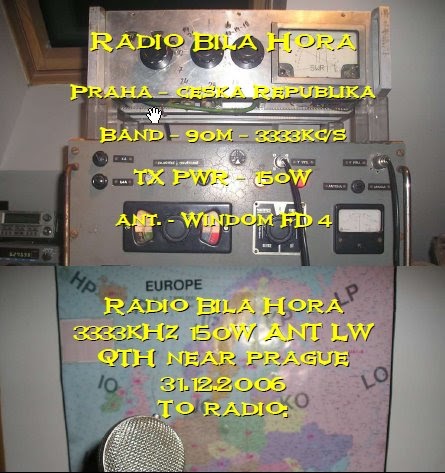
Monitoring for Radio Bila Hora broadcast on New Year's Eve


Hobbyist are speculating if the Euro pirate, Radio Bila Hora will recommence their annual New Year's Eve broadcast for 2018. If the station follows suit as in past years, they should broadcast on 3381.260 kHz. The station has also broadcast on 3334.82 kHz.

Last year's broadcast was logged from 1500 - 2330 UTC, and heard from remote SDR units in Germany, Hungary, Norway, and Sweden. The station's power at one time, was reported as 150 watts, and the transmitter was constructed by one of the radio operators. The exact location is unknown, but was mentioned as "outside the territory of the Czech Republic." The 2017 broadcast included two anthems played at 2300, speech segments, pop and local Czech music.

The 2017 broadcast also included a pre-recorded program presented by the former Czechoslovak pop singer, Richard Adams who was very popular in the 1950's and 1960's. Mr. Adams died in 2017 at age 86. He prepared the program for Radio Bila Hora several years ago, and the station presented it in his memory.

The station's English ID as, "Radio White Mountain," is a reference to the historical significance of the Battle of White Mountain, the most famous battle in Czech history.

The email address to send reception reports was rbb@email.cz

For a sample of previous programming, refer to You Tube videos at:

https://www.youtube.com/watch?v=zKnBaUGPydA

https://www.youtube.com/watch?v=k_B8Ie1OjfU

https://www.youtube.com/watch?v=4CHEoDnS0lo

https://www.youtube.com/watch?v=vg6oG5eXCkY


Saturday, December 29, 2018

FRS Holiday programming on 30 December


On Sunday December 30th, FRS-Holland will traditionally ring out the Old Year with its Seasonal Broadcast on 7700//5800 kHz. Programs will run from 08:52- 14:05 UTC/ 09:52- 15:05 CET.

In addition all programs will be repeated following close down of the first run: 14:05- 19:10 UTC/ 15:05- 20:10 CET. Particularly during the final hours of the second run, conditions will be
changing and as a result, signals will likely skip large areas. For that reason the final three hours- starting just after 16:00 UC/ 17:00 CET- will go out on an extra 3rd frequency: 3975 kHz.

The complete FRS team will join the party including Dave Scott, Jan van Dijk, Roger Davis, Bert van Leer & Peter Verbruggen. Traditionally it will be a mix of carefully selected rock/pop music
and a number of (radio related) program items as well as mail from November 18th and seasonal greetings. We also look back in the comprehensive FRS archives: a flashback to a December broadcast
many years ago. And a new edition of FRS goes DX will be aired  including news from the world of (free) Radio. Just listen for yourself!!

Important: it can happen that we are forced to change frequency during the broadcast. In such case FRS will publish it on the website. So...if there's latest news...you will find it at  http://www.frsholland.nl/  at Latest News.

May we take this opportunity to thank you, the listener for your support over 2018 hoping we may count on you in 2019, being our 39th year as a Free Radio station on short wave. We would like to
express the wish that  2019 will become a peaceful, successful and healthy year ! 

Have a great Season Holiday, 
73s from Peter, Jan, Brian, Dave, Roger & Bert

Friday, December 28, 2018

Schedule news from World Music Radio


Denmark
Some more details about this, including QSL info, from Stig (NB no QSLs will be issued for reports via remote receivers):

World Music Radio (WMR) commenced broadcasting on 15805 kHz on December 24th
2018 with a power of 200 W. Transmissions were irregular for the first couple of days, but should hopefully now be regular. The old transmitter and the simple aerial willing. Until January 6th 2019 the approx. hours of daily operation will be 0700-2000 UTC.   As from January 7th 15805 kHz will
probably be on the air Saturday-Sunday only.

Power is only 200 W, which of course is a very low on the 19 meter band, propagation is quite poor on this band now - and the aerial (a simple dipole) is not very efficient so reception is quite difficult and irregular.

So far -  poor to fair reception in Southern Europe has been observed in daytime till around 1300 UTC and fair to good reception in Ireland, Scotland, western England and Iceland has been experienced during evenings around 17-20 UTC.

Transmissions on 5840 kHz continues 24/7 with a power of 100 W.

The transmitter site for 5840 as well as 15805 kHz is Randers, Denmark.

QSL Cards
Please note that the current QSL-design will be used for reception reports covering reception in 2018 only. A new design will be used in 2019.

An eQSL is available for reports sent to wmr@wmr.dk - a reply can be expected within a month or so.

A printed QSL is available for reports sent to World Music Radio, PO Box 112, DK-8960 Randers SØ, Denmark.  Return postage is kindly required. For a fast reply enclose 5 euro or 5 USD (QSL will be mailed from Denmark, where postage rates are the highest in the world - 29DKK for a post card). If less return postage is enclosed, you will still get a QSL-card, but will have to wait some time till the QSLs can be mailed out from outside of Denmark.

Please note that no QSLs are available for reports made by listening via remote receivers.

MEDIUM WAVE

No news as for 927 kHz Copenhagen. Still struggling to find a transmitter site there.

Best 73s and Happy New Year,
Stig Hartvig Nielsen,
World Music Radio - WMR
www.wmr.radio
(HCDX)