Saturday, March 07, 2020

From the Isle of Music and Uncle Bill's Melting Pot schedules, March 8-14


From the Isle of Music, March 8-14: 

This week, our special guest is Antonio Duverger, leader of the changüi ensemble Son del Guaso. Also, we taste a new album by Barbarito Torres and a new single by Orquesta Failde featuring Omara Portuondo.

The broadcasts take place:
For Eastern Europe but audible well beyond the target area in most of the Eastern Hemisphere (including parts of East Asia and Oceania) with 100 kW Sunday 1500-1600 UTC on SpaceLine, 9400 KHz, from Sofia, Bulgaria (1800-1900 MSK)

If you don’t have a shortwave radio or are out of range, you can listen live to an uplink from a listening radio in the Netherlands during the broadcast at
http://websdr.ewi.utwente.nl:8901/?tune=9400am 

For the Americas and parts of Europe, Tuesday 0000-0100 (New UTC) on WBCQ, 7490 kHz from Monticello, ME, USA (Monday 8-9PM EST in the US).

If you don’t have a shortwave or are out of range, you can listen to a live stream from the WBCQ website here (choose 7490): http://www.wbcq.com/?page_id=7 

For Europe and sometimes beyond, Tuesday 1900-2000 UTC and Saturday 1200-1300 UTC on Channel 292, 6070 kHz from Rohrbach, Germany.

If you don’t have a shortwave radio or are out of range, you can listen live to an uplink from a listening radio in Europe.

Visit our Facebook page at https://www.facebook.com/fromtheisleofmusic 

Uncle Bill’s Melting Pot, March 8 and 10: 

Episode 155, It’s About Time, acknowledges the change to daylight savings time with songs about time and clock.

On WBCQ only, there is a second half-hour featuring one of the first episodes of our show in 2017.
The transmissions take place:

Sundays 2200-2300 NEW UTC (6:00PM -7:00PM Eastern US) on WBCQ The Planet 7490 kHz from the US to the Americas and parts of Europe

If you don’t have a shortwave or are out of range, you can listen to a live stream from the WBCQ website here (choose 7490): http://www.wbcq.com/?page_id=7 

Tuesdays 2000-2030 UTC on Channel 292, 6070 kHz from Rohrbach, Germany for Europe.

If you don’t have a shortwave radio or are out of range, you can listen live to an uplink from different web SDRs in Europe.

Visit our Facebook Page at https://www.facebook.com/UncleBillsMeltingPot 
(William "Bill" Tilford, Owner/Producer, Tilford Productions, LLC)

Thursday, March 05, 2020

LRA 36, Antarctica slated for March 6 broadcast


Antarctica

Broadcasting on 15476 kHz, LRA 36, Radio Nacional Arcángel San Gabriel, Base Esperana, according to information from the operator of the station, LRA 36 will be on air Friday 6th of March at 1500 or 1600, he doesn't clarify if it's  Argentinian or UTC time, with a special program about "Campaña Antártida de Verano". In the second or third week of March, LRA 36 will be on air regularly two days a week. 
(Manuel Méndez, Lugo, Spain)

2020 Teak International Air Show Guide is Now Available for Purchase


Every year, from March through November, millions of people hit the road to watch the excitement and thrills as military and civilian flight demonstration teams put their high-performance aircraft through the paces to entertain the crowds and perform at air shows all over the world. Anyone who has attended one of these events will tell you it is thrilling to watch the close quarter flying of the Blue Angels delta formation or the hair-splitting maneuvers of the Thunderbird opposing solos.
While attending the show and enjoying the sights and sounds is an exciting experience that is only half the fun. You can add another whole dimension to that visual experience by monitoring the performing teams’ radio communications.
With a radio scanner in hand, you will experience a whole new perspective of the show that few of the attendees will ever experience – pilot audio from the aircraft cockpit. While everyone else at the air show is just watching and listening to the public address system narrator, you’ll be able to hear what’s happening inside the cockpit, up in the tower and on the ground with the hundreds of players that keep these screaming, state-of-the-art air machines thundering through the skies.
But you can’t tell the players without a program, and to indulge in the craft of monitoring the air show experience you need a current and well-researched list of frequencies that the various performers may use during their performances.
In our new annual Teak Publishing International Air Show Guide eBook, 21st Edition, former Monitoring Times Editor and TSM Milcom columnist Larry Van Horn - N5FPW, delivers the hundreds of air and ground frequencies that you will need to monitor the action when you are within receiving distance of any air show this year.
From the Blue Angels and Thunderbirds, military parachute and search and rescue demonstration teams, to a wide variety of other military and civilian demonstration teams from the U.S. and abroad, Larry has the list of frequencies each unit has used. Now you can bring the excitement you see at the show to your ears. Listening to the nonstop action at the air show on dozens of radio frequencies is part of the real fun of being there.
But wait, there’s more! Larry also has a chapter on tips for enjoying a great day at the air show. You will also get frequency lists for other possible frequencies that may be used at the air show including DoD Intra-Squad Radio frequencies and hosting site aero and LMR frequencies/call signs. We also include in this eBook up-to-date air show frequency listings for overseas military and civilian aeronautical demonstrations teams.
Finally, you will get the latest air show schedules for the U.S. Navy Blue Angels, U.S. Air Force Thunderbirds, Canadian Forces Snowbirds, the Army Golden Knight Parachute Teams and more. We include the latest air traffic control frequencies and selected LMR trunk radio systems for each facility hosting or associated with a show when known.
This is the 21st annual edition of this popular frequency monitoring guide published by the author in either Monitoring Times magazine, The Spectrum Monitor e-zine, or by Teak Publishing in eBook form. This edition of the Teak Publishing Air Show Guide is the most comprehensive collection of air show information and frequencies ever published for the radio listening hobbyist.
The 2020 Teak International Air Show Guide is now available for purchase worldwide from Amazon.com at https://www.amazon.com/Teak-International-Air-Show-Guide-ebook/dp/B085FV1LCN/The price for this fourth e-Book the edition is still only US$3.99. Since this book is being released internationally, Amazon customers in the United Kingdom, Germany, France Spain, Italy, Japan, India, Canada, Brazil, Mexico, and Australia can order this e-Book from Amazon websites directly servicing these countries. All other countries can use the regular Amazon.com website.
So when the T-Birds and the Blue Angels, civilian/military precision flight teams, skydiving teams, and vintage aircraft crews are in the air, Larry has all the frequencies you need to hear them in this new e-book from Teak Publishing.

5-Star Amazon reviews on the last Teak Air Show Guide eBook.

Great information for the 2016 airshow season
Just what I was looking for. Great information for the 2016 airshow season. I bought it in preparation for a local airshow that I was going to stream over the internet. I was able to find most of the frequencies that I wanted and made for a great listening experience for all.

Larry Van Horn does his usual best
Excellent reference guide to get you pointed in all the right directions on any Airshow you attend. Covers all the Demo Teams with the latest frequencies

The best Air Show Guide you can buy
I have been a big fan of Larry Van Horn's work for many years. His publications are always very well written and full of detailed information. I look forward to purchasing next year's guide when it is available.

Five Stars
Perfect resource for the subject

Highly informative guide
I’ve been following Larry Van Horn's writings for a long time. This guy knows his stuff. I can without reservation recommend this book to fellow aviation enthusiasts.

Frequency updates, correction and late additions between editions of this e-Book will be posted on his Milcom Monitoring Post blog at http://mt-milcom.blogspot.com/. For a complete list of all the author's books, go to his Amazon authors page at http://www.amazon.com/-/e/B00G1QMO4C.
You do not even need to own a Kindle reader to read Amazon e-book publications. You can read any Kindle book with Amazon’s free reading apps. There are free Kindle reading apps for the Kindle Cloud Reader, Smartphones (iPhone, iTouch, Android, Windows Phone and Blackberry); computer platforms (Windows XP, Vista, 7 and 8 and Mac); Tablets (iPad, Android and Windows 8), and, of course, all of the Kindle family of readers including the Kindle Fire series. A Kindle e-book allows you to buy your book once and read it anywhere. You can find additional details on these apps by checking out this link to the Amazon website at www.amazon.com/gp/feature.html?ie=UTF8&docId=1000493771.
For additional information on this and other Teak Publishing radio hobby books, monitor the company sponsored Internet blogs – The Military Monitoring Post (http://mt-milcom.blogspot.com/), The Btown Monitor Post (http://monitor-post.blogspot.com/) and The Shortwave Central (http://mt-shortwave.blogspot.com/) for the availability of additional e-books that are currently in production.
You can learn more about the author by going to his author page on Amazon at http://www.amazon.com/-/e/B00G1QMO4C.

-30-

What Is Replacing Shortwave?

Screen shot of Dream software showing BBC transmission from Singapore 
A joint effort is necessary to bring the digitization of radio to a successful end

RUXANDRA OBREJA, 05 March 2020

The author is chairman of Digital Radio Mondiale.

Analog shortwave will celebrate about 100 years of existence in 2028 when many hope 5G will have been properly defined, tested and applied, though broadcasting is low on its long list of perceived advantages.

It’s true that shortwave was typically a medium of the Cold War that peaked in 1989 and that afterward its listenership dwindled. Many international broadcasters gave up on it as the post-war transmitters got rustier and the energy bills kept mounting.

Additional story from Radio World at: https://tinyurl.com/w8huaja
(Photo/Radio World via Dr. TK Rao)


Wednesday, March 04, 2020

Minicoy Island: The Island of the Long Racing Canoe-Boats


According to some historians, the long line of three island countries on the west side of the Indian sub-continent were all classified anciently as one contiguous whole, and they were identified collectively back then as Lakshadweep.  These days however, and beginning at the north, the three separate islandic units are identified as Lakshadweep, then to the south the Maldives, and then further south again Diego Garcia, all of which we collectively designate for our purposes as West Aquamontia.

The most southerly Indian island in the northern Lakshadweep Archipelago is identified as Minicoy, a name that has been translated with at least three different meanings.  It is said that the original name for Minicoy Island, Maliku, can be interpreted as: Island of the King, or perhaps Island of Women, or perhaps Cannibal Kingdom, all of which may have been correct.

The island of Minicoy claims to be the second largest island in Lakshadweep, though geographers would suggest that this island by itself is actually the third largest, with 4.01 square miles of land.  The current population on Minicoy is a little over 10,000. 

A very small uninhabited island nearby with a total area of just .01 of a square mile is called Viringili, a name that is taken from the Divehi language of the Maldive Islands, not the Malayali language of the other islands in Lakshadweep.  Viringili was known in the past as the Island of Lepers, and also as Small Pox Island. 

Minicoy Island is just 75 miles across the open ocean from Thuraakunu Island in the Maldives.  Way back in the dim distant past, it is said, there was just one family living on Minicoy.  Then two princesses and their retinue from the Maldive Islands came and settled on Minicoy, and the original inhabitant family left and went to ancient Ceylon.

During the colonial days, the British ruled Minicoy from mainland India.  Then in 1956, some time after India gained its independence from the British Raj, a referendum was held on Minicoy, and an absolute majority voted to remain with India.  Thus the island was absorbed into the Lakshadweep archipelago.

Minicoy is famed for the longest racing canoe-boats in the world, and they are designed and built entirely of handcrafted local wood, without any metal nails, bolts nor screws.  They race these Jahadhoni as they are called in the local Maliku language, on the waters of their large lagoon, with as many as 60 or more men seated in each and rowing at a remarkably fast speed.  In fact their racing style is so well organized that it is difficult for a regular motor boat to keep up with them. 

There are 10 villages on the island of Minicoy and each village has its own specific logo and color.  The village identification is crafted onto the blade of each oar.  These racing carnivals are staged usually twice each year, on two important Indian national days: Republic Day (January 26) and Independence Day (August 15).  Then too, if an important visitor comes to the island, they will stage a another special event carnival which will be equally magnificent as on any other occasion.

Back during the 1980s, Indian archaeologists investigated an ancient nearly 1,000 year old Buddhist stupa on Minicoy, though their research discovered very little of real historic value.

Radio came to Minicoy Island in 1941 when a government communication station was installed in the middle of the island.  Some 17 years later, this station was made available also to the general public for the transmission of communication messages back to mainland India.

Then in 1982, a Marine Radio Beacon was installed on the island with the tall transmission tower near the gleaming white lighthouse at the southern tip of the island.  This facility was replaced in the year 2000 with modern equipment that radiated 500 watts on 306 kHz.  However, the tall radio tower was felled during the devastating impact of Cyclone Ockhi two years ago in December 2017.

With the staging of more than half a dozen DXpeditions to the Lakshadweep Archipelago during the past more than half a century, amateur radio stations have been installed temporarily at more than a dozen different locations throughout these islands.  The first of these radio adventures took place in 1961 on the island of Minicoy itself, just 5 years after the aforementioned referendum. 

The well known international radio monitor Jose Jacob VU2JOS is an Assistant Director at NIAR, the National Institute of Amateur Radio in Hyderabad India and he has participated in two different amateur radio DXpeditions in the Lakshadweep Islands.  On the second occasion, he was appointed with four other team members to Minicoy Island, where they operated under the special event callsign VU7MY.  The callsign VU7MY is reminiscent of the callsign of the NIAR founder and current Chairman, Mr. S. Suri, whose home callsign is VU2MY.

A low power TV relay station was installed on Minicoy Island in 1989, and this was the first of many similar stations on the various islands in the Lakshadweep Archipelago.

That was our final topic regarding the Lakshadweep Islands, the Indian islands on the western side of the Indian sub-continent.  On coming occasions, we plan to present a couple of topics regarding the Radio Scene in the Maldive Islands to the south.
(AWR/Wavescan-NWS 572)

Special Marathon broadcast set for From the Isle of Music and Uncle Bill's Melting Pot


Save the date !!!

On Wednesday, March 4 from 0800 to 2000 UTC, Radio Channel 292, 6070 kHz (Rohrbach, Germany) will present a marathon of alternating From the Isle of Music and Uncle BIll's Melting Pot broadcasts featuring some of our favorite episodes of the last few years.

We will have a special QSL for reception reports regarding our broadcasts for that day. The program always includes the email towards the end. 
William "Bill" Tilford, Owner/Producer
Tilford Productions, LLC

Australian Radio Station 9AC on Bougainville Island

On May 26, 1942,  the American operated Armed Forces Radio Service AFRS was formally established, and its first operational office was installed in the Taft Building at the corner of Hollywood Boulevard and Vine Street in Hollywood California.  Among its many duties was the development of a worldwide network of medium wave broadcasting stations as a morale booster for American servicemen on duty in many widely separated countries.  By the time World War 2 ended, there were more than one hundred of these AFRS radio broadcasting stations on the air, large and small.

Somewhat parallel with the development of the American AFRS stations was the development in Australia of a similar network of medium wave radio broadcasting stations for the benefit of Australian service personnel on duty in various Pacific Islands, and elsewhere.  The first radio service for Australian armed personnel was established in the Middle East in 1940, with the broadcast of Australian programming in Egypt and Palestine.

During the year 1943, initial planning and construction began in Australia for a series of 21 mediumwave stations, fixed and mobile.  The electrical and electronic equipment for eight of these transportable stations, each rated at 200 watts, was installed into three army trucks, together with antennas which when erected, were strung between two metal masts, each 100 ft high. 

The callsigns for these eight transportable 200 watt mediumwave stations ranged from 9AB to 9AH, and also 9AT, and the callsign and the affiliation with AAAS, the Australian Army Amenities Service was nicely painted on the side of each truck.  Before each radio station was shipped overseas, test broadcasts were conducted, mainly from Williamstown, a seaside suburb of Melbourne in Victoria and from the Rose Bay Golf Links in Sydney, New South Wales. 

An additional thirteen of these mobile stations, each rated at 10 watts, operated with callsigns ranging from 9AI to 9AT, and also 9AV.  All of the electronic equipment for each of these low powered stations was installed in just one army truck.  Highly prized QSL cards were issued for the reception of these mobile and transportable stations.

In addition, the two fixed land stations, 5DR at Darwin in the Northern Territory and 9PA at Port Moresby in Papua New Guinea were considered originally to be part of the AAAS broadcast service.

The American AES-AFRS station WSSO-WVTI was earlier installed into a wooden Dallas Hut that arrived in Torokina on the island of Bougainville in kit form, and it was inaugurated on April 15, 1944.  This station was closed on January 21, 1945, and it was subsequently reinstalled in Manila in the Philippines. 

It was originally planned that the Australian transportable station 9AC would arrive in Torokina on Bougainville Island one month later, on February 23, though there was an unintended delay of three weeks.  During the interval between the departure of the American WVTI and the arrival of the Australian 9AC, the Australian forces installed a temporary low power fill in station, which also identified on air as 9AC. 

By mid year (1945), the new Radio Torokina (9AC) had been installed in the American Dallas Hut and it was already on the air with 200 watts on 1280 kHz.  The Americans had left some of their electronic equipment in the Dallas Hut, including much of their library of music records.

Programming from 9AC was made up of locally produced “Stars in Uniform”, a general knowledge quiz, and the Hospital Request Hour, which featured music that was requested by recuperating servicemen.  Many other programs over 9AC were on relay from the shortwave VOA stations in California, and also from Radio Australia in Melbourne.  Three of the announcing staff at 9AC Torokina were previously on air with mediumwave stations in Melbourne: Maurice Callard 3DB, Eric Spence 3AK, and Brian Carlton 3XY.   

Each of the Australian AAAS stations suffered from two major problems: Insufficient training and capability of the radio operators to diagnose and correct electronic problems, and the everlasting wet and moldy tropical weather patterns.  In December 1945, the Australian radio magazine, Radio and Hobbies, reported that station 9AC Torokina was transmitting its radio programs at only 20% modulation.

However by that time, the Pacific War was already over, and the Australian troops began to move out and return home.  The Australian radio station on Bougainville remained on the air until at least April (1946), and in August it was ordered to leave Torokina, and proceed to Lae in New Guinea, where it linked up with another AAAS station 9AB, which was also undergoing its own similar set of technical problems. 
    More from Bougainville another time.
(AWR/Wavescan-NWS 574)

Tuesday, March 03, 2020

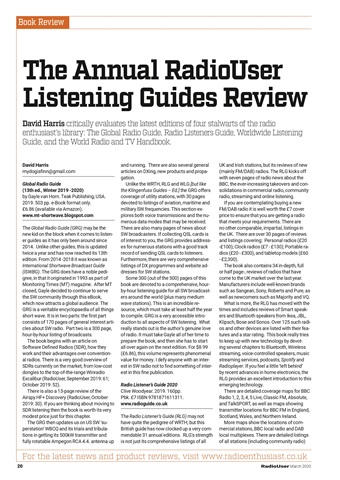
RadioUser Magazine Reviews the Teak Global Radio Guide


The March 2020 issue of the RadioUser Magazine has reviewed the current edition of the Global Radio Guide (Winter 2019-2020) by David Harris. We here at Teak Publishing sincerely appreciate his review of our flagship publication. You can purchase your copy of the March 0202 RadioUser at https://www.radioenthusiast.co.uk/store/latest-issue/radio-user/. You can get your copy of the Global Radio Guide (Winter 2019-2020) at Amazon https://www.amazon.com/dp/B082DNSN4P/ for US8.99.

Radio User Preview 20

Global Radio Guide (13th ed. Winter 2019 -2020) by Gayle van Horn. Teak Publishing, USA. 2019. 503 pp. eBook format only. £6.86. (available via Amazon)

Global Radio Guide (GRG) may be the new kid on the block when it comes to listener guides as it has only been around since 2014.  Unlike other guides, this is updated twice a year and has now reached its 13th edition. From 2014 -2018 it was known as International Shortwave Broadcast Guide (ISWBG).  GRG does have a noble pedigree in that it originated in 1993 as part of the much-lamented Monitoring Times (MT) magazine which closed in 2013.  After MT closed Gayle decided to continue to serve the SW community through this eBook which now attracts a global audience.

GRG is a veritable encyclopedia of all things SW. It is in two parts: the first part consists of 170 pages of general interest articles about SW radio.  Part two is a 300 page, hour by hour listing of broadcasts. The book begins with a lengthy article on Software-Defined Radios (SDR), how they work and their advantages over conventional radios.  There is a very good overview of SDRs currently on the market from low-cost dongles to the top of the range Winradio Excalibur.  There is also a 13-page review of the Airspy HF+ Discovery.  If you are thinking about moving to SDR listening then the book is worth its very modest price just for this chapter. 

GRG then updates us on US SW superstation WBCQ and its trials and tribulations in getting its 500 kW. transmitter and fully rotatable Ampegon RCA 4.4. antenna up and running.  There are also several general articles on DXing, new products and propagation. 

Unlike WRTH, RLG, and WLG, GRG has coverage of utility stations with 30 pages devoted to listings of aviation, maritime and military SW frequencies. This section explores both voice transmissions and the numerous data modes that may be received. There are also many pages of news about SW broadcasters.

If QSLing is an interest then GRG provides addresses for numerous stations with a track record of sending QSL cards to listeners. There are very comprehensive listings of DX programs and website addresses for SW stations.

Some 300 out of 500 pages of this book are devoted to an hour by hour listing guide for all SW broadcasters around the world (plus many mediumwave stations)  This is an incredible resource which must take half the year to compile.

GRG is more than just another listener guide – it is a very accessible introduction to all aspects of SW listening.  What really stands out is the author’s genuine love of radio. It must take Gayle all of her time to prepare the book and then she has to start all over again in the next edition.  For $8.99 (£6.86) it represents phenomenal value for money. I defy anyone with an interest in SW radio not to find something of interest in this fine publication.


War claims a revolutionary radio station in Syria

Syrian Civil War Map
By NABIH BULOSSTAFF WRITER
FEB. 28, 202012:49 PM
AMMAN, Jordan —  The news broadcast finished and Salah Abed began to dismantle the equipment: There would be no other broadcast that evening — and maybe never again — from the Radio Fresh station in the Syrian town of Kafranbel.

The town had been an icon of uprising and the radio station was its voice to the world. Activists relied on the station, along with skits and videos that frequently went viral, to lampoon President Bashar Assad and the international community’s inability to stop the carnage of Syria’s civil war.

Additional story at Los Angeles Times: https://www.latimes.com/world-nation/story/2020-02-28/war-claims-a-revolutionary-radio-station-in-syria


Former 2016 feature, Inside the Syrian radio station that won’t stop recording
MARIE CLAIRE
APRIL 18, 2016 5:28 PM
https://www.marieclaire.co.uk/news/radio-alwan-syrian-radio-station-that-won-t-stop-recording-10817

Australian Shortwave Callsigns VLR - Part 2


In our program today, we pick up the story of the Australian shortwave callsign VLR in Lyndhurst Victoria in September 1937.  It was back at that stage that the original locally made 1928 shortwave transmitter was again renovated, and re-engineered from 600 watts up to 1 kW.   During its 10 year experimental era, the transmitter callsign was listed as VK3LR, which was an amateur designation, though the station was always a professional operation, never amateur.

One year later (1938) on October 1, transmitter VLR was again upgraded, this time with an output power of 2 kW.  At this stage, three shortwave channels were in use (6140 kHz, 9580 kHz and 11880 kHz), and three different antenna systems were available, thus ensuring wide coverage throughout Australia, and also coverage into many areas worldwide.

At the outbreak of war in continental Europe on September 2, 1939, the ABC shortwave station at Lyndhurst was the only shortwave broadcasting station that was permitted to remain on air.  The programming feed for VLR was produced in the Melbourne studios of the (ABC) Australian Broadcasting Commission stations 3LO and 3AR, and fro there it was landlined to Lyndhurst, some 25 miles southeast of downtown Melbourne.  At this stage, the ABC announced that a new 10 kW shortwave transmitter was planned as a replacement for the now eleven year old ailing transmitter.

Due to the exigencies of the European war, rapid plans were implemented in Australia for the introduction of a government operated international shortwave voice; and three months later, on December 20 (1939), the new Australia Calling was inaugurated.  December 20 was the birthday of Australia’s Prime Minister (Sir) Robert Menzies.

Four shortwave transmitters were available for Australia’s new shortwave voice, and these were designated as VLQ and VLQ2 at Pennant Hills near Sydney in New South Wales, VLW near Perth in Western Australia, and the already mentioned VLR near Melbourne in Victoria.  Special international programming for the new Australia Calling was produced in the Melbourne and Sydney studios of the ABC. 

Eighteen months later, on June 21, 1941, the promised new 10 kW shortwave transmitter was activated in the Lyndhurst transmitter station, though now it was not a replacement for the old VLR, but rather it was an addition to the old VLR.  Initially this new STC transmitter was designated on air under the same VLR callsign, as VLR3 (11880 kHz) and VLR4 (15230 kHz). 

At this stage, there was confusion as to which of the two transmitters was in use, so two months later on August 24, (1941) the new 10 kW VLR was redesignated as VLG; and thus VLR3 on 11880 kHz became VLG5, and VLR4 on 15230 kHz became VLG6.  From this time onwards, VLG was on the air with programming for both Australia Calling and the ABC National Service, though the original VLR was in use only for ABC National Service coverage in Australia itself.  Never again was VLR taken into service for Australia Calling, nor for Radio Australia as the international service was known subsequently.

For a few years after the end of World War 2, the VLR transmitter was operating at a power level of 5 kW.  However unfortunately, this old VLR was always noted on air with a raspy signal, and sometimes a loud booming hum, and never with a good clean and easy to listen audio.

During the 1950s, a new building was erected over and around the old transmitter building, and the old building was then removed piece by piece.  In this way, the now three transmitters (VLH was added in 1946) were still in regular usage, and no damage was done to any of the electronic equipment.  At this stage, there was a change in the numeric designators, with the number now indicating the MHz band.  For example, VLR2 on 6150 kHz therefore became VLR6.

Now that there was more space in the transmitter building, three additional 10 kW shortwave transmitters were installed in 1956.  These American made RCA transmitters were redundant equipment originally planned for installation in American battleships and with the end of World War 2 they were no longer needed. 

At this stage, the old original VLR transmitter was removed.  In addition, the callsign VLR was no longer the identification of a specific transmitter, but rather it now became the designation of the ABC shortwave service for coverage in the Great Outback, which was on air from any of the available transmitters. 

Then beginning in the 1960's, a total of eight STC made 10 kW transmitters were installed progressively at the Lyndhurst shortwave station.  Give another score of years, and the VLR shortwave service was declared redundant, and thus it was closed at 1402 UTC on Friday morning June 12, 1987.  The final transmission from ABC VLR came to an end, as VLR6 with 10 kW on 6150 kHz just after midnight local time.

In summary, VLR was an experimental and broadcast transmitter at Lyndhurst that was on the air for 29 years stretching from 1928 to 1956.  This transmitter also carried a program relay for Australia Calling for a couple of years from 1939 to 1941.  From 1956 until closure in 1987, VLR was an ABC program service that was on the air from any of the multiple shortwave transmitters that were available in the Lyndhurst shortwave station. 
(AWR-Wavescan/NWS 575-01 Mar 2020)

The Grand Wireless Station at Monte Grande


Another great radio nostalgia story from Wavescan. Thanks to AWR.

      Construction work on the world’s largest wireless station, as it was touted at the time, began a little over one hundred years ago in the year 1918.  However, due to the Great War and its aftermath  over in continental Europe, progress on the work was quite slow.  Initially, the Marconi company in England began the preparatory work, but due to the total size of the completed project, a consortium group including other wireless manufacturing companies was formed.

A combined property of 1200 acres located on the south side of Buenos Aries and 25 miles from the city center was obtained as the location for the Monte Grande longwave wireless station.  Two powerful alternators at 400 kW each were installed, and electricity with 800 kW at 12,500 volts, was fed into the station from the city generating plant. 

The two alternators were capable of transmissions in the longwave spectrum, running from around 18 kHz up to about 72 kHz.  In regular usage, one transmitting alternator was on the air while the other was maintained in standby mode.

The massive antenna system in total was nearly two miles long, and it was formed in the shape of the English capital letter T.  It was supported on ten towers in pairs each 680 ft tall and spaced at nearly a quarter mile apart.  These towers were imported from CTSF in France and from Telefunken in Germany.

The 16 wire aerial system was supported at 200 places by cross wires incorporating the use of a thousand insulators.  The steel cables that supported the aerial wires were installed with insulated rollers, and the aerial wires were weighted at each end with weights at 88 pounds each, thus allowing for compensation in wire lengths due to variations in the local temperature.  There was a complicated double counterpoise system with a buried network of wires, as well as another system of wires, 30 ft above ground level.

The Monte Grande Wireless Station was officially opened in a formal ceremony on Thursday January 24, 1924, in the presence of the president of Argentina, Senor Marcelo Torcuato de Alvear.  Next day, this new and grand wireless station, with the international call letters LPZ, began Morse Code communication with similarly high powered longwave wireless stations in London, Paris, Berlin and New York.

During the early 1920's, the communication scene throughout the world was in transition from wireless to radio, and thus, in 1925, just one year after the opening of the Monte Grande wireless station, two American made RCA shortwave transmitters rated at 20 kW each were installed at the same location.  In this way, voice communication began to take over from communication by Morse Code.

Give six more years (1931), and the two hefty wireless alternators were decommissioned and a bevy of additional shortwave transmitters was installed.  At the beginning of the European War in 1939, several shortwave transmitters were in use at Transradio Monte Grande, ranging in power from 1 kW to 125 kW.   An additional 100 kW transmitter was installed in November of that same year (1939).

Beginning in the mid 1930s, the Monte Grande radio station was often noted in the United States and elsewhere with the broadcast of radio programming.  The transmitters generally in use for the relay of programming from local mediumwave stations were rated at 10 kW and 20 kW.

       Sometimes a shortwave transmitter was in use as a program link from a Buenos Aires mediumwave station to an upcountry mediumwave station, and on other occasions the purpose was for the relay of mediumwave programming for network rebroadcast in the United States as well as for direct reception worldwide. 

      Radio station LSX at Monte Grande was often heard with a program broadcast at 10 kW on 10350 kHz.  This station was recognized and appreciated internationally as a reliable verifier of listener reception reports. In 1970, the official telecommunication concession ended and the Grand Wireless station LPZ-LSX at Monte Grande was closed, and abandoned.  Several other shortwave stations in Argentina took over the various services previously on the air at Monte Grande.

In 2011, the Monte Grande location was declared a Nature Reserve as Laguna de Rocha (Rocky Lagoon), and much of the abandoned radio structure is still in place.  The front of the huge main building still stands intact, though a picture at the back of the building shows nothing but wrecked debris.  Some antenna towers are also still standing.

Two additional radio buildings on the same site are also abandoned, though they are still in good condition.  These two structures were the transmitter buildings for two mediumwave stations, Radio Splendid LR4 currently with 25 kW on 990 kHz, and Radio Excelsior LR5 with likewise currently 60 kW on 910 kHz.

Transradio Receiving Stations
The first receiver station for Transradio Monte Grande in Argentina was located at the outer suburban Villa Elisa, some 20 miles from downtown Buenos Aires, and 25 miles from the transmitter station.  Two flat top multi-wire aerial systems were installed, thus ensuring reception from both Europe and the United States. 

A bank of electrically operated receivers was installed in a specially constructed building.  It was back in 1924 that this receiver station was taken into service, along with the transmitter facility at Monte Grande.  These days, this Transradio property is serving the local community as an Ecological Reserve, a Nature Park.

During the year 1935, a replacement receiver station was installed on a property at suburban San Martin known as the La Dora Farm.  This receiver station was closed in 1970, along with the Monte Grande transmitter site, and since then this property has also been taken over as an Ecological Reserve.

According to information in print in Argentina, all three Transradio properties (transmitter site at Monte Grande, early receiver site at Villa Elisa, subsequent receiver site at San Martin); all, strangely enough, have been taken over by the local communities for public use as Nature Parks.
(AWR-Wavescan/NWS 575-01  Mar 2020)

Monday, March 02, 2020

Weekly Propagation Forecast Bulletins


Product: Weekly Highlights and Forecasts
:Issued: 2020 Mar 02 0510 UTC
# Prepared by the US Dept. of Commerce, NOAA, Space Weather Prediction Center
# Product description and SWPC web contact www.swpc.noaa.gov/content/subscription-services
#
#                Weekly Highlights and Forecasts
#
Highlights of Solar and Geomagnetic Activity 24 February - 01 March 2020

Solar activity was very low over the period under a spotless solar disk. No Earth-directed CMEs were observed.

No proton events were observed at geosynchronous orbit.

The greater than 2 MeV electron flux at geosynchronous orbit was at normal to moderate levels on 24-25 Feb, 27 Feb, and again on 29 Feb-01 Mar. High levels occurred on 26 and 28 Feb with a peak flux of 2,170 pfu observed at 26/1950 UTC.

Geomagnetic field activity ranged from quiet to active levels over the period. Solar wind parameters were at nominal levels from 24 Feb through early on 28 Feb. At 28/0650 UTC total field then began to increase to around 8 nT while the Bz component became variable between +/-7 nT. Solar wind speed initially increased to 503 at 29/0248 UTC before increasing a second time to 573 km/s at the 29/1942 UTC. This increase in solar wind parameters was due to a connection to a negative polarity southern crown coronal hole high speed stream (CH HSS) followed by a connection with an isolated negative polarity CH HSS. The geomagnetic field responded with quiet levels on 24-28 Feb and quiet to active levels on 29 Feb-01 Mar.

Forecast of Solar and Geomagnetic Activity 02 March - 28 March 2020

Solar activity is expected to continue at very low levels.

No proton events are expected at geosynchronous orbit.

The greater than 2 MeV electron flux at geosynchronous orbit is expected to reach moderate levels on 02-03, 10-18, 22-28 Mar. High levels are expected on 04-09 and 19-21 Mar due to the CH HSS influence.

Geomagnetic field activity is expected to increase to unsettled levels on 02-07, 18-20, 27-28 Mar with active periods likely on 02, 19, 27-28 Mar due to CH HSS activity.

Product: 27-day Space Weather Outlook Table 27DO.txt
:Issued: 2020 Mar 02 0510 UTC
# Prepared by the US Dept. of Commerce, NOAA, Space Weather Prediction Center
# Product description and SWPC web contact www.swpc.noaa.gov/content/subscription-services
#
#      27-day Space Weather Outlook Table
#                Issued 2020-03-02
#
#   UTC      Radio Flux   Planetary   Largest
#  Date       10.7 cm      A Index    Kp Index
2020 Mar 02      70          12          4
2020 Mar 03      70          10          3
2020 Mar 04      70           8          3
2020 Mar 05      70           8          3
2020 Mar 06      70           8          3
2020 Mar 07      70           8          3
2020 Mar 08      70           5          2
2020 Mar 09      70           5          2
2020 Mar 10      70           5          2
2020 Mar 11      70           5          2
2020 Mar 12      70           5          2
2020 Mar 13      70           5          2
2020 Mar 14      70           5          2
2020 Mar 15      70           5          2
2020 Mar 16      70           5          2
2020 Mar 17      70           5          2
2020 Mar 18      70           8          3
2020 Mar 19      70          12          4
2020 Mar 20      70           8          3
2020 Mar 21      70           5          2
2020 Mar 22      70           5          2
2020 Mar 23      70           5          2
2020 Mar 24      70           5          2
2020 Mar 25      70           5          2
2020 Mar 26      70           5          2
2020 Mar 27      70          12          4
2020 Mar 28      70          14          4
(NOAA)

Saturday, February 29, 2020

From the Isle of Music and Uncle Bill's Melting Pot schedules, March 1-7


From the Isle of Music, March 1-7
This week, our special guest is Daymé Arocena, who will converse with us in English about her beautiful new album, Sonocardiogram. 

The broadcasts take place
For Eastern Europe but audible well beyond the target area in most of the Eastern Hemisphere (including parts of East Asia and Oceania) with 100kW, Sunday 1500-1600 UTC on SpaceLine, 9400 kHz, from Sofia, Bulgaria (1800-1900 MSK)

If you don’t have a shortwave radio or are out of range, you can listen live to an uplink from a listening radio in the Netherlands during the broadcast at http://websdr.ewi.utwente.nl:8901/?tune=9400am

For the Americas and parts of Europe, Tuesday 0000-0100 (New UTC) on WBCQ, 7490 kHz from Monticello, ME, USA (Monday 8-9PM EST in the US).

If you don’t have a shortwave or are out of range, you can listen to a live stream from the WBCQ website here (choose 7490) http://www.wbcq.com/?page_id=7

For Europe and sometimes beyond, Tuesday 1900-2000 UTC and Saturday 1200-1300 UTC on Channel 292, 6070 kHz from Rohrbach, Germany.

If you don’t have a shortwave radio or are out of range, you can listen live to an uplink from a listening radio in Europe.
Visit our Facebook page at https://www.facebook.com/fromtheisleofmusic

Uncle Bill’s Melting Pot, March 1 and 3
Episode 153 takes us to Serbia.
On WBCQ only, there is a second half-hour featuring one of the first episodes of our show in 2017.
The transmissions take place:

Sundays 2200-2300 NEW UTC (6:00PM -7:00PM Eastern US) on WBCQ The Planet 7490 kHz from the US to the Americas and parts of Europe.

If you don’t have a shortwave or are out of range, you can listen to a live stream from the WBCQ website here (choose 7490) http://www.wbcq.com/?page_id=7

Tuesdays 2000-2030 UTC on Channel 292, 6070 kHz from Rohrbach, Germany for Europe.

 If you don’t have a shortwave radio or are out of range, you can listen live to an uplink from different web SDRs in Europe.
Visit our Facebook Page at https://www.facebook.com/UncleBillsMeltingPot 
(William "Bill" Tilford, Owner/Producer, Tilford Productions, LLC)

Friday, February 28, 2020

WRMI set to broadcast Encore-Classical Music program this weekend


EUROPE:
This coming weekend Encore - Classical Music on Radio Tumbril will be broadcast at 11:00 UTC on SATURDAY on 6070 kHz by Channel 292.
There are two repeats - 19:00 UTC Friday on 6070 kHz, and 09:00 UTC on Sunday on 7440 kHz by Channel 292.

NORTH AMERICA:
WWCR Nashville will broadcast Encore for the last time on Saturday at 21:00 UTC on 9350 kHz.
Many thanks to WWCR for relaying Encore to the US and Canada for the last few months.

WBCQ Maine will send out the show on 7490 kHz at 01:00 UTC Monday to the US. (Early evening Sunday local US - obviously.)

WRMI will begin broadcasting Encore to the US and Canada on 5850 kHz 01:00 UTC Sunday and 9455 kHz 03:00 UTC Monday this weekend.

Our email is  encoretumbril@gmail.com. Informal reception reports as well as those requesting eQSL welcome.

This week's program contains some music for organ and trumpet, a couple of Swedish folk songs, chamber music from Tchaikovsky, some Brahms, Ravel, Marin Marais, and a contemporary composition by Cheryl Frances-Hoad.

A very mixed selection as usual - but they seem to go well together. I hope you enjoy the sequence.
The playlist is on the website and will be updated soon after Saturday's broadcast of the new show by Channel 292 at 11:00 UTC - but probably not until Sunday evening.

Both Channel 292 and WBCQ as well as WWCR can be pulled live off the internet if the reception is poor in your location. Easy to find their sites with a google search.

In the meantime - thank you for spreading the word about Encore - Classical Music on Shortwave. And thank you to everyone for letting us know how well the signal is received where you live.

Brice Avery - Encore - Radio Tumbril - www.tumbril.co.uk

Regular Broadcast times are:
11:00 - 12:00 UTC Saturday on 6070 kHz and repeated at 09:00 UTC Sunday on 7440 kHz and Friday on 6070 kHz Channel 292 (Germany).
01:00 - 02:00 UTC Sunday on 5850 kHz and 9455 kHz 03:00 UTC Monday on WRMI (Florida USA).

Thursday, February 27, 2020

Shortwave Radiogram weekend schedules

Hello friends,

A reminder about this very useful reference for new and experienced Shortwave Radiogram decoders:
https://wiki.radioreference.com/index.php/Shortwave_Radiogram_Gateway

Videos of last weekend's Shortwave Radiogram (program 140) are listed in the table below.The audio archive is maintained by Mark in the UK. Analysis is prepared by Roger in Germany.
UTC Day UTC Time kHz Listener Location URL
Friday 1300-1330 15770 Lolo sdr Spain https://youtu.be/X08IJCth-_Q
Friday 1300-1330 15770 Scott Ontario https://youtu.be/saH_auO5X_I
Saturday 1330-1400 15770 Lolo sdr Spain https://youtu.be/R1WuiPZavQI
Sunday 0800-0830 5850 2010DFS Japan https://youtu.be/H8pecGbKUmY
Sunday 0800-0830 7730 Lolo sdr Spain https://youtu.be/AUIcHAlufWo
Sunday 2330-2400 7780 Lolo sdr Spain https://youtu.be/ih5-53oCNVc

This weekend's show is in the usual MFSK32 and MFSK64, with eight MFSK images.

Here is the lineup for Shortwave Radiogram, program 141,  UTC 27-29 February 2020, in MFSK modes as noted:

 1:51  MFSK32: Program preview
 3:06  Air New Zealand plane will monitor climate for NASA*
 8:40  MFSK64: Humans responsible for high methane emissions*
13:19  Mars InSight lander detects seismic activity
17:19  This week's images*
28:26  MFSK32: Closing announcements

* with image(s)
Please send reception reports to radiogram@verizon.net
And visit http://swradiogram.net
Twitter: @SWRadiogram or https://twitter.com/swradiogram (visit during the weekend to see listeners' results)
Facebook group: https://www.facebook.com/groups/567099476753304

Shortwave Radiogram Transmission Schedule
UTC Day UTC Time Frequency Transmitter
Friday 0030-0100 UTC 9265 kHz WINB Pennsylvania
Friday 1300-1330 UTC 15770 kHz WRMI Florida
Friday 1500-1530 UTC 13690 kHz DRM WINB Pennsylvania
Saturday 0330-0400 UTC 9265 kHz WINB Pennsylvania
Saturday 1330-1400 UTC 15770 kHz WRMI Florida
Sunday 0800-0830 UTC 5850 kHz
7730 kHz WRMI Florida
Sunday 2330-2400 UTC 7780 kHz WRMI Florida

The Mighty KBC transmits to North America Sundays at 0000-0200 UTC (Saturday 7-9 EST) on 5960 kHz, via Germany. A minute of MFSK is at about 0130 UTC.  Reports to Eric: themightykbc@gmail.com . See also http://www.kbcradio.eu/ and https://www.facebook.com/TheMightyKbc/.

“This is a Music Show” is the newest addition to digital modes via analog shortwave. Most of the show is a music show, but the host transmits some MFSK text and image near the end of the broadcast. It’s transmitted on WRMI, Thursdays at 0200-0300 UTC on 5850 kHz and 0130-0230 UTC on 9395 kHz (Wednesday evening in the Americas). Also look for a waterfall ID at the beginning of the show. thisisamusicshow@gmail.com . www.instagram.com/thisisamusicshow/ www.twitter.com/ThisIsAMusicSho/ @ThisIsAMusicSho

New York and Pennsylvania NBEMS nets. Most weekends, as KD9XB, I check in to the New York NBEMS (Narrow Band Emergency Messaging Software) net Saturday at 1300 UTC on 3584 kHz USB, and the Pennsylvania NBEMS net Sunday at 1300 UTC on 3583 kHz USB (with out-of-state check-ins now starting at 1230 UTC). Check-ins are usually in Thor 22, and messages are in MFSK32. Messages generally use the Flmsg add-on to Fldigi. If you are a radio amateur in eastern North America, feel free to check in. Outside the region, use an SDR in the eastern USA to tune in and decode. You do not need Flmsg to check in, and most of the messages can be read without Flmsg. If you can decode the net, send me an email to radiogram@verizon.net , or tweet to @SWRadiogram , and I will let them know you are tuned in. USEast NBEMS Net: Please also note the USEast NBEMS Net, Thursdays 0000 UTC (Wednesdays 7 pm EST) on 3536 kHz USB.

Thanks for your reception reports!
Kim

Kim Andrew Elliott, KD9XB
Producer and Presenter
Shortwave Radiogram
Reporting on international broadcasting at https://twitter.com/kaedotcom


Wednesday, February 26, 2020

USAGM budget request focuses on regions of strategic importance and innovative programming

10 February, 2020
The President today released his Fiscal Year 2021 Budget Request, detailing $637.3 million for U.S. Agency for Global Media (USAGM) to pursue its public service media mission to inform, engage and connect people around the world in support of freedom and democracy.

"USAGM networks continue unprecedented growth in innovative programming and audience reach. There is a continued and strong global demand for accurate, professional, and issues-oriented journalism," said USAGM CEO and Director Grant K. Turner, adding, "Strategically investing our resources will enable us to remain a leading source of objective news and information globally.

USAGM is in the midst of a significant multi-year modernization effort designed to improve the efficiency and effectiveness of the agency and to increase its impact in information-restricted places where the fundamental principles of democracy and human rights, such as press freedom, are gravely under siege. This undertaking advances USAGM's 2018-2022 Strategic Plan, and it aligns with the National Security Strategy and the President's management priorities of effectiveness, efficiency and accountability.

In a world awash in disinformation and propaganda, the agency recognizes the need to be dynamic and agile. Thus, USAGM is repositioning resources, refreshing staff skillsets and evolving its technological footprint to remain competitive in global media markets. Since the enactment of the FY17 National Defense Authorization Act (NDAA), which authorized the agency to pursue these on-going modernization initiatives, the agency has achieved important milestones using the resources invested in its operations, including:
Growing USAGM's measured weekly audience from 278 million people in FY 2017 to 350 million people at the end of FY 2019, an unprecedented 26 percent increase;
Expanding the agency's 24/7 Russian-language global TV and digital network, Current Time, and doubling the overall USAGM's measured weekly audience to 7.9 million Russian adults;
Launching a new 24/7 Persian-language global network, VOA 365-led by the Voice of America (VOA) in cooperation with Radio Free Europe/Radio Liberty (RFE/RL)-which builds on USAGM's position as the number one international television and radio broadcaster in Iran;
Conducting an end-to-end transformation of the Middle East Broadcasting Networks (MBN), including significant changes to all television, radio and digital programming as well as content delivered to Syria and the Levant;
Development of a new global Mandarin-language strategy that combines VOA and Radio Free Asia (RFA) resources to provide innovative and engaging content. This effort-similar to other USAGM initiatives-pivots away from thinking about markets as countries, and instead targets a global network of Mandarin-speakers keen to access uncensored news and information. This effort also empowers both VOA and RFA to provide digital and social media content in China, as well as for diaspora communities, overseas workers and the growing cohort of Chinese citizens traveling around the world for business, leisure and education; and
Establishment of a new USAGM grantee, the Open Technology Fund (OTF), dedicated to advancing internet freedom tools, technologies and approaches to ensure that USAGM journalists and audiences can safely create, access and share digital news and other information without fear of repressive censorship or surveillance.
The agency will build on these successes in the President's FY 2021 Budget Request by prioritizing funding for regions of strategic importance to United States national security and foreign policy, leveraging technology and data, investing in a state-of-the-art media enterprise and combating online censorship and repressive surveillance. FY 2021 investments also include advancing the agency's multi-year transformation and modernization efforts to create exceptional content for the audiences that need it the most.

FY 2021 Budget Request for USAGM includes the following priorities:
Influencing Regions of Strategic Importance to United States National Security
Build on the success of the Russian-language Current Time network;
Enhance the programming of USAGM's new 24/7 Persian-language global network;
Launch RFA and VOA digital news initiatives to engage Mandarin-speaking audiences in China and beyond;
Maintain expanded reporting in Central America and Venezuela; and
Engage audiences in Eastern Europe-particularly new audiences in Hungary, Bulgaria, and Romania-where press freedom is on the decline.
Transforming and Modernizing USAGM Operations
Continue transforming USAGM's premium Arabic-language programming and leading-edge operations;
Advance internet freedom and combat online censorship and repressive surveillance with continued investments in OTF;
Leveraging Cuba's emerging digital revolution, the Office of Cuba Broadcasting (OCB) will expand its digital reach and impact and ensure the production of content adheres to the highest journalistic standards; and
Lead through technology, data, and engagement by integrating field-leading tools and techniques into operations, research, and decision-making.
Additional information is available in the Fiscal Year 2021 Congressional Budget Request.
(USAGM)

WRTH 2020 Review


originally appeared in the February 2020 issue of The Spectrum Monitor e-zine


World Radio TV Handbook 2020 Review 
Gayle Van Horn W4GVH

World Radio TV Handbook 2020, has recently released their 74th edition. As hobbyist, we always welcome the arrival during the DX season, and absorb it for days, reading the features, predictions and changes for a new listening year.
The 2020 edition, begins with an editorial by Nicholas Hardyman, Publisher, noting a brief synopsis of products, information on the WRTH Frequency Bargraph and website Updates reminders.  
            WRTH Contributors 2020, features radio hobbyist, Luis Cavalho, WRTH contributor for Portugal, the Azores and Madeira. Luis, an avid radio listener for decades, complies his information using a variety of listening equipment to monitor the bands. To follow Luis Cavalho, visit his blog Mundo da Rádio at http://mundodaradio.blogspot.com/.
Receiver Reviews, begin with a look at the Elad FDM-DUOr. The DUOr, a stand-alone device, is a general-coverage receiver, covering 9kHz-54 MHz and offers AM, USB, LSB, CW and FM reception. Overall, reviews note that despite a few ergonomics considerations, it is a good value for the cost.
The popularity of SDR’s continue to expand. This year, WRTH awarded the new Airspy HF+ Discovery, with the WRTH Awards 2020, for the Best Value SDR. In 2019, with the release of an upgraded version of Airspy HF+, the expanded version Airspy HF+ Discovery, caught on immediately with worldwide radio enthusiasts. Overall, this is an amazing and affordable SDR unit, one that is highly recommended. SDRPlay RSPDuro Diversity is also a popular SDR unit, one with new potential functionally, and excellent reception. SDR’s continue to amaze the casual and experienced hobbyist.
Two of the newer product releases in so-called ‘internet radios,’ is the release of Pure Elan E3, and Pure Elan IR5. The Pure Elan E-3, offers DAB, DAB+, and FM. The Pure Elan IR5, replaces radio reception with internet connectivity in a similar basic package. Both radios are a good choice.
The Tecsun portable radio, has been a popular alternative to hobbyists, in terms of size and affordability for many years. The new Tecsun PL-310ET, is equally impressive, and one to consider, given the size and price. If an external antenna is not feasible at your location, consider the Tecsun AN-200 MW Loop Antenna. The small manually tunable loop antenna is intended for indoor use in the medium wave band (500-1700 kHz). At this low-price, it’s a bargain not to be missed.
Dave Porter G4OYX, opens the Features section, with The Development of HF Broadcast Antennas. The former BBC Transmitter Engineer, continues the story of the development of HF broadcasting from curtain arrays to Allis antenna.
Hans Johnson, a returning features writer and active hobbyist, explores the story behind the transmissions broadcast to Japanese citizens who were abducted by North Korea, in his informative feature, Sea Breeze & Wind from Japan.
            New Caledonia once graced the airwaves on shortwave and medium wave, however in the modern age of island broadcasting, both have ceased, leaving FM the one means of operation to the island east of New Zealand. Stu Forsyth, WRTH contributor and chief editor of New Zealand DX Times, outlines in Radio on New Caledonia, the history of broadcasting from and on the French Pacific island of New Caledonia.  
Understanding the elements of radio propagation has been known to perplex the beginner, as well as the seasoned shortwave listener. How can a medium wave station, thousands of miles away be audible, when logically it should not be possible? The WRTH staff examines MW Propagation and the finer points to consider.  
Ashraf Chaabane, president of the Association des Radio Amateurs Tunisiens (ARAT), details a recent visit to the old transmitting site in Tunisia. A Visit to Sidi Mansour Transmitter Site, about a once vibrant broadcasting site.
Digital broadcasting continues to gain popularity in the hobby. This edition of Digital Update continues WRTH regular roundup of digital broadcasting, looking this year at the distinctive power characteristics of analogue and digital transmission systems. Will a fully digital broadcasting system be the wave of the future?
Wrapping up the Features section is the annual update of HF Broadcasting Reception Conditions Expected During 2020. Ulf-Peter Hoppe, adjunct professor of physics at the Arctic University of Norway, delves into the New Sunspot Cycle in 2020. As always, it’s an interesting addition, and compliments the Most Suitable Frequencies 2020 listings. Using both sources, you can expect improved reception on the HF broadcasting bands.
Eleven pages of colored maps, plus the World Time Table is a great segue to the National Radio section. Sections include domestic radio stations broadcasting to a national listening audience on medium wave, shortwave, FM and DAB. Listings are grouped by country and include frequencies, transmitter information, power kW, contact and website information.
The International Radio list the same information for international broadcasters, airing to a global listening audience.
Clandestine and other Target Broadcast, cover stations broadcasting politically motivated programming, or those targeted at zones of local or regional conflicts. A one-page listing   Religious Broadcasters Cross Reference Table closes this section.
The Frequency List, includes by-frequency listings of world medium wave stations. SW Stations of the World, is a by-frequency listing of stations, followed by International Broadcasts in English, French, German, Portuguese and Spanish, in a 24-hour UTC format. DRM International Broadcast, are 24-hour UTC listings of worldwide stations airing on DRM. Closing this section is the National Television listing information in country order.
Lastly, this edition contains an extensive Reference section of country indexes and codes, world transmitting sites, radio clubs, organizations and institutes, selected Internet resources, WRTH abbreviations and symbols. Additional information; Transmitter Sites (Location and Decode Tables) for international transmitter sites, Domestic SW Transmitter Sites, and Standard Time & Frequency Transmissions, containing contact information and schedules for worldwide time and frequency stations.
The 74th edition of World Radio TV Handbook, continues to be a comprehensive reference book. It remains the gold standard, and most authoritative for a global radio and television audience. It remains the gem of the industry, and highly recommended to one and all.

World Radio TV Handbook 2020, is available from the WRTH website at: http://www.wrth.com/
Universal Radio http://www.universal-radio.com/
Amazon http://www.amazon.comhttp://www.amazon.com


Denge Welat schedule updates

Clandestine
Changes of clandestine station, Denge Welat /transmitters as indicated

All times UTC

programming is targeted to Turkey

Denge Welat
Kurdish
0330-0600 7350 ISS 250 kW / 090 deg to WeAs, ex  7360 (Issoudun, France)
1000-1100 15175#KCH 300 kW / 116 deg to WeAs, ex 13730 (Grigoriopol, Moldova)
1300-1400 on 13730 KCH 300 kW / 116 deg to WeAs, (additional time)
1400-1600 on 11540*KCH 300 kW / 116 deg to WeAs, (additional.frequency)

# on air on February 20, but not on air on February 21, probably test
* on air on February 20, but not on air on February 21, probably test

Denge Welat /on February 21
Kurdish
0330-0559 on  7350 ISS 250 kW / 090 deg to WeAs
0600-1400 on 13730 KCH 300 kW / 116 deg to WeAs
0600-1500 on 11530 KCH 300 kW / 130 deg to WeAs
1500-1559 on 11530 ISS 250 kW / 090 deg to WeAs
1600-2159 on  9525 ISS 250 kW / 090 deg to WeAs
(DXB)